


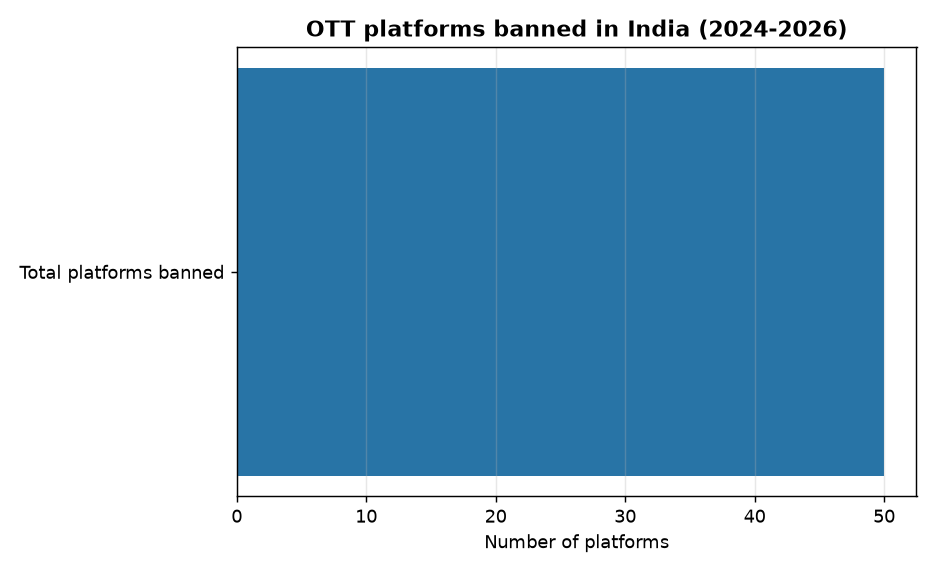
22 Jul UPSC Alert: 50 OTT Platforms Banned in 2 Years for Obscenity & IT Act Violations
Subject Relevance — Where This Topic Fits
- GS Paper II — Governance, Constitution, Polity, Social Justice and International Relations (Digital Governance, Regulatory Mechanisms) | GS Paper III — Science and Technology (Digital Media, Cyber Laws, Ethical Concerns)
- Prelims: IT Act, 2000, IT (Intermediary Guidelines and Digital Media Ethics Code) Rules, 2021, Section 67, 67A of IT Act, Section 294 of BNS, Indecent Representation of Women (Prohibition) Act, 1986, OTT Platforms, Digital Ethics Code, Intermediary Liability, Grievance Redressal Mechanism
- Essay: The Role of Regulation in Balancing Free Speech and Societal Morality in the Digital Age, Ethical Governance of Digital Platforms: A Necessity for a Democratic Society
Quick Revision: The IT (Intermediary Guidelines and Digital Media Ethics Code) Rules, 2021, regulate OTT platforms under Part III, mandating compliance with ethical codes, grievance redressal mechanisms, and adherence to Sections 67, 67A of the IT Act, 2000, and Section 294 of the BNS, 2023.
Why is this in the news?
The Press Information Bureau (PIB) of the Ministry of Information and Broadcasting, Government of India, released a press note on 22 July 2026, stating that 50 OTT platforms have been blocked over the past two years for disseminating obscene content and violating provisions of the IT Act, 2000, the Bharatiya Nyaya Sanhita (BNS), 2023, and the Indecent Representation of Women (Prohibition) Act, 1986. This development underscores the government’s proactive stance on regulating digital content to uphold public morality and legal compliance, while also raising questions about the efficacy of existing regulatory mechanisms and the balance between free expression and statutory restrictions.
Background
- The exponential growth of OTT platforms in India has necessitated a robust regulatory framework to address concerns related to obscenity, misinformation, and violation of societal norms.
- The IT Act, 2000, was amended to include provisions for intermediary liability and digital content regulation, culminating in the notification of the IT (Intermediary Guidelines and Digital Media Ethics Code) Rules, 2021, on 25 February 2021.
- Part III of the IT Rules, 2021, specifically addresses the ethical conduct of digital news publishers and online curated content providers, including OTT platforms.
- Section 79(3)(b) of the IT Act, 2000, provides for informing intermediaries to remove or disable access to unlawful content upon receiving a government notification.
- The Bharatiya Nyaya Sanhita (BNS), 2023, replaces the Indian Penal Code, 1860, and includes provisions such as Section 294, which criminalizes obscene acts or songs in public spaces.
- The Indecent Representation of Women (Prohibition) Act, 1986, prohibits the depiction of women in an indecent or derogatory manner, with penalties for violations.
What are the Key Legal Provisions and Institutional Mechanisms Governing OTT Platforms in India?
- The IT Act, 2000, is the primary legislation governing digital intermediaries, including OTT platforms, and imposes obligations on intermediaries to ensure compliance with Indian laws.
- The IT (Intermediary Guidelines and Digital Media Ethics Code) Rules, 2021, were notified under the IT Act, 2000, to regulate digital media and OTT platforms. These rules mandate self-regulation, grievance redressal mechanisms, and adherence to a code of ethics.
- Part III of the IT Rules, 2021, outlines the ethical code for digital news publishers and online curated content providers, including OTT platforms. It prohibits content that is obscene, defamatory, or violates Indian laws.
- Section 67 of the IT Act, 2000, criminalizes the publication or transmission of obscene material in electronic form, with penalties including imprisonment and fines.
- Section 67A of the IT Act, 2000, addresses the publication or transmission of sexually explicit material, with stricter penalties, including imprisonment up to 7 years and fines up to ₹10 lakh.
- Section 294 of the Bharatiya Nyaya Sanhita (BNS), 2023, replaces Section 294 of the Indian Penal Code, 1860, and criminalizes obscene acts or songs in public spaces, with penalties including imprisonment up to 3 months or fines.
- The Indecent Representation of Women (Prohibition) Act, 1986, prohibits the depiction of women in an indecent or derogatory manner, with penalties including imprisonment up to 2 years and fines up to ₹2,000 for first-time offenders.
- The grievance redressal mechanism under the IT Rules, 2021, requires OTT platforms to establish a three-tier structure: self-regulation by the publisher, self-regulation by the self-regulatory body, and oversight by the government.
Key Features
| Feature | Significance |
|---|---|
| IT (Intermediary Guidelines and Digital Media Ethics Code) Rules, 2021 (Part-III) | Establishes a statutory framework for self-regulation by OTT platforms and digital news publishers, mandating adherence to a Code of Ethics and a three-tier grievance redressal mechanism. |
| Section 79(3)(b) of the IT Act, 2000 | Empowers intermediaries (including OTT platforms) to remove or disable access to unlawful content upon receiving a government or court directive, balancing intermediary liability with regulatory oversight. |
| Section 67 & 67A of the IT Act, 2000 | Prohibits the publication or transmission of obscene material in electronic form, with stringent penalties for violations, including imprisonment and fines. |
| Section 294 of the Bharatiya Nyaya Sanhita (BNS), 2023 | Replaces the Indian Penal Code’s Section 294, criminalizing obscene acts or songs in public spaces, extending legal scrutiny to digital platforms hosting such content. |
| Indecent Representation of Women (Prohibition) Act, 1986 (Section 4) | Prohibits the depiction of women in an indecent or derogatory manner, with provisions for penalties and imprisonment, applicable to digital media including OTT platforms. |
Why it Matters
Regulatory Governance
- Demonstrates the Indian state’s proactive stance in regulating digital content, ensuring compliance with constitutional morality and public order under Article 19(2) of the Constitution.
- Highlights the shift from self-regulation to statutory oversight in the digital media ecosystem, particularly for OTT platforms, aligning with global trends in content moderation.
- Reinforces the role of the Ministry of Information and Broadcasting as the nodal authority for digital media regulation, in coordination with the Ministry of Electronics and IT.
Legal Framework
- Illustrates the interplay between the IT Act, 2000, BNS, 2023, and the Indecent Representation of Women Act, 1986, in addressing obscenity and indecency in digital spaces.
- Showcases the use of Section 79(3)(b) of the IT Act to enforce accountability on intermediaries, ensuring swift action against platforms violating legal provisions.
Public Order and Morality
- Underscores the state’s obligation to prevent the dissemination of content that may incite social disharmony, violate cultural norms, or perpetuate gender-based discrimination.
- Reflects the judiciary’s evolving interpretation of obscenity in the digital age, balancing freedom of expression with societal values.
Challenges
1. Jurisdictional Ambiguity
- Difficulty in enforcing regulations on OTT platforms hosted outside India, necessitating international cooperation and bilateral agreements.
- Overlap between central and state laws, particularly in matters of public order and morality, leading to potential conflicts in regulatory enforcement.
UPSC Link: GS-II: Functions and responsibilities of the Union and the States
2. Technological and Operational Challenges
- Rapid proliferation of OTT platforms and user-generated content, making real-time monitoring and compliance a logistical challenge.
- Need for advanced AI-driven content moderation tools to detect and flag obscene or illegal content, balancing accuracy with user privacy.
UPSC Link: GS-III: Challenges to internal security through communication networks
3. Freedom of Expression vs. Regulation
- Risk of over-regulation stifling creative freedom and artistic expression, particularly in a diverse cultural landscape like India.
- Balancing the right to freedom of speech (Article 19(1)(a)) with reasonable restrictions under Article 19(2) remains a persistent challenge.
UPSC Link: GS-II: Fundamental Rights
4. Cross-Border Content Moderation
- Challenges in regulating content hosted on foreign servers, requiring coordination with international bodies like the UN or bilateral treaties.
- Varied legal frameworks across jurisdictions complicate enforcement, necessitating harmonization of global standards.
UPSC Link: GS-II: Important International institutions, agencies and fora
5. Public Awareness and Compliance
- Low awareness among content creators and consumers about legal provisions and grievance redressal mechanisms, leading to inadvertent violations.
- Need for robust public education campaigns to foster a culture of responsible digital citizenship.
UPSC Link: GS-II: Government policies and interventions for development in various sectors
Challenges — UPSC Perspective
| Issue | Concern |
|---|---|
| Enforcement on Foreign Platforms | Jurisdictional limitations hinder effective regulation of OTT platforms hosted outside India. |
| Content Moderation Technology | Lack of scalable AI tools to detect and remove illegal content in real-time without compromising user privacy. |
| Freedom of Expression | Risk of over-regulation infringing upon constitutional rights, particularly in artistic and journalistic domains. |
| Inter-Ministerial Coordination | Need for seamless collaboration between the Ministry of Information and Broadcasting, MeitY, and state authorities. |
| Public Compliance | Low awareness among stakeholders about legal obligations and redressal mechanisms. |
| Cross-Border Legal Harmonization | Divergent legal frameworks across countries complicate enforcement and cooperation. |
Way Forward
- Strengthen international collaborations to address jurisdictional challenges in regulating foreign-hosted OTT platforms.
- Invest in AI-driven content moderation tools, ensuring they are transparent, accountable, and compliant with data protection laws.
- Enhance public awareness campaigns to educate content creators, consumers, and intermediaries about legal provisions and grievance redressal mechanisms.
- Establish a dedicated digital media ombudsman to streamline grievance redressal and ensure timely resolution of complaints.
- Promote self-regulatory bodies for OTT platforms, incentivizing compliance through industry-led standards and certifications.
- Conduct periodic reviews of the IT Rules, 2021, and related laws to adapt to evolving digital trends and societal expectations.
- Foster inter-ministerial coordination to eliminate regulatory overlaps and ensure a unified approach to digital content governance.
UPSC Value Addition
Keywords for Mains Answer-Writing
Digital Media Regulation · OTT Platform Governance · Information Technology Act 2000 · IT Rules 2021 · Section 67 IT Act · Section 294 BNS · Indecent Representation of Women (Prohibition) Act 1986 · Self-Regulation in Media · Digital Content Moderation · Intermediary Liability · Constitutional Provisions on Morality · Freedom of Speech vs Regulation
Constitutional & Policy Linkages
- [‘Article 19(1)(a): Freedom of speech and expression’, ‘Balancing with Article 19(2) restrictions’]
- [‘Article 19(2): Reasonable restrictions on free speech’, ‘Public order, morality, and decency’]
- [‘Article 21: Right to privacy’, ‘Protection from surveillance and data misuse’]
Concept Flow
Rise of OTT platforms and user-generated content → Proliferation of obscene/illegal content → Public complaints and legal violations → Government action under IT Act, 2000 and allied laws → Closure of 50 platforms in two years → Reinforcement of IT Rules, 2021 (Part-III) → Strengthening of grievance redressal mechanisms → Need for technological and regulatory upgrades → Balancing freedom of expression with public order and morality.
Prelims Practice Questions
Q1. Which of the following legal provisions was NOT cited by the Government for banning OTT platforms in the past two years?
- Section 67 of the Information Technology Act, 2000
- Section 67A of the Information Technology Act, 2000
- Section 294 of the Bharatiya Nyaya Sanhita, 2023
- Section 124A of the Indian Penal Code
Answer: Section 124A of the Indian Penal Code — Section 124A of the IPC pertains to sedition and was not cited in the PIB release regarding OTT platform bans. The other three sections were explicitly mentioned as grounds for action.
Q2. Under the IT Rules 2021, which part specifically governs the conduct of OTT platforms and digital news publishers?
- Part I
- Part II
- Part III
- Part IV
Answer: Part III — Part III of the IT Rules 2021 outlines the Code of Ethics for digital news publishers and online curated content (OTT platforms), mandating self-regulation and grievance redressal mechanisms.
Mains Practice Question
✍ Critically evaluate the regulatory framework governing OTT platforms in India, with reference to the Information Technology Act 2000, IT Rules 2021, and judicial precedents. How does this framework balance freedom of expression with the need for content regulation in a digital democracy?
Approach: Begin by outlining the constitutional and statutory basis for regulating OTT platforms, including the IT Act 2000 and IT Rules 2021. Discuss the role of intermediary liability under Section 79(3)(b) and the obligations imposed on OTT platforms under Part III of the IT Rules 2021. Examine judicial interpretations, such as the Supreme Court’s stance on balancing Article 19(1)(a) with reasonable restrictions under Article 19(2). Highlight the challenges in enforcement, including jurisdictional issues and the need for harmonized global standards. Conclude by assessing whether the current framework achieves a balanced approach or risks over-regulation, suggesting reforms where necessary.
Source: PIB (Press Information Bureau)
Generated by AanyaAi for educational purpose.

- UNEP Report 2026 Warns: Paris 1.5°C Target Slipping Away - October 23, 2026
- पूर्व आईएएस अधिकारी हत्या मामले में आईएएस एसोसिएशन की मुख्यमंत्री से मुलाकात - October 23, 2026
- UPSC Exam: Rare Glimpse of Ritwik Ghatak’s Cinematic Legacy at 4-Day Festival - October 23, 2026

No Comments