


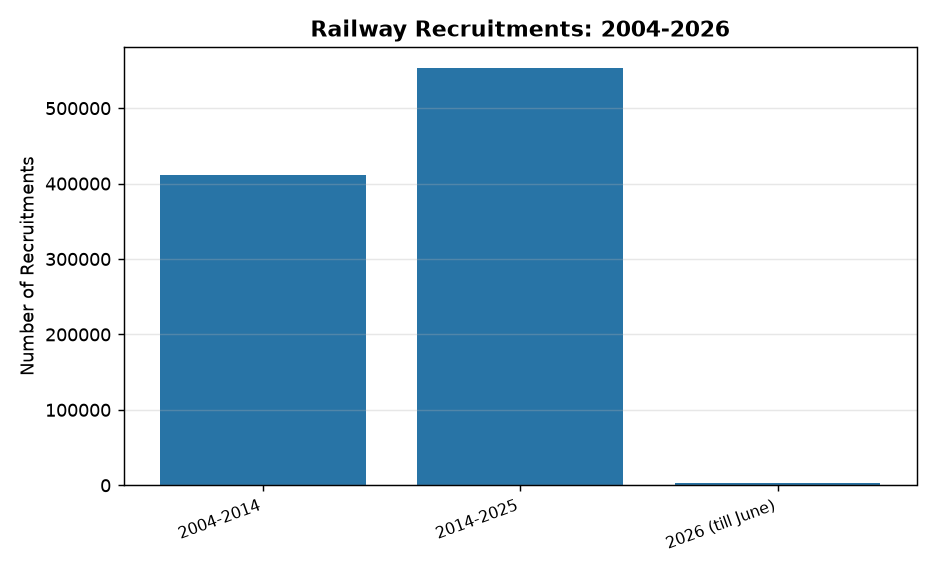
22 Jul Indian Railways Recruitment 2024: 5.56 Lakh Hires Under Mission Mode Since 2014
Subject Relevance — Where This Topic Fits
- GS Paper III — Human Resource Development, Employment and Skill Development | GS Paper III — Infrastructure: Railways and Logistics
- Prelims: Mission Mode Recruitment, RRB, RPF, ALP, JE, DMS, CMA, Annual Recruitment Calendar, Non-Technical Popular Categories (NTPC), Computer Based Test (CBT), Group C posts
- Essay: The Role of Public Sector Undertakings in India’s Employment Ecosystem: A Case Study of Indian Railways
Quick Revision: Mission Mode Recruitment in Indian Railways is a transparent, technology-driven, and time-bound framework implemented since 2014 to fill over 5.56 lakh vacancies by June 2026, ensuring operational efficiency and eliminating malpractices through centralised CBT-based examinations and an Annual Recruitment Calendar.
Why is this in the news?
The Press Information Bureau (PIB) has released data highlighting the unprecedented scale of recruitment undertaken by Indian Railways under Mission Mode Recruitment from 2014 to June 2026, with over 5.56 lakh appointments completed. This initiative, coupled with the introduction of an Annual Recruitment Calendar since 2024, represents a structural reform in public sector employment practices, ensuring transparency, predictability, and efficiency in filling critical operational and technical vacancies across the national rail network.
Background
- Indian Railways, the world’s fourth-largest rail network, operates a vast and geographically dispersed workforce of approximately 1.3 million employees, including gazetted and non-gazetted staff.
- The expansion in recruitment aligns with the operational demands of a modernising rail sector, including technological upgrades, mechanisation, and the adoption of innovative processes such as digital ticketing, high-speed rail corridors, and automated maintenance systems.
- Prior to 2014, recruitment processes were often delayed, lacked transparency, and were susceptible to malpractices such as paper leaks and irregularities in examination conduct.
- The Mission Mode Recruitment initiative was launched to address systemic inefficiencies, ensure timely filling of vacancies, and enhance the operational readiness of the railway system.
- The introduction of the Annual Recruitment Calendar in 2024 marked a paradigm shift by providing aspirants with a predictable timeline for examinations, reducing uncertainty and improving preparation efficacy.
What is Mission Mode Recruitment in Indian Railways?
- Mission Mode Recruitment refers to a systematic, time-bound, and transparent framework adopted by Indian Railways to fill vacancies across all non-gazetted posts (Group C and Group D) in a mission-driven manner.
- The initiative was launched in 2014 to address chronic understaffing, operational bottlenecks, and inefficiencies in the traditional recruitment process, which often led to delays of several years in filling critical posts.
- Under this model, recruitment is conducted through centralised employment notifications (CENs) issued by the Railway Recruitment Boards (RRBs) and Railway Recruitment Cells (RRCs), ensuring uniformity and standardisation across regions.
- The process is technology-driven, utilising Computer Based Tests (CBTs) for screening and selection, thereby minimising human intervention and reducing the scope for malpractice.
- Key categories filled under Mission Mode Recruitment include Assistant Loco Pilots (ALP), Technicians, Junior Engineers (JE), Depot Material Superintendents (DMS), Chemical and Metallurgical Assistants (CMA), Railway Protection Force (RPF) personnel, paramedical staff, and Non-Technical Popular Categories (NTPC) such as Graduate and Undergraduate posts.
- The Annual Recruitment Calendar, introduced in 2024, outlines the schedule of examinations for the next three years, providing aspirants with clarity on examination dates, syllabus, and vacancies, thereby enhancing preparation efficiency and reducing anxiety.
- The initiative has ensured zero instances of paper leaks or malpractices since its inception, demonstrating a commitment to integrity and transparency in public sector recruitment.
- From 2014 to June 2026, over 5.56 lakh appointments have been completed, with an additional 1.61 lakh vacancies under active recruitment for 2024–2026, covering posts such as ALP, Technician, JE/DMS/CMA, RPF Constable and Sub-Inspector, and Level-1 categories like Track Maintainers and Pointsmen.
Key Features
| Feature | Significance |
|---|---|
| Mission Mode Recruitment (2014–2026) | Ensures systematic, large-scale augmentation of railway workforce to meet operational and technological demands, replacing ad-hoc hiring practices. |
| Annual Recruitment Calendar (2024–2026) | Introduces predictability and transparency in recruitment, reducing delays and improving candidate preparation through pre-announced schedules. |
| Transparent and Leak-Proof Process | Eliminates malpractices (e.g., paper leaks) via strict adherence to guidelines, ensuring fairness and credibility in selection. |
| Multi-Stage Examination System | Structured CBT stages (Prelims, Mains) for technical and non-technical roles, ensuring merit-based selection and role-specific competency assessment. |
| Geographical Distribution of Examinations | Conducts exams across 150+ cities with regional language options, enhancing accessibility and reducing logistical burdens on candidates. |
Why it Matters
Economic
- Boosts employment generation in India, particularly for semi-skilled and skilled labour, aligning with the government’s ‘Make in India’ and ‘Vocal for Local’ initiatives.
- Enhances operational efficiency of Indian Railways, a critical public infrastructure sector, by filling critical vacancies in locomotive operations, maintenance, and safety roles.
- Stimulates demand in allied sectors (e.g., training institutes, coaching centres) through large-scale recruitment drives, contributing to economic multiplier effects.
Strategic
- Strengthens India’s railway network, a backbone of logistics and mobility, by ensuring adequate manpower for high-speed corridors, dedicated freight corridors, and electrification projects.
- Supports technological upgradation (e.g., semi-high-speed trains, automation) by recruiting skilled personnel trained in modern railway systems and maintenance protocols.
- Reduces dependency on contractual labour, improving service reliability and passenger safety across the 68,000+ km network.
Social
- Provides structured career pathways for youth, particularly in Tier-II/Tier-III cities, through transparent and competitive examinations for non-gazetted posts.
- Promotes gender inclusivity by offering equal opportunities in recruitment, with provisions for reserved categories (SC/ST/OBC/EWS) as per constitutional mandates.
- Enhances socio-economic mobility for marginalised communities via reservation policies and skill-based recruitment in safety-critical roles.
Governance
- Demonstrates model recruitment practices in public sector undertakings, setting benchmarks for transparency, scalability, and efficiency in large-scale hiring.
- Aligns with the Right to Service (RTI) principles by publishing annual calendars and timelines, ensuring accountability and citizen-centric governance.
- Reduces litigation risks by adhering to due process, thereby minimizing disputes over recruitment irregularities.
Challenges
1. Scalability and Logistics
- Managing 3.5+ lakh candidates per examination cycle across 150+ cities requires robust IT infrastructure, exam centres, and invigilation teams.
- Ensuring uniformity in evaluation standards and language accessibility (15 regional languages) across diverse examination formats.
UPSC Link: GS Paper 3: Infrastructure – Challenges in Public Service Delivery
2. Skill Mismatch and Training
- Bridging the gap between academic qualifications and practical railway operational requirements for technical roles (e.g., ALP, JE).
- Designing and delivering standardized training programmes for 5.5+ lakh recruits to ensure readiness for safety-critical positions.
UPSC Link: GS Paper 3: Skill Development – Challenges in Vocational Training
3. Demographic and Regional Disparities
- Addressing disparities in candidate participation and success rates across states, particularly in aspirational districts.
- Ensuring equitable representation of women and marginalised groups in technical and safety roles, where participation remains low.
UPSC Link: GS Paper 1: Social Justice – Regional Disparities
4. Technological Integration
- Adapting recruitment processes to emerging technologies (e.g., AI for proctoring, blockchain for document verification) while maintaining fairness.
- Integrating digital literacy assessments for non-technical roles to align with the government’s Digital India mission.
UPSC Link: GS Paper 3: Science & Technology – Digital Public Infrastructure
5. Policy and Regulatory Compliance
- Navigating complex labour laws, service conditions, and constitutional provisions (e.g., reservations) while ensuring operational flexibility.
- Balancing speed of recruitment with adherence to constitutional mandates (e.g., Article 16, 335) and judicial precedents.
UPSC Link: GS Paper 2: Constitutional Framework – Fundamental Rights
Challenges — UPSC Perspective
| Issue | Concern |
|---|---|
| Examination Conduct | Managing 3.5+ lakh candidates per cycle across 150+ cities with minimal errors in scheduling, evaluation, and logistics. |
| Skill Gap in Recruits | Ensuring technical recruits (e.g., ALP, JE) possess operational readiness despite varying educational backgrounds. |
| Regional Imbalance | Addressing underrepresentation of candidates from aspirational districts and northeastern states in recruitment. |
| Women Participation | Increasing female representation in safety-critical roles (e.g., RPF, loco pilots) where participation is historically low. |
| Digital Divide | Ensuring equitable access to online examination platforms for candidates from rural and remote areas. |
| Policy Harmonisation | Aligning recruitment policies with evolving labour laws, judicial rulings, and constitutional provisions without compromising efficiency. |
Way Forward
- Expand the Annual Recruitment Calendar to cover all non-gazetted posts, including gazetted roles, to further enhance transparency and predictability.
- Leverage AI and data analytics to identify skill gaps in recruits and tailor training programmes for operational readiness.
- Strengthen regional outreach programmes to improve participation from aspirational districts and northeastern states through targeted awareness campaigns.
- Introduce gender-inclusive policies (e.g., flexible timings, reserved quotas) to boost female representation in technical and safety roles.
- Enhance digital infrastructure for examinations, including offline-capable platforms and multilingual support, to reduce the digital divide.
- Collaborate with state governments and skill development agencies to align railway recruitment with local vocational training programmes.
- Establish a dedicated grievance redressal mechanism for recruitment-related disputes to ensure timely resolution and maintain public trust.
- Publish periodic impact assessments of recruitment drives to evaluate their effectiveness in improving railway operations and service delivery.
UPSC Value Addition
Keywords for Mains Answer-Writing
Mission Mode Recruitment · Indian Railways workforce augmentation · Group C and non-gazetted posts · Railway Recruitment Boards (RRBs) · Annual Recruitment Calendar · Computer-Based Tests (CBT) · Transparency in recruitment · Technical and non-technical categories · Railway Protection Force (RPF) · Locomotive pilot recruitment · Skilled manpower for railway operations · Recruitment process reforms · Employment generation in railways · Human resource management in PSUs
Constitutional & Policy Linkages
- {‘article’: ‘Article 16 (Equality of Opportunity)’, ‘note’: ‘Guarantees equality in public employment and reservation policies.’}
- {‘article’: ‘Article 335’, ‘note’: ‘Special provisions for SC/ST in public employment.’}
- {‘article’: ‘Article 46’, ‘note’: ‘Promotion of educational and economic interests of SC/ST.’}
- {‘article’: ‘Seventh Schedule (Union List – Entry 24)’, ‘note’: ‘Railways as a central subject under Union List.’}
Concept Flow
Post-independence industrialisation → Expansion of railway network → Chronic manpower shortages → Ad-hoc hiring practices → Operational inefficiencies → Mission Mode Recruitment (2014–2026) → Systematic augmentation of workforce → Technology adoption (e.g., CBT exams) → Transparent and predictable recruitment → Enhanced operational efficiency → Strengthened public infrastructure → Economic multiplier effects (employment, skill development)
Prelims Practice Questions
Q1. Which of the following statements about the Mission Mode Recruitment in Indian Railways is correct?
- A. The Mission Mode Recruitment covers only gazetted posts in Indian Railways.
- B. The Annual Recruitment Calendar was introduced in 2024 to provide certainty to candidates regarding examination schedules.
- C. The Railway Recruitment Boards (RRBs) conduct recruitment exclusively through offline examinations.
- D. The Mission Mode Recruitment has not addressed the issue of paper leaks in the examination process.
Answer: B. The Annual Recruitment Calendar was introduced in 2024 to provide certainty to candidates regarding examination schedules. — Statement B is correct as the Annual Recruitment Calendar was introduced in 2024 to provide transparency and certainty to candidates. Statements A, C, and D are incorrect as the Mission Mode Recruitment covers non-gazetted posts, examinations are conducted online, and the process has been transparent with no reported paper leaks.
Q2. Consider the following pairs of posts and their recruitment bodies in Indian Railways:
1. Assistant Loco Pilot (ALP) – Railway Recruitment Boards (RRBs)
2. Railway Protection Force (RPF) Constable – Union Public Service Commission (UPSC)
3. Junior Engineer (JE) – Railway Recruitment Cells (RRCs)
4. Group D posts – Ministry of Railways
Which of the pairs given above is/are correctly matched?
- A. 1 only
- B. 1 and 4 only
- C. 2 and 3 only
- D. 1, 2, 3 and 4
Answer: A. 1 only — Pair 1 is correct as Assistant Loco Pilots are recruited by Railway Recruitment Boards (RRBs). Pair 2 is incorrect because RPF Constables are recruited by the Railway Recruitment Boards, not UPSC. Pair 3 is incorrect as Junior Engineers are recruited by RRBs, not RRCs. Pair 4 is incorrect as Group D posts are recruited by RRBs, not the Ministry of Railways directly.
Q3. Which of the following is NOT a benefit of the Annual Recruitment Calendar introduced by the Ministry of Railways?
- A. Increased opportunities for candidates every year
- B. Reduced transparency in the recruitment process
- C. Certainty in examination schedules for candidates
- D. Accelerated recruitment, training, and appointment processes
Answer: B. Reduced transparency in the recruitment process — The Annual Recruitment Calendar was introduced to enhance transparency, provide certainty in examination schedules, and accelerate recruitment processes. Therefore, statement B is incorrect as it contradicts the purpose of the initiative.
Mains Practice Question
✍ Examine the significance of the Mission Mode Recruitment initiative by Indian Railways in strengthening its workforce. How does the introduction of the Annual Recruitment Calendar contribute to transparency, efficiency, and inclusivity in the recruitment process? Substantiate your answer with relevant data from the initiative.
Approach: The answer should highlight the objectives of Mission Mode Recruitment, such as augmenting the workforce to meet operational and technological demands. Discuss the role of the Annual Recruitment Calendar in providing certainty to candidates, reducing delays, and ensuring transparency. Use data such as the number of vacancies filled (5.56 lakh since 2014), the scale of examinations (3.58 crore candidates for 92,116 vacancies in 2024), and the structured recruitment process to substantiate the argument. Additionally, address how the initiative addresses challenges like paper leaks and ensures a fair selection process.
Source: PIB (Press Information Bureau)
Generated by AanyaAi for educational purpose.

- यूपीएससी/पीसीएस: 25 सितंबर 2026 को सरकारी प्रतिभूतियों की बोली प्रक्रिया, ₹34,000 करोड़ का पुनर्प्रस्ताव - September 24, 2026
- RBI to Auction ₹34,000 Crore Govt Securities on Sept 25, 2026: Key Details for UPSC & PCS - September 24, 2026
- भारत सेमीकंडक्टर उद्योग में ‘सकारात्मक चक्र’ की ओर: अशोक चंदक - September 24, 2026

No Comments