


22 Jul UPSC Exam: National Disaster Management Plan (NDMP) 2026 – Key Features & Role of IDRN
Subject Relevance — Where This Topic Fits
- GS Paper III — Disaster Management (Linkages between Development and Disaster Risk Reduction)
- Prelims: Disaster Management Act, 2005, National Disaster Management Authority (NDMA), National Disaster Response Force (NDRF), Sendai Framework for Disaster Risk Reduction, Sustainable Development Goals (SDGs), Paris Agreement on Climate Change, India Disaster Resource Network (IDRN), State Disaster Management Authorities (SDMAs)
- Essay: Disaster management as a critical component of sustainable development, Role of technology in mitigating human and economic losses from disasters
Quick Revision: The National Disaster Management Plan (NDMP) is India’s statutory framework for disaster risk reduction, integrating legal, policy, and technological dimensions under the Disaster Management Act, 2005, and aligning with global frameworks like the Sendai Framework and Paris Agreement.
Why is this in the news?
The National Disaster Management Plan (NDMP) has been highlighted in a recent Press Information Bureau (PIB) release dated 22 July 2026, underscoring its institutional evolution, pillars, and operational tool—the India Disaster Resource Network (IDRN)—as part of India’s commitment to global disaster risk reduction frameworks. This development is significant for UPSC aspirants as it reflects the integration of statutory, policy, and technological dimensions in India’s disaster management architecture, aligning with constitutional provisions and international obligations.
Background
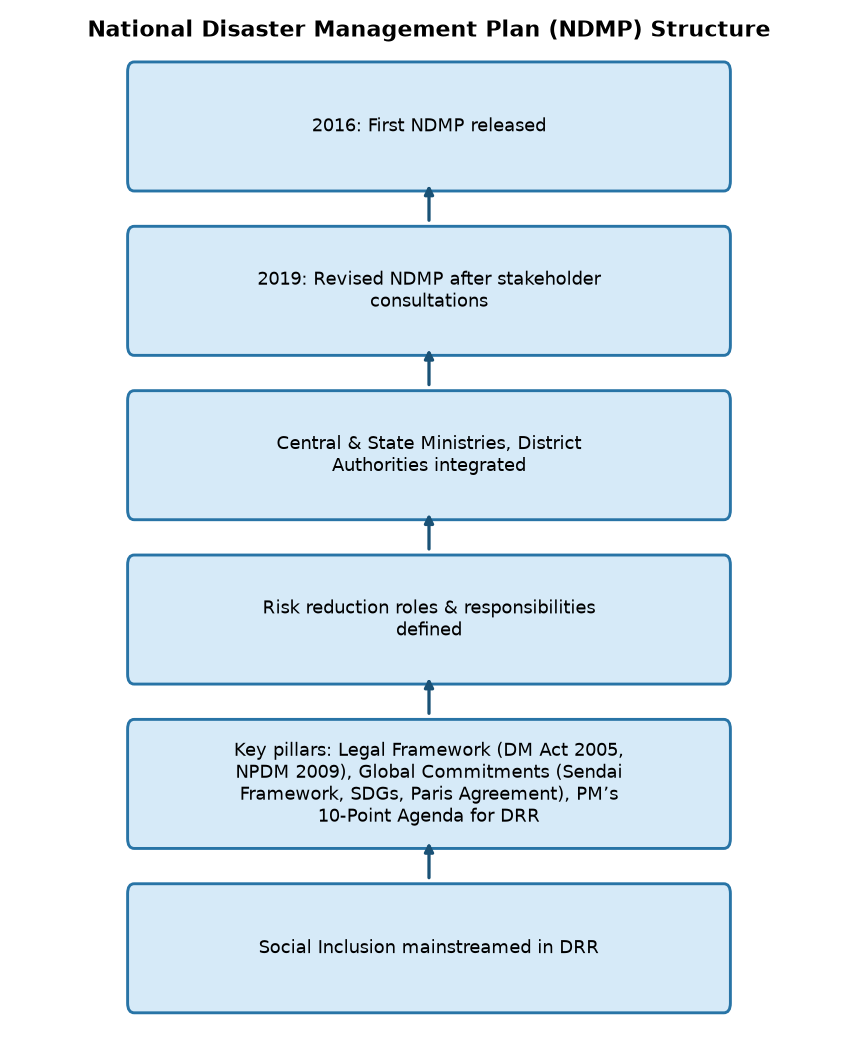
- The NDMP was first formulated and released in 2016, following the enactment of the Disaster Management Act, 2005, which provides the legal and institutional framework for disaster management in India.
- The plan was revised in 2019 after extensive consultations with stakeholders across central ministries, state governments, district authorities, and sectoral agencies to enhance its comprehensiveness and responsiveness.
- India’s disaster management strategy is guided by constitutional provisions under the Seventh Schedule (Union and Concurrent Lists), particularly Entry 23 (Social Security and Social Insurance) and Entry 97 (Concurrent jurisdiction for matters not specified elsewhere).
- The NDMP is aligned with India’s international commitments, including the Sendai Framework for Disaster Risk Reduction (2015–2030), the Sustainable Development Goals (SDGs), and the Paris Agreement on Climate Change, reflecting a global consensus on disaster risk mitigation.
- The plan operationalises the Prime Minister’s Ten-Point Agenda on Disaster Risk Reduction, which prioritises mainstreaming DRR into development planning, leveraging technology, and ensuring community participation.
- The India Disaster Resource Network (IDRN) was conceptualised as a digital inventory to address critical gaps in resource mobilisation during emergencies, ensuring rapid deployment of assets and personnel.
What is the National Disaster Management Plan (NDMP)?
- The NDMP is India’s apex strategic document for disaster risk reduction, preparedness, response, and recovery, mandated under the Disaster Management Act, 2005.
- It serves as a unified framework that integrates the roles and responsibilities of all stakeholders—central ministries, state governments, district authorities, and sectoral agencies—across all phases of disaster management.
- The NDMP ensures compliance with the National Policy on Disaster Management (NPDM), 2009, and aligns with India’s international obligations under the Sendai Framework, SDGs, and Paris Agreement.
- A distinctive feature of the NDMP is its emphasis on social inclusion, ensuring that marginalised and vulnerable communities are prioritised in disaster risk reduction strategies.
- The NDMP is a living document, periodically reviewed and updated to incorporate emerging risks, technological advancements, and lessons learned from past disasters.
Key Features
| Feature | Significance |
|---|---|
| National Disaster Management Plan (NDMP) 2019 Revision | Integrates Centre, state, sectoral ministries, and district authorities into a unified framework for disaster risk reduction (DRR) with clearly defined roles and responsibilities. |
| Legal and Policy Anchorage | Compliance with the Disaster Management Act, 2005, National Policy on Disaster Management (NPDM) 2009, and alignment with global frameworks such as the Sendai Framework, SDGs, and Paris Agreement. |
| Prime Minister’s Ten-Point Agenda on DRR | Embeds contemporary national priorities into NDMP, ensuring policy coherence with evolving socio-economic and environmental challenges. |
| Social Inclusion as a Cross-Cutting Principle | Mainstreams marginalised groups (women, children, elderly, persons with disabilities) in disaster preparedness, response, and recovery mechanisms. |
| India Disaster Resource Network (IDRN) | Provides a real-time, web-based electronic inventory of equipment, skilled human resources, and critical supplies across districts, states, and national agencies for rapid deployment during emergencies. |
Why it Matters
Institutional and Governance
- Establishes a multi-level, multi-stakeholder governance structure for disaster risk management, reducing fragmentation between agencies and jurisdictions.
- Enhances inter-ministerial and inter-departmental coordination, particularly for cross-sectoral disasters (e.g., floods, cyclones, urban heatwaves).
- Strengthens the role of district authorities as first responders, aligning with the 73rd and 74th Constitutional Amendments.
Legal and Policy Integration
- Operationalises the Disaster Management Act, 2005, by translating statutory provisions into actionable plans and protocols.
- Ensures India’s compliance with international obligations under the Sendai Framework (2015–2030), SDGs (especially SDG 11 and 13), and the Paris Agreement on climate change.
- Bridges domestic policy with global DRR commitments, facilitating international cooperation and resource mobilisation.
Resource Management and Efficiency
- IDRN acts as a centralised repository, eliminating duplication of resources and enabling rapid allocation during crises.
- Facilitates pre-positioning of critical supplies (e.g., medical kits, relief materials) in high-risk zones, reducing response time.
- Promotes utilisation of indigenous resources and local expertise, reducing dependency on external aid.
Social and Inclusive Resilience
- Mandates inclusion of vulnerable groups in risk assessments, early warning systems, and rehabilitation plans.
- Ensures gender-sensitive disaster management, recognising differential impacts on women and girls.
- Supports community-based DRR initiatives, empowering local populations in preparedness and recovery.
Climate Change and Sustainability
- Aligns DRR strategies with climate adaptation measures, addressing compounded risks from extreme weather events.
- Integrates ecosystem-based approaches (e.g., mangrove restoration, urban green spaces) into disaster mitigation.
- Supports the implementation of India’s National Action Plan on Climate Change (NAPCC) and State Action Plans on Climate Change (SAPCCs).
Challenges
1. Fragmented Implementation Across States
- Variations in state-level disaster management plans due to differing administrative capacities and resource allocations.
- Lack of standardised protocols for inter-state resource sharing during large-scale disasters.
- Delays in updating state plans to align with NDMP 2019 revisions.
UPSC Link: GS-III: Disaster Management
2. Data Gaps and IDRN Utilisation
- Incomplete or outdated data entries in IDRN, particularly for remote and tribal districts.
- Low awareness among district officials and emergency responders about IDRN’s functionalities and access protocols.
- Digital divide limits real-time utilisation in rural and under-served areas.
UPSC Link: GS-III: Science & Technology
3. Resource Mobilisation and Funding Constraints
- Inadequate budgetary allocations for disaster preparedness and mitigation, with funds often diverted to relief and rehabilitation.
- Over-reliance on centralised resources, leading to bottlenecks during simultaneous disasters.
- Limited private sector and civil society engagement in DRR funding and implementation.
UPSC Link: GS-III: Economics of Disaster Management
4. Climate-Induced Disaster Complexity
- Increasing frequency and intensity of extreme weather events (e.g., cyclones, heatwaves) outpacing adaptive capacities.
- Overlap between climate change adaptation and disaster risk reduction, requiring integrated planning.
- Need for dynamic risk assessments to account for evolving climate patterns.
UPSC Link: GS-III: Environment & Climate Change
5. Community Awareness and Participation
- Low public awareness of NDMP and IDRN, leading to poor compliance with safety protocols.
- Cultural and socio-economic barriers to participation in disaster preparedness activities.
- Inadequate training of local leaders and volunteers in DRR and emergency response.
UPSC Link: GS-II: Governance & Social Justice
Challenges — UPSC Perspective
| Issue | Concern |
|---|---|
| State-Level Disparities | Inconsistent adoption of NDMP guidelines across states due to varying administrative and financial capacities. |
| IDRN Data Quality | Outdated or incomplete resource inventories in IDRN, hampering real-time decision-making. |
| Funding Gaps | Insufficient allocation for pre-disaster mitigation, with overemphasis on post-disaster relief. |
| Climate-Disaster Nexus | Inadequate integration of climate adaptation strategies into NDMP, leading to reactive responses. |
| Public Participation | Low awareness and engagement of communities in disaster preparedness and response mechanisms. |
| Inter-Agency Coordination | Lack of synchronised protocols among central ministries, state agencies, and district authorities. |
Government Initiatives — Must-Memorise for Prelims
- National Disaster Management Plan (NDMP) 2019
- India Disaster Resource Network (IDRN)
- Prime Minister’s Ten-Point Agenda on Disaster Risk Reduction (DRR)
Way Forward
- Strengthen state-level capacities through targeted training programmes and financial incentives for NDMP compliance.
- Conduct periodic audits of IDRN data to ensure accuracy, timeliness, and completeness of resource inventories.
- Establish a dedicated fund for pre-disaster mitigation, with transparent allocation and utilisation mechanisms.
- Integrate climate change projections into NDMP to enhance adaptive strategies for evolving disaster risks.
- Launch nationwide awareness campaigns on NDMP and IDRN, leveraging digital platforms and community networks.
- Develop standardised inter-state resource-sharing protocols to facilitate rapid deployment during large-scale disasters.
- Enhance private sector and civil society partnerships for funding, technology, and volunteer engagement in DRR.
- Promote community-based DRR initiatives, including localised early warning systems and preparedness drills.
UPSC Value Addition
Keywords for Mains Answer-Writing
National Disaster Management Plan (NDMP) · Disaster Risk Reduction (DRR) · Sendai Framework · Disaster Management Act 2005 · National Policy on Disaster Management 2009 · India Disaster Resource Network (IDRN) · Social inclusion in disaster management · Climate change and disaster resilience · Sustainable Development Goals (SDGs) · Paris Agreement on Climate Change
Constitutional & Policy Linkages
- Article 243G (73rd Amendment): Empowers Panchayats to prepare disaster management plans.
- Article 243W (74th Amendment): Enables Municipalities to plan for urban disasters.
- Article 355 (Duty of Union to protect states): Mandates central intervention in disaster scenarios.
Concept Flow
Climate change and anthropogenic pressures → Increased frequency of extreme weather events → Higher disaster risk → Need for integrated DRR frameworks. → Disaster Management Act, 2005 → National Policy on Disaster Management, 2009 → NDMP 2016 → NDMP 2019 revision. → NDMP 2019 → Multi-level governance structure (Centre, states, districts) → Role clarity and inter-agency coordination. → NDMP 2019 → Social inclusion and climate adaptation → Mainstreaming DRR into development planning. → NDMP 2019 → IDRN as a real-time resource management tool → Rapid deployment of supplies and personnel. → Implementation challenges → Fragmented state capacities, data gaps, funding constraints → Need for reforms and capacity-building. → Reforms and capacity-building → Effective DRR → Reduced disaster losses and enhanced community resilience.
Prelims Practice Questions
Q1. Which of the following is NOT a key pillar of the National Disaster Management Plan (NDMP) as per the 2019 revision?
- A. Compliance with the Disaster Management Act, 2005
- B. Implementation of the Sendai Framework for Disaster Risk Reduction
- C. Exclusive focus on urban disaster management
- D. Integration of social inclusion principles
Answer: C. Exclusive focus on urban disaster management — The NDMP’s key pillars include compliance with the Disaster Management Act, 2005, adherence to the Sendai Framework, and integration of social inclusion, but it does not exclusively focus on urban disaster management.
Q2. The India Disaster Resource Network (IDRN) is primarily designed to:
- A. Provide financial assistance to disaster-affected regions
- B. Serve as an electronic inventory of resources for emergency response
- C. Conduct post-disaster damage assessment
- D. Train disaster management professionals exclusively
Answer: B. Serve as an electronic inventory of resources for emergency response — The IDRN functions as a web-based platform to manage an electronic inventory of resources, including equipment and human resources, for rapid emergency response.
Q3. Which global agreement is explicitly referenced in the NDMP as a framework for disaster risk reduction?
- A. Kyoto Protocol
- B. Sendai Framework
- C. Montreal Protocol
- D. Ramsar Convention
Answer: B. Sendai Framework — The Sendai Framework for Disaster Risk Reduction is explicitly cited in the NDMP as a guiding global agreement for disaster risk reduction.
Mains Practice Question
✍ Critically examine the role of the National Disaster Management Plan (NDMP) in enhancing India’s disaster resilience. How does the NDMP integrate global frameworks such as the Sendai Framework and the Paris Agreement to achieve its objectives? Discuss with reference to institutional mechanisms and technological tools like the India Disaster Resource Network (IDRN).
Approach: Begin by outlining the NDMP’s legal and policy foundations under the Disaster Management Act, 2005, and the National Policy on Disaster Management, 2009. Analyse how the NDMP aligns with global frameworks like the Sendai Framework and the Paris Agreement to address disaster risk reduction (DRR) and climate change adaptation. Discuss the institutional mechanisms, including multi-level coordination among central, state, and district authorities, and the integration of social inclusion principles. Highlight the technological tool, IDRN, as a critical enabler for real-time resource management during emergencies. Conclude by assessing the NDMP’s effectiveness in mainstreaming DRR and its limitations in achieving comprehensive disaster resilience.
Source: PIB (Press Information Bureau)
Generated by AanyaAi for educational purpose.

- वित्त मंत्रालय का विशेष अभियान 6.0: स्वच्छता अभियान के लिए तैयारियाँ पूर्ण - September 18, 2026
- Expenditure Dept Launches Special Campaign 6.0 for Cleanliness & Efficiency - September 18, 2026
- सेवा संकल्प अभियान: नागरिक-केंद्रित विकास का नया अध्याय, जानें मुख्य बिंदु - September 18, 2026

No Comments