


22 Jul UPSC Alert: National Disaster Management Plan (NDMP) 2026 – Key Features & Role of IDRN
Subject Relevance — Where This Topic Fits
- GS Paper III — Disaster Management | GS Paper II — Governance and Constitutional Framework
- Prelims: Disaster Management Act, 2005, Sendai Framework for Disaster Risk Reduction, National Disaster Management Policy 2009, India Disaster Resource Network (IDRN), NDMP pillars, Social inclusion in disaster risk reduction, Paris Agreement, SDG 11, SDG 13
- Essay: Disaster resilience as a cornerstone of sustainable development, Role of technology in governance and public service delivery
Quick Revision: The NDMP is India’s statutory disaster risk reduction framework, integrating global commitments (Sendai Framework, SDGs, Paris Agreement) with a four-pillar structure: legal framework, global alignment, social inclusion, and technological enablement via the India Disaster Resource Network (IDRN).
Why is this in the news?
The National Disaster Management Plan (NDMP) has been highlighted in a recent Press Information Bureau (PIB) release by the Ministry of Home Affairs, dated 22 July 2026, underscoring its evolving institutional framework, alignment with global commitments, and the operationalisation of the India Disaster Resource Network (IDRN) as a critical technological intervention for real-time resource mobilisation during emergencies.
Background
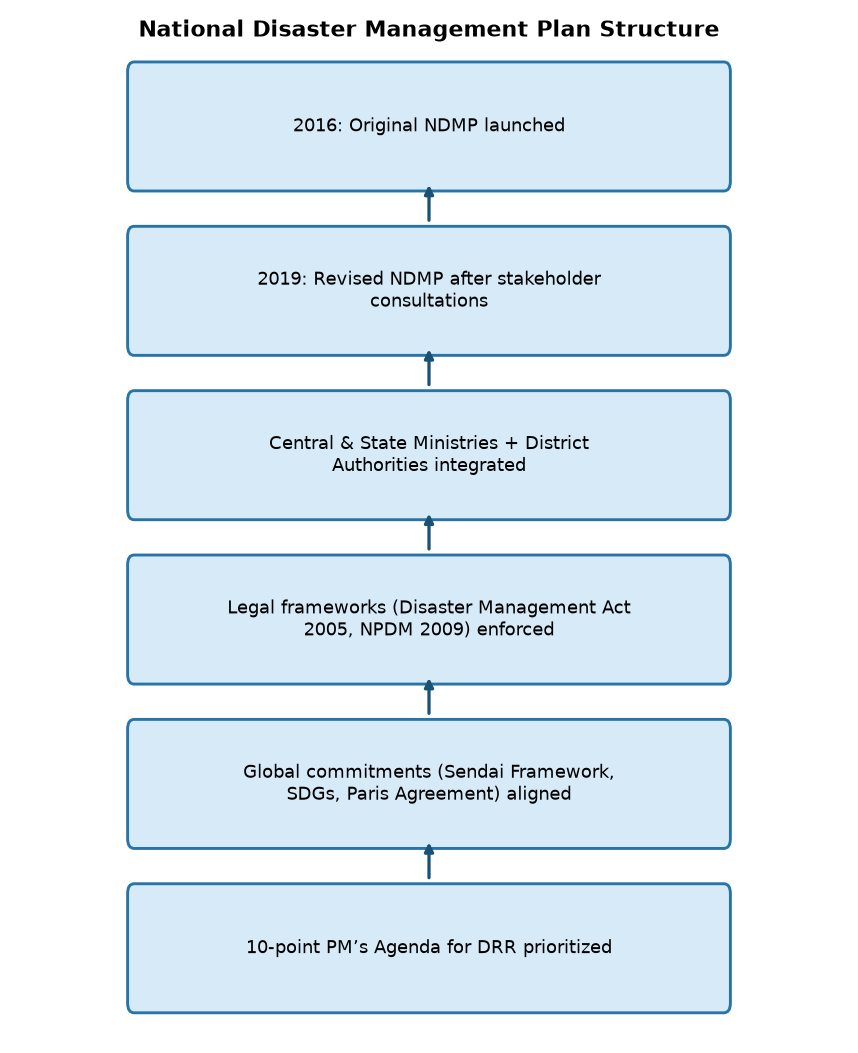
- The NDMP was first formulated and released in 2016, marking a paradigm shift from reactive to proactive disaster risk management in India.
- The plan was revised in 2019 following extensive consultations with all stakeholders, including central ministries, state governments, district authorities, and sectoral experts.
- The NDMP operationalises the Disaster Management Act, 2005, which provides the statutory basis for disaster risk reduction, response, and recovery in India.
- The plan integrates India’s international obligations under the Sendai Framework for Disaster Risk Reduction (2015–2030), Sustainable Development Goals (SDGs), and the Paris Agreement on Climate Change.
- The NDMP reflects the Prime Minister’s Ten-Point Agenda for Disaster Risk Reduction, which prioritises resilience-building across sectors and geographies.
- Social inclusion is embedded as a cross-cutting principle, ensuring that marginalised communities are not disproportionately affected by disasters.
What is the National Disaster Management Plan (NDMP)?
- The NDMP is India’s apex strategic document for disaster risk reduction, preparedness, response, and recovery, formulated under the Disaster Management Act, 2005.
- It is a multi-hazard, multi-sectoral plan that aligns central, state, and district-level institutions, ensuring coordinated action across ministries, departments, and agencies.
- The legal framework is anchored in the Disaster Management Act, 2005, and the National Policy on Disaster Management (NPDM) 2009, which define roles, responsibilities, and institutional mechanisms.
- Global integration is achieved through adherence to the Sendai Framework, SDGs, and the Paris Agreement.
- The Prime Minister’s Ten-Point Agenda for Disaster Risk Reduction serves as a guiding framework, addressing contemporary priorities such as urban resilience, community-based preparedness, and climate adaptation.
- Social inclusion is a core principle, ensuring that disaster risk reduction strategies are inclusive of gender, disability, caste, and socio-economic vulnerabilities.
- The NDMP emphasises mainstreaming disaster risk reduction into development planning, thereby reducing the creation of new risks and enhancing resilience.
Key Features
| Feature | Significance |
|---|---|
| Legal and Policy Framework | Ensures compliance with the Disaster Management Act, 2005 and the National Policy on Disaster Management (NPDM), 2009, providing statutory backing to disaster risk reduction (DRR) efforts. |
| Multi-Stakeholder Integration | Unifies central, state, sectoral ministries, departments, and district authorities, clarifying roles and responsibilities for coordinated disaster management. |
| Global Commitment Alignment | Aligns with international frameworks such as the Sendai Framework for DRR, SDGs, and the Paris Agreement, ensuring India’s adherence to global best practices in disaster risk mitigation. |
| Prime Minister’s Ten-Point Agenda for DRR | Highlights contemporary national priorities in disaster risk reduction, integrating them into the NDMP’s operational strategy. |
| Social Inclusion and Mainstreaming of DRR | Embeds social inclusion as a cross-cutting principle, ensuring equitable disaster risk reduction across vulnerable and marginalised communities. |
| India Disaster Resource Network (IDRN) | Provides a national electronic inventory of resources, including equipment and skilled personnel, enabling rapid deployment during emergencies. |
Why it Matters
Institutional and Governance
- Establishes a robust institutional framework for disaster management, integrating all levels of government and ensuring accountability through clearly defined roles.
- Facilitates inter-ministerial and inter-departmental coordination, reducing duplication of efforts and enhancing resource utilisation during disasters.
- Strengthens the legal and policy foundation for disaster management, ensuring compliance with national and international obligations.
Operational and Technological
- The IDRN platform enables real-time tracking of resources, ensuring rapid mobilisation and deployment during emergencies, thereby reducing response time.
- Digital integration of resources enhances transparency, accountability, and efficiency in disaster resource management.
Social and Economic
- Mainstreaming social inclusion ensures that disaster risk reduction strategies are equitable and reach marginalised and vulnerable populations, reducing socio-economic disparities in disaster impacts.
- Alignment with global frameworks like the Sendai Framework and SDGs ensures that India’s disaster management strategies contribute to broader sustainable development goals.
Strategic and Environmental
- Integration of climate change considerations, as per the Paris Agreement, ensures that disaster risk reduction strategies are climate-resilient and adaptive to future challenges.
- The NDMP’s focus on contemporary national priorities, such as the Prime Minister’s Ten-Point Agenda, aligns disaster management with broader national development strategies.
Challenges
1. Implementation Gaps at District Level
- Despite the NDMP’s comprehensive framework, effective implementation at the district level remains uneven due to limited capacity, resources, and training among local authorities.
- Lack of standardised protocols for resource mobilisation and utilisation across states can lead to inefficiencies and delays during emergencies.
UPSC Link: GS3: Disaster Management
2. Data Gaps and Interoperability
- The IDRN platform, while advanced, faces challenges in data accuracy, timeliness, and interoperability with other national and state-level databases, hindering seamless resource tracking.
- Incomplete or outdated data on resources and personnel can undermine the effectiveness of the IDRN during critical emergencies.
UPSC Link: GS3: Disaster Management
3. Coordination Among Stakeholders
- Multi-stakeholder coordination, though a strength of the NDMP, often faces bureaucratic hurdles, lack of clear communication channels, and overlapping jurisdictions, leading to delays in decision-making.
- Differences in priorities and resource allocation between central and state governments can create friction in disaster response efforts.
UPSC Link: GS2: Centre-State Relations
4. Climate Change and Emerging Risks
- The increasing frequency and intensity of climate-related disasters pose a significant challenge to the NDMP’s effectiveness, requiring continuous adaptation and integration of new risk assessment tools.
- Limited understanding of cascading risks (e.g., floods leading to disease outbreaks) can undermine comprehensive disaster preparedness.
UPSC Link: GS3: Environment and Disaster Management
5. Resource Mobilisation and Funding
- Inadequate and inconsistent funding for disaster management initiatives, both at central and state levels, can limit the implementation of NDMP strategies and the maintenance of the IDRN platform.
- Dependence on ad-hoc allocations rather than a structured, long-term funding mechanism can hinder sustained disaster risk reduction efforts.
UPSC Link: GS3: Disaster Management
Challenges — UPSC Perspective
| Issue | Concern |
|---|---|
| District-Level Capacity | Limited training, resources, and institutional capacity at the district level undermines the NDMP’s implementation. |
| Data Accuracy in IDRN | Outdated or incomplete data in the IDRN platform reduces its reliability for real-time resource tracking during emergencies. |
| Inter-Ministerial Coordination | Bureaucratic delays and overlapping jurisdictions hinder effective coordination among ministries and departments. |
| Climate-Resilient Strategies | Emerging climate risks require continuous updating of risk assessment tools, which may not be fully integrated into the NDMP. |
| Funding and Resource Allocation | Inconsistent and ad-hoc funding mechanisms limit the NDMP’s operational effectiveness and long-term sustainability. |
| Public Awareness and Community Engagement | Low awareness among communities about disaster preparedness and NDMP roles reduces its effectiveness in grassroots implementation. |
Way Forward
- Strengthen district-level capacity through targeted training programmes, resource allocation, and institutional support to ensure effective implementation of the NDMP.
- Enhance data accuracy and interoperability in the IDRN platform by integrating real-time updates, standardised protocols, and cross-platform compatibility with state and central databases.
- Establish clear communication channels and protocols for multi-stakeholder coordination, including regular inter-ministerial meetings and joint exercises to improve response efficiency.
- Develop climate-resilient disaster management strategies by integrating advanced risk assessment tools, scenario-based planning, and adaptive frameworks aligned with the Paris Agreement and Sendai Framework.
- Institute a structured, long-term funding mechanism for disaster management, including dedicated budgets for NDMP implementation, IDRN maintenance, and emergency response preparedness.
- Promote public awareness and community engagement through awareness campaigns, drills, and participatory disaster risk reduction programmes to enhance grassroots preparedness.
- Leverage technology, such as AI and machine learning, to predict disaster risks, optimise resource allocation, and improve decision-making during emergencies.
- Conduct periodic reviews and audits of the NDMP’s implementation to identify gaps, assess effectiveness, and incorporate lessons learned from recent disasters.
UPSC Value Addition
Keywords for Mains Answer-Writing
National Disaster Management Plan (NDMP) · Disaster Risk Reduction (DRR) · Sendai Framework · Disaster Management Act 2005 · National Policy on Disaster Management 2009 · India Disaster Resource Network (IDRN) · Social Inclusion in Disaster Management · Sustainable Development Goals (SDGs) · Paris Agreement on Climate Change · Prime Minister’s Ten-Point Agenda on DRR · Multi-hazard Disaster Risk Management · Institutional Framework for Disaster Management
Concept Flow
Climate Change and Anthropogenic Pressures → Increased Frequency and Intensity of Disasters → Need for Comprehensive Disaster Risk Reduction (DRR) Strategies → Enactment of Disaster Management Act, 2005 and NPDM, 2009 → Formulation of National Disaster Management Plan (NDMP) in 2016 and its revision in 2019 → Integration of Global Frameworks (Sendai Framework, SDGs, Paris Agreement) → Establishment of IDRN for Resource Tracking and Mobilisation → Implementation Challenges at District Level and Stakeholder Coordination Gaps → Need for Strengthened Capacity, Funding, and Technology Integration → Enhanced Disaster Preparedness and Resilience
Prelims Practice Questions
Q1. Which of the following is NOT a pillar of the National Disaster Management Plan (NDMP) as revised in 2019?
- A. Compliance with the Disaster Management Act, 2005 and National Policy on Disaster Management, 2009
- B. Integration of social inclusion as a cross-cutting principle
- C. Establishment of a parallel disaster management authority under the Ministry of Defence
- D. Participation in global frameworks like the Sendai Framework and SDGs
Answer: C. Establishment of a parallel disaster management authority under the Ministry of Defence — The NDMP does not establish a parallel authority; it integrates existing institutions under a unified framework. The other options directly align with the pillars of the NDMP.
Q2. The India Disaster Resource Network (IDRN) is primarily designed to:
- A. Provide financial assistance to disaster-affected individuals
- B. Serve as a web-based electronic inventory of resources for emergency response
- C. Conduct post-disaster damage assessments
- D. Train local communities in disaster preparedness
Answer: B. Serve as a web-based electronic inventory of resources for emergency response — The IDRN functions as a web-based platform to manage and deploy resources (equipment, human resources) during emergencies, ensuring rapid response.
Q3. Which global framework is explicitly cited in the NDMP as a guiding principle for disaster risk reduction?
- A. Kyoto Protocol
- B. Sendai Framework for Disaster Risk Reduction
- C. Montreal Protocol
- D. New Urban Agenda
Answer: B. Sendai Framework for Disaster Risk Reduction — The Sendai Framework (2015–2030) is explicitly referenced in the NDMP as a guiding framework for disaster risk reduction.
Q4. The National Disaster Management Plan (NDMP) was first released in which year?
- A. 2010
- B. 2014
- C. 2016
- D. 2018
Answer: C. 2016 — The NDMP was first prepared and released in 2016, with subsequent revisions in 2019.
Mains Practice Question
✍ Critically examine the institutional and legal framework of India’s National Disaster Management Plan (NDMP). How does it align with global frameworks like the Sendai Framework and the Paris Agreement? Substantiate your answer with relevant provisions.
Approach: Begin by outlining the institutional structure of the NDMP, emphasizing the roles of the National Disaster Management Authority (NDMA), State Disaster Management Authorities (SDMAs), and District Disaster Management Authorities (DDMAs) under the Disaster Management Act, 2005. Discuss the NDMP’s alignment with the Sendai Framework’s four priorities for action and the Paris Agreement’s climate-resilient disaster risk reduction strategies. Highlight the inclusion of social inclusion and the India Disaster Resource Network (IDRN) as cross-cutting mechanisms. Conclude by assessing the effectiveness of this framework in achieving comprehensive disaster risk reduction.
Source: PIB (Press Information Bureau)
Generated by AanyaAi for educational purpose.


No Comments