


23 Jul UPSC Alert: Govt Strengthens Drug Demand Reduction Measures in 2026
Subject Relevance — Where This Topic Fits
- GS Paper II — Social Justice and Governance | GS Paper III — Issues relating to Development and Management of Social Sector/Services relating to Health
- Prelims: Nasha Mukt Bharat Abhiyaan (NMBA), National Action Plan for Drug Demand Reduction (NAPDDR), Integrated Rehabilitation Centres for Addicts (IRCA), Atal Vayo Abhyudaya Yojana (AVYAY), National Drug Dependence Treatment Centre (NDDTC)
- Essay: The role of community participation in public health interventions, Balancing individual liberty and state intervention in substance abuse control
Why is this in the news?
The Ministry of Social Justice and Empowerment has strengthened measures to reduce drug demand by streamlining financial assistance under centrally sponsored schemes, expanding de-addiction services, and enhancing transparency in fund disbursement. This initiative aligns with the National Action Plan for Drug Demand Reduction (NAPDDR) and the Nasha Mukt Bharat Abhiyaan (NMBA), which has already engaged over 29.68 crore citizens through nationwide awareness campaigns. The press release underscores the government’s commitment to evidence-based interventions, as reflected in the findings of the National Survey on Extent and Pattern of Substance Use in India conducted by NDDTC, AIIMS New Delhi.
Background
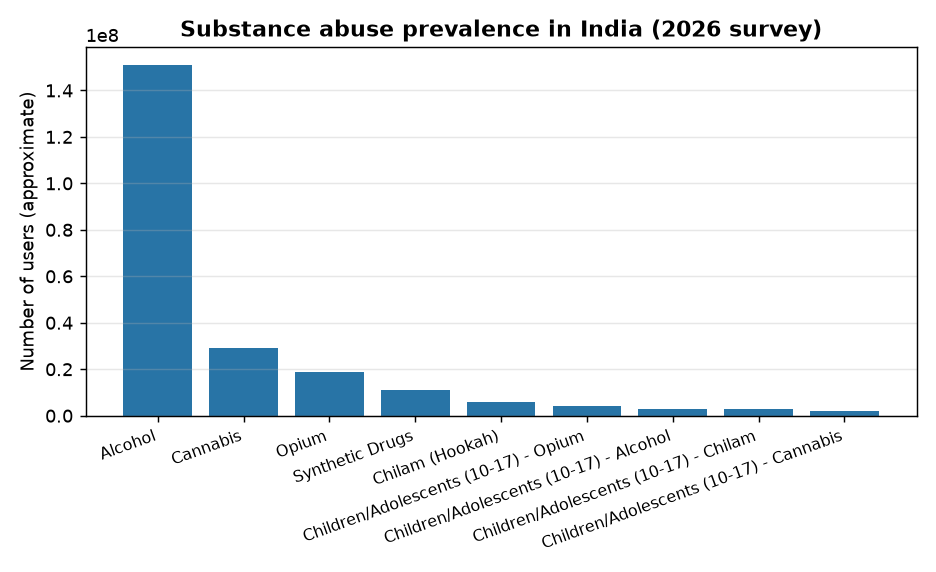
- India faces a significant challenge of substance abuse, with the National Survey on Extent and Pattern of Substance Use (2019) estimating that over 15.10 crore adults consume alcohol, followed by cannabis (2.90 crore), opioids (1.90 crore), and other substances.
- The Nasha Mukt Bharat Abhiyaan (NMBA), initiated on 15 August 2020, is one of the world’s largest awareness campaigns against substance abuse, targeting youth and women through community engagement and institutional outreach.
What is the National Action Plan for Drug Demand Reduction (NAPDDR)?
- NAPDDR is a comprehensive, evidence-based framework launched by the Ministry of Social Justice and Empowerment to reduce the demand for narcotic drugs and psychotropic substances in India.
- The plan focuses on four pillars: prevention through education and awareness, early identification and intervention, treatment and counseling, and rehabilitation and social reintegration.
- Financial assistance is provided to states, UTs, NGOs, and government hospitals for establishing and operating de-addiction centres, including Integrated Rehabilitation Centres for Addicts (IRCA) and Community Peer-Led Intervention (CPLI) centres.
- The plan incorporates data-driven strategies, leveraging findings from the National Survey on Extent and Pattern of Substance Use (2019) conducted by NDDTC, AIIMS New Delhi, to tailor interventions to regional and demographic needs.
- Monitoring and evaluation mechanisms, including a strict financial disbursement framework, ensure timely and transparent release of funds to implementing agencies.
- NAPDDR also promotes intersectoral coordination with the Ministry of Health and Family Welfare, Ministry of Women and Child Development, and state governments to address multi-dimensional aspects of substance abuse.
Key Features
| Feature | Significance |
|---|---|
| National Drug Demand Reduction Strategy under NAPDDAR | Provides a comprehensive, evidence-based framework to address substance abuse, grounded in empirical data from the National Survey on Drug Use by AIIMS-NDDTC. |
| Expansion of De-addiction and Rehabilitation Centres | Increased support to 765 centres nationwide, including Integrated Rehabilitation Centres (IRCs), Community-based Peer-led Centres (CPLCs), and Drop-in Centres, enhancing accessibility to treatment services. |
| Streamlined Financial Assistance under CSS | Simplified fund disbursement processes and tightened monitoring mechanisms to ensure timely and transparent support for NGOs, state governments, and UT administrations. |
| Nasha Mukt Bharat Abhiyaan (NMBA) 2.0 | Launched a mobile application to improve access to treatment services and launched nationwide awareness campaigns reaching 29.68 crore citizens, including 11.43 crore youth and 8.05 crore women. |
| Standard Operating Procedure (SOP) Revision | Reduced bureaucratic hurdles in grant disbursement to implementing partners, improving administrative efficiency and reducing documentation requirements. |
Why it Matters
Public Health
- Addresses the rising burden of substance abuse, particularly alcohol (15.10 crore users), opioids (2.90 crore), and cannabis (1.90 crore), as per the National Survey on Drug Use.
- Expands preventive, curative, and rehabilitative services to mitigate long-term health impacts, including mental health disorders and infectious diseases linked to intravenous drug use.
Social Justice
- Promotes inclusive access to rehabilitation services for marginalised groups, including women, youth, and children, through community-led initiatives like ‘Nasha Mukti Mitras’.
- Aligns with constitutional directives under Article 47 (DPSP) to improve public health and welfare, particularly for vulnerable populations.
Governance and Efficiency
- Enhances transparency and accountability in fund utilisation through revised SOPs and real-time monitoring of CSS schemes.
- Strengthens inter-sectoral coordination between central ministries, state governments, and civil society for holistic drug demand reduction.
Youth and Education
- Targets youth (10–17 years) and school-going populations through NMBA’s outreach in 21.73 lakh educational institutions, reducing early initiation into substance use.
- Leverages peer-led models to foster behavioural change and resilience against peer pressure.
Challenges
1. Stigma and Social Barriers
- Persistent social stigma associated with substance abuse discourages individuals from seeking treatment, particularly in rural and conservative communities.
- Limited awareness of available rehabilitation services among affected populations exacerbates underutilisation of existing infrastructure.
UPSC Link: GS-II: Social Justice (Healthcare Access)
2. Geographical Disparities
- Uneven distribution of de-addiction centres across states, with higher concentrations in urban areas, leaving rural populations underserved.
- Logistical challenges in reaching remote and tribal regions hinder the effectiveness of outreach programmes like NMBA.
UPSC Link: GS-II: Health Infrastructure
3. Sustainability of Funding
- Dependence on centralised CSS funding may lead to delays or shortfalls in disbursement, impacting long-term programme continuity.
- Limited participation of private sector and corporate social responsibility (CSR) in funding rehabilitation initiatives.
UPSC Link: GS-II: Centre-State Financial Relations
4. Data Gaps and Monitoring
- Incomplete or delayed reporting from state-level implementing agencies complicates real-time assessment of programme impact.
- Lack of standardised metrics to evaluate the efficacy of peer-led interventions and community-based models.
UPSC Link: GS-II: Governance (Monitoring Mechanisms)
5. Intersection with Crime and Law
- Overlap between substance abuse and organised crime necessitates coordinated efforts with law enforcement agencies, which often lack training in public health approaches.
- Legal ambiguities in the regulation of certain substances (e.g., cannabis derivatives) create challenges in enforcement and treatment protocols.
UPSC Link: GS-III: Internal Security (Drug Trafficking)
Challenges — UPSC Perspective
| Issue | Concern |
|---|---|
| Stigma and Social Barriers | Discourages treatment-seeking behaviour and reduces community participation in rehabilitation programmes. |
| Geographical Disparities | Urban-centric service delivery leaves rural and tribal populations with limited access to de-addiction services. |
| Funding Sustainability | Centralised CSS reliance risks programme discontinuity due to delays or shortfalls in fund disbursement. |
| Data Gaps | Incomplete reporting hampers evidence-based policymaking and programme evaluation. |
| Crime-Law Interface | Requires multi-agency coordination between public health and law enforcement, often lacking in practice. |
Government Initiatives — Must-Memorise for Prelims
- Nasha Mukt Bharat Abhiyaan (NMBA)
- Atal Vayo Abhyuday Yojana (AVYAY)
Way Forward
- Strengthen state-level monitoring mechanisms to ensure real-time tracking of fund utilisation and programme outcomes under CSS schemes.
- Expand mobile health units and telemedicine services to bridge the rural-urban divide in access to de-addiction and counselling services.
- Integrate substance abuse prevention modules into school curricula and teacher training programmes to foster early intervention.
- Launch targeted awareness campaigns in tribal and remote regions, leveraging local leaders and NGOs to reduce stigma.
- Establish a national digital dashboard for standardised data collection on substance use patterns, treatment outcomes, and rehabilitation progress.
- Encourage CSR partnerships with private healthcare providers to augment rehabilitation infrastructure in underserved districts.
- Develop a cadre of trained ‘Nasha Mukti Mitras’ with specialised skills in youth engagement and community mobilisation.
- Harmonise legal frameworks across states to decriminalise personal drug use while ensuring robust treatment and harm-reduction services.
UPSC Value Addition
Keywords for Mains Answer-Writing
Nasha Mukti Abhiyan (NMA) · National Action Plan for Drug Demand Reduction (NAPDDR) · Substance Abuse Prevention · Rehabilitation Centres · Community-Based Peer-Led Initiatives · National Survey on Drug Use · Atal Vayo Abhyuday Yojana (AVYAY) · Integrated Rehabilitation Centres for Addicts (IRCA) · Drug Demand Reduction Strategy · Social Justice and Empowerment Ministry · Evidence-Based Policy · Narcotic Drugs and Psychotropic Substances (NDPS) Act · Peer Support Networks · Public Health Infrastructure
Constitutional & Policy Linkages
- Article 47 (DPSP) – Duty of the State to improve public health and prohibit intoxicating drugs.
Concept Flow
Substance Abuse Epidemic (Alcohol, Opioids, Cannabis) → National Survey on Drug Use (AIIMS-NDDTC) → Evidence-Based Policy (NAPDDR) → Expansion of De-addiction Centres → Streamlined CSS Funding → NMBA Awareness Campaigns → Community Mobilisation (Nasha Mukti Mitras) → Treatment and Rehabilitation (28.29 lakh beneficiaries) → Reduction in Demand and Harm.
Prelims Practice Questions
Q1. Which of the following statements about the ‘Nasha Mukti Abhiyan’ is/are correct?
1. It is a centrally sponsored scheme under the Ministry of Health and Family Welfare.
2. The campaign has reached over 29.68 crore citizens through nationwide awareness activities.
3. It includes the establishment of 765 de-addiction and rehabilitation centres across India.
4. The campaign was launched on 15 August 2020 and covers all districts as of August 2023.
Select the correct answer using the code below:
- 1 and 2 only
- 2 and 4 only
- 1, 2, and 4 only
- 2, 3, and 4 only
Answer: 2 and 4 only — Statement 1 is incorrect as the Nasha Mukti Abhiyan is under the Ministry of Social Justice and Empowerment, not Health and Family Welfare. Statements 2, 3, and 4 are correct as per official data.
Q2. Consider the following statements regarding the National Action Plan for Drug Demand Reduction (NAPDDR):
1. It is implemented under the aegis of the Narcotic Drugs and Psychotropic Substances (NDPS) Act, 1985.
2. The plan provides financial assistance to state governments, NGOs, and government hospitals for prevention, treatment, and rehabilitation.
3. The plan includes the establishment of Integrated Rehabilitation Centres for Addicts (IRCA) and Community Peer-Led Initiatives (CPLI).
Which of the statements given above is/are correct?
- 1 only
- 1 and 2 only
- 2 and 3 only
- 1, 2, and 3
Answer: 2 and 3 only — Statement 1 is incorrect as the NAPDDR is a policy framework under the Ministry of Social Justice and Empowerment, not directly under the NDPS Act. Statements 2 and 3 are correct as they align with the scheme’s objectives and components.
Mains Practice Question
✍ Critically examine the role of the National Action Plan for Drug Demand Reduction (NAPDDR) in addressing the menace of substance abuse in India. Highlight the key components of the plan, its implementation challenges, and suggest measures to enhance its effectiveness.
Approach: Begin by outlining the objectives and key components of the NAPDDR, including its focus on prevention, treatment, and rehabilitation. Discuss the role of the Ministry of Social Justice and Empowerment in implementing the plan and the support provided to state governments, NGOs, and community-based initiatives. Analyse the implementation challenges such as limited infrastructure, stigma, and funding constraints. Conclude by suggesting measures like strengthening community participation, leveraging technology for outreach, and ensuring inter-ministerial coordination to enhance the plan’s effectiveness.
Source: PIB (Press Information Bureau)
Generated by AanyaAi for educational purpose.

- संयुक्त राष्ट्र महासभा अध्यक्ष का Rohingya संकट से सीख: विश्वास और AI पर बल - September 19, 2026
- UNGA President’s Rohingya Crisis Lessons for UPSC: Trust & AI Challenges - September 19, 2026
- HAL ने IAF को दो LCA ट्रेनर विमान सौंपे: सुरक्षा तैयारी में बड़ा कदम - September 19, 2026

No Comments