


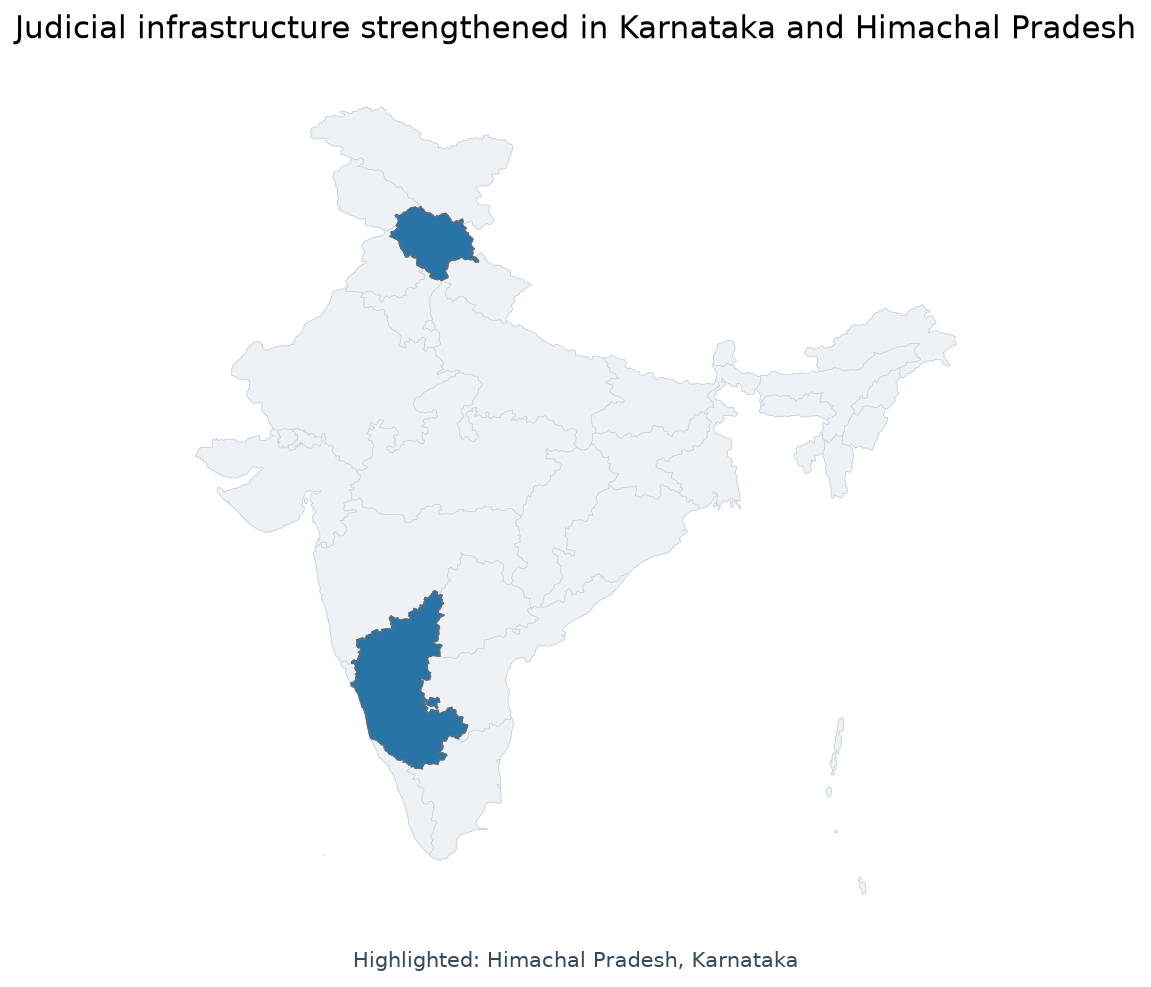
26 Jul UPSC Focus: Centre Strengthens Judicial Infrastructure in Karnataka & Himachal Pradesh
Subject Relevance — Where This Topic Fits
- GS Paper II — Polity and Governance | GS Paper III — Infrastructure and Digital Governance
- Prelims: Centrally Sponsored Schemes (CSS), Judicial Infrastructure, E-Courts Mission Mode Project, District Courts, Subordinate Courts, Digital Judiciary
- Essay: Judicial Reforms and Governance: Balancing Infrastructure and Digital Transformation
Quick Revision: The Centrally Sponsored Scheme (CSS) for judicial infrastructure, operational since 1993-94, funds five key components—court halls, residential units, lawyer halls, sanitation complexes, and digital computer rooms—to strengthen district and subordinate courts, with Karnataka and Himachal Pradesh recently receiving allocations under this scheme.
Why is this in the news?
The Press Information Bureau (PIB) released a detailed update on 25 July 2026 highlighting the augmentation of judicial infrastructure in Karnataka and Himachal Pradesh under the Centrally Sponsored Scheme (CSS) for judicial infrastructure. The report underscores the progress in constructing court halls, residential units for judicial officers, lawyer halls, sanitation complexes, and digital computer rooms, alongside the financial allocations made over the past five years. This initiative is critical for enhancing judicial efficiency and accessibility, particularly in states with significant case backlogs.
Background
- The Centrally Sponsored Scheme (CSS) for judicial infrastructure has been operational since 1993-94, aimed at developing basic facilities for district and subordinate courts across India.
- Five key components are prioritized under the scheme: court halls, residential units for judicial officers, halls for lawyers, sanitation complexes, and digital computer rooms.
- The E-Courts Mission Mode Project, launched under the National e-Governance Plan, complements this scheme by digitizing judicial processes, including case filing, hearing, and judgment delivery.
- The latest data (as of 31 May 2026) reveals gaps in the availability of court halls and residential units relative to sanctioned posts, necessitating continued investment.
What is the Centrally Sponsored Scheme (CSS) for Judicial Infrastructure?
- The CSS for judicial infrastructure is a long-standing initiative (since 1993-94) of the Government of India to strengthen the physical and digital infrastructure of district and subordinate courts.
- It is a centrally sponsored scheme, meaning the central government provides central funds, and states/UTs implement the scheme.
- The scheme aims to address critical gaps in judicial infrastructure by focusing on five key components: court halls, residential units for judicial officers, lawyer halls, sanitation complexes, and digital computer rooms.
- The scheme operates in tandem with the E-Courts Mission Mode Project, which digitizes judicial processes to improve efficiency, transparency, and accessibility.
- After receiving eligible proposals from the States and Union Territories, temporary allocation of funds is made to them, and the main sanction (Mother Sanction) is issued.
- The scheme is demand-driven, with states and union territories identifying projects based on local needs, ensuring targeted and efficient utilization of funds.
- The scheme also includes provisions for the construction of additional court halls and residential units to address the shortage of judicial officers and infrastructure deficits.
- Digital infrastructure under the scheme includes the provision of computer labs, video conferencing facilities, and case management systems to support the E-Courts ecosystem.
Key Features
| Feature | Significance |
|---|---|
| Court Halls | Primary infrastructure for judicial proceedings; directly impacts case disposal efficiency and judicial capacity. |
| Residential Units for Judicial Officers | Ensures availability of judges in remote areas, reduces pendency, and improves judicial governance. |
| Lawyers’ Halls | Facilitates legal practice by providing dedicated spaces for advocates, enhancing court functionality. |
| Sanitation Complexes | Promotes hygiene and accessibility, particularly in rural and semi-urban courts, aligning with Sustainable Development Goals. |
| Digital Computer Labs | Supports e-Courts Mission Mode Project, enabling digital case management, virtual hearings, and faster justice delivery. |
Why it Matters
Judicial Efficiency
- Reduces case pendency by ensuring adequate court infrastructure, particularly in Karnataka and Himachal Pradesh where judicial capacity is constrained.
- Enhances the quality of judicial proceedings through modernized courtrooms and digital tools.
- Supports the e-Courts Mission Mode Project, facilitating end-to-end digital case management.
Equitable Access to Justice
- Improves judicial infrastructure in under-served regions, promoting geographical equity in justice delivery.
- Addresses the shortage of residential units for judicial officers, reducing vacancies and improving judicial presence in district courts.
- Enhances accessibility for litigants, particularly in Himachal Pradesh’s hilly terrains and Karnataka’s rural areas.
Economic Impact
- Stimulates local economies through construction activities and allied services, generating employment.
- Reduces litigation costs for litigants by expediting case disposal and minimizing delays.
- Supports the digital economy by integrating courts with online dispute resolution mechanisms.
Governance and Transparency
- Strengthens the institutional capacity of district judiciary, a critical pillar of the Indian federal structure.
- Promotes transparency in judicial processes through digital documentation and case tracking.
- Aligns with the National Judicial Infrastructure Corporation’s mandate for standardized court infrastructure.
Challenges
1. Infrastructure Deficit in Hilly Regions
- Himachal Pradesh’s terrain poses logistical challenges in constructing court buildings and residential units.
- Delays in land acquisition and environmental clearances exacerbate project timelines.
- Limited availability of skilled labor in remote areas hampers construction efficiency.
UPSC Link: GS-II: Federalism, Local Governance
2. Digital Divide and Cybersecurity Risks
- Inadequate digital literacy among stakeholders (judges, lawyers, litigants) may hinder adoption of e-Courts services.
- Cybersecurity threats to digital court records and virtual hearings require robust safeguards.
- Rural and semi-urban courts may lack reliable internet connectivity for seamless digital integration.
UPSC Link: GS-III: Science & Technology
3. Funding Gaps and Fiscal Constraints
- Inconsistent fund disbursement (e.g., Himachal Pradesh received negligible funds in FY 2021-22) delays project execution.
- State governments’ fiscal limitations may prioritize other sectors over judicial infrastructure.
- Delays in release of central funds (e.g., FY 2025-26 allocations) disrupt project continuity.
UPSC Link: GS-II: Centre-State Relations
4. Human Resource Shortages
- Shortage of judicial officers in Karnataka (1398 sanctioned vs. 1278 available court halls) exacerbates pendency.
- Lack of residential units for judges in Himachal Pradesh (161 available vs. 192 sanctioned) leads to postings in distant locations.
- Inadequate staffing for digital infrastructure maintenance impedes long-term sustainability.
UPSC Link: GS-II: Judiciary
5. Regulatory and Bureaucratic Delays
- Multi-layered approval processes (e.g., state high courts, central ministries) slow down project implementation.
- Compliance with environmental and building norms adds to project costs and timelines.
- Lack of standardized procurement processes across states leads to inefficiencies.
UPSC Link: GS-II: Governance
Challenges — UPSC Perspective
| Issue | Concern |
|---|---|
| Terrain Constraints (Himachal Pradesh) | Logistical and environmental challenges in construction. |
| Digital Literacy Gaps | Stakeholder readiness for e-Courts adoption. |
| Inconsistent Fund Flow | Delays in central fund disbursement disrupt project timelines. |
| Judicial Officer Shortages | Inadequate court halls and residential units reduce judicial capacity. |
| Regulatory Overheads | Complex approval processes and compliance requirements. |
| Maintenance of Digital Infrastructure | Lack of skilled personnel for long-term upkeep. |
Government Initiatives — Must-Memorise for Prelims
- e-Courts Mission Mode Project (Phase III)
Way Forward
- Accelerate fund disbursement for Karnataka and Himachal Pradesh under the CSS-JID to address pending projects.
- Strengthen digital literacy programs for judges, lawyers, and litigants to enhance e-Courts adoption.
- Establish a dedicated task force to expedite land acquisition and environmental clearances in hilly regions.
- Increase sanctioned posts for judicial officers and residential units in Himachal Pradesh to match demand.
- Develop a standardized procurement framework for judicial infrastructure to reduce delays and costs.
- Enhance cybersecurity protocols for e-Courts to safeguard digital records and virtual hearings.
- Promote public-private partnerships (PPPs) for maintenance of digital and physical infrastructure.
- Conduct periodic audits of infrastructure utilization to identify gaps and prioritize interventions.
UPSC Value Addition
Keywords for Mains Answer-Writing
Judicial Infrastructure Development · Centrally Sponsored Schemes (CSS) · District and Subordinate Courts · E-Courts Mission Mode Project · Judicial Officers’ Residential Units · Digital Court Ecosystem · Judicial Pendency Reduction · Constitutional Provisions for Judiciary · Judicial Reforms · Access to Justice · Government Funding for Judiciary · Judicial Infrastructure Gap Analysis
Constitutional & Policy Linkages
- Article 50: Separation of Judiciary from Executive (Directive Principles of State Policy).
- Article 21: Right to Speedy Trial (Fundamental Right).
- Seventh Schedule: Concurrent List (Entry 11A: Administration of Justice)
Concept Flow
Centrally Sponsored Scheme for Judicial Infrastructure Development (CSS-JID) → Allocation of funds to states → Identification of projects by high courts and state governments → Construction of court halls, residential units, and digital labs → Enhanced judicial capacity and efficiency → Reduction in case pendency and improved access to justice. → Judicial Infrastructure Development → Digital Integration via e-Courts Mission Mode Project → End-to-end digital case management → Faster justice delivery and transparency. → Inadequate Infrastructure → Case backlog and delays → Reduced judicial efficiency → Need for CSS-JID intervention. → Hilly Terrain Challenges → Logistical constraints in construction → Delays in project completion → Requires targeted policy interventions. → Fund Disbursement Gaps → Project stagnation → Need for streamlined fiscal mechanisms. → Digital Literacy Gaps → Low adoption of e-Courts → Requires stakeholder training and awareness programs. → Judicial Officer Shortages → Inadequate court halls → Pendency persists → Requires sanctioned post increases and residential unit provision.
Prelims Practice Questions
Q1. Which of the following is NOT a component of the Centrally Sponsored Scheme (CSS) for judicial infrastructure development as per the given press release?
- A. Court halls
- B. Residential units for judicial officers
- C. Lawyers’ halls
- D. Judicial training academies
Answer: D. Judicial training academies — The CSS for judicial infrastructure includes court halls, residential units for judicial officers, lawyers’ halls, toilet complexes, and digital computer rooms. Judicial training academies are not mentioned as a component in the press release.
Q2. The E-Courts Mission Mode Project aims to achieve which of the following objectives?
- A. Reduce the number of pending cases through digital case management
- B. Establish new high courts in every state
- C. Increase the retirement age of judges
- D. Privatise judicial services
Answer: A. Reduce the number of pending cases through digital case management — The E-Courts Mission Mode Project is designed to create a comprehensive digital ecosystem for courts, streamlining processes from case filing to final judgment, thereby reducing pendency.
Q3. Under the CSS for judicial infrastructure, funds are allocated to states based on which of the following criteria?
- A. Population size of the state
- B. Proposals submitted by states and union territories after approval by the High Court
- C. Political representation in Parliament
- D. Per capita income of the state
Answer: B. Proposals submitted by states and union territories after approval by the High Court — Funds under the CSS are allocated to states and union territories based on eligible proposals identified by the respective state/UT and the High Court, following the scheme’s guidelines.
Mains Practice Question
✍ Critically analyse the role of centrally sponsored schemes in addressing the judicial infrastructure deficit in India. How do initiatives like the E-Courts Mission Mode Project complement these schemes in ensuring timely justice delivery?
Approach: Begin by defining judicial infrastructure deficit and its constitutional significance under Articles 21 and 39A. Discuss the CSS framework, its components, and funding mechanisms, citing the Karnataka and Himachal Pradesh case studies. Highlight the gaps in physical infrastructure (e.g., court halls, residential units) and digital infrastructure (e.g., E-Courts). Critically evaluate the effectiveness of CSS in reducing pendency and improving access to justice, while also addressing challenges such as fund utilisation delays, state-level coordination, and sustainability. Conclude by suggesting measures to enhance the efficacy of these schemes, such as integrated monitoring systems and capacity-building for state agencies.
Source: PIB (Press Information Bureau)
Generated by AanyaAi for educational purpose.

- Tamil Nadu Expands Breakfast Scheme to Classes 6-8: 15.30 Lakh Students Benefit - September 22, 2026
- राज्यसभा उपचुनाव उत्तराखंड: 16 अक्तूबर को मतदान, जानें पूरा कार्यक्रम और महत्व - September 22, 2026
- राज्यसभा उपचुनाव उत्तराखंड: 16 अक्टूबर को मतदान, जानें प्रक्रिया और महत्व - September 22, 2026

No Comments