


27 Jul Anti-Paper Leak Bill 2026: Key Amendments & Penalties Explained for UPSC
Subject Relevance — Where This Topic Fits
- GS Paper II — Governance, Transparency and Accountability | GS Paper III — Issues relating to Quality of Education and Skill Development
- Prelims: Public Examinations (Prevention of Unfair Means) Act, 2024, NEET-UG paper leak controversy, Fast-track courts for exam-related offences, Union Education Minister’s resignation, Monsoon Session of Parliament 2026
- Essay: The Role of Technology in Ensuring Fairness in Public Examinations, Ethical Governance and Public Trust in Institutions
Quick Revision: The Public Examinations (Prevention of Unfair Means) Amendment Bill, 2026 introduces stringent measures such as ten-year imprisonment, ₹50 lakh fines, fast-track courts, and mandatory two-month investigations to curb paper leaks and ensure integrity in competitive examinations.
Why is this in the news?
The Union Government introduced the Public Examinations (Prevention of Unfair Means) Amendment Bill, 2026 in the Lok Sabha on 27 July 2026, amid sustained protests by opposition parties over the NEET-UG paper leak controversy and police action during student agitations. The Bill seeks to amend the existing Public Examinations (Prevention of Unfair Means) Act, 2024, by introducing stricter penalties, expedited trials through fast-track courts, and mandatory timelines for investigations to curb malpractices in competitive examinations.
Background
- The Public Examinations (Prevention of Unfair Means) Act, 2024 was enacted to address the growing menace of question paper leaks and other malpractices in competitive examinations such as NEET, JEE, and UPSC Civil Services.
- Recent years have witnessed recurring incidents of paper leaks in examinations like NEET-UG, UGC-NET, and others, eroding public trust in the examination system and triggering widespread student protests.
- The NEET-UG controversy in 2024-25 led to allegations of irregularities, including paper leaks, prompting nationwide agitations and demands for systemic reforms in examination conduct.
- Parliamentary proceedings during the Monsoon Session 2026 were disrupted by opposition protests, demanding a comprehensive response to the NEET-UG paper leak and related issues.
- The Bill reflects the government’s intent to enhance the legal framework governing public examinations, aligning with the constitutional mandate for fair and transparent conduct of competitive tests.
What is the Public Examinations (Prevention of Unfair Means) Amendment Bill, 2026?
- The Bill seeks to amend the Public Examinations (Prevention of Unfair Means) Act, 2024, by introducing stricter penalties and procedural reforms to deter malpractices in competitive examinations.
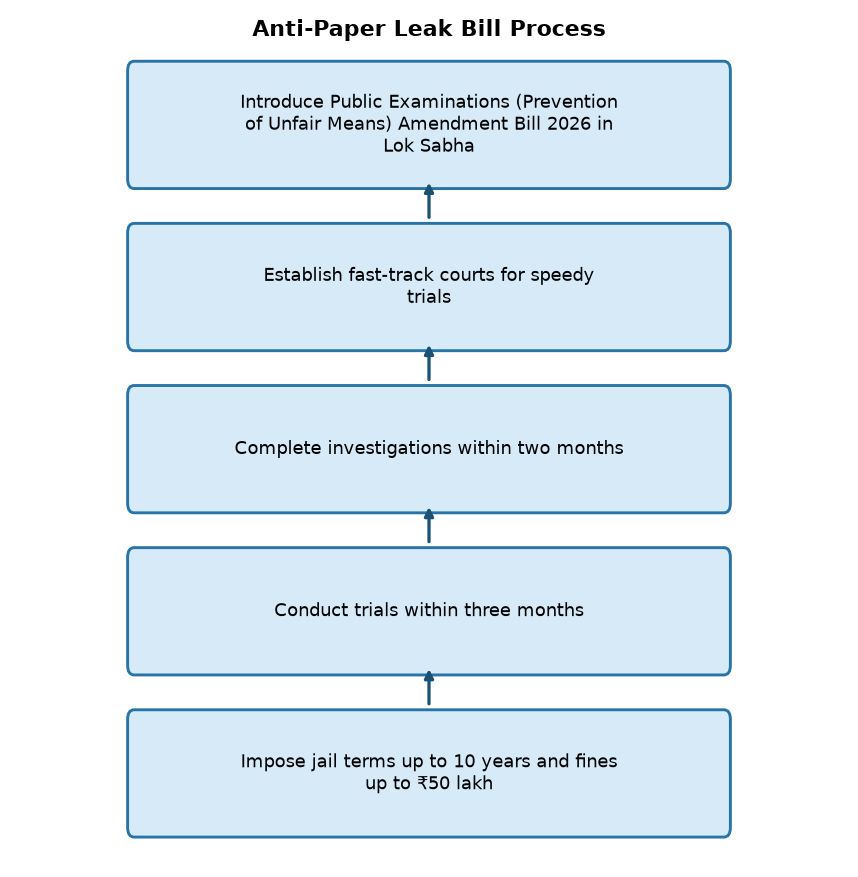
- Key amendments include the establishment of fast-track courts in every state to expedite trials of accused individuals involved in paper leaks or other unfair means.
- Investigations into paper leak cases are mandated to be completed within two months, ensuring timely action against perpetrators.
- The Bill enhances punishments by increasing the maximum jail term from five years (under the 2024 Act) to ten years, and raising fines from ₹10 lakh to ₹50 lakh for individuals found guilty of malpractices.
- Trials under the Bill are required to be concluded within three months from the date of filing of the chargesheet, ensuring swift justice delivery.
- The Bill covers a wide range of examinations, including those conducted by the Union Public Service Commission (UPSC), National Testing Agency (NTA), Staff Selection Commission (SSC), and other central agencies.
- The Bill also introduces provisions for the seizure and forfeiture of property derived from unfair means in examinations, acting as a deterrent against financial gains from malpractices.
- The amendments are aimed at restoring public confidence in the examination system by ensuring transparency, accountability, and fairness in the conduct of competitive tests.
Key Features
| Feature | Significance |
|---|---|
| Establishment of fast-track courts | Ensures speedy trials with proceedings to be completed within three months of chargesheet filing, addressing delays in justice delivery. |
| Mandate for investigations within two months | Reduces the timeframe for probe completion, enhancing accountability and deterrence against paper leaks. |
| Enhanced punishment: Up to 10 years imprisonment | Increases severity of penalties compared to the 2024 Act (5 years maximum), acting as a stronger deterrent. |
| Enhanced punishment: Fines up to ₹50 lakh | Raises financial penalties from ₹10 lakh (2024 Act) to ₹50 lakh, increasing the cost of malpractice for offenders. |
| Expansion of scope to cover all public examinations | Broadens the ambit beyond competitive exams like NEET/UPSC, including state-level and institutional assessments. |
Why it Matters
Examination Integrity
- Strengthens the credibility of public examinations by criminalising unfair means, ensuring fair competition for candidates.
- Addresses systemic vulnerabilities exposed by recent NEET-UG paper leaks and protests, restoring public trust in examination systems.
Governance & Accountability
- Imposes strict timelines for investigations and trials, reducing bureaucratic delays and enhancing administrative efficiency.
- Demonstrates the government’s commitment to accountability, particularly in light of the resignation of the Union Education Minister.
Legal Framework
- Builds upon the Public Examinations (Prevention of Unfair Means) Act, 2024, by introducing stricter penalties and procedural reforms.
- Aligns with global best practices in examination security, such as those in the United Kingdom and United States.
Social Impact
- Mitigates the psychological and economic burden on students affected by paper leaks, particularly in competitive exams like NEET.
- Reduces social unrest by addressing grievances related to examination malpractices and perceived injustices.
Challenges
1. Implementation Bottlenecks
- Rapid establishment of fast-track courts across states may face logistical and resource constraints, delaying trials.
- Ensuring uniformity in investigation and prosecution standards across diverse state jurisdictions.
UPSC Link: GS Paper 2 – Judiciary & Governance
2. Balancing Deterrence with Fairness
- Risk of over-criminalisation where minor administrative lapses are treated as serious offences, undermining the intent of the law.
- Need for clear guidelines to distinguish between deliberate malpractice and systemic failures in examination conduct.
UPSC Link: GS Paper 4 – Ethics in Governance
3. Political Polarisation
- Opposition protests during the bill’s introduction highlight political tensions, potentially delaying legislative passage.
- Perception of the bill as a reaction to protests rather than a proactive reform, complicating its acceptance.
UPSC Link: GS Paper 2 – Parliament & Federalism
4. Technological Vulnerabilities
- Inadequate focus on digital safeguards for online examinations, leaving room for cyber-enabled malpractices.
- Need for robust encryption, AI-based proctoring, and blockchain for secure question paper distribution.
UPSC Link: GS Paper 3 – Science & Technology
5. Resource Allocation
- High financial burden on states to establish fast-track courts and train personnel for specialised investigations.
- Potential diversion of funds from other critical education sector initiatives.
UPSC Link: GS Paper 2 – Centre-State Relations
Challenges — UPSC Perspective
| Issue | Concern |
|---|---|
| State-level coordination | Variations in investigative capacity and judicial infrastructure may lead to uneven enforcement. |
| Digital security gaps | Lack of standardised protocols for online exams increases vulnerability to hacking and data breaches. |
| Protest-driven legislation | Perception of the bill as a knee-jerk response to unrest may reduce its long-term effectiveness. |
| Overlap with existing laws | Potential duplication with IPC sections (e.g., cheating, forgery) requiring harmonisation. |
| Public perception of bias | Concerns that the law disproportionately targets certain communities or institutions. |
Government Initiatives — Must-Memorise for Prelims
- Public Examinations (Prevention of Unfair Means) Act, 2024
Way Forward
- Constitute a high-powered committee under the Ministry of Education to oversee the establishment of fast-track courts and monitor trial progress.
- Develop standard operating procedures (SOPs) for state-level investigations to ensure uniformity in evidence collection and prosecution.
- Invest in digital infrastructure, including AI-based proctoring and blockchain for secure question paper distribution, to address technological vulnerabilities.
- Launch a nationwide awareness campaign to educate stakeholders—students, parents, and institutions—on the provisions of the amended Act.
- Allocate dedicated funds in the Union Budget for state-level implementation, ensuring resource parity across jurisdictions.
- Introduce periodic reviews of the Act’s effectiveness, with provisions for mid-course corrections based on ground realities.
- Strengthen inter-state coordination mechanisms to facilitate seamless sharing of intelligence and evidence in paper leak cases.
UPSC Value Addition
Keywords for Mains Answer-Writing
Public Examinations (Prevention of Unfair Means) Act, 2024 · paper leak menace in civil services examinations · examination integrity and fairness · fast-track courts for judicial efficiency · NEET-UG examination controversies · institutional reforms in education governance · penal provisions for malpractices in examinations · legislative measures for transparency in recruitment · judicial reforms for time-bound justice · UPSC Civil Services Examination reforms
Constitutional & Policy Linkages
- Article 14 – Equality before law (ensuring fair examination processes for all candidates)
- Article 21 – Right to life and personal liberty (protecting students from malpractices affecting career prospects)
Concept Flow
Persistent paper leaks in public examinations (e.g., NEET-UG) → Public outrage and protests → Government introduces stricter anti-paper leak Bill → Bill proposes enhanced penalties (10 years imprisonment, ₹50 lakh fine) and fast-track courts → Aimed at deterring malpractice → Fast-track courts mandate trials within three months → Addresses delays in justice delivery → Investigations to be completed within two months → Reduces procedural bottlenecks → Broader scope to cover all public examinations → Ensures systemic integrity across sectors → Implementation challenges (logistical, political) → Requires coordinated action by Centre and states → Long-term outcome: Restored trust in examination systems and fair competition for candidates
Prelims Practice Questions
Q1. Which of the following provisions is NOT included in the Public Examinations (Prevention of Unfair Means) Amendment Bill, 2026?
- A. Establishment of fast-track courts for speedy trials
- B. Mandate for investigations to be completed within two months
- C. Imposition of life imprisonment for all offences
- D. Enhancement of fines up to ₹50 lakh for individuals involved in paper leaks
Answer: C. Imposition of life imprisonment for all offences — The Bill proposes enhanced penalties, including jail terms up to ten years and fines up to ₹50 lakh, but does not mandate life imprisonment for all offences. The other options are explicitly mentioned in the Bill.
Q2. The Public Examinations (Prevention of Unfair Means) Act, 2024, was introduced primarily to address which of the following issues?
- A. Delay in judicial proceedings for civil services examinations
- B. Malpractices and paper leaks in public examinations
- C. Lack of transparency in university admissions
- D. Inadequate infrastructure in examination centres
Answer: B. Malpractices and paper leaks in public examinations — The Act was introduced to prevent unfair means such as paper leaks and malpractices in public examinations, including civil services examinations, to ensure fairness and integrity.
Q3. Under the proposed amendments in the Public Examinations (Prevention of Unfair Means) Amendment Bill, 2026, what is the maximum time limit prescribed for completing investigations in paper leak cases?
- A. 30 days
- B. 60 days
- C. 90 days
- D. 120 days
Answer: B. 60 days — The Bill mandates that investigations into paper leak cases must be completed within two months (60 days) to ensure timely justice.
Mains Practice Question
✍ Examine the significance of the Public Examinations (Prevention of Unfair Means) Amendment Bill, 2026, in addressing the menace of paper leaks in civil services examinations. Critically analyse the proposed legislative measures and their potential impact on examination integrity and judicial efficiency.
Approach: The answer should begin by highlighting the persistent issue of paper leaks in public examinations, particularly in the context of civil services examinations, and their adverse impact on the credibility of recruitment processes. Discuss the key provisions of the Bill, such as the establishment of fast-track courts, time-bound investigations, and enhanced penalties, and analyse their potential to deter malpractices. Critically evaluate the feasibility of implementation, including the challenges in ensuring judicial efficiency and the need for systemic reforms in examination governance. Conclude by emphasizing the importance of balancing deterrence with fairness to restore public trust in examination systems.
Source: Mint
Generated by AanyaAi for educational purpose.

- दिल्ली में 99% पीजी में नहीं है फायर एनओसी, 30% को नहीं मिला लेआउट अप्रूवल: एमसीडी सर्वे - September 15, 2026
- महत्वपूर्ण: MSC एल्सा 3 जहाज के डूबने के दीर्घकालिक प्रभावों का आकलन करेगा केंद्र, जानिए पूरा मामला - September 15, 2026
- केरल की इकोसेंस छात्रवृत्तियां: 46,000 छात्रों को अपशिष्ट प्रबंधन में सशक्त बना रही हैं - September 14, 2026

No Comments