


27 Jul Lok Sabha Introduces Bill for Fast-Track Courts to Curb Paper Leaks
Subject Relevance — Where This Topic Fits
- GS Paper II — Governance, Constitution, Polity, Social Justice and International Relations (Role of Institutions) | GS Paper III — Internal Security, Cyber Security, and Governance
- Prelims: Public Examinations (Prevention of Unfair Means) Act, 2024, Fast-track courts, Special Task Force (STF), Section 124A of the Indian Penal Code (IPC), Constitutional Provisions for Concurrent List (Entry 66), Judicial reforms in examination malpractices, NEET-UG 2026, Union Public Service Commission (UPSC) reforms
- Essay: The Erosion of Trust in Public Institutions: A Crisis of Governance and Accountability, Ethical Imperatives in Public Examinations: Balancing Speed, Justice, and Integrity
Quick Revision: The Public Examinations (Prevention of Unfair Means) Amendment Bill, 2026, introduces fast-track courts, time-bound trials (3 months), and enhanced penalties to combat examination malpractices and restore public trust in the examination system.
Why is this in the news?
The Public Examinations (Prevention of Unfair Means) Amendment Bill, 2026, was introduced in the Lok Sabha on July 27, 2026, to amend the two-year-old anti-paper leak law following prolonged nationwide protests over alleged irregularities in NEET-UG 2026 and other examinations. The Bill seeks to strengthen institutional integrity by introducing stringent measures, including fast-track courts, time-bound trials, and enhanced penalties, in response to escalating concerns over examination malpractices and their impact on public trust in examination systems.
Background
- The Public Examinations (Prevention of Unfair Means) Act, 2024, was enacted to address the growing menace of paper leaks and other unfair means in public examinations conducted by bodies such as the Union Public Service Commission (UPSC), Staff Selection Commission (SSC), and National Testing Agency (NTA).
- Recent years have witnessed recurring incidents of examination malpractices, particularly in high-stakes examinations like NEET-UG, eroding public confidence in the examination system.
- The NEET-UG 2026 controversy, marked by allegations of paper leaks and irregularities, triggered widespread protests by students and Opposition parties, demanding systemic reforms and accountability from examination authorities.
- The Union Cabinet approved the proposed amendments to the 2024 Act in July 2026, signalling a legislative push to address the crisis of institutional integrity and trust in public examinations.
What is the Public Examinations (Prevention of Unfair Means) Amendment Bill, 2026?
- The Bill seeks to amend the Public Examinations (Prevention of Unfair Means) Act, 2024, to introduce stricter measures for preventing and penalising examination malpractices in public examinations conducted by central and state authorities.
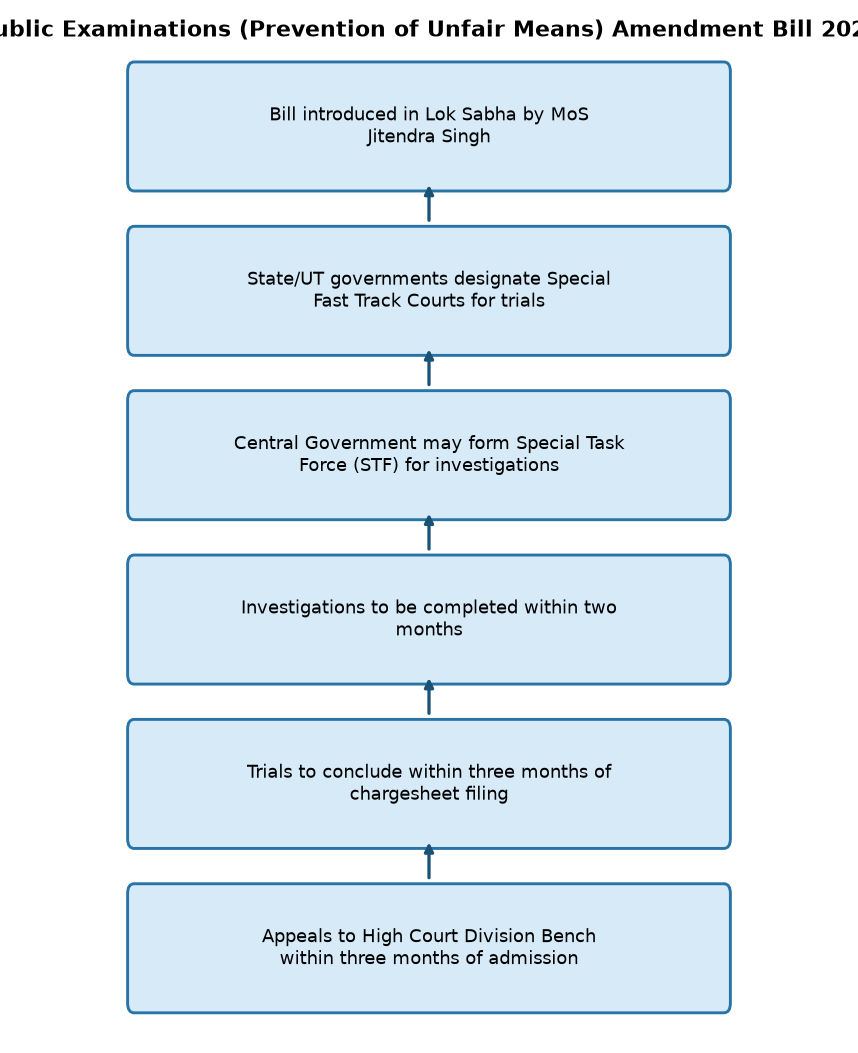
- Key provisions include the establishment of fast-track courts in every state to expedite trials of accused individuals involved in paper leaks or other unfair means, with trials to be completed within three months of chargesheet filing.
- The Bill empowers state governments and union territory administrations to designate any Court of Session as a Special Fast Track Court for trying offences under the Act, ensuring judicial efficiency and deterrence.
- A Special Task Force (STF) may be constituted by the Central Government to investigate offences under the Act, with investigations mandated to be completed within two months, reflecting a commitment to time-bound justice.
- The Bill enhances penalties for offences, including imprisonment terms and fines, to act as a stronger deterrent against examination malpractices and to restore public trust in examination systems.
- An appeal mechanism is proposed, wherein appeals against judgments or orders under the Act shall lie before a Division Bench of the High Court and are to be disposed of within three months of admission, ensuring swift judicial redressal.
- The Bill also empowers state governments and Union Territory Administrations to appoint Special Public Prosecutors for conducting cases under the Act, streamlining prosecution and ensuring specialised legal representation.
- The amendments reflect a legislative response to the crisis of institutional integrity, addressing concerns over examination irregularities and their broader implications for governance and social justice.
Key Features
| Feature | Significance |
|---|---|
| Fast-track courts in States/UTs | Ensures expeditious trials for paper leak offences, reducing pendency and enhancing deterrence through swift justice delivery. |
| Mandatory day-to-day hearings | Accelerates trial completion, minimising delays and ensuring timely resolution of cases to restore public trust in examinations. |
| Three-month trial completion mandate | Imposes strict timelines on courts, preventing prolonged legal battles and ensuring accountability in high-stakes cases. |
| Central Special Task Force (STF) | Enables coordinated, multi-agency investigations across States for complex paper leak cases, ensuring thorough and impartial probes. |
| Two-month investigation deadline | Reduces the window for evidence tampering or obfuscation, ensuring timely filing of chargesheets and preserving case integrity. |
| Enhanced penalties and fines | Strengthens deterrence by increasing the severity of punishments for offences under the Act, including imprisonment and monetary penalties. |
Why it Matters
Institutional Integrity and Public Trust
- The Bill addresses systemic vulnerabilities exposed by recurring examination irregularities, particularly in high-stakes tests like NEET-UG, which have eroded public confidence in India’s examination ecosystem.
- By institutionalising fast-track courts and strict timelines, the amendments aim to restore credibility in competitive examinations, which are critical for merit-based access to education and employment.
- The amendments reflect a shift from reactive measures to proactive governance, aligning with the constitutional mandate of ensuring fairness and equity in public examinations.
Governance and Administrative Efficiency
- The Bill empowers State Governments and Union Territories to designate special courts, decentralising judicial capacity and ensuring localised, efficient resolution of cases.
- The establishment of a Central Special Task Force (STF) enables cross-jurisdictional collaboration, addressing the transnational nature of some paper leak conspiracies.
- Strict timelines for investigations and trials reduce administrative bottlenecks, ensuring that legal processes do not become tools for delaying justice.
Deterrence and Preventive Framework
- Enhanced penalties and fines act as a strong deterrent, discouraging potential offenders from engaging in or facilitating paper leaks.
- The requirement for day-to-day hearings and three-month trial completion mandates sends a clear signal that paper leaks will not be tolerated, reinforcing the rule of law.
- The appeal mechanism, with a three-month disposal timeline, ensures that higher courts do not become bottlenecks, further expediting justice.
Social and Political Implications
- The Bill responds to widespread student protests and demands for accountability, demonstrating the government’s commitment to addressing public grievances through legislative action.
- By addressing systemic failures in examination conduct, the amendments aim to mitigate social unrest and restore confidence in India’s educational and employment frameworks.
- The focus on transparency and fairness in examinations aligns with broader societal expectations of equity and meritocracy in governance.
Challenges
1. Implementation and Judicial Capacity
- Fast-track courts require significant judicial infrastructure and trained personnel, which may be lacking in States with limited resources.
- Strict timelines for trials may pressure courts to compromise on procedural fairness if adequate staffing and logistical support are not ensured.
- The success of the STF depends on inter-agency coordination, which can be hindered by bureaucratic silos or political interference.
UPSC Link: Judicial Activism, Judicial Review
2. Balancing Speed and Fairness
- Mandating day-to-day hearings and three-month trials risks undermining the principles of natural justice if courts are unable to thoroughly examine evidence.
- The appeal mechanism’s efficiency may be compromised if High Courts are already overburdened with cases, leading to delays despite the mandate.
- Enhanced penalties could disproportionately affect minor offenders if not accompanied by clear guidelines on sentencing.
UPSC Link: Right to Fair Trial, Due Process
3. Political and Social Polarisation
- The Bill’s introduction amid protests risks being perceived as a political response rather than a genuine reform, potentially undermining its credibility.
- Opposition parties and student groups may continue to demand systemic overhauls, including changes to the examination system itself, rather than just punitive measures.
- Public perception of the Bill’s effectiveness may vary based on outcomes, with failures in implementation fueling further distrust.
UPSC Link: Parliamentary Accountability, Federalism
4. Technological and Operational Challenges
- Paper leaks often involve digital collusion, requiring advanced forensic capabilities to trace sources and prevent future incidents.
- The STF’s effectiveness depends on real-time data sharing and collaboration between agencies, which may be hindered by outdated technological infrastructure.
- Ensuring the security of examination papers in a digital age demands robust cybersecurity measures, which may not be uniformly implemented across States.
UPSC Link: Cybersecurity, Digital Governance
5. Federalism and State Autonomy
- The Bill empowers States to designate fast-track courts, but differences in judicial capacity and administrative efficiency may lead to uneven enforcement.
- State Governments may resist centralised oversight, particularly if they perceive the STF as an encroachment on their autonomy.
- Funding for fast-track courts and STF operations may become a point of contention between the Centre and States.
UPSC Link: Cooperative Federalism, State vs. Union Powers
Challenges — UPSC Perspective
| Issue | Concern |
|---|---|
| Judicial Infrastructure | Inadequate staffing and infrastructure in fast-track courts may compromise trial quality and fairness. |
| Procedural Fairness | Strict timelines could lead to rushed trials, risking miscarriages of justice if evidence is not thoroughly examined. |
| Inter-Agency Coordination | The STF’s success hinges on seamless collaboration between investigative agencies, which may face bureaucratic hurdles. |
| Political Interference | Perceptions of the Bill as a political tool may undermine public trust and its long-term effectiveness. |
| Technological Gaps | Lack of advanced forensic tools and cybersecurity measures may hinder the investigation of digital paper leaks. |
| State-Level Implementation | Variations in State capacities could lead to inconsistent enforcement and outcomes across jurisdictions. |
Way Forward
- Strengthen judicial infrastructure by allocating dedicated funds for fast-track courts and training judicial officers in handling examination-related offences.
- Establish a National Examination Security Board under the Union Public Service Commission (UPSC) to oversee cybersecurity and forensic standards across all examinations.
- Develop a centralised digital platform for real-time monitoring of examination processes, including secure paper printing, distribution, and storage.
- Conduct periodic audits of State-level fast-track courts to ensure adherence to timelines and procedural fairness, with penalties for non-compliance.
- Enhance public awareness campaigns to educate stakeholders—students, parents, and educators—about the legal consequences of paper leaks and examination malpractices.
- Foster inter-agency collaboration by signing Memorandums of Understanding (MoUs) between the STF, CBI, and State Police forces for seamless investigations.
- Introduce a whistle-blower protection mechanism to encourage insiders to report irregularities without fear of retaliation.
- Pilot a blockchain-based system for examination paper storage and distribution in select States to assess its feasibility for nationwide adoption.
UPSC Value Addition
Keywords for Mains Answer-Writing
Public Examinations (Prevention of Unfair Means) Act, 2024 · paper leaks in competitive examinations · fast-track courts for examination fraud · Special Task Force (STF) for investigation · examination reforms and institutional integrity · NEET-UG paper leak controversy · amendment to anti-paper leak law · judicial reforms in examination malpractice cases · examination malpractice penalties · Parliamentary legislation on examination reforms
Constitutional & Policy Linkages
- [‘Article 14: Equality before Law’, ‘Ensures fair trials and non-discriminatory enforcement of anti-paper leak measures.’]
- [‘Article 21: Right to Life and Personal Liberty’, ‘Protects the right to a speedy trial and fair examination processes.’]
- [‘Article 39A: Equal Justice and Free Legal Aid’, ‘Mandates that legal processes are accessible and do not disproportionately burden marginalised groups.’]
Concept Flow
Recurring paper leaks in high-stakes examinations (e.g., NEET-UG) → Erosion of public trust in examination systems and institutions → Widespread student protests and demands for accountability → Government introduces Public Examinations (Prevention of Unfair Means) Amendment Bill, 2026 → Establishment of fast-track courts and STF to expedite trials → Enhanced penalties and strict timelines to deter malpractices → Restoration of institutional credibility and public confidence.
Prelims Practice Questions
Q1. Which of the following is NOT a provision of the Public Examinations (Prevention of Unfair Means) Amendment Bill, 2026?
- Designation of Courts of Session as Special Fast Track Courts by State Governments
- Mandatory completion of trials within three months from the date of chargesheet filing
- Empowerment of the Central Government to constitute a Special Task Force for investigation
- Prohibition of the Union Government from intervening in State-level examination reforms
Answer: Prohibition of the Union Government from intervening in State-level examination reforms — The Bill empowers the Central Government to constitute a Special Task Force (STF) for investigation, and State Governments to designate fast-track courts. It does not restrict Union Government intervention in State-level reforms.
Q2. Under the proposed amendments to the Public Examinations (Prevention of Unfair Means) Act, 2024, what is the maximum timeframe stipulated for the completion of investigations in paper leak cases?
- One month
- Two months
- Three months
- Six months
Answer: Two months — The Bill mandates that investigations into paper leak cases must be completed within two months from the date of registration.
Q3. The Public Examinations (Prevention of Unfair Means) Amendment Bill, 2026, seeks to address which of the following issues?
- Delay in judicial proceedings for examination malpractice cases
- Lack of transparency in the appointment of examination authorities
- Inadequate infrastructure for conducting competitive examinations
- Absence of a national-level examination body
Answer: Delay in judicial proceedings for examination malpractice cases — The Bill primarily focuses on expediting trials and investigations for examination malpractice, including paper leaks, through fast-track courts and Special Task Forces.
Mains Practice Question
✍ Examine the significance of the Public Examinations (Prevention of Unfair Means) Amendment Bill, 2026, in addressing the challenges posed by paper leaks in competitive examinations. Discuss its provisions and their potential impact on institutional integrity and public trust in examination systems.
Approach: The answer should analyse the Bill’s key provisions—fast-track courts, Special Task Force, time-bound investigations and trials, and enhanced penalties—while linking them to the broader issue of institutional credibility. Highlight how these measures aim to restore public confidence and deter malpractice. Reference the NEET-UG controversy to contextualise the urgency of reforms.
Source: The Hindu
Generated by AanyaAi for educational purpose.

- दिल्ली में 99% पीजी में नहीं है फायर एनओसी, 30% को नहीं मिला लेआउट अप्रूवल: एमसीडी सर्वे - September 15, 2026
- महत्वपूर्ण: MSC एल्सा 3 जहाज के डूबने के दीर्घकालिक प्रभावों का आकलन करेगा केंद्र, जानिए पूरा मामला - September 15, 2026
- केरल की इकोसेंस छात्रवृत्तियां: 46,000 छात्रों को अपशिष्ट प्रबंधन में सशक्त बना रही हैं - September 14, 2026

No Comments