


27 Jul National Commission for Minorities Enhances Institutional Reach in 2026: Key Initiatives & Studies
Subject Relevance — Where This Topic Fits
- GS Paper II — Constitutional and Non-Constitutional Bodies (Statutory, Regulatory and various Quasi-Judicial Bodies) | GS Paper II — Welfare Schemes for Vulnerable Sections of the Population by the Centre and States and the Performance of these Schemes
- Prelims: National Commission for Minorities (NCM), statutory body under Ministry of Minority Affairs, constitutional provisions for minorities, state minority commissions, minority welfare schemes, inclusive development, social harmony, cultural preservation
- Essay: Minority rights and inclusive governance: Balancing diversity and national unity, The role of statutory bodies in fostering social cohesion and equitable development
Quick Revision: The National Commission for Minorities (NCM), established under the National Commission for Minorities Act, 1992, is a statutory body tasked with safeguarding minority rights, evaluating welfare schemes, and recommending measures for their socio-economic and educational upliftment.
Why is this in the news?
The National Commission for Minorities (NCM) has intensified its institutional outreach through a series of high-level seminars, conferences, and thematic studies in 2026, including a landmark study on the contributions of the Jain community to education. These initiatives underscore the Commission’s evolving role in documenting community contributions, facilitating policy coordination, and addressing systemic gaps in minority welfare delivery, particularly in the domains of education, cultural preservation, and socio-economic inclusion.
Background
- The National Commission for Minorities (NCM) was established under the National Commission for Minorities Act, 1992, as a statutory body to safeguard the rights and interests of minority communities in India.
- Minority communities in India, as notified by the Government of India, include Muslims, Christians, Sikhs, Buddhists, Zoroastrians (Parsis), and Jains.
- The NCM functions under the aegis of the Ministry of Minority Affairs, which implements various welfare schemes such as the Pre-Matric and Post-Matric Scholarships for Minority Students, Maulana Azad National Fellowship, and Naya Savera (Free Coaching and Allied Scheme).
- The Commission’s mandate includes evaluating the implementation of minority welfare schemes, investigating complaints of deprivation of minority rights, and recommending measures for their socio-economic and educational upliftment.
- The NCM’s outreach initiatives in 2026 reflect a strategic shift towards evidence-based policy advocacy, inter-state coordination, and community engagement to address emerging challenges in minority welfare.
- The Commission’s role is particularly significant in the context of India’s commitment to the UN Sustainable Development Goals (SDGs), particularly SDG 4 (Quality Education), SDG 10 (Reduced Inequalities), and SDG 16 (Peace, Justice, and Strong Institutions).
What is the National Commission for Minorities (NCM)?
- The NCM is a statutory body constituted under the National Commission for Minorities Act, 1992, to protect and promote the rights of minority communities in India.
- It consists of a Chairperson, a Vice-Chairperson, and five Members, all nominated by the Central Government for a term of three years.
- The Commission’s functions include: (a) evaluating the implementation of policies and schemes for minority welfare; (b) investigating complaints of deprivation of minority rights; (c) conducting studies on socio-economic and educational conditions of minorities; and (d) recommending measures for their upliftment.
- The NCM operates through regional offices and collaborates with State Minority Commissions to ensure grassroots-level implementation of welfare measures.
- The Commission plays a pivotal role in addressing issues of discrimination, access to education, economic empowerment, and cultural preservation among minority communities.
- The NCM’s recommendations are advisory in nature but carry significant weight in policy formulation and legislative amendments.
- The Commission also serves as a bridge between minority communities and the government, facilitating dialogue and grievance redressal.
- In 2026, the NCM has expanded its institutional outreach through thematic seminars, state-level conferences, and collaborative studies to enhance policy coherence and community participation.
Key Features
| Feature | Significance |
|---|---|
| Institutional outreach expansion of the National Commission for Minorities (NCM) | Enhances the Commission’s advisory and facilitative role in safeguarding minority rights and ensuring welfare scheme implementation. |
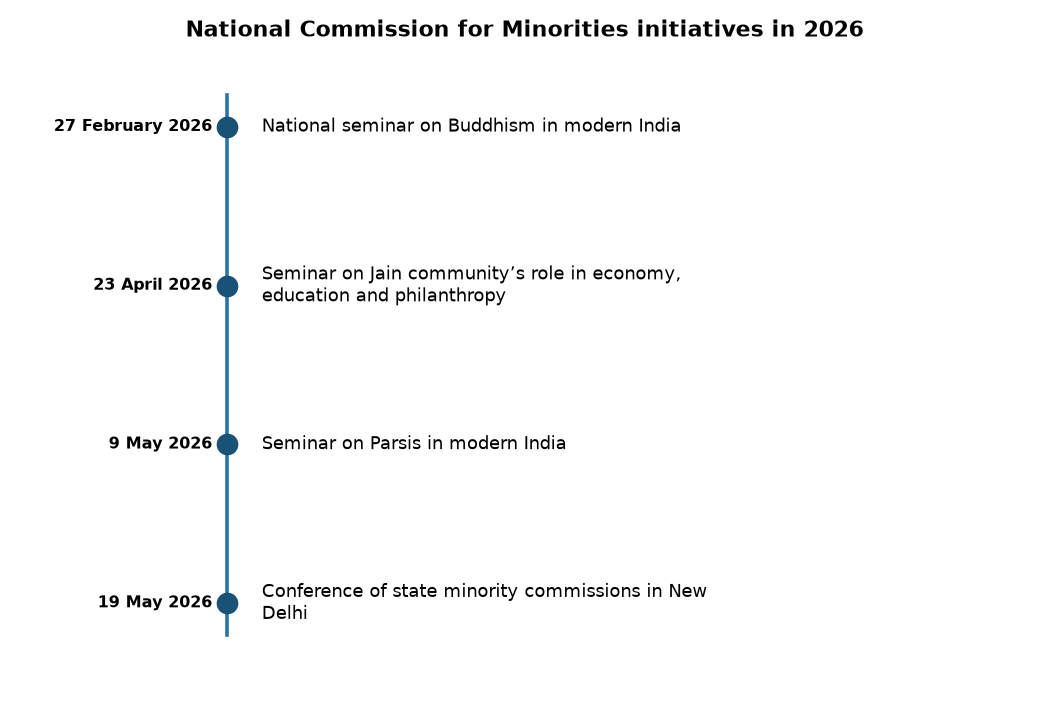
| State Minority Commissions’ Conference (19 May 2026) | Facilitates inter-state best practices in administrative coordination, grievance redressal, and welfare scheme delivery for minority communities. |
| Study on Jain community’s contribution to education (2026) | Documents historical, institutional, and philosophical contributions of the Jain community to India’s educational landscape, promoting inclusive access. |
| National Seminar on Buddhism’s role in modern India (27 Feb 2026) | Focuses on heritage conservation, education, youth engagement, and social harmony through Buddhist philosophy. |
| National Seminar on Parsis’ socio-economic role (09 May 2026) | Highlights cultural preservation, socio-economic challenges, and the community’s contributions to nation-building. |
Why it Matters
Constitutional and Legal
- Strengthens the constitutional mandate of the NCM under Article 30(1) to promote educational and cultural rights of minorities.
- Enhances the implementation of the National Commission for Minorities Act, 1992, by improving institutional coordination.
Social and Cultural
- Promotes inter-community dialogue and social harmony by documenting and celebrating contributions of minority communities (Jain, Buddhist, Parsi).
- Encourages preservation of cultural heritage and traditional knowledge systems of minority groups.
Administrative and Governance
- Improves administrative efficiency in minority welfare delivery through state-level coordination and grievance redressal mechanisms.
- Fosters data-driven policy formulation by commissioning studies on minority communities’ socio-economic and educational contributions.
Educational
- Highlights the role of minority communities in promoting value-based education and inclusive learning environments.
- Encourages scholarship and research on minority contributions to India’s educational and economic development.
Challenges
1. Institutional Fragmentation in Minority Welfare Delivery
- Lack of uniform implementation of welfare schemes across states due to varying administrative capacities.
- Inadequate coordination between central and state minority commissions leading to policy gaps.
UPSC Link: GS-II: Centre-State Relations
2. Grievance Redressal Inefficiencies
- Delayed or inadequate resolution of minority grievances due to bureaucratic bottlenecks.
- Limited awareness among minority communities about grievance redressal mechanisms.
UPSC Link: GS-II: Constitutional and Statutory Bodies
3. Cultural Heritage Erosion in Minority Communities
- Loss of traditional knowledge systems and cultural practices due to urbanisation and globalisation.
- Insufficient funding and policy support for heritage conservation initiatives.
UPSC Link: GS-I: Indian Culture
4. Socio-Economic Disparities Among Minorities
- Persistent economic inequalities and underrepresentation in formal employment sectors.
- Limited access to quality education and healthcare among marginalised minority groups.
UPSC Link: GS-II: Social Justice
5. Data Gaps in Minority Welfare
- Incomplete or outdated demographic data on minority communities hinders targeted policy interventions.
- Lack of disaggregated data on minority communities’ socio-economic indicators.
UPSC Link: GS-II: Government Policies
Challenges — UPSC Perspective
| Issue | Concern |
|---|---|
| Administrative Coordination | Variability in state-level implementation of minority welfare schemes. |
| Grievance Redressal | Slow or ineffective resolution of minority grievances due to systemic inefficiencies. |
| Cultural Preservation | Erosion of traditional knowledge systems and cultural practices among minority groups. |
| Socio-Economic Inclusion | Economic disparities and underrepresentation in key sectors. |
| Policy Data Deficits | Inadequate or outdated data on minority communities for evidence-based policymaking. |
Way Forward
- Establish a unified digital grievance redressal portal for minority communities to ensure timely and transparent resolution.
- Conduct annual inter-state conclaves to share best practices in minority welfare delivery and policy implementation.
- Expand funding for cultural heritage conservation projects under the National Mission for Manuscripts and other schemes.
- Mandate disaggregated data collection on minority communities in all socio-economic surveys and censuses.
- Strengthen the role of State Minority Commissions by providing them with dedicated administrative and financial resources.
- Promote research fellowships and scholarships to document minority communities’ contributions to India’s development.
- Enhance awareness campaigns to educate minority communities about their rights and available welfare schemes.
UPSC Value Addition
Keywords for Mains Answer-Writing
National Commission for Minorities · Institutional outreach · Minority rights protection · State Minority Commissions · Welfare schemes for minorities · Jain community contributions · Buddhist heritage preservation · Parsi socio-economic contributions · Minority education empowerment · Social harmony and peace · Community-based governance · Altruism and philanthropy in India · Cultural preservation of minority faiths · Inclusive development · Administrative coordination for minorities
Constitutional & Policy Linkages
- {‘Article 29(1): Protection of interests of minorities in matters of education and culture.’: ‘Ensures minority communities’ right to conserve their distinct language, script, and culture.’}
- {‘Article 30(1): Right of minorities to establish and administer educational institutions.’: ‘Empowers minority communities to promote educational institutions of their choice.’}
- {‘Article 350A: Facilities for instruction in mother-tongue at primary stage.’: ‘Supports minority language preservation in educational settings.’}
Concept Flow
Initiation of NCM’s outreach initiatives → Documentation of minority contributions (e.g., Jain/Buddhist/Parsi studies) → Identification of systemic gaps in welfare delivery → Conferences for inter-state coordination → Formulation of actionable recommendations → Implementation of schemes and policies → Monitoring and evaluation of outcomes → Feedback loop for continuous improvement.
Prelims Practice Questions
Q1. Consider the following statements regarding the National Commission for Minorities (NCM) in India: 1. The NCM is a statutory body constituted under the National Commission for Minorities Act, 1992. 2. The NCM has the power to investigate and review the implementation of constitutional safeguards for minorities. 3. The NCM can only function as an advisory body and has no executive or judicial powers. 4. The NCM’s jurisdiction extends to all religious and linguistic minorities notified by the Government of India. Which of the statements given above are correct?
- 1, 2 and 3 only
- 1, 2 and 4 only
- 2, 3 and 4 only
- 1, 2, 3 and 4
Answer: 1, 2 and 4 only — Statements 1, 2, and 4 are correct. The NCM is a statutory body under the 1992 Act, possesses advisory powers to review constitutional safeguards, and its jurisdiction covers notified religious and linguistic minorities. Statement 3 is incorrect as the NCM can recommend actions to the government, though it lacks executive or judicial powers.
Q2. Which of the following minority communities in India has historically contributed significantly to the field of education through the establishment of trusts, scholarships, and institutions?
- Sikh community
- Jain community
- Muslim community
- Christian community
Answer: Jain community — The Jain community has a well-documented history of establishing educational institutions, trusts, and scholarships, as highlighted in the NCM’s 2026 study on their contributions to education and philanthropy.
Q3. The National Commission for Minorities (NCM) organized a national seminar titled ‘Modern India and Buddhism: Cultural and Social Pathways’ in February 2026. What was the primary focus of this seminar?
- Economic reforms and Buddhist economic models
- Heritage preservation, education, and social harmony
- Political representation of Buddhists in Parliament
- Buddhist contributions to India’s space programme
Answer: Heritage preservation, education, and social harmony — The seminar focused on heritage preservation, education, youth participation, and promoting peace and social harmony through Buddhist philosophy, as outlined in the NCM’s press release.
Mains Practice Question
✍ Examine the role of the National Commission for Minorities (NCM) in enhancing institutional outreach and safeguarding minority rights in India. How does the NCM’s recent initiatives, including seminars on religious minorities, contribute to inclusive development and social cohesion? Support your answer with relevant constitutional provisions and case examples.
Approach: Begin by outlining the constitutional and statutory framework governing the NCM, including its composition, powers, and functions under the National Commission for Minorities Act, 1992. Discuss the NCM’s role in investigating violations of minority rights, reviewing the implementation of constitutional safeguards (Articles 29 and 30), and advising the government on policy matters. Analyze the NCM’s recent initiatives, such as the 2026 seminars on the Jain, Buddhist, and Parsi communities, to highlight how these efforts promote cultural preservation, education, and social harmony. Conclude by evaluating the effectiveness of the NCM’s institutional outreach in fostering inclusive development and addressing challenges faced by minority communities.
Source: PIB (Press Information Bureau)
Generated by AanyaAi for educational purpose.

- हिमाचल में डिजिटल भुगतान क्रांति: बिलासपुर अव्वल, महिलाओं की भागीदारी 93% तक पहुंची - September 23, 2026
- Himachal Pradesh Leads in Digital Payments: Bilaspur Tops, Women’s Role Rises - September 23, 2026
- केरल लोक सेवा आयोग ने उच्च न्यायालय में दायर किया मामला, सदस्यों के खिलाफ मामला रद्द करने की मांग - September 23, 2026

No Comments