


27 Jul ABVKY Scheme Extended: Key Eligibility & Benefits for UPSC Aspirants
Subject Relevance — Where This Topic Fits
- GS Paper II — Governance, Administration and Policies for Development | GS Paper III — Employment, Labour Reforms and Social Security
- Prelims: Atal Bimit Vyakti Kalyan Yojana (ABVKY), Employees’ State Insurance Corporation (ESIC), Direct Benefit Transfer (DBT), Unemployment Insurance, Contribution Period, Misconduct Exclusions, Pandemic-induced unemployment, Social Security Code 2020
- Essay: Universal Social Security: A Pillar for Inclusive Growth in India, Balancing Economic Efficiency and Social Protection: Lessons from India’s Unemployment Insurance Schemes
Quick Revision: ABVKY provides unemployment relief to ESIS-covered workers who have contributed for 78+ days in the last 12 months, excluding misconduct or voluntary exits, with benefits disbursed via DBT.
Why is this in the news?
The Employees’ State Insurance Corporation (ESIC) has extended the operational duration of the Atal Bimit Vyakti Kalyan Yojana (ABVKY) from 01 July 2026 to 30 June 2027. This extension, announced through a Press Information Bureau (PIB) release, underscores the scheme’s role in providing financial relief to insured persons facing involuntary unemployment. The development is significant as it reflects the government’s commitment to strengthening social security nets amid evolving labour market dynamics and economic uncertainties.
Background
- The ABVKY was launched under the Employees’ State Insurance Act, 1948, to provide unemployment relief to insured persons who have contributed to the Employees’ State Insurance Scheme (ESIS) for a minimum period.
- The scheme is administered by the Employees’ State Insurance Corporation (ESIC), a statutory body under the Ministry of Labour and Employment, Government of India.
- ABVKY was introduced to mitigate the financial distress of workers during periods of involuntary unemployment, particularly in sectors prone to economic volatility.
- The scheme operates as a non-contributory insurance mechanism, where benefits are disbursed from the ESIC’s fund, which is financed through contributions from employers and employees.
- The COVID-19 pandemic highlighted the vulnerabilities in India’s labour market, accelerating the need for robust unemployment insurance frameworks like ABVKY.
- The scheme aligns with the broader objectives of the Social Security Code, 2020, which aims to universalise social security coverage in India.
What is the Atal Bimit Vyakti Kalyan Yojana (ABVKY)?
- ABVKY is a welfare scheme implemented by the ESIC to provide financial relief to insured persons who become involuntarily unemployed.
- The scheme is applicable to employees covered under the Employees’ State Insurance Scheme (ESIS), which includes workers in factories, establishments, and other notified sectors.
- Eligibility for ABVKY requires the insured person to have been in continuous insurable employment for at least 12 months prior to unemployment and to have contributed for a minimum of 78 days in any one of the preceding 12 months.
- The scheme excludes unemployment arising from misconduct, voluntary retirement, lock-outs, or any fraudulent activity under the ESI Act, 1948.
- The scheme incorporates Direct Benefit Transfer (DBT) to ensure timely and transparent disbursement of benefits to the beneficiaries’ bank accounts.
- Digitalisation of claim submission and processing has been introduced to expedite benefit disbursement and reduce administrative delays.
Key Features
| Feature | Significance |
|---|---|
| Duration Extension (01.07.2026–30.06.2027) | Ensures continuity of unemployment insurance coverage for insured workers during the specified period. |
| Eligibility: 12-month continuous insurable employment | Establishes a minimum contribution period to qualify for unemployment benefits under ABVKY. |
| Contribution Requirement: 78 days in 12 months | Ensures active participation in the ESI scheme before claiming unemployment benefits. |
| Exclusion Criteria (Misconduct, Lockout, Retirement, False Statements) | Prevents misuse of the scheme by disqualifying beneficiaries under specified conditions. |
| Digital Claim Processing & DBT | Enhances transparency, reduces delays, and ensures direct benefit transfer to beneficiaries’ bank accounts. |
Why it Matters
Social Security Architecture
- ABVKY is a component of India’s formal social security framework under the Employees’ State Insurance Corporation (ESIC), providing unemployment insurance to insured workers.
- Aligns with Directive Principles of State Policy (Article 41) to secure the right to work and public assistance in case of unemployment.
- Complements other ESIC benefits such as sickness, maternity, and disablement benefits, reinforcing a layered social security system.
Economic Resilience
- Provides financial cushioning to unemployed workers, reducing distress and supporting consumption during joblessness.
- Mitigates adverse economic shocks by preventing a sharp decline in household incomes in the formal sector.
- Encourages formal employment by offering a safety net, thereby supporting the growth of the formal economy.
Administrative Efficiency
- Digitalisation of claim processing and DBT reduces leakages and administrative costs while improving beneficiary experience.
- Real-time monitoring of claim settlements ensures timely disbursement of benefits, enhancing trust in the system.
- Data-driven evaluation of scheme performance enables evidence-based policy adjustments.
Data Trends (2023-26)
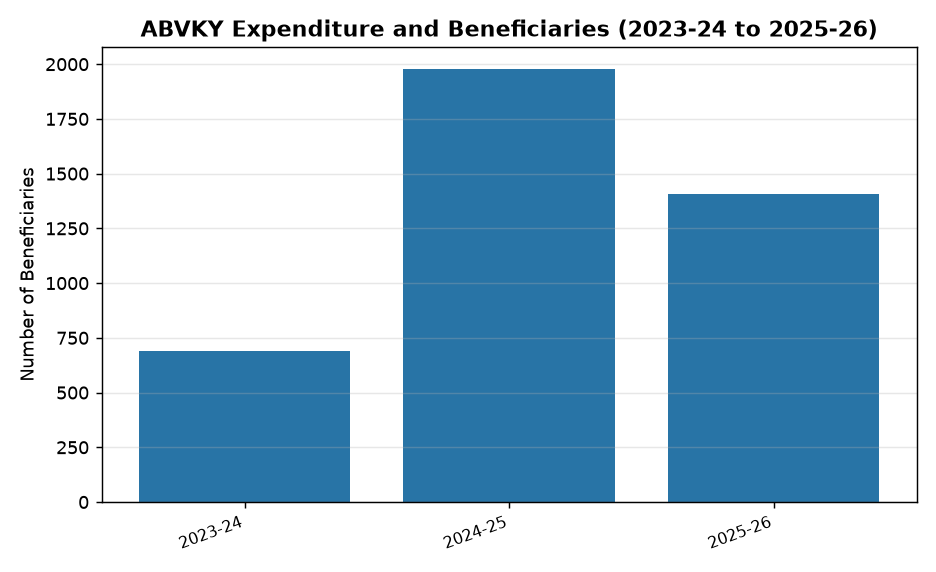
- Beneficiary count peaked in 2024-25 (1,978), indicating higher unemployment or increased awareness of the scheme.
- Total expenditure rose from ₹1.02 crore in 2023-24 to ₹2.72 crore in 2024-25, reflecting higher claim volumes.
- The decline in 2025-26 (₹1.52 crore) may correlate with economic recovery or stricter eligibility enforcement.
Challenges
1. Limited Coverage
- ABVKY covers only insured workers under the ESI scheme, excluding the vast unorganised sector where unemployment risks are higher.
- Gig workers, self-employed individuals, and those in informal employment remain outside the ambit of this scheme.
UPSC Link: GS2: Social Sector/Schemes
2. Eligibility Enforcement
- Strict 12-month continuous employment and 78-day contribution requirement may exclude workers with fragmented or short-term formal employment histories.
- Verification challenges in establishing continuous employment and contribution records could lead to delays or disputes in claims.
UPSC Link: GS2: Governance/Issues
3. Digital Divide and Exclusion
- Beneficiaries in remote or economically disadvantaged areas may face difficulties in accessing digital platforms for claim submission.
- Low digital literacy could hinder the effective utilisation of online services, exacerbating exclusion.
UPSC Link: GS2: E-Governance
4. Sustainability Concerns
- Rising claim volumes and expenditure (e.g., 2024-25 peak) may strain the ESIC’s financial sustainability without corresponding increases in contributions.
- Dependence on formal sector contributions limits scalability to address broader unemployment challenges.
UPSC Link: GS3: Economic Development
5. Awareness and Outreach
- Low awareness among eligible workers about ABVKY’s benefits and eligibility criteria may result in underutilisation of the scheme.
- Language barriers and limited outreach in regional languages could further restrict access for marginalised groups.
UPSC Link: GS2: Social Sector/Schemes
Challenges — UPSC Perspective
| Issue | Concern |
|---|---|
| Coverage Gap | Exclusion of unorganised and informal sector workers from unemployment benefits. |
| Strict Eligibility | High contribution thresholds may exclude workers with intermittent formal employment. |
| Digital Barriers | Limited access to digital platforms in rural/remote areas hinders claim processing. |
| Financial Sustainability | Rising claims may strain ESIC’s financial resources without proportional contribution increases. |
| Awareness Deficit | Low outreach and language barriers reduce scheme utilisation among eligible beneficiaries. |
Way Forward
- Expand coverage of ABVKY to include gig workers, self-employed individuals, and other informal sector workers through policy reforms.
- Simplify eligibility criteria by reducing the continuous employment period or contribution threshold for vulnerable groups.
- Enhance digital infrastructure and literacy programmes in rural and remote areas to ensure equitable access to online services.
- Strengthen grievance redressal mechanisms to address delays or disputes in claim settlements promptly.
- Conduct periodic reviews of contribution rates and benefit structures to ensure financial sustainability of the scheme.
- Launch targeted awareness campaigns in regional languages to improve outreach and utilisation among eligible workers.
- Integrate ABVKY with other social security schemes (e.g., PM-SYM, AABY) to create a seamless safety net for workers.
- Explore public-private partnerships to leverage technology for efficient claim processing and fraud detection.
UPSC Value Addition
Keywords for Mains Answer-Writing
Atal Beemit Vyakti Kalyan Yojana (ABVKY) · Employees’ State Insurance Corporation (ESIC) · Unemployment Insurance Scheme · Direct Benefit Transfer (DBT) · Social Security Measures · Labour Welfare Schemes · Contributory Employment · ESIC Act, 1948 · Skill Development and Employment · Welfare of Insured Persons · Labour Reforms · Formal Sector Employment
Constitutional & Policy Linkages
- Article 41: Right to Public Assistance in Unemployment
Concept Flow
Formal employment in ESI-covered establishments → Contribution to ESIC fund → Job loss due to economic/industry factors → Eligibility check under ABVKY → Digital claim submission → Verification and approval → Direct Benefit Transfer to bank account → Financial support during unemployment → Economic resilience and consumption stability.
Prelims Practice Questions
Q1. Consider the following statements regarding the Atal Beemit Vyakti Kalyan Yojana (ABVKY):
1. It provides unemployment relief to insured persons under the ESIC Act, 1948.
2. The beneficiary must have contributed for at least 78 days in any one of the 12 months preceding unemployment.
3. The scheme covers unemployment due to misconduct or retirement.
4. Claims under ABVKY are processed through offline submission and manual verification.
Which of the statements given above are correct?
- 1 and 2 only
- 1, 2 and 4 only
- 1 and 3 only
- 2, 3 and 4 only
Answer: 1 and 2 only — Statement 1 is correct as ABVKY is an unemployment relief scheme under the ESIC framework. Statement 2 is correct as the eligibility requires at least 78 days of contribution in any one of the preceding 12 months. Statement 3 is incorrect as misconduct, retirement, or lockout are explicitly excluded. Statement 4 is incorrect as claims are processed online with DBT for timely disbursement.
Q2. Which of the following is NOT a feature of the Atal Beemit Vyakti Kalyan Yojana (ABVKY)?
- Direct Benefit Transfer to beneficiaries’ bank accounts
- Online submission and processing of claims
- Coverage of unemployment due to misconduct
- Requirement of continuous insurable employment for 12 months prior to unemployment
Answer: Coverage of unemployment due to misconduct — The ABVKY explicitly excludes unemployment due to misconduct, lockout, or retirement as per the eligibility criteria. The other options are features of the scheme as highlighted in the PIB release.
Q3. The Atal Beemit Vyakti Kalyan Yojana (ABVKY) is administered by which of the following institutions?
- Ministry of Labour and Employment
- Employees’ Provident Fund Organisation (EPFO)
- Employees’ State Insurance Corporation (ESIC)
- National Skill Development Corporation (NSDC)
Answer: Employees’ State Insurance Corporation (ESIC) — The ABVKY is administered by the Employees’ State Insurance Corporation (ESIC), as stated in the PIB release. The Ministry of Labour and Employment oversees the scheme but does not administer it directly.
Mains Practice Question
✍ Critically examine the significance of the Atal Beemit Vyakti Kalyan Yojana (ABVKY) in the context of India’s labour market reforms. How does the scheme address the vulnerabilities of formal sector workers in the event of unemployment? Substantiate your answer with reference to the scheme’s eligibility criteria, administrative mechanisms, and recent data on its performance.
Approach: Begin by contextualising the ABVKY within India’s broader social security architecture, particularly the ESIC framework. Analyse its eligibility criteria to highlight how it targets insured workers in the formal sector while excluding certain categories of unemployment. Discuss the administrative reforms such as online claim processing and DBT, which enhance efficiency and transparency. Use the provided expenditure and beneficiary data (2023-24 to 2025-26) to illustrate the scheme’s reach and impact. Conclude by evaluating the scheme’s limitations, such as exclusion of informal workers and the need for broader coverage, while suggesting measures to strengthen its effectiveness in mitigating unemployment risks.
Source: PIB (Press Information Bureau)
Generated by AanyaAi for educational purpose.

- PM Vishwakarma Yojana Completes 3 Years: 30 Lakh Artisans Registered - September 16, 2026
- डीएफपीडी विशेष अभियान 6: 2 से 31 अक्टूबर 2026 तक स्वच्छता एवं दक्षता अभियान - September 16, 2026
- DFPD’s Special Campaign 6: Key Focus Areas for UPSC & State PCS - September 16, 2026

No Comments