


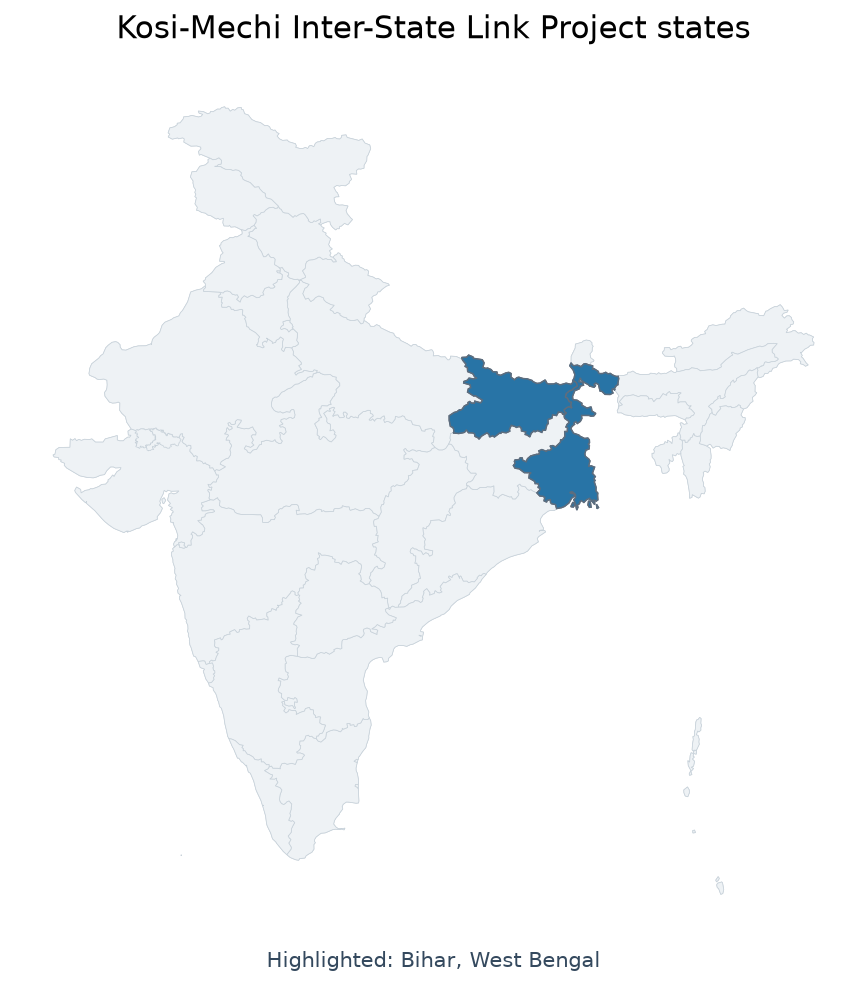
27 Jul कोसी-मेची अंतर-राज्यीय लिंक परियोजना: UPSC के लिए महत्वपूर्ण तथ्य
Subject Relevance — Where This Topic Fits
- GS Paper II — India and its Neighbourhood Relations (Indo-Nepal Cooperation) | GS Paper III — Water Resources and Irrigation Management (Interlinking of Rivers, PMKSY-AIBP)
- Prelims: Kosi-Mechai Link Project, PMKSY-AIBP, Interlinking of Rivers, Indo-Nepal Joint Projects, Flood Management in Bihar, Kosi-Gandak Basin, GLOF Studies
- Essay: Water Security and Regional Cooperation: The Case of Kosi-Mechai Link Project, Sustainable Development Goals and Transboundary Water Governance
Quick Revision: The Kosi-Mechai Inter-State Link Project, funded under PMKSY-AIBP, aims to transfer surplus waters from the Kosi to the Mechi basin, with a completion target of March 2029.
Why is this in the news?
The Kosi-Mechai Inter-State Link Project has been included under the Pradhan Mantri Krishi Sinchayee Yojana-Accelerated Irrigation Benefits Programme (PMKSY-AIBP) with a central assistance of ₹3,652.56 crore for a total estimated cost of ₹6,143.22 crore. Scheduled for completion by March 2029, this project assumes significance in the context of India’s river interlinking initiatives, Indo-Nepal water diplomacy, and flood mitigation in eastern India, particularly Bihar. The project’s progress, including the reconstruction of the Eastern Kosi Main Canal, and its linkage with broader transboundary water management efforts, has been highlighted in a recent PIB release, underscoring its strategic and developmental relevance.
Background
- The Kosi River, originating in Nepal and flowing through Bihar, is known for its erratic flow and recurrent floods, causing significant damage to agriculture and infrastructure in the region.
- India and Nepal have a long-standing history of cooperation on transboundary water resources, formalised through agreements such as the 1954 Kosi Agreement and the 1996 Mahakali Treaty.
- The Kosi-Mechai Link Project is part of India’s broader Interlinking of Rivers (ILR) programme, aimed at enhancing water security, irrigation coverage, and flood control through the transfer of surplus waters from one basin to another.
- The Pradhan Mantri Krishi Sinchayee Yojana (PMKSY), launched in 2015, includes the Accelerated Irrigation Benefits Programme (AIBP) to fast-track the completion of irrigation projects, with a focus on water-scarce and flood-prone regions.
- The project is located in the Kosi-Gandak basin, a critical flood-prone area in Bihar, where recurring floods have historically impacted livelihoods and economic stability.
- The Eastern Kosi Main Canal, a key component of the project, is being reconstructed under a ₹2,639.80 crore contract, with 8.5% physical progress reported as of July 2026.
What is the Kosi-Mechai Inter-State Link Project?
- The Kosi-Mechai Inter-State Link Project is an infrastructure initiative designed to transfer surplus waters from the Kosi River basin to the Mechi River basin, thereby enhancing irrigation potential in drought-prone areas of eastern India.
- The project includes the reconstruction of the Eastern Kosi Main Canal, spanning 41.30 km, to improve water conveyance efficiency and reduce transmission losses.
- The project incorporates modern engineering and environmental safeguards, including Glacial Lake Outburst Flood (GLOF) studies and seismic assessments, to mitigate risks associated with Himalayan river systems.
- The project is expected to contribute to flood mitigation in Bihar by regulating the flow of the Kosi River, thereby reducing the frequency and intensity of floods in downstream areas.
- The project’s implementation is being overseen by the Ministry of Jal Shakti, with coordination between central and state agencies, including the Bihar State Water Resources Department.
Key Features
| Feature | Significance |
|---|---|
| Financial Outlay and Funding | Central assistance of ₹3,652.56 crore under PMKSY-AIBP for a ₹6,143.22 crore project, ensuring fiscal viability and resource allocation for inter-state water transfer. |
| Timeline and Progress | Project completion targeted by March 2029; 8.5% physical progress achieved in the Eastern Kosi Main Canal reconstruction segment (0.00–41.30 km) under a ₹2,639.80 crore contract. |
| Technical Scope | Includes reconstruction of the Eastern Kosi Main Canal and inter-state water linkage between Kosi and Mechi rivers to enhance irrigation and flood mitigation. |
| Bilateral Cooperation | Ongoing negotiations with Nepal for Kosi river dam construction to address flood control and mutual benefits, reflecting India-Nepal hydrological diplomacy. |
| Institutional Framework | Joint Project Office (JPO-SKSKI) established in 2003 to prepare Detailed Project Reports (DPRs) for multi-purpose projects like Sapta-Kosi and Sun-Kosi-Kamala Diversion. |
Why it Matters
Economic
- Augments agricultural productivity in Bihar and adjoining regions through reliable irrigation, reducing dependency on monsoon variability.
- Enhances flood mitigation capabilities in the Kosi-Gandak basin, minimizing economic losses from recurrent floods.
- Generates employment and infrastructure development in rural areas during construction and post-completion phases.
Strategic
- Strengthens India-Nepal hydrological cooperation, fostering regional stability and trust in transboundary water resource management.
- Supports India’s Act East Policy by improving connectivity and water security in the eastern Himalayan region.
- Demonstrates India’s commitment to sustainable water resource development, aligning with SDG 6 (Clean Water and Sanitation).
Environmental
- Integrates flood control measures to mitigate GLOF (Glacial Lake Outburst Flood) risks in the Himalayan catchments.
- Promotes efficient water use through canal systems, reducing groundwater exploitation in the command areas.
Administrative
- Leverages PMKSY-AIBP framework to fast-track irrigation projects, ensuring timely completion and resource optimization.
- Facilitates coordinated implementation through JPO-SKSKI, streamlining bilateral project execution.
Challenges
1. Bilateral Water Diplomacy
- Negotiations with Nepal on Kosi dam construction face delays due to differing priorities on flood control, hydropower, and environmental safeguards.
- Absence of India-Nepal Joint Committee meetings in 2025-26 indicates stagnation in bilateral dialogue, hindering project momentum.
UPSC Link: GS-II: India-Nepal relations
2. Technical and Geological Risks
- Complex topography of the Himalayas poses challenges in canal alignment, tunneling, and structural stability.
- Seismic vulnerability in the region necessitates rigorous earthquake-resistant design and monitoring.
UPSC Link: GS-I: Geographical features
3. Financial and Resource Constraints
- High project cost (₹6,143.22 crore) demands sustained funding and efficient expenditure tracking to avoid cost overruns.
- Dependence on central assistance under PMKSY-AIBP requires robust monitoring to ensure timely disbursement.
UPSC Link: GS-III: Resource mobilization
4. Environmental and Social Concerns
- Potential displacement of communities and ecological disruption due to canal construction and reservoir formation.
- Need for comprehensive Environmental Impact Assessments (EIAs) and mitigation measures to address local resistance.
UPSC Link: GS-III: Environmental governance
5. Institutional and Governance Gaps
- Lack of a permanent basin authority (e.g., Kosi-Gandak Basin Authority) delays integrated water resource management.
- Coordination between central and state agencies (e.g., Bihar) must be strengthened to avoid implementation bottlenecks.
UPSC Link: GS-II: Centre-State relations
Challenges — UPSC Perspective
| Issue | Concern |
|---|---|
| Bilateral Negotiations | Delays in India-Nepal talks on Kosi dam construction due to divergent priorities. |
| Topography and Seismicity | Himalayan terrain and seismic risks complicate canal alignment and structural design. |
| Funding and Cost Overruns | High project cost and reliance on central funds pose fiscal sustainability challenges. |
| Environmental Impact | Risk of ecological disruption and community displacement necessitates robust EIAs. |
| Institutional Coordination | Absence of a permanent basin authority hinders integrated water resource management. |
Way Forward
- Accelerate India-Nepal bilateral negotiations on Kosi dam construction to finalize DPRs and MOUs, ensuring mutual benefits in flood control and hydropower.
- Conduct detailed geological and seismic studies to optimize canal alignment and structural design, mitigating construction risks.
- Strengthen institutional coordination between central and state agencies (e.g., Bihar) to streamline project implementation and monitoring.
- Undertake comprehensive Environmental and Social Impact Assessments (ESIA) to address local concerns and ensure sustainable project execution.
- Leverage PMKSY-AIBP funding efficiently by establishing a robust financial tracking mechanism to prevent cost overruns.
- Develop a permanent basin authority (e.g., Kosi-Gandak Basin Authority) to integrate water resource management and flood mitigation efforts.
- Enhance public awareness and stakeholder engagement to build local support and minimize resistance to the project.
UPSC Value Addition
Keywords for Mains Answer-Writing
Inter-State River Linking Project · Kosi-Mechi Link Project · Pradhan Mantri Krishi Sinchayee Yojana-Accelerated Irrigation Benefit Programme (PMKSY-AIBP) · Flood control mechanisms · India-Nepal water diplomacy · Kosi-Gandak Basin Authority · GLOF studies in Himalayan rivers · Multi-purpose river projects · Irrigation infrastructure in Bihar · Himalayan seismic vulnerability · Trans-boundary water governance · Hydrological surveys for river linking
Constitutional & Policy Linkages
- [‘Article 262 – Inter-State Water Disputes’, ‘Provides legal framework for resolving disputes over inter-state river projects.’]
- [‘Article 253 – International Agreements’, ‘Empowers Parliament to legislate for implementing international water treaties (e.g., with Nepal).’]
Concept Flow
Kosi-Mech link project conceived → PMKSY-AIBP funding approved → DPRs prepared under JPO-SKSKI → Bilateral negotiations with Nepal initiated → Canal reconstruction and inter-state linkage constructed → Irrigation and flood mitigation benefits realized → Agricultural productivity and regional stability enhanced.
Prelims Practice Questions
Q1. Which of the following statements about the Kosi-Mechi Link Project is/are correct? 1) It is a component of the PMKSY-AIBP. 2) The project is being implemented under the aegis of the Kosi-Gandak Basin Authority. 3) The project aims to mitigate floods in Bihar and Nepal. 4) The project is scheduled for completion by March 2029.
- 1, 2 and 3 only
- 1 and 4 only
- 2 and 4 only
- 1, 3 and 4 only
Answer: 1 and 4 only — Statement 1 is correct as the project is funded under PMKSY-AIBP. Statement 2 is incorrect because no such authority has been proposed for this project. Statement 3 is incorrect as the project’s primary objective is irrigation, not flood mitigation. Statement 4 is correct as the project is scheduled for completion by March 2029.
Q2. Consider the following statements regarding the India-Nepal Joint Project Office (JPO-SKS&KI): 1) It was established in 2003. 2) Its mandate includes preparing Detailed Project Reports (DPRs) for the Sapta-Kosi Multi-Purpose Project and Sun-Kosi-Kamala Diversion Multipurpose Project. 3) It has successfully completed all geological drilling for the Sapta-Kosi project. Which of the above statements is/are correct?
- 1 only
- 1 and 2 only
- 2 and 3 only
- 1, 2 and 3
Answer: 2 and 3 only — Statement 1 is correct as the JPO was established in 2003. Statement 2 is correct as its mandate includes preparing DPRs for the two projects. Statement 3 is incorrect because while drilling has been completed for the Sapta-Kosi project, the statement implies all geological work, which is not accurate.
Q3. The Kosi-Mechi Link Project is primarily aimed at:
- Generating hydroelectric power in Bihar
- Providing irrigation to drought-prone areas in Bihar
- Diverting water from the Kosi River to the Mechi River for flood control
- Establishing a permanent Kosi-Gandak Basin Authority
- Integrating the Kosi and Gandak river systems for navigation
Answer: Diverting water from the Kosi River to the Mechi River for flood control — The primary objective of the Kosi-Mechi Link Project is to provide irrigation to drought-prone areas in Bihar by diverting water from the Kosi River to the Mechi River.
Mains Practice Question
✍ Evaluate the significance of the Kosi-Mechi Link Project in the context of India’s inter-state and international river water governance. How does this project align with the objectives of the Pradhan Mantri Krishi Sinchayee Yojana-Accelerated Irrigation Benefit Programme (PMKSY-AIBP)? Discuss the challenges in its implementation, particularly in the context of India-Nepal bilateral relations and environmental concerns.
Approach: Begin by outlining the objectives of the Kosi-Mechi Link Project and its alignment with PMKSY-AIBP’s focus on irrigation infrastructure development. Examine its role in addressing irrigation deficits in Bihar and potential benefits for agricultural productivity. Discuss the project’s significance in the broader framework of India’s inter-state river linking initiatives, highlighting its potential to mitigate flood risks and enhance water security. Critically analyze the challenges, including geopolitical considerations in India-Nepal water diplomacy, environmental impacts such as seismic vulnerability and GLOF risks, and the absence of a permanent basin authority. Conclude by emphasizing the need for integrated water resource management and sustainable governance mechanisms to ensure the project’s success.
Source: PIB (Press Information Bureau)
Generated by AanyaAi for educational purpose.


No Comments