


27 Jul UPSC Alert: PM POSHAN Scheme Nutrition Standards for Govt Schools Explained
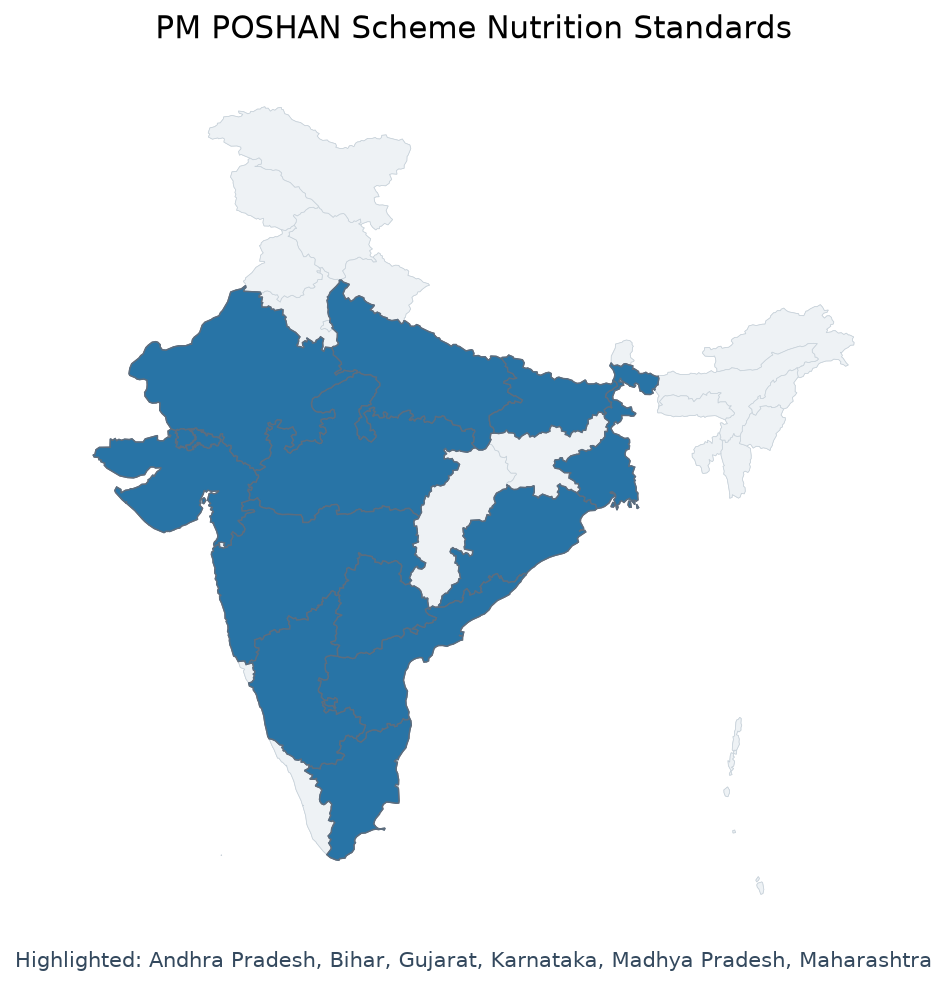
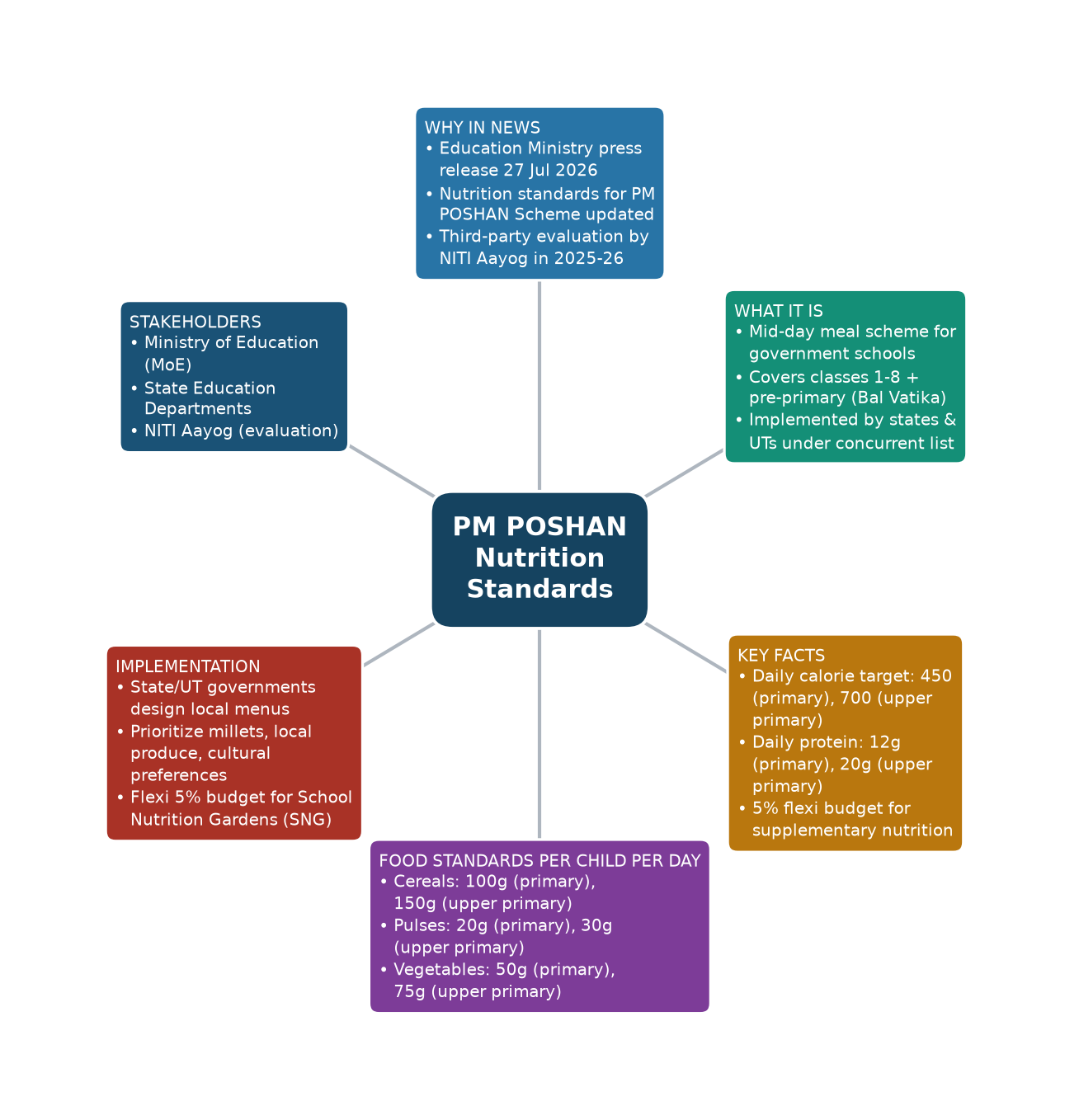
Map & concept mind-map: PM POSHAN Scheme Nutrition Standards
Subject Relevance — Where This Topic Fits
- GS Paper II — Governance, Constitution, Polity, Social Justice and International Relations (Concurrent List, Centre-State Relations) | GS Paper III — Issues relating to Poverty and Hunger, Food Security, Government Budgeting and Schemes for Vulnerable Sections
- Prelims: PM POSHAN Scheme, National Food Security Act, 2013, Concurrent List (7th Schedule), Mid-Day Meal Scheme, Millets Promotion, Flexi Component in Centrally Sponsored Schemes
- Essay: Universalisation of School Meals as a Tool for Social Equity and Human Capital Development, Balancing Centralised Standards with Localised Nutritional Solutions in Public Policy
Quick Revision: The PM POSHAN Scheme provides 450 kcal and 12g protein daily to primary students and 700 kcal with 20g protein to upper primary students, with prescribed quantities of cereals, pulses, vegetables, and oils, while promoting local procurement and dietary diversity.
Why is this in the news?
The Press Information Bureau (PIB) released updated nutritional standards under the PM POSHAN Scheme on 27 July 2026, outlining daily caloric and protein requirements, food quantity norms, and implementation guidelines for government and government-aided schools across India. This update underscores the scheme’s role in addressing child malnutrition, improving learning outcomes, and promoting local food procurement, including coarse cereals like millets, in alignment with the National Food Security Act, 2013.
Background
- The PM POSHAN Scheme (erstwhile Mid-Day Meal Scheme) is a Centrally Sponsored Scheme (CSS) succeeding the Mid-Day Meal Scheme (MDMS) operational since 1995.
- Education is a Concurrent List subject under the Seventh Schedule of the Indian Constitution, mandating shared responsibility between the Centre and States for school education and nutrition programmes.
- The scheme covers all children enrolled in government and government-aided schools from Balvatika (pre-primary) to Class 8 across States and Union Territories.
- The National Food Security Act (NFSA), 2013, provides the legal framework for food security, including the entitlement of school meals for eligible children.
- The scheme aims to reduce hunger, improve nutritional status, and enhance enrolment, retention, and attendance in schools, particularly among marginalised communities.
- A 2025-26 evaluation by NITI Aayog, conducted through a third-party agency, found a positive correlation between the scheme and improvements in child nutrition and learning outcomes.
What is the PM POSHAN Scheme?
- A centrally sponsored programme providing hot-cooked meals to children in government and government-aided schools from Balvatika to Class 8 on all working days of the academic year.
- The scheme is implemented by State Governments and Union Territory Administrations, with the Centre providing financial and technical support.
- Nutritional standards are prescribed per child per day, with differentiated requirements for primary and upper primary students.
- The scheme mandates the inclusion of locally procured food items, such as millets, vegetables, and spices, to enhance dietary diversity and support local agriculture.
- A ‘Flexi Component’ of 5% of the total recurring budget is allocated for supplementary nutrition initiatives, including the establishment of School Nutrition Gardens (SNGs) and targeted interventions in identified districts.
- The scheme encourages States and UTs to design menus based on local food habits, cultural preferences, and dietary traditions to ensure acceptability and nutritional adequacy.
- The PM POSHAN Scheme is aligned with the Sustainable Development Goals (SDGs), particularly SDG 2 (Zero Hunger) and SDG 4 (Quality Education), by addressing both nutritional deficits and educational disparities.
- The scheme operates under the legal framework of the National Food Security Act, 2013, which guarantees the right to food for eligible beneficiaries, including school-going children.
Key Features
| Feature | Significance |
|---|---|
| Coverage of students | Ensures all children in government and government-aided schools from Balvatika to Class 8 receive hot, nutritious meals on all school working days, addressing nutritional gaps in formative years. |
| Nutritional standards (per child per day) | Prescribes daily caloric and protein intake: 450 kcal and 12g protein for primary classes; 700 kcal and 20g protein for upper primary classes, aligning with dietary requirements for growth and cognitive development. |
| Food quantity standards | Specifies daily quantities of food items: 100g/150g cereals, 20g/30g pulses, 50g/75g vegetables, and 5g/7.5g oils & fats for primary and upper primary classes respectively, ensuring balanced macronutrient distribution. |
| Flexi-component allocation | 5% of the recurring budget is earmarked for flexible use by states/UTs to establish School Nutrition Gardens (SNGs) and implement supplementary nutrition initiatives tailored to local needs. |
| Local procurement and dietary integration | Encourages states/UTs to prioritise locally grown foods (e.g., millets, vegetables, spices) and design menus based on regional dietary habits, cultural preferences, and food availability. |
Why it Matters
Public Health & Nutrition
- Addresses child malnutrition by providing scientifically designed meals, reducing deficiencies in essential micronutrients and macronutrients critical for physical and cognitive development.
- Supports the National Food Security Act, 2013, by ensuring food security for school-going children, particularly in marginalised and low-income households.
- Evidence from NITI Aayog’s 2025-26 evaluation indicates measurable improvement in nutritional status and learning outcomes among beneficiary children.
Education & Human Capital
- Enhances school attendance and retention by incentivising enrolment and reducing hunger-induced absenteeism, particularly among girls and children from disadvantaged backgrounds.
- Contributes to the Right to Education (RTE) Act, 2009, by improving the learning environment and ensuring holistic development through nutrition-integrated schooling.
- Promotes dietary awareness and healthy eating habits from an early age, fostering long-term public health benefits.
Governance & Federalism
- Demonstrates cooperative federalism by entrusting implementation to state governments and UTs while maintaining national nutritional benchmarks, ensuring uniformity in outcomes.
- Leverages local governance structures (Panchayati Raj Institutions, Urban Local Bodies) for efficient monitoring and community participation in menu planning and procurement.
Agriculture & Rural Economy
- Stimulates local agricultural economies by prioritising procurement of millets, vegetables, and spices, aligning with the government’s focus on promoting nutri-cereals and doubling farmer incomes.
- Encourages the establishment of School Nutrition Gardens (SNGs), integrating agriculture with education and promoting sustainable food systems.
Challenges
1. Implementation Gaps
- Variability in execution across states/UTs due to differential administrative capacities, resource allocation, and political prioritisation, leading to uneven nutritional outcomes.
- Delays in fund disbursement and procurement cycles, particularly in remote and tribal areas, disrupting meal schedules and compromising food quality.
- Inadequate monitoring mechanisms at the grassroots level, resulting in underreporting of malnourishment cases and suboptimal utilisation of allocated resources.
UPSC Link: GS2: Centre-State Relations; GS2: Issues and Challenges Pertaining to the Federal Structure
2. Nutritional Adequacy & Quality Control
- Risk of calorific and protein deficits in meals due to cost-cutting measures, improper food storage, or substitution with lower-quality ingredients, particularly in resource-constrained regions.
- Lack of standardised quality checks for locally procured food items, leading to potential contamination or adulteration, especially in perishable goods like vegetables and oils.
- Insufficient training for mid-day meal providers on hygiene, nutritional balance, and dietary diversification, resulting in monotonous or nutritionally inadequate meals.
UPSC Link: GS2: Government Policies and Interventions for Development; GS3: Food Processing and Technology
3. Logistical & Infrastructure Constraints
- Inadequate kitchen infrastructure in schools, particularly in rural and tribal areas, leading to poor meal preparation conditions and hygiene violations.
- Transportation challenges in hilly, desert, and island regions, causing delays in food delivery and compromising the freshness and safety of meals.
- Limited storage facilities for perishable items, increasing the risk of spoilage and wastage, thereby reducing the cost-effectiveness of the scheme.
UPSC Link: GS2: Development and Management of Social Sector/Services; GS3: Infrastructure
4. Socio-Cultural & Behavioural Barriers
- Resistance from communities accustomed to traditional diets, leading to low acceptance of millets and other nutri-cereals, despite their nutritional benefits.
- Gender disparities in meal consumption, with girls often receiving smaller portions or being served later, exacerbating nutritional inequalities within households.
- Lack of awareness among parents about the scheme’s benefits, resulting in underutilisation or scepticism regarding the quality of meals provided.
UPSC Link: GS1: Social Empowerment; GS2: Welfare Schemes for Vulnerable Sections
5. Financial Sustainability
- Dependence on central funding makes the scheme vulnerable to budgetary cuts or reallocation during fiscal constraints, particularly in competing priority areas.
- Rising food prices and inflation erode the purchasing power of allocated funds, forcing states to compromise on meal quality or quantity.
- Limited fiscal space in state budgets to match central allocations, leading to underfunding and reduced coverage in economically weaker regions.
UPSC Link: GS3: Indian Economy and Issues Relating to Planning, Mobilisation of Resources
Challenges — UPSC Perspective
| Issue | Concern |
|---|---|
| Variability in execution | Uneven nutritional outcomes due to differential administrative capacities and resource allocation across states/UTs. |
| Fund disbursement delays | Disruptions in meal schedules and compromised food quality due to administrative bottlenecks in fund flow. |
| Quality control lapses | Risk of contamination, adulteration, or nutritional deficits due to inadequate monitoring of food items. |
| Infrastructure deficits | Poor meal preparation conditions and hygiene violations in schools lacking adequate kitchen facilities. |
| Logistical constraints | Delays and spoilage in food delivery due to transportation and storage challenges in remote regions. |
| Socio-cultural resistance | Low acceptance of nutri-cereals and gender disparities in meal consumption within communities. |
Way Forward
- Strengthen inter-state coordination through the establishment of a dedicated PM-POSHAN Mission Cell under the Ministry of Education to monitor implementation, address bottlenecks, and ensure adherence to nutritional standards.
- Enhance capacity-building initiatives for school authorities, mid-day meal providers, and local procurement agencies on hygiene, nutritional balance, and dietary diversification.
- Accelerate the establishment of School Nutrition Gardens (SNGs) by leveraging the flexi-component funds, integrating agriculture with education and promoting sustainable food systems.
- Introduce a robust third-party auditing mechanism, including real-time monitoring via GPS-enabled meal delivery tracking and random nutritional testing of meals.
- Prioritise infrastructure development in schools through convergence with the Samagra Shiksha Abhiyan and the PM eVIDYA programme to ensure adequate kitchen facilities and storage solutions.
- Launch targeted awareness campaigns in collaboration with local leaders, NGOs, and self-help groups to address socio-cultural barriers and promote community participation in menu planning.
- Explore public-private partnerships (PPPs) to augment logistical support, particularly in remote and hilly regions, ensuring timely and safe meal delivery.
- Institutionalise a performance-linked funding mechanism, tying central allocations to measurable outcomes such as reduction in malnutrition rates and improvement in learning outcomes.
UPSC Value Addition
Keywords for Mains Answer-Writing
Mid-Day Meal Scheme · PM POSHAN Scheme · Concurrent List · National Food Security Act 2013 · Nutritional standards in schools · Malnutrition among children · Government school nutrition · State-UT collaboration in welfare schemes
Concept Flow
Constitutional mandate (Article 45, RTE Act) → National Food Security Act, 2013 → PM POSHAN Scheme (2021) → Nutritional standards and food quantity guidelines → State/UT implementation → Local procurement and menu design → Meal delivery to schools → Impact on child nutrition and learning outcomes → Periodic evaluation (NITI Aayog, 2025-26) → Feedback loop for scheme refinement.
Prelims Practice Questions
Q1. Which of the following is NOT a nutritional standard prescribed under the PM POSHAN Scheme for primary class children per day?
- 450 calories
- 12 grams of protein
- 150 grams of cereals
- 50 grams of vegetables
Answer: 150 grams of cereals — For primary class children, the prescribed nutritional standard under PM POSHAN includes 450 calories, 12 grams of protein, 100 grams of cereals, and 50 grams of vegetables per day. The quantity of 150 grams of cereals is prescribed for upper primary class children, not primary.
Q2. The PM POSHAN Scheme is implemented under which constitutional provision?
- Article 21-A (Right to Education)
- Article 39 (Directive Principles of State Policy)
- Concurrent List (Education)
- State List (Public Health)
Answer: Concurrent List (Education) — The PM POSHAN Scheme falls under the Concurrent List of the Constitution, as education is a shared responsibility between the Centre and the States. This enables both levels of government to legislate and implement welfare schemes like mid-day meals.
Q3. Which of the following is a key feature of the PM POSHAN Scheme?
- Provision of dry rations to children
- Hot cooked meals on all school working days
- Cash transfers to parents for child nutrition
- Subsidized food grains through PDS
Answer: Hot cooked meals on all school working days — The PM POSHAN Scheme mandates the provision of hot cooked meals to all eligible children on all school working days, ensuring immediate nutritional benefits. Dry rations, cash transfers, or PDS subsidies are not the primary components of this scheme.
Mains Practice Question
✍ Critically examine the role of the PM POSHAN Scheme in addressing malnutrition among school-going children in India. How does the scheme align with the objectives of the National Food Security Act, 2013? Suggest measures to enhance its effectiveness.
Approach: Begin by outlining the nutritional standards prescribed under the PM POSHAN Scheme and their alignment with the National Food Security Act, 2013. Discuss the scheme’s impact on reducing malnutrition and improving learning outcomes, citing studies like the NITI Aayog evaluation (2025-26). Highlight challenges such as implementation gaps, regional disparities, and the need for localised menu planning. Conclude with recommendations like strengthening state-UT collaboration, leveraging local food systems (e.g., millets), and integrating supplementary nutrition initiatives to enhance effectiveness.
Source: PIB (Press Information Bureau)
Generated by AanyaAi for educational purpose.

- नासा-इसरो सहयोग: अंतरिक्ष अनुसंधान में नया मोड़, जानिए क्या है अगला कदम? - September 20, 2026
- NASA highlights ISRO partnership for future space missions in UPSC focus - September 20, 2026
- सीजी सरकार की श्रीरामलला दर्शन योजना: धमतरी के 2,176 श्रद्धालुओं को मिला अयोध्या दर्शन का अवसर - September 20, 2026

No Comments