


27 Jul UPSC Focus: Special Drive to Clear 16,033 Pending Labour Cases by Aug 2026
Subject Relevance — Where This Topic Fits
- GS Paper II — Governance, Transparency and Accountability | GS Paper III — Labour, Employment and Industrial Relations
- Prelims: Industrial Disputes Act, 1947, Gratuity Payment Act, 1972, Maternity Benefit Act, 1961, Chief Labour Commissioner (CLC), Conciliation Officers, Labour Courts, Industrial Tribunals
- Essay: Judicial delays and their socio-economic costs, Balancing labour rights with economic growth
Quick Revision: The Special Campaign for Disposal of Pending Labour Disputes aims to resolve pending cases through intensified conciliation and adjudication under the Industrial Disputes Act, 1947.
Why is this in the news?
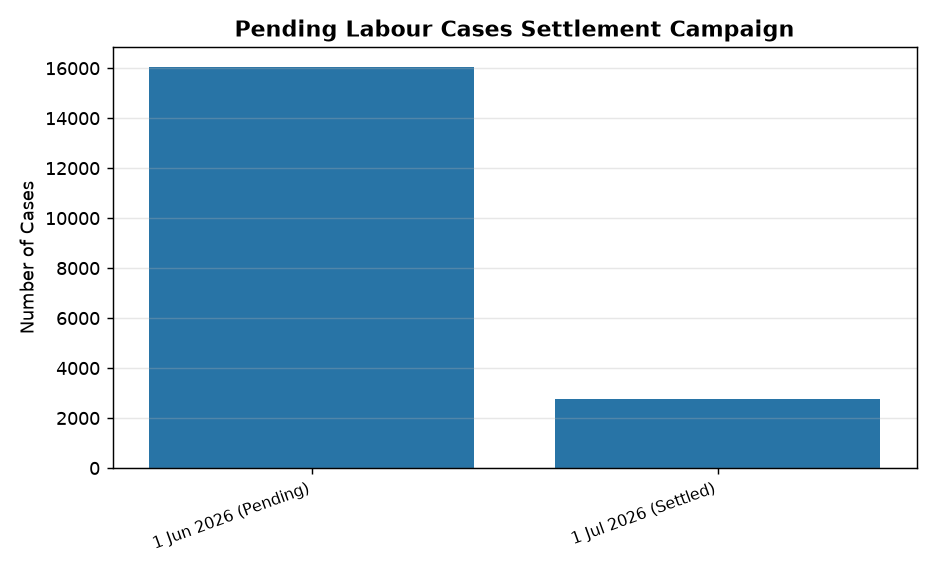
The initiative aims to address systemic delays in the adjudication of industrial disputes, which have significant implications for workers’ welfare and industrial harmony. The campaign’s progress was highlighted in a written reply by the Minister of State for Labour and Employment in the Lok Sabha, reporting the disposal of 2,769 cases in the first month alone.
Background
- The Industrial Disputes Act, 1947, provides the legal framework for the resolution of disputes between employers and workmen, including individual and collective disputes such as unfair labour practices, wrongful dismissals, and non-payment of wages.
- Pending labour disputes often result in prolonged litigation, leading to financial hardship for workers and operational inefficiencies for industries, thereby impacting economic productivity and social justice.
- The Chief Labour Commissioner (CLC) under the Ministry of Labour and Employment plays a pivotal role in conciliation and adjudication of labour disputes, operating through a network of regional and sub-regional offices.
- The Maternity Benefit Act, 1961, ensures paid maternity leave for women employees, while the Payment of Gratuity Act, 1972, mandates the payment of gratuity to employees upon termination of employment after a minimum period of service.
- The Labour Courts and Industrial Tribunals, established under the Industrial Disputes Act, are specialised quasi-judicial bodies tasked with adjudicating disputes that remain unresolved through conciliation.
- The Government of India has, in recent years, emphasised the need for time-bound resolution of labour disputes to align with the objectives of the ‘Ease of Doing Business’ rankings and to foster a conducive environment for both workers and industries.
What is the Special Campaign for Disposal of Pending Labour Disputes?
- The campaign is a time-bound initiative launched by the Chief Labour Commissioner (CLC) under the Ministry of Labour and Employment to expedite the resolution of pending labour disputes across India.
- The campaign covers disputes related to wages, gratuity, maternity benefits, and other statutory entitlements, including those arising under the Industrial Disputes Act, 1947.
- The initiative leverages the existing institutional framework of Labour Courts, Industrial Tribunals, and Conciliation Officers to ensure swift resolution through mediation and adjudication.
- The campaign includes intensified monitoring, dedicated benches, and streamlined processes to prioritise cases based on urgency, such as those involving vulnerable workers or pending for extended periods.
- The progress of the campaign is being monitored at the central and regional levels, with regular reviews to ensure accountability and transparency in the disposal of cases.
- The initiative aligns with broader policy objectives to reduce judicial pendency and improve the ease of doing business by providing a predictable and efficient dispute resolution mechanism for industries.
- The campaign also underscores the government’s commitment to upholding labour rights and ensuring timely payment of statutory benefits, thereby enhancing social security for workers.
Key Features
| Feature | Significance |
|---|---|
| Duration | A three-month focused campaign (1 June 2026 – 31 August 2026) to expedite the resolution of long-pending labour disputes, ensuring timely justice for workers and reducing backlog in regional offices. |
| Coverage | Encompasses industrial disputes, wage claims, gratuity, maternity benefits, and other statutory entitlements, addressing a wide spectrum of labour-related grievances. |
| Target | Aims to resolve 16,033 pending cases across regional offices, with 2,769 cases already disposed of in the first month, demonstrating early progress. |
| Institutional Mechanism | Operationalised through the Central Office of the Chief Labour Commissioner, leveraging existing administrative structures for efficient implementation. |
| Transparency | Public dissemination of progress through written parliamentary replies, ensuring accountability and stakeholder awareness of the initiative’s outcomes. |
Why it Matters
Economic
- Enhances labour market efficiency by reducing disputes, thereby fostering a stable and predictable business environment for industries and enterprises.
- Ensures timely disbursal of statutory dues (wages, gratuity, maternity benefits), which directly impacts household consumption and economic stability for workers.
- Mitigates long-term financial liabilities for employers by resolving disputes expeditiously, reducing litigation costs and potential penalties.
Social
- Upholds workers’ rights by expediting resolution of claims, particularly for vulnerable groups such as women (maternity benefits) and low-wage workers.
- Reduces socio-economic distress caused by prolonged disputes, which can lead to financial insecurity and mental health challenges for affected families.
- Promotes gender equity by prioritising claims related to maternity benefits, aligning with constitutional directives on social justice.
Administrative
- Demonstrates the efficacy of targeted administrative interventions in addressing systemic delays in dispute resolution mechanisms.
- Highlights the role of the Chief Labour Commissioner’s office in streamlining labour governance and enhancing inter-departmental coordination.
- Sets a precedent for periodic review and resolution of backlog cases, ensuring sustained improvements in labour administration.
Legal
- Reinforces the principle of ‘justice delayed is justice denied’ by ensuring timely adjudication of labour disputes under existing labour laws.
- Supports the enforcement of statutory entitlements (e.g., Payment of Gratuity Act, 1972; Maternity Benefit Act, 1961) through expedited dispute resolution.
Challenges
1. Systemic Backlog
- The sheer volume of 16,033 pending cases reflects chronic understaffing and resource constraints in regional labour offices.
- Historical delays in dispute resolution erode trust in labour institutions, discouraging workers from filing claims.
- Complexity of industrial disputes, involving multiple stakeholders (employers, unions, government), exacerbates resolution timelines.
UPSC Link: Labour Administration – Industrial Disputes Act, 1947
2. Resource Constraints
- Limited manpower in regional labour offices hampers the implementation of intensive dispute resolution campaigns.
- Inadequate digital infrastructure for case management and tracking may impede the efficiency of the campaign.
- Budgetary allocations for labour administration often remain insufficient, constraining operational capabilities.
UPSC Link: Labour Administration – Organisational Structure
3. Legal and Procedural Hurdles
- Multi-tiered dispute resolution mechanisms (conciliation, adjudication, appellate) introduce inherent delays.
- Lack of standardised procedures for evidence collection and case documentation leads to procedural bottlenecks.
- Inter-state variations in labour laws and enforcement further complicate dispute resolution.
UPSC Link: Labour Laws – Adjudication Mechanisms
4. Stakeholder Resistance
- Employers may resist expedited resolutions due to financial liabilities (e.g., unpaid wages, gratuity) or operational disruptions.
- Trade unions may prioritise broader industrial demands over individual worker claims, delaying resolution.
- Workers’ lack of awareness about their rights and the dispute resolution process can hinder participation.
UPSC Link: Industrial Relations – Role of Trade Unions
5. Monitoring and Accountability
- Ensuring sustained progress beyond the three-month campaign requires robust monitoring mechanisms.
- Lack of real-time data analytics for case tracking may obscure the true impact of the initiative.
- Accountability for delays in resolution remains weak, with no clear penalties for non-compliance by labour offices.
UPSC Link: Labour Administration – Performance Monitoring
Challenges — UPSC Perspective
| Issue | Concern |
|---|---|
| Chronic Backlog | 16,033 pending cases reflect systemic inefficiencies in labour dispute resolution. |
| Resource Gaps | Understaffing and inadequate infrastructure in regional labour offices hinder campaign effectiveness. |
| Legal Complexity | Multi-tiered adjudication processes delay resolution of industrial disputes. |
| Stakeholder Apathy | Employers and workers may lack incentives to engage proactively in dispute resolution. |
| Monitoring Gaps | Absence of real-time tracking systems obscures the campaign’s true progress and impact. |
Way Forward
- Strengthen regional labour offices by augmenting staff strength and providing digital tools for case management and tracking.
- Implement standardised SOPs for dispute resolution, including time-bound conciliation and adjudication stages.
- Launch awareness campaigns to educate workers about their statutory rights and the dispute resolution process.
- Establish a grievance redressal portal for real-time case monitoring and stakeholder feedback.
- Introduce incentives for employers to resolve disputes amicably, such as tax rebates or reduced penalties.
- Conduct periodic reviews of the campaign’s progress with state governments to ensure uniformity in implementation.
- Integrate labour dispute resolution with broader initiatives like the ‘Ease of Doing Business’ to align economic and social objectives.
- Develop a cadre of labour dispute resolution experts to handle complex cases and reduce administrative bottlenecks.
UPSC Value Addition
Keywords for Mains Answer-Writing
Industrial Disputes Act, 1947 · Labour Law Reforms · Pending Labour Cases · Wage Disputes · Gratuity Claims · Maternity Benefit · Statutory Claims · Industrial Tribunals · Labour Welfare · Labour Administration · Ease of Doing Business · Labour Justice · Regional Labour Offices · Labour Dispute Resolution · Constitutional Provisions for Labour
Constitutional & Policy Linkages
- Article 41 – Directive Principle of State Policy (Right to Work and Public Assistance in cases of unemployment)
- Article 42 – Directive Principle of State Policy (Just and humane conditions of work and maternity relief)
Concept Flow
Long-pending labour disputes → Economic inefficiency and social distress → Initiation of special campaign by Chief Labour Commissioner → Targeted resolution of 16,033 cases → Early disposal of 2,769 cases in first month → Enhanced trust in labour institutions → Sustainable improvements in labour administration
Prelims Practice Questions
Q1. Which of the following is NOT a statutory claim under the purview of the Labour Ministry’s special campaign for settlement of pending labour cases?
- A. Wage disputes
- B. Gratuity claims
- C. Property tax disputes
- D. Maternity benefit claims
Answer: C. Property tax disputes — The special campaign targets statutory claims such as wages, gratuity, and maternity benefits. Property tax disputes fall under municipal or revenue jurisdictions, not labour laws.
Q2. The Industrial Disputes Act, 1947, primarily aims to:
- A. Regulate industrial production quotas
- B. Provide for the investigation and settlement of industrial disputes
- C. Impose penalties on labour unions for strikes
- D. Determine corporate tax rates for industries
Answer: B. Provide for the investigation and settlement of industrial disputes — The Industrial Disputes Act, 1947, is enacted to provide mechanisms for the investigation and settlement of industrial disputes, ensuring industrial peace and harmony.
Mains Practice Question
✍ Examine the significance of the Labour Ministry’s three-month special campaign (June–August 2026) for the settlement of pending labour cases. How does this initiative align with the broader objectives of labour justice and ease of doing business in India? Substantiate your answer with constitutional provisions and statutory frameworks governing labour disputes.
Approach: The answer must analyse the campaign’s objectives (settlement of pending cases under Industrial Disputes Act, 1947, and related labour laws) and its alignment with constitutional principles such as Articles 38, 39, 41, and 42 (Directive Principles of State Policy) and Articles 14, 16, and 21 (Fundamental Rights). Discuss the role of industrial tribunals and labour courts under the Act, and link the initiative to India’s Ease of Doing Business rankings by reducing legal bottlenecks. Highlight the socio-economic impact on workers and industries, ensuring a balanced perspective.
Source: PIB (Press Information Bureau)
Generated by AanyaAi for educational purpose.

- ईरान में नागरिकों पर अत्याचार: संयुक्त राष्ट्र के तथ्यान्वेषण मिशन की रिपोर्ट - September 18, 2026
- UN Report: Iran’s Crimes Against Humanity & US War Crimes Exposed - September 18, 2026
- आरबीआई ने गुवाहाटी सहकारी शहरी बैंक पर निर्देशों का विस्तार किया, जानें पूरा मामला - September 18, 2026

No Comments