


18 Sep UN Report: Iran’s Crimes Against Humanity & US War Crimes Exposed
✎ The Independent International Fact-Finding Mission on Iran exemplifies the application of international humanitarian law and human rights law in conflict and post-conflict settings, where ‘reasonable grounds’ to believe crimes…
Subject Relevance — Where This Topic Fits
- GS Paper II — International Relations: International Organisations, Human Rights, and Conflict Resolution | GS Paper III — Internal Security: Human Rights Violations and Accountability
- Prelims: Human Rights Council, UN Fact-Finding Missions, Geneva Conventions, Crimes Against Humanity, War Crimes, International Humanitarian Law (IHL), Enforced Disappearances, Arbitrary Detention, Geneva Conventions Act
- Essay: The Role of Multilateral Institutions in Upholding Humanitarian Law, Balancing Sovereignty and Accountability: The Challenge of Prosecuting State and Non-State Actors
Quick Revision: The Independent International Fact-Finding Mission on Iran exemplifies the application of international humanitarian law and human rights law in conflict and post-conflict settings, where ‘reasonable grounds’ to believe crimes against humanity or war crimes have been committed necessitate multilateral accountability mechanisms.
Why is this in the news?
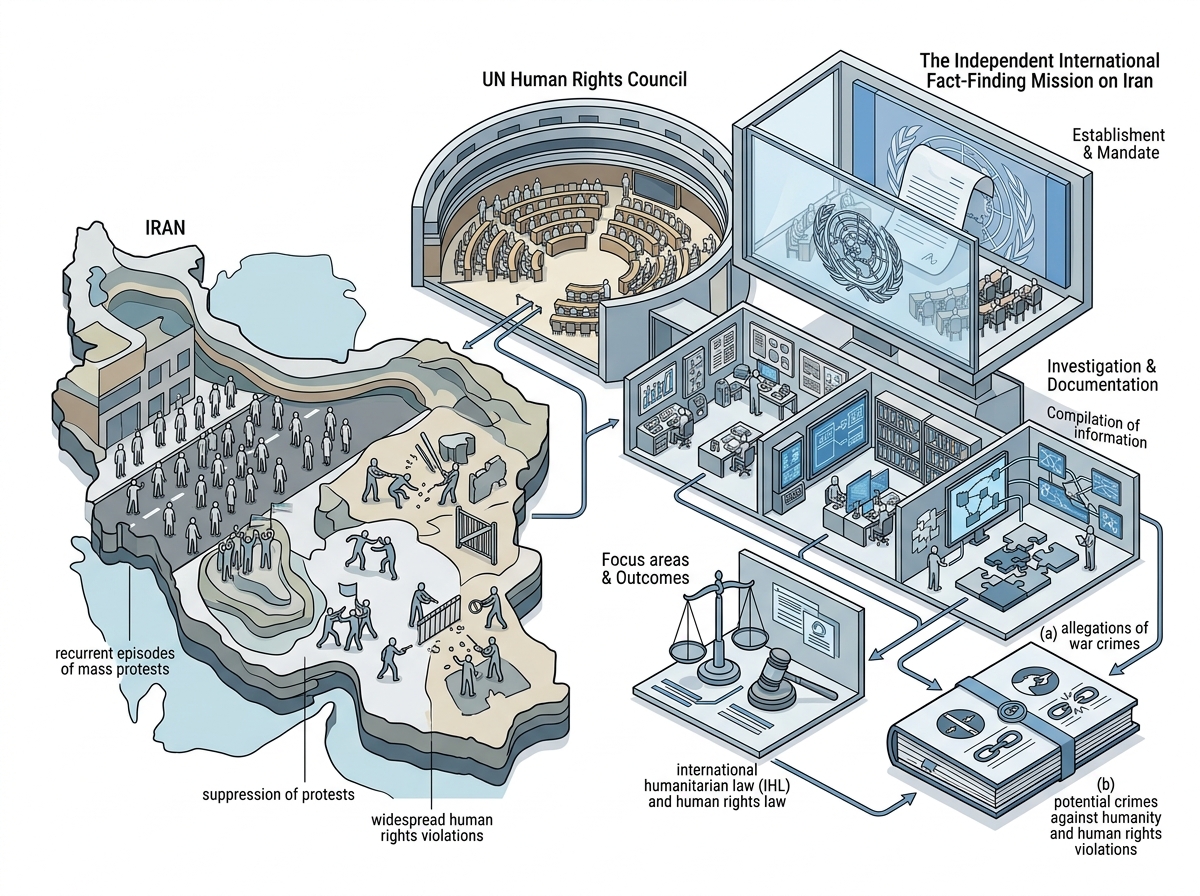
The Independent International Fact-Finding Mission on Iran documented widespread human rights violations and potential crimes against humanity by Iranian authorities during the suppression of protests, alongside allegations of war crimes by the United States in military operations against Iran. This report is significant as it underscores the application of international humanitarian law (IHL) and human rights law in conflict zones, the accountability mechanisms of multilateral bodies, and the challenges of enforcing compliance with global norms.
Background
- The Islamic Republic of Iran has experienced recurrent episodes of mass protests since 2022, primarily driven by economic grievances, political repression, and demands for civil liberties, with the most recent wave occurring between 2025 and 2026.
- The UN Human Rights Council, established under the UN Charter, has the mandate to promote and protect human rights globally and may establish fact-finding missions to investigate alleged violations, as it did in this case through Resolution 56/18.
- International humanitarian law (IHL), codified in the Geneva Conventions (1949) and their Additional Protocols (1977), governs the conduct of parties in armed conflict, prohibiting attacks on civilians, medical facilities, and the use of indiscriminate weapons.
- The principle of state sovereignty under international law (UN Charter, Article 2(1)) coexists with the obligation to respect human rights and IHL, creating a tension when domestic actions violate global norms.
- The UN Fact-Finding Mission operates independently, comprising legal experts appointed by the Human Rights Council, and its findings are intended to inform international justice mechanisms, including the International Criminal Court (ICC).
- The report’s allegations of war crimes by the United States highlight the extraterritorial application of IHL, which binds all parties to a conflict, regardless of their domestic legal frameworks.
What is the Independent International Fact-Finding Mission on Iran?
- The mission was established by the UN Human Rights Council in 2025 to investigate alleged human rights violations and crimes under international law during the suppression of protests in Iran and subsequent military actions.
- It comprises independent experts, typically jurists and human rights practitioners, who are not UN staff and operate under a mandate to gather evidence, interview witnesses, and assess compliance with international law.
- The mission’s findings are based on a methodology that includes remote interviews, analysis of open-source intelligence, medical reports, and forensic evidence to establish facts and legal implications.
- Under international law, fact-finding missions serve as a preliminary step to identify potential violations, which may later be referred to judicial bodies such as the ICC or the International Court of Justice (ICJ).
- The mission’s report distinguishes between human rights violations (governed by treaties like the International Covenant on Civil and Political Rights) and war crimes (governed by IHL, such as the Geneva Conventions).
- Its conclusions of ‘reasonable grounds’ to believe crimes against humanity or war crimes were committed trigger obligations under international law for states to investigate, prosecute, and provide reparations.
- The mission’s recommendations include calls for ceasefires, independent investigations, accountability for perpetrators, and reparations for victims, aligning with the UN’s ‘Responsibility to Protect’ (R2P) framework.
- Such missions operate under the principle of complementarity, meaning they do not replace domestic legal systems but instead provide an independent assessment when states fail to act.
Key Features
| Feature | Significance |
|---|---|
| Independent International Fact-Finding Mission | Established to investigate alleged human rights violations and war crimes, ensuring accountability under international law. |
| Crimes Against Humanity (Iran) | Involves systematic attacks on civilians, including murder, imprisonment, torture, and enforced disappearances during protests. |
| War Crimes (United States) | Indiscriminate attacks on civilian objects, including schools and residential areas, resulting in civilian casualties. |
| Violations Against Children | At least 221 children killed, with health care facilities attacked, discouraging life-saving care for victims. |
| Arbitrary Detention and Torture | Tens of thousands detained without legal recourse, subjected to torture, solitary confinement, and denial of legal advice. |
| Enforced Disappearances | Families left without information on detained relatives, raising concerns about systematic disappearances. |
Why it Matters
International Human Rights Law
- The report underscores the obligations of states under the International Covenant on Civil and Political Rights (ICCPR) and the Convention on the Rights of the Child (CRC) to protect civilians, especially children, during conflicts and internal disturbances.
- The findings highlight the principle of non-refoulement and the prohibition of torture, as enshrined in the UN Convention Against Torture (UNCAT).
- The mission’s mandate reflects the role of the UN Human Rights Council in addressing gross violations through fact-finding mechanisms.
International Humanitarian Law (IHL)
- The report examines violations of the Geneva Conventions, particularly the protection of civilians and civilian objects during armed conflict, as outlined in Additional Protocol I.
- Indiscriminate attacks on schools and residential areas violate the principle of distinction between combatants and non-combatants under IHL.
- The use of weapons causing indiscriminate harm, such as tungsten pellets, raises concerns under the prohibition of weapons causing superfluous injury or unnecessary suffering.
Accountability and Justice
- The mission calls for independent investigations and prosecutions under international criminal law, including the Rome Statute of the International Criminal Court (ICC).
- The report emphasizes the role of universal jurisdiction in holding perpetrators accountable, irrespective of their nationality or location.
- Victim compensation and reparations are highlighted as essential components of transitional justice and reconciliation.
Regional Stability and Conflict Dynamics
- The findings underscore the destabilizing impact of protracted conflicts on civilian populations, particularly in the Middle East region.
- The report highlights the risks of escalation and the need for diplomatic efforts to prevent further civilian harm.
- The involvement of multiple state and non-state actors complicates the application of IHL and human rights frameworks.
Role of UN Mechanisms
- The fact-finding mission operates under the mandate of the UN Human Rights Council, which plays a key role in monitoring and reporting on human rights violations globally.
- The report aligns with the UN’s ‘Responsibility to Protect’ (R2P) doctrine, which emphasizes the international community’s duty to prevent atrocities.
- The findings contribute to the UN’s broader efforts to document and address human rights abuses in conflict zones.
Challenges
1. Enforcement of International Law
- The lack of a centralized enforcement mechanism for international human rights and humanitarian law complicates accountability.
- States may resist investigations or prosecutions due to sovereignty concerns, undermining the effectiveness of fact-finding missions.
- Political divisions within the UN Security Council can hinder the adoption of binding resolutions to address violations.
UPSC Link: GS-II: International Organizations
2. Protection of Civilians in Armed Conflict
- The principle of civilian protection is often violated due to the use of indiscriminate weapons and tactics by state and non-state actors.
- The increasing involvement of non-state armed groups complicates the application of IHL, as these groups may not be bound by international treaties.
- The lack of access to conflict zones for humanitarian organizations exacerbates civilian suffering.
UPSC Link: GS-III: Security Challenges
3. Human Rights Documentation in Closed Regimes
- Authoritarian regimes may restrict access to conflict zones, making independent verification of violations difficult.
- The use of digital surveillance and censorship can intimidate witnesses and suppress dissent, further obscuring the truth.
- The reliance on remote sensing and open-source intelligence (OSINT) for documentation raises questions about the reliability of evidence.
UPSC Link: GS-II: India and the World
4. Child Rights Violations in Conflict Zones
- Children are particularly vulnerable to recruitment by armed groups, sexual violence, and denial of access to education and healthcare.
- The psychological and physical trauma inflicted on children during conflicts has long-term societal consequences.
- The lack of age-appropriate rehabilitation and reintegration programs exacerbates the cycle of violence.
UPSC Link: GS-II: Social Justice
5. Transitional Justice and Reconciliation
- The absence of truth commissions or reparations mechanisms can perpetuate cycles of violence and mistrust in post-conflict societies.
- The politicization of justice processes may undermine public confidence in transitional justice mechanisms.
- The need for inclusive peace processes that address the grievances of all affected communities, including marginalized groups.
UPSC Link: GS-II: Governance
Challenges — UPSC Perspective
| Issue | Concern |
|---|---|
| Sovereignty vs. International Law | States may resist external investigations or prosecutions, citing sovereignty concerns. |
| Indiscriminate Warfare | The use of weapons and tactics that fail to distinguish between combatants and civilians exacerbates civilian harm. |
| Access to Conflict Zones | Restricted access for humanitarian organizations and fact-finding missions limits the scope of documentation. |
| Politicization of Justice | International bodies may be divided along geopolitical lines, hindering the adoption of binding resolutions. |
| Long-Term Trauma | The psychological and physical impact on civilians, particularly children, has lasting societal consequences. |
| Accountability Gaps | The lack of a centralized enforcement mechanism undermines the effectiveness of international law. |
Way Forward
- Strengthen the mandate and resources of the UN Human Rights Council to ensure timely and impartial investigations into human rights violations.
- Encourage states to ratify and implement core international human rights and humanitarian law treaties, including the Rome Statute.
- Promote the use of remote sensing, open-source intelligence, and digital forensics to document violations in closed regimes.
- Advocate for the protection of civilians, particularly children, through targeted diplomatic efforts and sanctions against violators.
- Support the establishment of truth commissions and reparations programs in post-conflict societies to facilitate reconciliation.
- Enhance the role of regional organizations, such as the African Union or ASEAN, in mediating conflicts and protecting civilians.
- Encourage states to adopt national legislation that criminalizes war crimes and crimes against humanity, enabling domestic prosecutions.
- Promote public awareness and education on international human rights and humanitarian law to foster a culture of accountability.
UPSC Value Addition
Keywords for Mains Answer-Writing
International Humanitarian Law · Human Rights Violations · War Crimes · Crimes Against Humanity · UN Fact-Finding Missions · Enforced Disappearances · Torture under International Law · Protection of Civilians in Armed Conflict · Indiscriminate Attacks · Accountability Mechanisms · Geneva Conventions · Rome Statute of the ICC · Universal Jurisdiction · Principle of Complementarity · International Humanitarian Law (IHL) · International Criminal Court (ICC) · Human Rights Council (HRC)
Concept Flow
Mass protests and crackdowns in Iran → Allegations of systematic human rights violations and crimes against humanity. → Escalation of conflict involving the United States and Israel → Indiscriminate attacks on civilian objects, raising war crimes allegations. → Independent fact-finding mission documents violations → Findings submitted to the UN Human Rights Council. → Report highlights violations of international human rights and humanitarian law → Calls for ceasefire, investigations, and accountability. → International community debates responses → Enforcement challenges due to sovereignty and geopolitical divisions. → Long-term focus on transitional justice and reconciliation → Addressing grievances and preventing future violations.
Prelims Practice Questions
Q1. Consider the following statements regarding the International Humanitarian Law (IHL) and the Geneva Conventions:
1. The Geneva Conventions apply only to international armed conflicts and not to non-international armed conflicts.
2. The principle of distinction under IHL requires parties to a conflict to distinguish between civilians and combatants.
3. The use of indiscriminate attacks against civilian objects is prohibited under the Geneva Conventions.
4. The International Criminal Court (ICC) has universal jurisdiction to prosecute war crimes committed anywhere in the world.
How many of the above statements are correct?
- Only one
- Only two
- Only three
- All four
Answer: Only three — Statements 2 and 3 are correct as they reflect core principles of IHL. Statement 1 is incorrect because the Geneva Conventions also apply to non-international armed conflicts (Common Article 3). Statement 4 is incorrect because the ICC does not have universal jurisdiction; it operates under the principle of complementarity and requires referral or acceptance by state parties.
Q2. Assertion (A): The UN Human Rights Council (HRC) can establish fact-finding missions to investigate human rights violations in any country, irrespective of the country’s consent.
Reason (R): The HRC operates under the principle of universal jurisdiction, allowing it to intervene in any state’s internal affairs to protect human rights.
Options:
A. Both A and R are true, and R is the correct explanation of A.
B. Both A and R are true, but R is not the correct explanation of A.
C. A is true, but R is false.
D. A is false, but R is true.
Answer: ? — Assertion (A) is true: the HRC can establish fact-finding missions without the consent of the concerned state, as seen in its investigations into human rights violations globally. Reason (R) is false: the HRC does not operate under universal jurisdiction; its authority is derived from UN Charter provisions and member state consensus, not a legal principle of universal jurisdiction.
Q3. Match the following international legal instruments with their primary focus:
Column I (Instrument)
1. Geneva Conventions
2. Rome Statute of the ICC
3. Universal Declaration of Human Rights
4. Convention Against Torture
Column II (Focus)
A. Prohibition of torture and cruel treatment
B. Protection of victims in armed conflicts
C. Establishment of the International Criminal Court
D. Fundamental human rights and freedoms
Options:
A. 1-B, 2-C, 3-D, 4-A
B. 1-A, 2-B, 3-C, 4-D
C. 1-D, 2-A, 3-B, 4-C
D. 1-C, 2-D, 3-A, 4-B
Answer: ? — 1-B: Geneva Conventions focus on protecting victims in armed conflicts. 2-C: Rome Statute establishes the ICC. 3-D: Universal Declaration of Human Rights outlines fundamental human rights. 4-A: Convention Against Torture prohibits torture and cruel treatment.
Mains Practice Question
✍ The report of the Independent International Fact-Finding Mission on Iran highlights grave violations of international human rights law and international humanitarian law, including crimes against humanity and war crimes. Critically examine the mechanisms available under international law to ensure accountability for such violations. Also, analyse the role of the International Criminal Court (ICC) in this context. (15 Marks)
Approach: MODEL-ANSWER SKELETON:
1. **Introduction (2 marks)**: Define crimes against humanity and war crimes under international law, citing the Rome Statute (Art. 7 and Art. 8) and the Geneva Conventions. Mention the UN fact-finding mission’s mandate and its findings as per the given report.
2. **Accountability Mechanisms (5 marks)**:
– **Universal Jurisdiction**: Explain its principle (e.g., Pinochet case, Eichmann trial) and how states can prosecute perpetrators regardless of where the crime was committed.
– **International Criminal Court (ICC)**: Discuss its jurisdiction (Art. 12-15 of Rome Statute), complementarity principle, and challenges (e.g., lack of universal ratification, non-cooperation by states like the US, Iran).
– **UN Human Rights Council (HRC)**: Role in establishing fact-finding missions (e.g., Commission of Inquiry on Syria) and issuing recommendations.
– **Ad-hoc Tribunals**: Reference the International Criminal Tribunal for the former Yugoslavia (ICTY) and Rwanda (ICTR) as precedents.
– **Hybrid Courts**: Mention examples like the Special Court for Sierra Leone.
3. **Challenges to Accountability (4 marks)**:
– **Political Realities**: Veto power in the UN Security Council (Art. 27 of UN Charter) and geopolitical interests hindering prosecutions.
– **State Sovereignty**: Resistance from states like Iran and the US to external interference or ICC jurisdiction.
– **Evidentiary Burden**: Difficulty in gathering evidence in conflict zones (e.g., lack of access, witness intimidation).
– **Enforced Disappearances**: Reference the UN Working Group on Enforced or Involuntary Disappearances and the UN Convention for the Protection of All Persons from Enforced Disappearance (Art. 1-2).
4. **Role of the ICC (4 marks)**:
– **Jurisdictional Scope**: ICC’s ability to investigate crimes committed by nationals of state parties or on the territory of state parties (Art. 12).
– **Limitations**: Non-party states (e.g., US, Iran, Israel) are not bound by the Rome Statute unless referred by the UN Security Council (Art. 13(b)).
– **Recent Cases**: Cite the ICC’s investigation into Ukraine (2022) or Afghanistan (2020) as examples of its role in contemporary conflicts.
– **Effectiveness**: Discuss criticisms of the ICC’s slow pace, selective prosecutions, and lack of enforcement mechanisms (e.g., arrest warrants unexecuted).
5. **Conclusion (2 marks)**: Summarise the need for a multi-layered approach combining international, regional, and domestic mechanisms. Emphasise the importance of political will, international cooperation, and strengthening of domestic legal frameworks to address impunity.
Source: news.un.org
Generated by AanyaAi for educational purpose.
Related guides on our sites
- Current affairs for upsc 2026
- Best PSIR optional coaching for upsc
- Best PSIR optional teacher for upsc
- Best teacher of PSIR optional for upsc

- ईरान में नागरिकों पर अत्याचार: संयुक्त राष्ट्र के तथ्यान्वेषण मिशन की रिपोर्ट - September 18, 2026
- UN Report: Iran’s Crimes Against Humanity & US War Crimes Exposed - September 18, 2026
- आरबीआई ने गुवाहाटी सहकारी शहरी बैंक पर निर्देशों का विस्तार किया, जानें पूरा मामला - September 18, 2026

No Comments