


27 Jul AI-driven ज्ञान भारतम Mission: Digitizing 1.19 Crore Manuscripts for UPSC
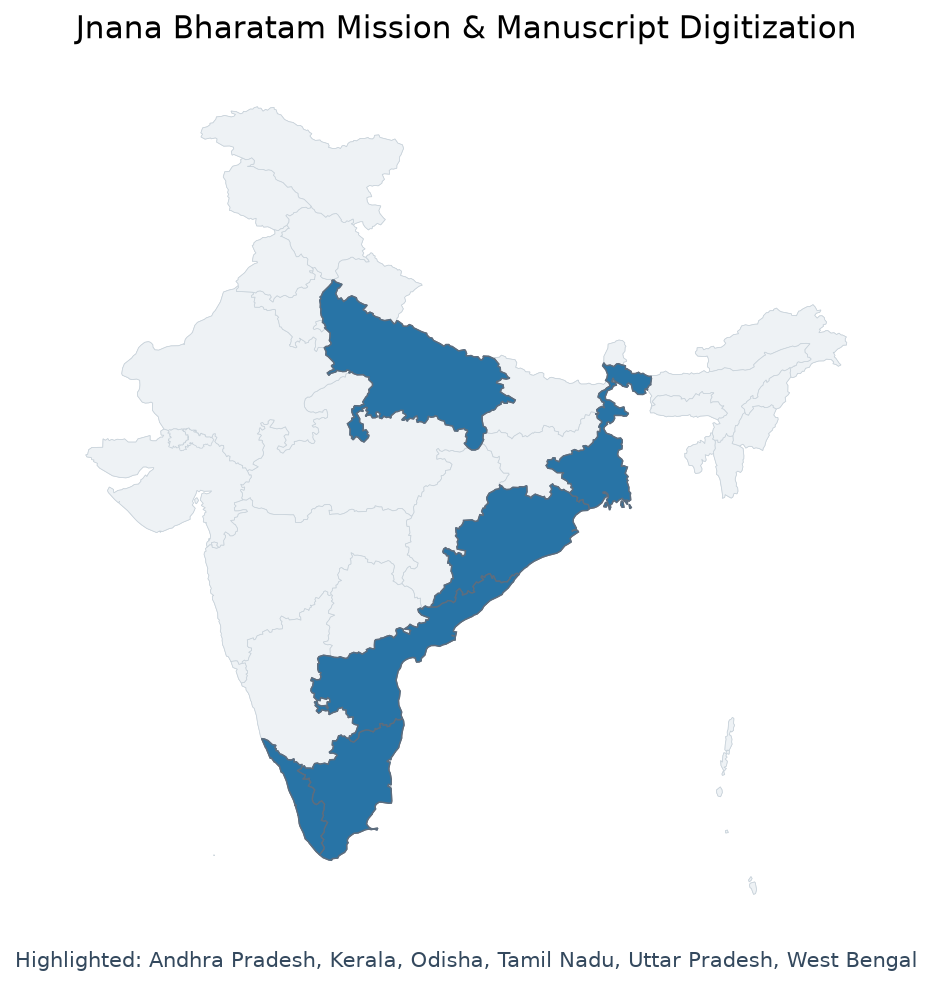
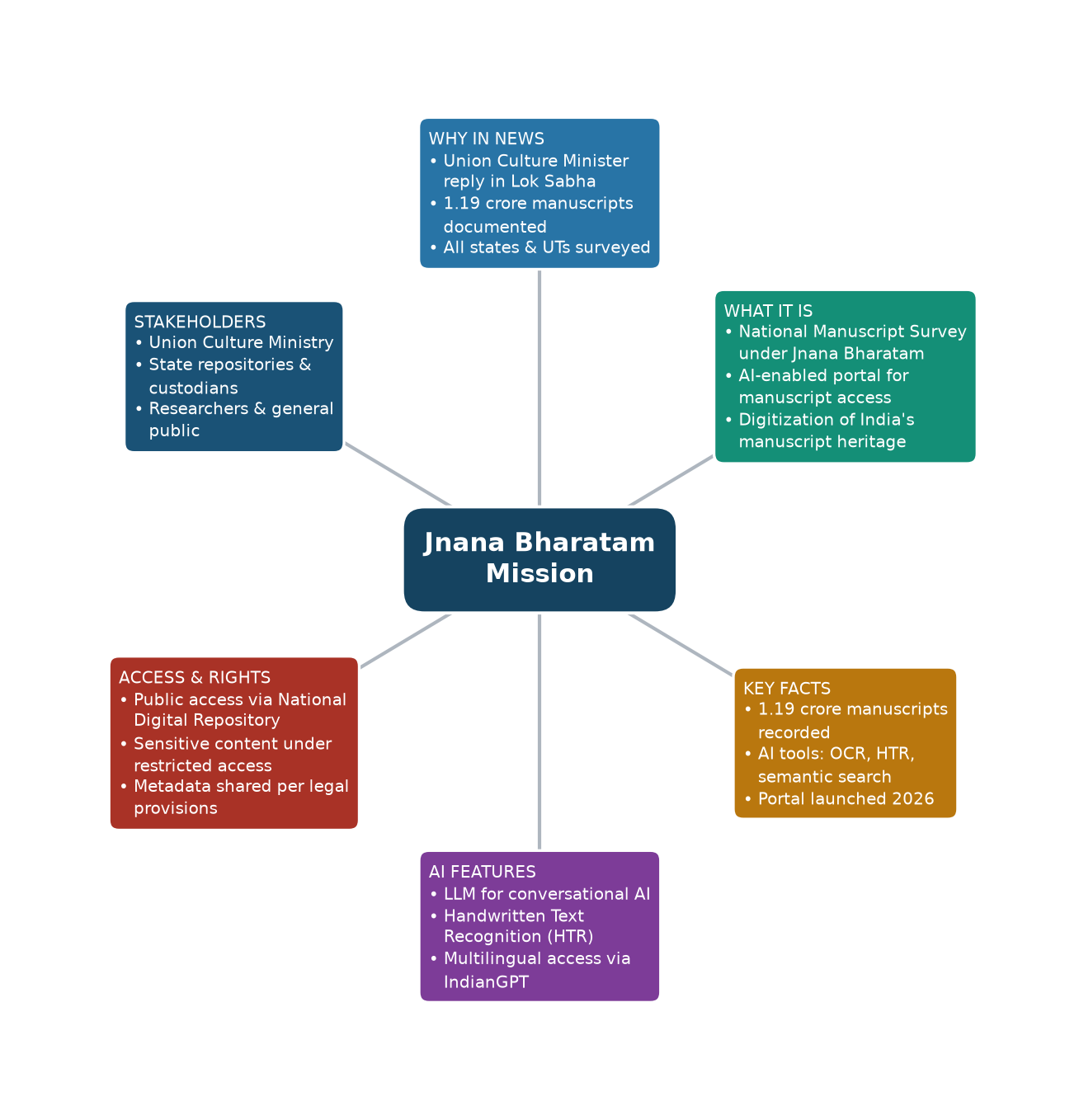
Map & concept mind-map: Jnana Bharatam Mission & Manuscript Digitization
Subject Relevance — Where This Topic Fits
- GS Paper I — Indian Heritage and Culture | GS Paper II — Governance, Administration and Policies
- Prelims: National Mission for Manuscripts (NMM), Jnana Bharatam Mission, Manuscript Digitisation Portal, AI-enabled OCR/HTR, Semantic Search in Sanskrit/Indic scripts, Large Language Script Models (LLSM), Machine Translation for Indic languages, Intellectual Property Rights (IPR) in digital archives
- Essay: Preservation of cultural heritage in the digital age: Balancing access and protection, The role of technology in democratising knowledge systems
Quick Revision: The Jnana Bharatam Mission uses AI tools like OCR, HTR, and LLSM to digitise over 1.19 crore manuscripts, enabling multilingual, multimodal access while balancing preservation and intellectual property rights.
Why is this in the news?
The Union Minister of Culture and Tourism, through a press release dated 27 July 2026, provided information on the progress of the Jnana Bharatam Mission and manuscript digitisation initiative, highlighting the survey of over 1.19 crore manuscripts across India’s states and Union Territories. The mission leverages artificial intelligence (AI) tools such as Optical Character Recognition (OCR), Handwritten Text Recognition (HTR), and Large Language Script Models (LLSM) to create an AI-ready, machine-readable repository of India’s manuscript heritage, enabling multilingual and multimodal access for scholars, researchers, and the public.
Background
- The National Mission for Manuscripts (NMM), launched in 2003, was the precursor to the Jnana Bharatam Mission, aiming to survey, document, and preserve India’s vast manuscript collections.
- Manuscripts in India are written in over 100 languages and 20 scripts, including Sanskrit, Prakrit, Persian, and regional languages such as Tamil, Telugu, and Malayalam.
- Many manuscripts are housed in private collections, temples, and academic institutions, making systematic documentation challenging without a centralised digital framework.
- Digital preservation addresses threats from decay, neglect, and commercial exploitation, while ensuring compliance with intellectual property rights and cultural sensitivities.
What is the Jnana Bharatam Mission and Manuscript Digitisation?
- The Jnana Bharatam Mission is a government initiative under the Ministry of Culture to systematically survey, document, and digitise India’s manuscript heritage across all states and Union Territories, with no district-wise targets imposed.
- The mission has documented information on over 1.19 crore manuscripts, representing diverse linguistic and script traditions, including rare and endangered texts.
- The Jnana Bharatam Web Portal serves as a centralised digital repository, integrating AI-enabled tools such as Optical Character Recognition (OCR) for printed scripts, Handwritten Text Recognition (HTR) for manuscripts, and Script Recognition for ancient and regional scripts.
- Large Language Script Models (LLSM) enable semantic search, contextualisation, and machine-assisted translation, facilitating cross-lingual and cross-script access to manuscript content.
- The portal features ‘Manuscript Mirror’, an AI-powered tool allowing users to upload digitised manuscript images and access AI-assisted script identification, transcription, and translation services.
- ‘Talk to Manuscript’ is an interactive AI interface that enables text, audio, and voice-based interactions with manuscripts, converting them into machine-readable, AI-ready knowledge systems.
- The digitisation process adheres to legal frameworks governing intellectual property rights, ensuring that sensitive or restricted content is accessible only under specified conditions.
- The mission promotes open access to non-sensitive manuscripts and metadata through the National Digital Repository, while protecting culturally sensitive or copyrighted materials.
Key Features
| Feature | Significance |
|---|---|
| National Manuscript Survey under ‘Jnana Bharatam Mission’ | Systematic identification and documentation of manuscript collections across all states and UTs, covering diverse languages and scripts, without imposing district-wise targets. |
| Jnana Bharatam Web Portal | AI-enabled platform providing intelligent access to India’s manuscript heritage through advanced computational techniques. |
| Large Language Script Model (LLSM) | Enables contextual interpretation, semantic search, and machine-assisted translation of manuscripts in multiple scripts. |
| Optical Character Recognition (OCR) & Handwritten Text Recognition (HTR) | Converts manuscript images into machine-readable text, facilitating searchability and analysis of historical documents. |
| Pandulipi Darpan (AI Tool) | Allows users to upload digitized manuscript images and receive AI-assisted script recognition, transcription, and translation. |
| Interactive AI (‘Talk to Manuscript’) | Enables multilingual and multimodal interaction with manuscripts via text, audio, and voice-based queries. |
Why it Matters
Cultural Preservation
- Digitisation and AI-driven analysis of manuscripts safeguard India’s intangible cultural heritage by making ancient knowledge accessible to future generations.
- Bridges the gap between classical knowledge systems and modern research methodologies, fostering interdisciplinary scholarship.
- Promotes linguistic diversity by preserving manuscripts in regional languages and scripts, many of which are endangered.
Academic & Research Utility
- Provides scholars, students, and researchers with a centralised, searchable repository of primary sources for historical, literary, and philosophical studies.
- Facilitates comparative analysis of manuscripts across regions, languages, and time periods, enhancing historical research precision.
- Supports the reconstruction of lost or fragmented texts through AI-assisted transcription and cross-referencing.
Technological Advancement
- Demonstrates India’s leadership in applying AI and machine learning to humanities and cultural studies, aligning with the vision of a ‘Techade’.
- Sets a precedent for global digital humanities initiatives, particularly for non-Latin scripts and low-resource languages.
- Encourages innovation in optical character recognition and natural language processing for historical documents.
Public Engagement
- Democratises access to India’s manuscript heritage, enabling citizen participation in cultural preservation and research.
- Enhances educational outreach by integrating manuscripts into school and university curricula through interactive tools.
- Strengthens India’s soft power by showcasing its rich intellectual traditions to a global audience.
Policy & Governance
- Aligns with the National Education Policy (NEP) 2020’s emphasis on integrating traditional knowledge systems into modern education.
- Supports the implementation of the National Mission for Manuscripts (NMM) by providing a digital infrastructure for conservation and dissemination.
- Facilitates evidence-based policymaking for heritage conservation through data-driven insights from digitised manuscripts.
Challenges
1. Linguistic & Scriptal Diversity
- Over 100 languages and 20+ scripts are represented in Indian manuscripts, posing challenges for AI models in script recognition and translation.
- Many manuscripts are in undocumented or endangered scripts, requiring customised OCR/HTR solutions.
- Dialectal variations within languages further complicate accurate transcription and semantic search.
UPSC Link: GS Paper 1: Indian Heritage
2. Data Privacy & Intellectual Property
- Sensitive or restricted manuscripts require controlled access, balancing public interest with copyright and ethical considerations.
- Lack of standardised metadata and provenance records for manuscripts complicates rights management.
- Potential misuse of digitised manuscripts for commercial exploitation without proper safeguards.
UPSC Link: GS Paper 2: Governance
3. Technological Limitations
- AI models trained on modern texts may struggle with archaic language, abbreviations, and non-standardised spellings in manuscripts.
- Handwritten manuscripts, especially those with cursive scripts, present higher error rates in OCR/HTR systems.
- High computational costs and infrastructure requirements for processing large-scale digitised collections.
UPSC Link: GS Paper 3: Science & Tech
4. Infrastructure & Accessibility
- Digital divide limits access to the portal in rural and remote areas, exacerbating inequities in knowledge dissemination.
- Inadequate preservation of physical manuscripts in some institutions due to lack of funding or expertise.
- Need for continuous updating of AI models to handle evolving linguistic and scriptal nuances.
UPSC Link: GS Paper 2: Governance
5. Interdisciplinary Collaboration
- Bridging the gap between humanities scholars, computer scientists, and archivists requires sustained coordination and capacity-building.
- Lack of standardised protocols for digitisation, metadata tagging, and quality control across institutions.
- Need for long-term funding and institutional partnerships to sustain the mission.
UPSC Link: GS Paper 4: Ethics
Challenges — UPSC Perspective
| Issue | Concern |
|---|---|
| Script Recognition | AI models may fail to accurately identify and transcribe manuscripts in rare or undocumented scripts. |
| Data Privacy | Risk of unauthorised access or commercial exploitation of restricted manuscripts. |
| Technological Gaps | OCR/HTR systems may misinterpret archaic language or cursive handwriting, leading to errors in transcription. |
| Infrastructure Gaps | Limited digital infrastructure in rural areas restricts equitable access to the portal. |
| Collaboration Deficits | Lack of coordination between cultural institutions, academia, and technology providers hinders progress. |
| Funding Sustainability | Long-term financial commitments are required to maintain and update the digital repository. |
Government Initiatives — Must-Memorise for Prelims
- National Mission for Manuscripts (NMM)
Way Forward
- Establish a dedicated interdisciplinary task force comprising linguists, computer scientists, and archivists to refine AI models for manuscript digitisation.
- Develop standardised metadata protocols and provenance tracking systems to enhance data integrity and rights management.
- Expand digital infrastructure in rural and remote areas through partnerships with state governments and private sector entities.
- Launch targeted capacity-building programmes for heritage institutions to improve digitisation and preservation practices.
- Promote public-private partnerships to fund and sustain the Jnana Bharatam Mission and its technological upgrades.
- Integrate the portal with academic curricula at school and university levels to foster research and cultural appreciation.
- Conduct periodic audits of AI models to address biases and improve accuracy in script recognition and translation.
- Facilitate international collaborations to share best practices and leverage global expertise in digital humanities.
UPSC Value Addition
Keywords for Mains Answer-Writing
Jnana Bharatam Mission · Manuscript Digitisation · Cultural Heritage Preservation · AI in Manuscript Access · Optical Character Recognition · Handwritten Text Recognition · Semantic Search in Manuscripts · Machine-Assisted Translation · National Manuscript Mission · Intangible Cultural Heritage · Digital Archiving of Manuscripts · Multilingual Access to Knowledge · Script Recognition Technology · Cultural Resource Management · Intellectual Property Rights in Digital Heritage
Constitutional & Policy Linkages
- Article 51A(f) – Fundamental Duty to value and preserve the rich heritage of our composite culture
Concept Flow
Identification of manuscript collections → Systematic documentation under NMM → Digitisation and AI-enablement → Development of Jnana Bharatam Portal → Intelligent access via LLSM, OCR, HTR → Multilingual and multimodal interaction → Academic and public engagement → Policy support for heritage conservation
Prelims Practice Questions
Q1. Consider the following statements regarding the Jnana Bharatam Mission: 1. It aims to digitise all manuscripts in India irrespective of their linguistic or script diversity. 2. The mission utilises AI tools such as OCR, HTR, and semantic search for manuscript access. 3. The mission has set district-wise targets for manuscript survey and registration. Which of the statements given above is/are correct?
- 1 and 2 only
- 2 and 3 only
- 1 and 3 only
- 1, 2 and 3
Answer: 1 and 2 only — Statement 1 is correct as the mission aims to digitise manuscripts across linguistic and script diversity. Statement 2 is correct as AI tools like OCR, HTR, and semantic search are explicitly mentioned. Statement 3 is incorrect as no district-wise targets were set for the survey and registration.
Q2. Which of the following technologies is NOT directly utilised by the Jnana Bharatam Portal for manuscript digitisation and access?
- Optical Character Recognition (OCR)
- Handwritten Text Recognition (HTR)
- Semantic Search
- Quantum Computing
Answer: Quantum Computing — Quantum Computing is not mentioned in the context of the Jnana Bharatam Portal’s technological framework. The other three technologies (OCR, HTR, and Semantic Search) are explicitly listed as part of the portal’s AI-enabled tools.
Q3. The ‘Talk to Manuscript’ feature of the Jnana Bharatam Portal enables:
- Voice-based interaction with digitised manuscripts
- Real-time translation of manuscripts into all Indian languages
- Direct editing of original manuscript texts
- Automated destruction of damaged manuscripts
Answer: Voice-based interaction with digitised manuscripts — The ‘Talk to Manuscript’ feature provides multilingual and multimodal access, including text, audio, and voice-based interaction with digitised manuscripts, as stated in the press release.
Mains Practice Question
✍ Critically examine the role of the Jnana Bharatam Mission in preserving and disseminating India’s manuscript heritage. How does the integration of Artificial Intelligence enhance accessibility and scholarly engagement with these cultural resources? Substantiate your answer with examples.
Approach: Begin by outlining the objectives of the Jnana Bharatam Mission, including its focus on digitisation, survey, and access to manuscripts across linguistic and script diversity. Discuss the AI-enabled tools employed, such as OCR, HTR, semantic search, and machine-assisted translation, and their significance in transforming raw manuscript data into machine-readable and accessible formats. Highlight the ‘Talk to Manuscript’ feature as an example of multimodal interaction. Critically analyse the challenges, such as ensuring copyright compliance, maintaining data integrity, and addressing the digital divide. Conclude by assessing the mission’s contribution to cultural heritage preservation and its potential to democratise access to India’s intangible knowledge systems.
Source: PIB (Press Information Bureau)
Generated by AanyaAi for educational purpose.

- महाराष्ट्र में त्योहार जुलूसों पर बॉम्बे हाईकोर्ट का बड़ा फैसला: पटाखे, लेजर और संगीत पर रोक - September 24, 2026
- Bombay HC Bans Firecrackers, Music in Maharashtra Processions: Key UPSC Analysis - September 24, 2026
- तमिलनाडु में महिला कर्मचारियों के लिए सवैतनिक माहवारी अवकाश नीति पर HC का आदेश - September 24, 2026

No Comments