


24 Sep Bombay HC Bans Firecrackers, Music in Maharashtra Processions: Key UPSC Analysis
✎ The Noise Pollution (Regulation and Control) Rules, 2000, govern noise levels during festivals, mandating permissions, sound limiters, and decibel meters, with penalties for violations including forfeiture of deposits.
Subject Relevance — Where This Topic Fits
- GS Paper II — Governance, Constitution and Polity | GS Paper III — Environment and Ecology
- Prelims: Noise Pollution (Regulation and Control) Rules, 2000, Air (Prevention and Control of Pollution) Act, 1981, Environment Protection Act, 1986, Fundamental Duty under Article 51A(g), Decibel meter, Suo motu cognisance, Mandal (religious/cultural associations), Air quality index (AQI), Environmental Impact Assessment (EIA), Polluter Pays Principle
- Essay: The Role of Judiciary in Environmental Governance: Balancing Rights and Responsibilities, Sustainable Urban Celebrations: Integrating Tradition with Environmental Stewardship
Quick Revision: The Noise Pollution (Regulation and Control) Rules, 2000, govern noise levels during festivals, mandating permissions, sound limiters, and decibel meters, with penalties for violations including forfeiture of deposits.
Why is this in the news?
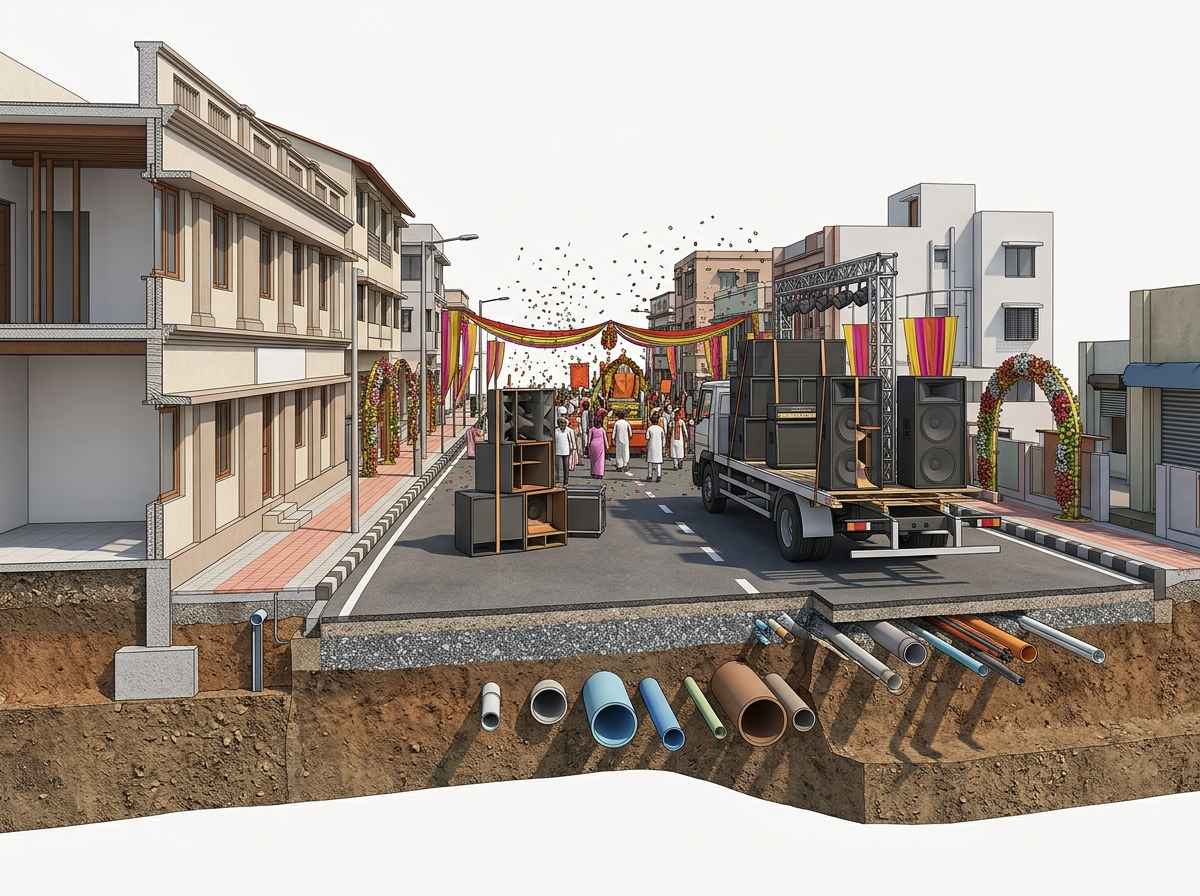
The Bombay High Court, in a suo motu cognisance of noise pollution from festival processions, issued a comprehensive order banning firecrackers, laser lights, and loud music in Maharashtra. The judgment reinforces the legal framework under the Noise Pollution (Regulation and Control) Rules, 2000, and introduces stringent compliance mechanisms, including financial deposits, decibel meters, and accountability measures for organisers. This development is significant as it underscores the judiciary’s proactive role in addressing environmental degradation during cultural festivities, while also highlighting regulatory gaps in air pollution control from firecrackers.
Background
- The Noise Pollution (Regulation and Control) Rules, 2000, framed under the Environment Protection Act, 1986, regulate noise levels in public spaces, including during festivals and processions.
- Festivals in India, particularly in urban areas, often involve large-scale processions with amplified music, firecrackers, and laser displays, contributing to noise and air pollution.
- The Supreme Court of India, in *Noise Pollution (V) (2005)*, directed states to enforce noise pollution norms strictly, especially during festivals, and banned the use of firecrackers in silence zones.
- The National Green Tribunal (NGT) has repeatedly highlighted the health impacts of noise and air pollution from firecrackers, including respiratory diseases and hearing impairment.
- Maharashtra, a state with high urban density and frequent cultural festivals, has faced recurring complaints about noise and air pollution during celebrations.
- The Bombay High Court’s order follows suo motu cognisance of public interest, reflecting the judiciary’s expanding role in environmental governance beyond legislative and executive domains.
What are the Noise Pollution (Regulation and Control) Rules, 2000?
- These rules, framed under the Environment Protection Act, 1986, regulate noise levels in public places, workplaces, and residential areas.
- They prescribe ambient noise standards for different zones (e.g., industrial, commercial, residential, and silence zones), with permissible limits varying by time of day.
- The rules prohibit the use of loudspeakers or public address systems without prior written permission from the competent authority, and mandate the use of sound limiters to ensure compliance.
- They empower authorities to seize and confiscate sound systems and impose penalties for violations, including forfeiture of deposits.
- The rules apply uniformly to all public events, including religious and cultural festivals, processions, and public gatherings.
- They require organisers to obtain permissions, display decibel meters, and provide undertakings to adhere to noise limits.
- The rules also mandate the maintenance of records of noise measurements and compliance reports.
- Violations are punishable under the Environment Protection Act, 1986, with penalties including fines and imprisonment.
Key Features
| Feature | Significance |
|---|---|
| Ban on firecrackers, laser lights, and music in processions | Directly addresses noise and air pollution concerns during festivals, aligning with constitutional duty to protect public health under Article 21. |
| Mandatory deposits (₹1 lakh for organisers, ₹50,000 for individuals) | Acts as a deterrent against violations and ensures financial accountability for non-compliance with noise pollution norms. |
| Installation of decibel meters and display of permissions | Enhances transparency and enables real-time monitoring of noise levels during processions. |
| Requirement of sound limiters in sound systems | Technical measure to cap noise output, ensuring adherence to permissible decibel limits. |
| Seizure and confiscation of devices on breach | Strengthens enforcement by removing instruments used in violations, acting as a punitive and preventive measure. |
Why it Matters
Public Health and Environmental Protection
- Directly mitigates risks of noise-induced hearing loss and respiratory ailments from firecracker smoke, particularly for vulnerable groups such as children, the elderly, and individuals with pre-existing conditions.
- Reduces ambient air pollution, addressing the acute problem of particulate matter (PM2.5 and PM10) spikes during festival seasons in urban areas like Mumbai.
- Aligns with the constitutional obligation under Article 21 (Right to Life and Personal Liberty) to ensure a clean and healthy environment, as interpreted by the Supreme Court in Subhash Kumar v. State of Bihar (1991).
Legal and Institutional Framework
- Reinforces the application of the Noise Pollution (Regulation and Control) Rules, 2000, ensuring that statutory norms are not merely advisory but actively enforced.
- Demonstrates judicial activism in environmental governance, where the judiciary steps in to enforce statutory duties when executive action is inadequate.
- Establishes a precedent for similar interventions in other states facing high festival-related pollution, potentially standardising environmental safeguards nationwide.
Governance and Accountability
- Introduces a structured accountability mechanism through mandatory disclosures (names, addresses, and contact details of organisers and participants), facilitating traceability for violations.
- Shifts the burden of proof to organisers via undertakings and deposits, reducing the state’s enforcement burden while ensuring compliance.
- Encourages inter-departmental coordination between police, municipal authorities, and pollution control boards to enforce the order effectively.
Technological and Procedural Advancements
- Promotes the use of sound limiters and decibel meters, integrating technology into environmental governance for real-time monitoring and compliance.
- Highlights the need for standardised norms for firecracker toxicity, addressing a critical gap in the existing regulatory framework.
Challenges
1. Enforcement and Compliance
- High population density and cultural significance of festivals in Maharashtra may lead to resistance or circumvention of the order, necessitating robust ground-level enforcement.
- Limited awareness among organisers and participants about the technical requirements (e.g., sound limiters, decibel meters) may hinder effective implementation.
- Resource constraints in municipal bodies and pollution control boards could delay the installation of monitoring infrastructure and training of personnel.
UPSC Link: GS Paper 2: Governance, Transparency and Accountability
2. Cultural and Social Sensitivity
- Balancing environmental regulations with cultural practices requires sensitisation campaigns to ensure public buy-in and reduce backlash.
- The order may face challenges from communities that view festival celebrations as integral to their identity, necessitating dialogue and compromise.
UPSC Link: GS Paper 1: Indian Society, Secularism
3. Regulatory Gaps and Standardisation
- The absence of norms for firecracker toxicity underscores the need for a comprehensive regulatory framework to assess and limit harmful emissions.
- Lack of standardised decibel limits for different zones (residential, commercial, silence zones) may lead to ambiguity in enforcement.
UPSC Link: GS Paper 3: Environment and Ecology
4. Inter-Agency Coordination
- Effective implementation requires seamless coordination between police, municipal corporations, pollution control boards, and district administrations, which is often challenging in practice.
- Delays in sharing data or resources among agencies could undermine the order’s objectives.
UPSC Link: GS Paper 2: Federalism, Cooperative Federalism
5. Technological and Financial Constraints
- Small-scale organisers may lack the financial capacity to install decibel meters or comply with deposit requirements, necessitating state support or subsidies.
- Technical expertise for calibrating sound limiters and monitoring decibel levels may be in short supply, particularly in rural areas.
UPSC Link: GS Paper 3: Science and Technology
Challenges — UPSC Perspective
| Issue | Concern |
|---|---|
| Public resistance due to cultural practices | Risk of non-compliance or backlash from communities accustomed to traditional celebrations. |
| Limited awareness among stakeholders | Organisers and participants may lack understanding of technical requirements like sound limiters. |
| Resource constraints in enforcement agencies | Municipal bodies and pollution control boards may struggle with infrastructure and personnel. |
| Ambiguity in decibel limits for zones | Lack of standardised noise thresholds across residential, commercial, and silence zones. |
| Absence of firecracker toxicity norms | Regulatory gap in assessing and limiting harmful emissions from firecrackers. |
| Inter-agency coordination challenges | Delays or gaps in collaboration between police, municipal bodies, and pollution control boards. |
Way Forward
- Conduct large-scale awareness campaigns for organisers and communities on the order’s provisions, technical requirements, and health impacts.
- Provide financial and technical assistance to small-scale organisers for installing decibel meters and sound limiters.
- Establish a dedicated task force comprising police, municipal authorities, and pollution control boards to monitor compliance and address violations.
- Develop standardised decibel limits for different zones (residential, commercial, silence zones) in consultation with environmental experts.
- Formulate norms for assessing firecracker toxicity, in collaboration with scientific bodies like NEERI or CPCB.
- Integrate real-time monitoring systems (e.g., IoT-based decibel meters) for continuous data collection and enforcement.
- Introduce graded penalties for repeat offenders, including suspension of future permissions for organisers violating norms.
- Conduct post-implementation reviews to assess the order’s impact on noise and air pollution levels, and refine regulations accordingly.
UPSC Value Addition
Keywords for Mains Answer-Writing
Noise Pollution (Regulation and Control) Rules, 2000 · Bombay High Court judgment on festival processions · Environmental jurisprudence and public health · Decibel meters and sound limiters · Air and noise pollution from firecrackers · Regulation of laser lights and music in processions · Polluter pays principle · Environmental Impact Assessment (EIA) · Constitutional mandate under Article 21 (Right to Life) · Suo motu cognisance by High Courts · Sustainable development and festival celebrations · Environmental governance and accountability
Constitutional & Policy Linkages
- Article 21: Right to Life and Personal Liberty (Right to a clean and healthy environment)
Concept Flow
Noise Pollution (Regulation and Control) Rules, 2000 → Judicial intervention via suo motu cognisance → High Court order banning firecrackers, laser lights, and music → Mandatory deposits and technical compliance measures → Enforcement and monitoring by authorities → Public health and environmental impact assessment → Feedback loop for policy refinement.
Prelims Practice Questions
Q1. Consider the following statements regarding the Noise Pollution (Regulation and Control) Rules, 2000:
1. The Rules mandate the installation of decibel meters at all public events.
2. The Rules prohibit the use of firecrackers during festivals without prior permission.
3. The Rules impose a mandatory deposit of ₹1 lakh for organisers and ₹50,000 for individuals to obtain permission.
4. The Rules apply only to industrial noise and not to noise from public events.
How many of the above statements are correct?
- Only one
- Only two
- Only three
- All four
Answer: Only three — Statements 1, 2, and 3 are correct as per the Rules and the Bombay High Court order. Statement 4 is incorrect because the Rules explicitly cover noise from public events, including festivals and processions.
Q2. Assertion (A): The Bombay High Court, in its suo motu cognisance, directed authorities to confiscate sound systems and devices in case of breach of noise norms during festivals.
Reason (R): The Noise Pollution (Regulation and Control) Rules, 2000, empower authorities to seize and confiscate instruments used in violation of noise limits.
Options:
A. Both A and R are true, and R is the correct explanation of A.
B. Both A and R are true, but R is not the correct explanation of A.
C. A is true, but R is false.
D. A is false, but R is true.
- A
- B
- C
- D
Answer: A — Both Assertion (A) and Reason (R) are true. The Bombay High Court order explicitly directs confiscation of devices in case of breach, and the Noise Pollution Rules empower authorities to seize instruments violating noise limits. R correctly explains A.
Q3. Match the following provisions under the Noise Pollution (Regulation and Control) Rules, 2000 with their correct descriptions:
Column I (Provision) | Column II (Description)
———————|————————-
1. Sound limiter | A. Device to measure noise levels in decibels
2. Decibel meter | B. Mechanism to restrict sound output to prescribed limits
3. Polluter pays principle | C. Financial deposit to be forfeited in case of violation
4. Environmental Impact Assessment | D. Assessment of cumulative noise impact before granting permission
Options:
A. 1-B, 2-A, 3-C, 4-D
B. 1-A, 2-B, 3-C, 4-D
C. 1-C, 2-A, 3-B, 4-D
D. 1-D, 2-B, 3-A, 4-C
- A
- B
- C
- D
Answer: A — 1-B: Sound limiter restricts sound output. 2-A: Decibel meter measures noise levels. 3-C: Polluter pays principle involves financial deposits forfeited on violation. 4-D: Environmental Impact Assessment assesses cumulative noise impact.
Mains Practice Question
✍ The Bombay High Court’s recent order banning firecrackers, laser lights, and music in festival processions in Maharashtra underscores the tension between cultural practices and environmental governance. Critically examine the legal and constitutional basis for such regulatory interventions. Also, assess the effectiveness of the Noise Pollution (Regulation and Control) Rules, 2000, in balancing cultural rights with environmental protection. (15 Marks)
Approach: MODEL-ANSWER SKELETON:
1. **Constitutional Basis**:
– Article 21 (Right to Life and Personal Liberty) and Article 48A (DPSP on environmental protection) provide the constitutional foundation for noise and air pollution regulation.
– Judicial precedents: Subhash Kumar v. State of Bihar (1991), MC Mehta v. Union of India (1987), and recent High Court orders on noise pollution.
2. **Legal Framework**:
– Noise Pollution (Regulation and Control) Rules, 2000, framed under the Environment (Protection) Act, 1986.
– Key provisions: Permissible noise limits (day/night), mandatory permissions, sound limiters, decibel meters, and penalties.
– Role of state governments in framing rules under the Rules (e.g., Maharashtra Noise Pollution (Regulation and Control) Rules, 2005).
3. **Cultural Rights vs. Environmental Protection**:
– Cultural rights under Article 29 and Article 51A (Fundamental Duties) vs. environmental justice.
– Judicial approach: Courts have consistently upheld environmental protection over cultural practices when they cause harm (e.g., ban on firecrackers during Diwali in Delhi).
– Balancing test: Proportionality and least restrictive means to achieve environmental goals.
4. **Effectiveness of the Rules**:
– Strengths: Clear standards, mandatory deposits, and enforcement mechanisms (confiscation, penalties).
– Limitations: Lack of toxicity norms for firecracker smoke, weak implementation at local levels, and cultural resistance.
– Suggestions for improvement: Strengthening EIA for festivals, community awareness, and stricter penalties.
5. **Conclusion**:
– Regulatory interventions are constitutionally valid and necessary for public health.
– The Rules require stronger implementation and periodic review to align with contemporary environmental challenges.
Source: The Hindu
Maharashtra PCS (MPSC) — State PCS Practice
Prelims: Which of the following High Court orders directly impacts the use of firecrackers, laser lights, and music in festival processions in Maharashtra?
- Ban on all public gatherings during festivals
- Restriction on firecrackers, laser lights, and music in processions
- Mandatory noise pollution control measures for all events
- Prohibition of religious processions in urban areas
Answer: Restriction on firecrackers, laser lights, and music in processions — The Bombay High Court has specifically banned the use of firecrackers, laser lights, and loud music in festival processions in Maharashtra to curb pollution and noise pollution.
Mains: Critically analyze the Bombay High Court’s order banning firecrackers, laser lights, and music in festival processions in Maharashtra. Discuss its implications on cultural traditions, environmental protection, and public health, with a focus on the state’s socio-cultural fabric.
Generated by AanyaAi for educational purpose.
Related guides on our sites
- Best PSIR optional coaching for upsc
- Best PSIR optional teacher for upsc
- Best teacher of PSIR optional for upsc
- Best PSIR optional coaching in delhi for UPSC

- Bombay HC Bans Firecrackers, Music in Maharashtra Processions: Key UPSC Analysis - September 24, 2026
- तमिलनाडु में महिला कर्मचारियों के लिए सवैतनिक माहवारी अवकाश नीति पर HC का आदेश - September 24, 2026
- Madras HC Directs TN Govt on Paid Menstrual Leave Policy: Key UPSC Insights - September 24, 2026

No Comments