


27 Jul PM SHRI Scheme: 13,092 Schools Empowered Across India – Key Facts for UPSC & PCS
Subject Relevance — Where This Topic Fits
- GS Paper II — Governance, Transparency and Accountability (Role of Government in Education) | GS Paper III — Human Resource Development (Education Sector Reforms)
- Prelims: PM SHRI Scheme, NEP 2020, School Education Quality Index (SEQI), DIKSHA Platform, UDISE+ 2025-26, KVS, NVS, NCERT, Non-Hindi Local Language Teachers
- Essay: Education as a Catalyst for National Development: The Role of PM SHRI in Bridging Linguistic and Socio-Economic Divides, Balancing Uniformity and Diversity: The Federal Challenge in Implementing National Education Policies
Quick Revision: PM SHRI scheme, launched under NEP 2020, aims to transform 14,500+ government schools into model institutions, with a focus on multilingual education, digital integration, and teacher capacity building.
Why is this in the news?
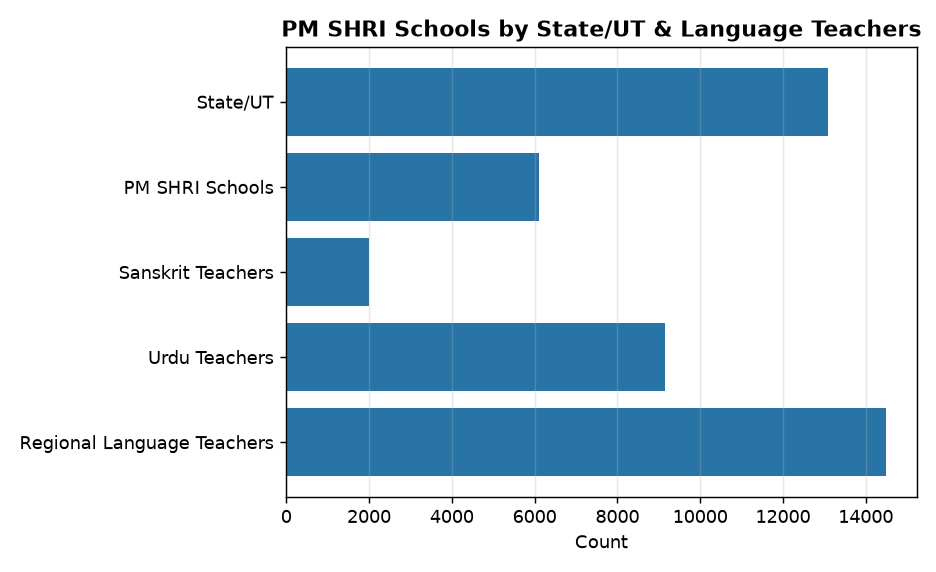
On 27 July 2026, the Ministry of Education released official data through a Press Information Bureau (PIB) release, detailing the state-wise distribution of 13,092 PM SHRI schools across India and the deployment of teachers for non-Hindi local languages within these institutions. This disclosure, provided in response to a written question in the Lok Sabha, underscores the operationalisation of the Pradhan Mantri Schools for Rising India (PM SHRI) scheme, a centrally sponsored initiative aimed at upgrading over 14,500 government schools to model institutions aligned with the National Education Policy (NEP) 2020. The data highlights the linguistic diversity in teacher appointments, reflecting the scheme’s commitment to multilingual education and inclusive pedagogy.
Background
- The National Education Policy (NEP) 2020 envisages a paradigm shift in school education, emphasizing holistic development, foundational literacy, and numeracy, and the integration of local languages in teaching-learning processes.
- The PM SHRI scheme was launched in September 2022 as a centrally sponsored programme under the aegis of the Ministry of Education.
- The scheme targets the transformation of existing government schools into ‘PM SHRI Schools’ through infrastructure upgradation, digital integration, and teacher capacity building, ensuring alignment with global best practices.
- The selection of schools under PM SHRI is based on a transparent, multi-stage process involving district, state, and national-level evaluations, with preference given to schools demonstrating strong community engagement and academic performance.
- The UDISE+ (Unified District Information System for Education Plus) 2025-26 data serves as the primary source for monitoring school-level progress, including teacher deployment and linguistic needs.
- The scheme operates in synergy with existing institutions such as Kendriya Vidyalayas (KVS), Navodaya Vidyalayas (NVS), and NCERT, while also integrating state-specific educational frameworks.
What is the Pradhan Mantri Schools for Rising India (PM SHRI) Scheme?
- The PM SHRI scheme is a centrally sponsored initiative launched in September 2022 to upgrade 14,500+ government schools into model institutions under the National Education Policy (NEP) 2020.
- The primary objective is to provide high-quality, equitable, and inclusive education by transforming schools into vibrant learning hubs with modern infrastructure, digital resources, and innovative pedagogical practices.
- The scheme focuses on four key pillars: (i) Quality enhancement through curriculum reform and teacher training, (ii) Infrastructure development including smart classrooms and digital labs, (iii) Community and parental involvement in school governance, and (iv) Multilingual education to preserve linguistic diversity.
- Selected schools are designated as ‘PM SHRI Schools’ and are expected to serve as exemplars, demonstrating best practices in school education that can be replicated across the country.
- The scheme mandates the appointment of teachers proficient in local languages, including non-Hindi languages, to ensure that instruction is accessible and culturally relevant to students across linguistic regions.
- PM SHRI schools are required to adopt a competency-based, experiential learning approach, integrating art, sports, and vocational education into the mainstream curriculum.
- The scheme is implemented through a collaborative framework involving central agencies (KVS, NVS, NCERT), state governments, and local bodies, ensuring alignment with both national and state-level educational priorities.
- Monitoring and evaluation are conducted through the UDISE+ platform, which tracks real-time data on school performance, teacher deployment, and student outcomes.
Key Features
| Feature | Significance |
|---|---|
| Scale and Coverage | The PM SHRI scheme targets over 14,500 schools across India, with 13,092 already selected, ensuring broad geographical representation including states, Union Territories, and institutions like KVS, NVS, and NCERT. |
| Multi-Lingual Teaching Framework | Appointment of teachers for non-Hindi local languages (Sanskrit, Urdu, and regional languages) in selected schools, reflecting India’s linguistic diversity and promoting multilingual education. |
| Focus on Local Languages | Regional language teachers are appointed in significant numbers (e.g., 2,142 in Andhra Pradesh, 1,666 in Telangana), aligning with the National Education Policy 2020’s emphasis on mother-tongue instruction. |
| Data-Driven Selection | The selection of schools and allocation of language teachers are based on UDISE+ data (2025-26), ensuring evidence-based policy implementation and accountability. |
| Institutional Collaboration | Involvement of central institutions (KVS, NVS, NCERT) alongside state/UT governments, fostering a unified approach to school improvement and resource sharing. |
Why it Matters
Educational Transformation
- The PM SHRI scheme aims to transform 14,500+ schools into model institutions, serving as exemplars of quality education and innovation for other schools to emulate.
- It aligns with the National Education Policy (NEP) 2020’s vision of holistic, experiential, and inclusive learning environments.
- The scheme prioritizes multilingual education, addressing linguistic diversity and promoting cognitive benefits of early mother-tongue instruction.
- By integrating technology and modern pedagogical practices, it seeks to bridge the urban-rural divide in educational outcomes.
Policy and Governance
- The scheme is a centrally sponsored initiative, demonstrating the Union Government’s commitment to cooperative federalism in education.
- Data from UDISE+ ensures transparency and evidence-based decision-making in school selection and resource allocation.
- The inclusion of central institutions (KVS, NVS, NCERT) strengthens institutional capacity and standardizes best practices across regions.
Social and Cultural Impact
- Promotion of regional languages through teacher appointments fosters cultural preservation and social cohesion, aligning with India’s linguistic and ethnic diversity.
- The scheme’s focus on local languages can enhance parental engagement and student motivation, particularly in tribal and marginalized communities.
- By improving school infrastructure and pedagogy, it contributes to reducing dropout rates and improving learning outcomes.
Challenges
1. Linguistic Fragmentation and Teacher Shortages
- Appointing qualified teachers for multiple regional languages poses a significant challenge, particularly in states with low literacy rates or limited higher education infrastructure.
- Disparities in the availability of teachers for Sanskrit, Urdu, and regional languages may exacerbate existing educational inequities.
UPSC Link: GS2: Language Policy
2. Resource Allocation and Infrastructure Gaps
- Ensuring equitable distribution of resources (funds, technology, learning materials) across 13,092 schools, especially in remote and underdeveloped regions, remains a critical challenge.
- The scheme’s success hinges on timely disbursement of funds and effective monitoring of infrastructure upgrades.
UPSC Link: GS2: Education Policy
3. Monitoring and Evaluation
- Tracking the implementation progress and outcomes of the scheme across diverse geographies and linguistic contexts requires robust monitoring mechanisms.
- Data from UDISE+ must be complemented with qualitative assessments to ensure the scheme’s impact on learning outcomes is accurately measured.
UPSC Link: GS2: Governance
4. Community and Stakeholder Engagement
- Ensuring active participation from local communities, parents, and state governments is essential for the scheme’s sustainability and effectiveness.
- Resistance to language policy changes or curriculum reforms may arise, necessitating proactive stakeholder engagement.
UPSC Link: GS2: Social Justice
5. Equity in Access and Quality
- Balancing the needs of urban and rural schools, as well as tribal and marginalized communities, is critical to avoid reinforcing existing disparities.
- The scheme must ensure that schools in conflict-affected or economically backward regions receive adequate support.
UPSC Link: GS2: Inclusive Growth
Challenges — UPSC Perspective
| Issue | Concern |
|---|---|
| Teacher Recruitment | Shortage of qualified teachers for regional languages, particularly in states like Arunachal Pradesh, Mizoram, and Nagaland. |
| Infrastructure Deficits | Inadequate school buildings, digital infrastructure, and learning resources in remote areas like Andaman and Nicobar Islands and Lakshadweep. |
| Data Reliability | Potential discrepancies in UDISE+ data may lead to misallocation of resources or incorrect school selection. |
| Policy Implementation | Risk of top-down implementation without adequate consultation with state governments or local stakeholders. |
| Equity in Distribution | Uneven distribution of PM SHRI schools and language teachers, favoring certain states over others (e.g., Uttar Pradesh vs. Sikkim). |
Way Forward
- Constitute a National Task Force on Multilingual Education to address teacher shortages and develop standardized training modules for regional language instructors.
- Leverage digital platforms (e.g., DIKSHA, SWAYAM) to provide remote training and resource-sharing for teachers in linguistically diverse regions.
- Strengthen UDISE+ data collection and analysis to enable real-time monitoring of school performance and resource allocation.
- Establish state-level language academies to develop curriculum, textbooks, and assessment tools in regional languages, ensuring alignment with NEP 2020.
- Promote public-private partnerships to augment infrastructure and technology adoption in PM SHRI schools, particularly in underserved regions.
- Conduct periodic audits of the scheme’s implementation, including third-party evaluations, to assess impact on learning outcomes and equity.
- Develop a grievance redressal mechanism for teachers and communities to address implementation challenges and ensure accountability.
- Integrate PM SHRI schools with existing schemes like Samagra Shiksha Abhiyan to maximize resource utilization and avoid duplication.
UPSC Value Addition
Keywords for Mains Answer-Writing
PM SHRI Scheme · NEP 2020 · School Education Transformation · Language Policy in Education · Multilingualism · School Infrastructure Development · Central Sponsored Schemes · NEP Implementation · Regional Language Teaching · Education Equity · Digital Learning in Schools · Quality Education · School Governance · Curriculum Reform
Concept Flow
Identification of schools for PM SHRI scheme → Data-driven selection using UDISE+ → Appointment of multilingual teachers → Implementation of NEP 2020-aligned curriculum → Monitoring and evaluation through institutional collaboration → Impact assessment on learning outcomes → Feedback loop for policy refinement
Prelims Practice Questions
Q1. Consider the following statements regarding the PM SHRI Scheme: 1. It is a centrally sponsored scheme aimed at transforming 14,500+ schools across India. 2. The scheme includes the appointment of teachers for non-Hindi local languages in selected schools. 3. The scheme is implemented solely by the Central Government without state participation. Which of the statements given above is/are correct?
- 1 and 2 only
- 2 and 3 only
- 1 and 3 only
- 1, 2 and 3
Answer: 1 and 2 only — Statement 1 is correct as the PM SHRI Scheme is a centrally sponsored initiative targeting over 14,500 schools. Statement 2 is correct as the scheme mandates the appointment of teachers for non-Hindi local languages. Statement 3 is incorrect as the scheme involves active participation from states and union territories.
Q2. Which of the following Union Territories has the highest number of PM SHRI schools as per the data provided?
- Chandigarh
- Puducherry
- Delhi
- Lakshadweep
Answer: Delhi — Delhi has 46 PM SHRI schools, which is higher than the numbers for Chandigarh (6), Puducherry (18), and Lakshadweep (13), as per the provided data.
Q3. Under the PM SHRI Scheme, which state has the highest number of schools selected for the initiative?
- Uttar Pradesh
- Maharashtra
- Bihar
- Tamil Nadu
Answer: Uttar Pradesh — Uttar Pradesh has 1,888 PM SHRI schools, which is the highest among the listed states, as per the data provided.
Q4. The PM SHRI Scheme aligns with the objectives of which of the following policies?
- National Policy on Education 1986
- National Education Policy 2020
- Right to Education Act 2009
- Sarva Shiksha Abhiyan
Answer: National Education Policy 2020 — The PM SHRI Scheme is designed to align with the goals of the National Education Policy (NEP) 2020, which emphasizes school transformation, multilingualism, and quality education.
Mains Practice Question
✍ Critically evaluate the significance of the PM SHRI Scheme in the context of the National Education Policy (NEP) 2020. How does the scheme address the challenges of educational equity, multilingualism, and school infrastructure development in India? (250 words)
Approach: The candidate should begin by defining the PM SHRI Scheme and its objectives, emphasizing its role in transforming 14,500+ schools across India. Next, link the scheme to the NEP 2020, highlighting its alignment with the policy’s goals such as equitable access to quality education, promotion of multilingualism, and infrastructure modernization. Discuss the scheme’s provisions for appointing teachers in non-Hindi local languages, which supports linguistic diversity and inclusivity. Address the challenges of educational equity by examining how the scheme targets underrepresented regions and communities. Conclude by assessing the scheme’s potential impact on reducing disparities in school education and fostering a more inclusive and multilingual learning environment, while acknowledging the need for effective implementation and monitoring.
Source: PIB (Press Information Bureau)
Generated by AanyaAi for educational purpose.

- TDB halts Research Innovation Scheme invitations: Key reasons explained - October 1, 2026
- कर्नाटक में 1971 के बाद सबसे खराब मानसून: 35% बारिश की कमी, जानें पूरा मामला - October 1, 2026
- Raksha Mantri Launches Digital Initiatives for Defence Accounts Department - October 1, 2026

No Comments