


27 Jul Lok Sabha Introduces Public Exams (Malpractices Prevention) Amendment Bill 2026
Subject Relevance — Where This Topic Fits
- GS Paper II — Governance, Transparency and Accountability | GS Paper III — Challenges to Internal Security
- Prelims: Lok Pariksha (Prevention of Unfair Means) Act, 2024, Fast-track courts for examination fraud, Organised crime in public examinations, Penal provisions under criminal law
- Essay: Integrity in Public Institutions: The Role of Legal Frameworks, Combating Organised Crime in India: A Multi-Pronged Approach
Quick Revision: The Lok Pariksha (Prevention of Unfair Means) Amendment Bill, 2026 seeks to deter organised examination fraud by increasing imprisonment to a minimum of five years and fines up to ₹10 crore, while mandating expedited trials through special fast-track courts and strict accountability for service providers.
Why is this in the news?
On 27 July 2026, the Union Minister of State (Independent Charge) for the Ministry of Personnel, Public Grievances and Pensions introduced the Lok Pariksha (Prevention of Unfair Means) Amendment Bill, 2026 in the Lok Sabha. The Bill seeks to amend the Lok Pariksha (Prevention of Unfair Means) Act, 2024 by introducing stringent penal provisions, expedited trials through special fast-track courts, and enhanced accountability for service providers involved in organised examination fraud. The amendments are necessitated by recent incidents of question paper leaks and systemic malpractices in public examinations, which have undermined public trust in recruitment processes governed by constitutional bodies such as the UPSC and SSC.
Background
- The Lok Pariksha (Prevention of Unfair Means) Act, 2024 was enacted on 12 February 2024 and came into force on 21 June 2024 to address the growing menace of organised fraud in public examinations.
- Recent years have witnessed a surge in organised crime syndicates exploiting vulnerabilities in examination systems, leading to large-scale leaks, impersonation, and malpractices in competitive examinations.
- The 2024 Act introduced a legal framework to penalise unfair means with imprisonment of at least three years, which can be extended up to five years, and fines up to ₹10 lakh for individuals, and a maximum fine of ₹1 crore for service providers.
- Despite the Act, delays in trials and lenient penalties have failed to deter organised crime, necessitating stricter provisions and expedited judicial processes.
What is the Lok Pariksha (Prevention of Unfair Means) Amendment Bill, 2026?
- The Bill amends the Lok Pariksha (Prevention of Unfair Means) Act, 2024 to strengthen deterrence against organised examination fraud by enhancing penal provisions and expediting judicial processes.
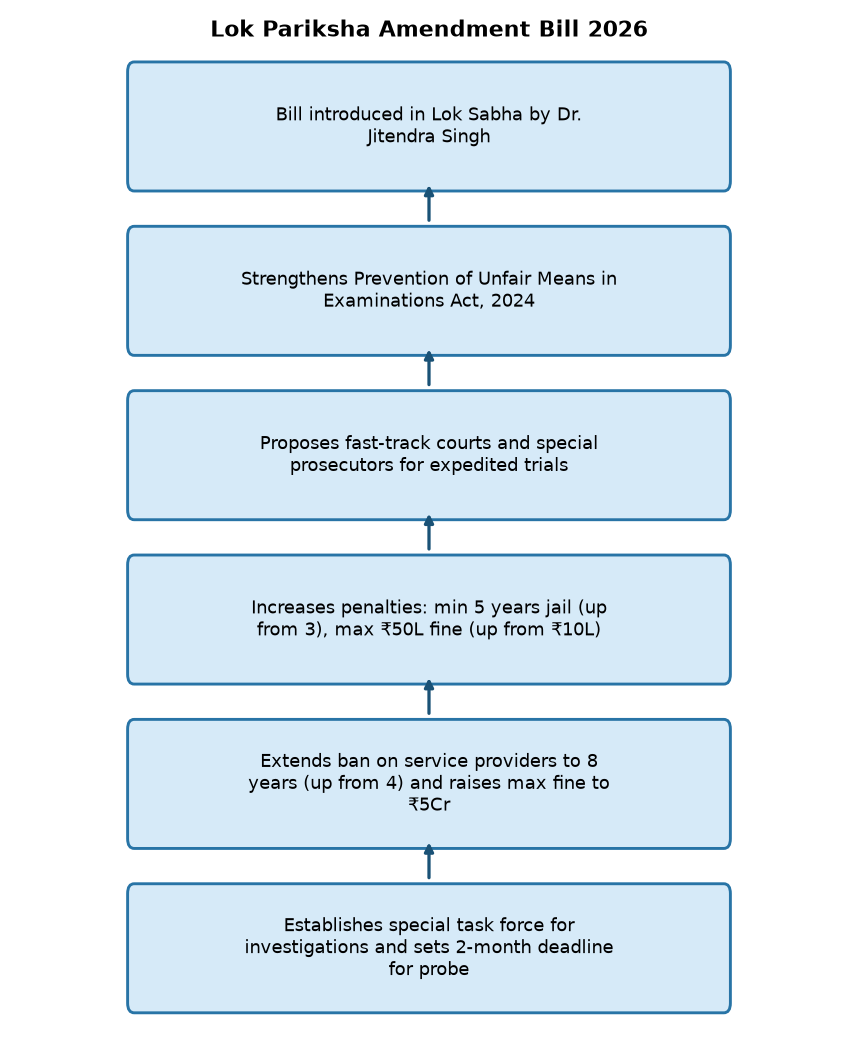
- It proposes to increase the minimum imprisonment for individuals involved in unfair means from at least three years, which can be extended up to five years, to five years, extendable up to ten years, and raise the fine from ₹10 lakh to ₹50 lakh.
- For service providers (e.g., examination conducting agencies), the Bill proposes to increase the maximum fine from ₹1 crore to ₹5 crore and extend the ban on conducting any public examination from four years to eight years.
- The Bill introduces stringent penalties for managerial personnel of service providers, with imprisonment ranging from five to ten years and fines up to ₹5 crore.
- For organised examination crimes, the Bill proposes to increase the minimum imprisonment from five years to seven years, extendable up to ten years, and raise the maximum fine from ₹1 crore to ₹10 crore.
- To ensure swift justice, the Bill mandates completion of investigations within two months, daily hearings in designated fast-track courts, and disposal of appeals within three months of filing where possible.
- A new Section 12A is proposed to establish a framework for expedited trials, including the constitution of special fast-track courts and appointment of dedicated public prosecutors.
- A new Section 12B is proposed to limit the time for filing appeals against orders of fast-track courts to 30 days, with mandatory disposal within three months by the High Court.
- The Bill empowers the central government to entrust investigation of offences under the Act to a specially constituted task force for effective enforcement.
Key Features
| Feature | Significance |
|---|---|
| Amendment to the Public Examinations (Prevention of Unfair Means) Act, 2024 | Strengthens the legal framework to combat organised malpractices in competitive examinations conducted by UPSC, SSC, RRB, IBPS, NTA, and other central government agencies. |
| Enhanced Punitive Provisions | Increases minimum imprisonment from 3 to 5 years (extendable to 10 years) and maximum fine from ₹10 lakh to ₹50 lakh for individuals involved in unfair means. |
| Stricter Penalties for Service Providers | Raises maximum fine from ₹1 crore to ₹5 crore and extends disqualification period from 4 to 8 years for entities facilitating malpractices; managerial staff face 5–10 years imprisonment and fines up to ₹5 crore. |
| Fast-Track Judicial Mechanisms | Introduces Section 12A for mandatory completion of investigations within 2 months, daily hearings in designated fast-track courts, and appointment of special public prosecutors to ensure swift justice. |
| Appeal Redressal Timeline | Mandates appeals against fast-track court orders to be filed within 30 days and disposed of within 3 months under Section 12B, reducing delays in final adjudication. |
Why it Matters
Governance and Institutional Integrity
- Preserves the sanctity of competitive examinations by deterring organised malpractices, thereby upholding meritocracy in public recruitment.
- Enhances accountability of examination conducting agencies and service providers through stringent penalties and disqualification provisions.
- Aligns with constitutional principles of equality (Article 14) and fairness (Article 16) in public employment by ensuring a level playing field for all candidates.
Judicial Efficiency
- Reduces pendency of cases related to examination fraud by mandating time-bound investigations and trials, addressing systemic delays in the judicial process.
- Strengthens the role of special fast-track courts and dedicated prosecutors to expedite adjudication of complex, organised examination-related crimes.
Economic and Social Stability
- Mitigates the economic burden on candidates and families by preventing disruptions caused by examination leaks and malpractices, which often necessitate re-examinations.
- Safeguards public trust in government recruitment processes, critical for maintaining social cohesion and reducing perceptions of systemic corruption.
Challenges
1. Implementation and Enforcement Gaps
- Risk of inadequate capacity in fast-track courts and investigative agencies to handle the increased caseload under the amended provisions.
- Potential delays in the appointment of special public prosecutors and judicial officers, undermining the efficacy of time-bound trials.
- Challenges in coordinating between multiple agencies (e.g., NTA, SSC, state police) for seamless investigation and prosecution.
UPSC Link: GS-II: Judicial reforms, Public service delivery
2. Technological and Operational Vulnerabilities
- Persistent risks of digital examination fraud, including hacking, impersonation, and data leaks, despite stricter penalties.
- Need for robust cybersecurity measures and real-time monitoring systems to preempt organised malpractices in online examinations.
UPSC Link: GS-III: Cybersecurity, Technology in governance
3. Balancing Deterrence with Fairness
- Ensuring that enhanced penalties do not inadvertently criminalise minor infractions or procedural lapses by candidates or service providers.
- Addressing concerns of over-criminalisation, particularly where malpractices may stem from systemic failures rather than deliberate intent.
UPSC Link: GS-II: Rule of law, Criminal justice reforms
Challenges — UPSC Perspective
| Issue | Concern |
|---|---|
| Capacity constraints in fast-track courts | Risk of backlog despite time-bound trials due to limited judicial and prosecutorial resources. |
| Coordination among multiple agencies | Potential delays and inefficiencies in cross-agency investigations and prosecutions. |
| Cybersecurity vulnerabilities in digital exams | Increased reliance on technology necessitates stronger safeguards against digital fraud. |
| Over-criminalisation of minor infractions | Need to distinguish between organised malpractice and unintentional procedural errors. |
| Public perception of systemic corruption | Requires transparent enforcement to rebuild trust in examination processes. |
Way Forward
- Establish a dedicated inter-agency task force under the amended Act to coordinate investigations, prosecutions, and judicial proceedings.
- Invest in capacity-building for fast-track courts, including the appointment of special public prosecutors and judicial officers with expertise in cybercrime.
- Develop a national cybersecurity framework for examination agencies to preempt digital malpractices, including real-time monitoring and encryption standards.
- Conduct periodic audits of examination processes to identify systemic vulnerabilities and implement corrective measures proactively.
- Launch public awareness campaigns to educate candidates, service providers, and educational institutions about the amended provisions and their implications.
- Strengthen whistleblower protection mechanisms to encourage reporting of malpractices while ensuring anonymity and safety of informants.
- Collaborate with state governments to harmonise enforcement of the Act, particularly for examinations conducted in collaboration with central agencies.
UPSC Value Addition
Keywords for Mains Answer-Writing
Lok Pariksha (Unfair Means Prevention) Amendment Bill, 2026 · Examination integrity in India · Fast-track courts for examination fraud · Organised malpractice in recruitment exams · Public Examination (Prevention of Unfair Means) Act, 2024 · Penal provisions for examination fraud · Specialised investigation task forces · UPSC, SSC, NTA and recruitment fraud · Judicial accountability in examination malpractice · Preventive measures for competitive examination security
Constitutional & Policy Linkages
- [‘Article 14: Equality before law and equal protection of laws’, ‘Ensures fair treatment of all candidates in public examinations.’]
- [‘Article 16: Equality of opportunity in public employment’, ‘Upholds meritocracy and prevents discrimination in recruitment.’]
Concept Flow
Organised malpractices in competitive examinations → Public distrust in recruitment processes → Enactment of Public Examinations (Prevention of Unfair Means) Act, 2024 → Inadequacy of provisions to address organised fraud → Introduction of Amendment Bill, 2026 → Enhanced penalties and fast-track judicial mechanisms → Swift investigations and trials → Deterrence against malpractices → Restoration of meritocracy and public trust.
Prelims Practice Questions
Q1. Which of the following is NOT a provision of the Lok Pariksha (Unfair Means Prevention) Amendment Bill, 2026?
- Establishment of fast-track courts with daily hearings for examination fraud cases
- Increase in minimum imprisonment from three to five years for organised malpractice
- Appointment of special public prosecutors for examination fraud trials
- Mandatory five-year debarment of service providers involved in question paper leaks
Answer: Mandatory five-year debarment of service providers involved in question paper leaks — The Bill proposes an eight-year debarment period for service providers, not five years. Other options correctly reflect the Bill’s provisions.
Q2. The Lok Pariksha (Unfair Means Prevention) Act, 2024 applies to examinations conducted by which of the following bodies?
- Only Union Public Service Commission (UPSC) and Staff Selection Commission (SSC)
- UPSC, SSC, Railway Recruitment Board (RRB), and National Testing Agency (NTA)
- State Public Service Commissions and private coaching institutes
- Only central government ministries and their subordinate offices
Answer: UPSC, SSC, Railway Recruitment Board (RRB), and National Testing Agency (NTA) — The Act covers examinations conducted by UPSC, SSC, RRB, IBPS, NTA, central ministries, and other notified authorities, as per its scope under Section 2.
Q3. Under the proposed amendments, what is the maximum fine for service providers involved in examination malpractice?
- 1 crore rupees
- 5 crore rupees
- 10 crore rupees
- 50 lakh rupees
Answer: 10 crore rupees — The Bill proposes to increase the maximum fine for service providers involved in organised malpractice to 10 crore rupees, as outlined in the proposed amendments.
Mains Practice Question
✍ Examine the significance of the Lok Pariksha (Unfair Means Prevention) Amendment Bill, 2026 in ensuring the integrity of public examinations in India. How does the Bill address the challenges posed by organised malpractice and what constitutional safeguards are embedded to ensure fairness in its implementation?
Approach: Begin by contextualising the rise of organised malpractice in public examinations and its impact on meritocracy. Analyse the key provisions of the Amendment Bill, such as fast-track courts, increased penalties, and specialised investigation mechanisms, to assess their effectiveness in deterring fraud. Discuss the constitutional dimensions, including Article 14 (equality), Article 19(1)(g) (freedom to practice profession), and Article 21 (right to fair trial), to evaluate the Bill’s compliance with fundamental rights. Conclude by suggesting measures to enhance public trust in examination systems, such as technological interventions and stakeholder consultations.
Source: PIB (Press Information Bureau)
Generated by AanyaAi for educational purpose.


No Comments