


28 Jul Lok Sabha Introduces Anti-Paper Leak Bill 2026: Key Provisions & UPSC Analysis
Subject Relevance — Where This Topic Fits
- GS Paper II — Parliament and State Legislatures; Functions and Conduct of Business | GS Paper III — Issues Relating to Development and Management of Social Sector/Services relating to Education
- Prelims: Public Examination (Prevention of Unfair Means) Act, 2024, NEET-UG 2026 paper leak controversy, Lok Sabha legislative procedure, Speaker’s role in parliamentary proceedings, Ethanol-blended fuel policy, Ram Temple Trust (Shri Ram Janmabhoomi Teerth Kshetra) donations
- Essay: The erosion of institutional trust in India: Causes and remedies, Balancing accountability and dissent in democratic governance
Quick Revision: The Public Examination (Prevention of Unfair Means) Amendment Bill, 2026 introduces stringent penalties (up to 10 years imprisonment and ₹50 lakh fine) and time-bound investigations to curb examination malpractices, following the NEET-UG 2026 controversy and widespread student protests.
Why is this in the news?
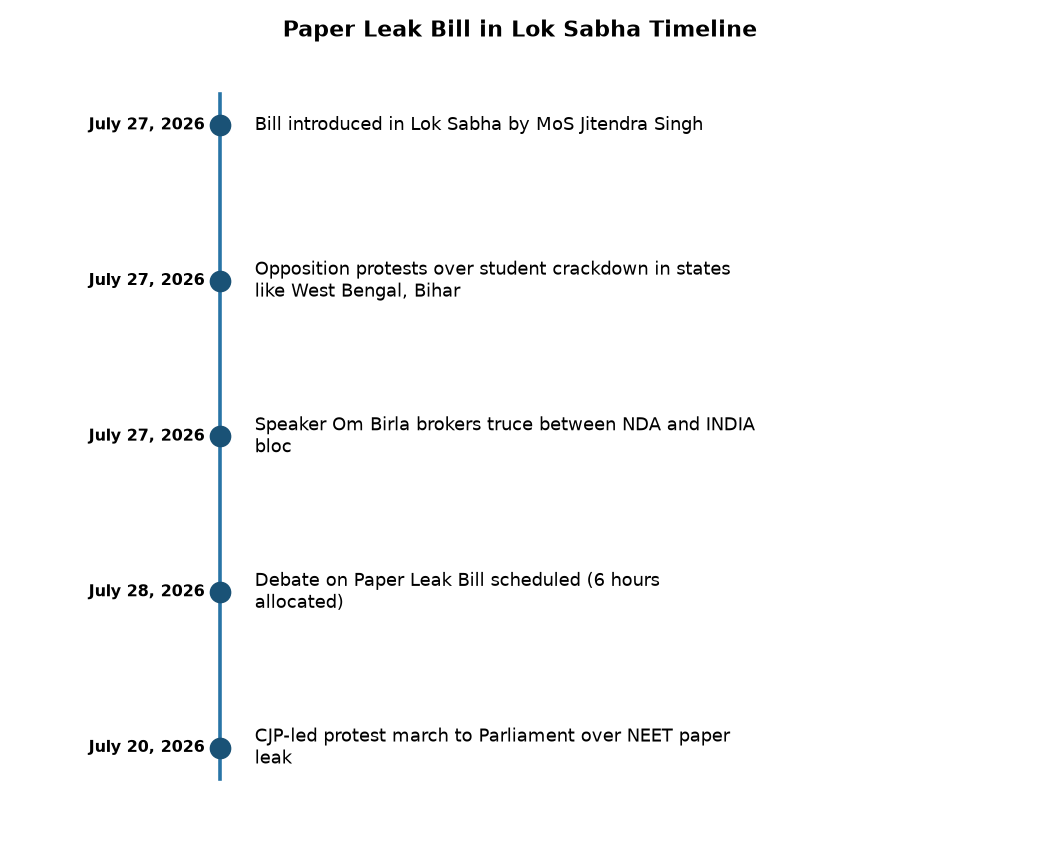
The Union Government introduced the Public Examination (Prevention of Unfair Means) Amendment Bill, 2026 in the Lok Sabha on July 27, 2026, to strengthen penalties against examination paper leaks and expedite investigations. The Bill follows widespread student protests over the NEET-UG 2026 paper leak, which led to the resignation of the Union Education Minister. The legislative initiative aims to restore public confidence in examination systems amid allegations of institutional failures and political interference, while also addressing Opposition demands for broader discussions on governance and policy issues.
Background
- The NEET-UG 2026 examination faced allegations of paper leaks, triggering nationwide protests by students and aspirants demanding transparency and accountability in the examination process.
- The Bill introduces stricter penalties, including imprisonment up to 10 years and fines up to ₹50 lakh, for offences related to examination malpractices.
- Parliamentary proceedings were disrupted by Opposition protests over police action against student demonstrators and unrelated issues such as the Ram Temple donation controversy and ethanol-blended fuel policy.
- Speaker Om Birla brokered a truce between the ruling and Opposition benches, leading to a six-hour debate scheduled for July 28, 2026, with 91 amendments proposed by Lok Sabha members.
What is the Public Examination (Prevention of Unfair Means) Amendment Bill, 2026?
- The Bill seeks to amend the Public Examination (Prevention of Unfair Means) Act, 2024, to enhance deterrence against examination malpractices through stricter penalties and procedural reforms.
- Key provisions include imprisonment for a term up to 10 years and a fine of up to ₹50 lakh for offences such as paper leaks, impersonation, and tampering with examination materials.
- The Bill mandates time-bound investigations by designated authorities, including the Central Bureau of Investigation (CBI) or State agencies, to ensure swift justice and deter future malpractices.
- It expands the scope of offences to cover digital and technological means of cheating, such as hacking, data leaks, and use of unauthorised devices during examinations.
- The legislation aims to restore public trust in competitive examinations, particularly those conducted by bodies like the National Testing Agency (NTA), which administers NEET, JEE, and other national-level tests.
- The Bill introduces provisions for compensation to affected candidates and institutional reforms to prevent recurrence of malpractices, including mandatory audits of examination centres.
- The proposed amendments reflect a shift from reactive measures to proactive safeguards, aligning with global best practices in examination governance.
- The Bill also addresses concerns of institutional bias by ensuring transparency in the appointment of examination authorities and grievance redressal mechanisms for candidates.
UPSC Value Addition
Keywords for Mains Answer-Writing
Public Examination (Prevention of Unfair Means) Amendment Bill, 2026 · examination paper leak · institutional integrity in governance · NEET-UG 2026 controversy · time-bound investigations · penalties for malpractices in examinations · Parliamentary debate and legislative process · student protests and police action · ethical standards in public examinations · judicial and legislative oversight of examinations
Prelims Practice Questions
Q1. Consider the following statements regarding the Public Examination (Prevention of Unfair Means) Amendment Bill, 2026:
1. The Bill seeks to amend an existing law to address examination paper leaks.
2. It proposes penalties of up to 10 years imprisonment and a fine of ₹50 lakh.
3. The Bill was introduced in the Rajya Sabha first.
4. The Bill aims to ensure time-bound investigations into examination malpractices.
Which of the above statements are correct?
- 1, 2 and 4 only
- 1, 2 and 3 only
- 2, 3 and 4 only
- 1, 3 and 4 only
Answer: 1, 2 and 4 only — Statement 1 is correct as the Bill amends an existing law. Statement 2 is correct as it specifies penalties of up to 10 years imprisonment and a fine of ₹50 lakh. Statement 3 is incorrect as the Bill was introduced in the Lok Sabha, not the Rajya Sabha. Statement 4 is correct as the Bill aims to ensure time-bound investigations.
Q2. Which of the following is NOT a feature of the Public Examination (Prevention of Unfair Means) Amendment Bill, 2026?
- Introduction of stricter penalties for paper leaks
- Provision for time-bound investigations
- Mandatory use of digital platforms for all examinations
- Amendment to an existing law
Answer: Mandatory use of digital platforms for all examinations — The Bill focuses on stricter penalties, time-bound investigations, and amending an existing law. There is no provision mandating the use of digital platforms for all examinations in the Bill.
Mains Practice Question
✍ Examine the significance of the Public Examination (Prevention of Unfair Means) Amendment Bill, 2026, in addressing the challenges of examination malpractices in India. Discuss the ethical and institutional implications of such legislative measures.
Approach: Begin by outlining the context of the Bill, including the NEET-UG 2026 controversy and the need for legislative intervention. Analyze the provisions of the Bill, such as stricter penalties and time-bound investigations, and their potential impact on institutional integrity. Discuss the ethical dimensions, including fairness, transparency, and the protection of students’ rights. Conclude with a balanced assessment of the Bill’s effectiveness in restoring trust in examination systems.
Source: The Hindu
Generated by AanyaAi for educational purpose.

- उत्तराखंड राज्यपाल के 5 वर्ष: पांच मिशन और AI क्रांति का लेखा-जोखा - September 15, 2026
- UPSC Focus: Uttarakhand Governor’s 5-Year Journey & 5 Key Missions Explained - September 15, 2026
- AI का वादा और खतरा: क्या मानवता के लिए खतरा है कृत्रिम बुद्धिमत्ता? - September 15, 2026

No Comments