


28 Jul MSME Amendment Bill 2026: Key Changes for UPSC & State PCS Aspirants
Subject Relevance — Where This Topic Fits
- GS Paper II — Government Policies and Interventions for Development in various sectors | GS Paper III — Indian Economy and issues relating to Planning, Mobilisation of Resources, Growth, Development and Employment
- Prelims: MSMED Act, 2006, Udyam Registration, Credit Guarantee Scheme for MSMEs, ZED Certification Scheme, Global Competitiveness Report, Ease of Doing Business Index, Public Procurement Policy for MSMEs, Statutory definitions of MSMEs
- Essay: The role of MSMEs in India’s self-reliance (Atmanirbhar Bharat) and employment generation, Balancing regulatory reforms with social protection in India’s informal economy
Quick Revision: The Micro, Small and Medium Enterprises Development (Amendment) Bill, 2026, aims to modernise the MSME regulatory framework by reducing compliance burdens, improving credit access, and enforcing stricter timelines for delayed payments to enhance the sector’s global competitiveness.
Why is this in the news?
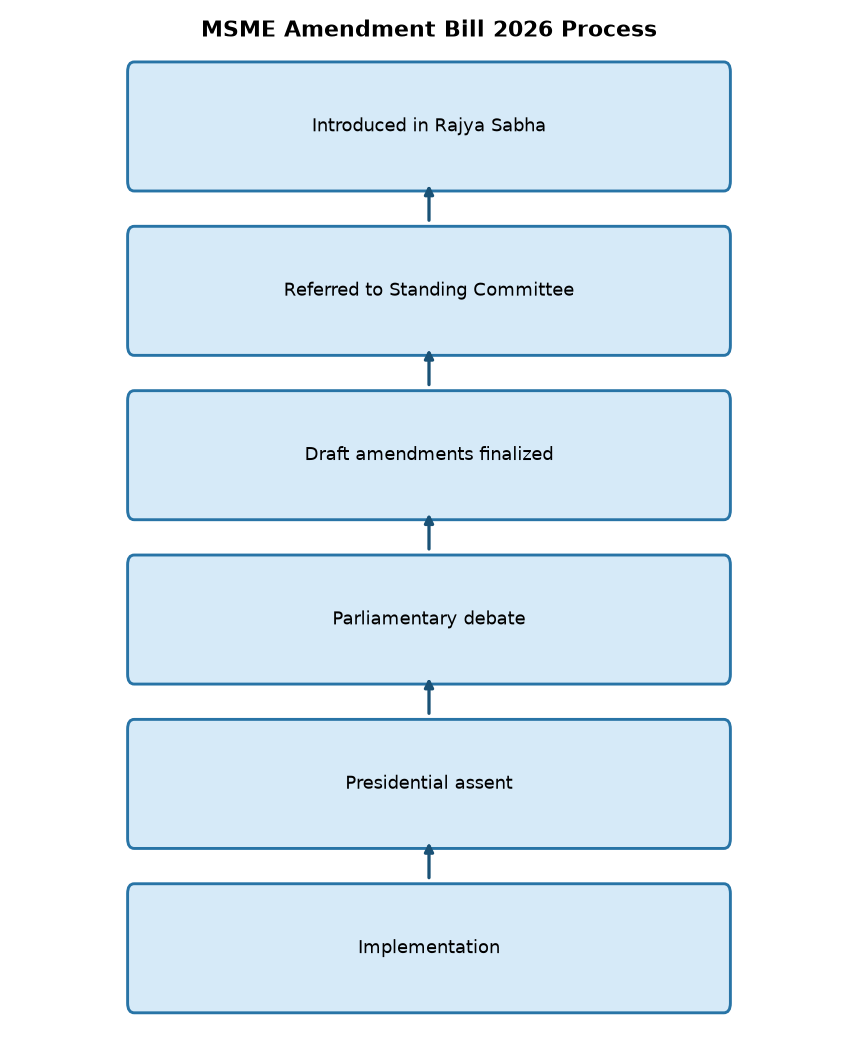
The Micro, Small and Medium Enterprises Development (Amendment) Bill, 2026, introduced in the Rajya Sabha on 28 July 2026, seeks to amend the Micro, Small and Medium Enterprises Development Act, 2006, to enhance the regulatory and institutional framework governing MSMEs. The Bill is significant as it aligns with the government’s broader objectives of improving ease of doing business, formalising the MSME sector, and addressing long-standing challenges such as credit access, delayed payments, and compliance burdens. The proposed amendments reflect evolving economic priorities, technological advancements, and global best practices in MSME promotion.
Background
- The Micro, Small and Medium Enterprises Development Act, 2006, was enacted to address the fragmentation and inefficiencies in the MSME sector by providing a statutory definition of MSMEs and establishing a framework for their promotion, development, and regulation.
- MSMEs contribute approximately 30% to India’s GDP, account for over 45% of manufacturing output, and employ nearly 110 million people, making them a critical pillar of India’s economic and employment landscape.
- The sector remains predominantly informal, with challenges such as limited access to formal credit, delayed payments from buyers, regulatory compliances, and technological lag impacting competitiveness and growth.
- The COVID-19 pandemic exposed vulnerabilities in the MSME ecosystem, prompting policy interventions such as the Emergency Credit Line Guarantee Scheme (ECLGS) and the Atmanirbhar Bharat package to mitigate liquidity crises.
- The government has progressively introduced reforms, including the Udyam Registration portal (2020), the ZED Certification Scheme, and the Public Procurement Policy for MSMEs, to formalise and support the sector.
- Global benchmarks, such as the World Bank’s Ease of Doing Business Index and the Global Competitiveness Report, consistently highlight the need for regulatory simplification and institutional strengthening in India’s MSME ecosystem.
What is the Micro, Small and Medium Enterprises Development (Amendment) Bill, 2026?
- The Bill proposes amendments to the Micro, Small and Medium Enterprises Development Act, 2006, to modernise the regulatory framework governing MSMEs in India.
- Key objectives include enhancing ease of doing business, reducing compliance burdens, improving access to credit, and strengthening dispute resolution mechanisms for delayed payments.
- The Bill seeks to redefine the classification thresholds for MSMEs to align with evolving economic realities, including inflation, technological adoption, and global standards.
- Provisions may include streamlined registration processes, digital integration of compliance systems, and incentives for formalisation and adoption of advanced technologies.
- The Bill aims to address systemic issues such as delayed payments through stricter enforcement of the Micro and Small Enterprise Facilitation Council (MSEFC) mechanism and faster dispute resolution.
- It may introduce measures to promote cluster-based development, skill upgradation, and integration with global value chains to enhance competitiveness.
- The Bill is expected to reinforce the role of the Ministry of MSMEs in policy coordination, monitoring, and implementation of sector-specific schemes.
- Stakeholder consultations with industry associations, financial institutions, and state governments are likely to shape the final provisions of the Bill.
Key Features
| Feature | Significance |
|---|---|
| Definition of MSMEs: Revised investment and turnover thresholds | Aligns with global standards to enhance classification flexibility and reduce compliance burden. |
| Inclusion of new sub-categories (e.g., micro, small, medium) | Facilitates targeted policy interventions and credit allocation based on enterprise scale. |
| Enhanced role of the MSME Development Council | Strengthens advisory functions for policy formulation and sectoral coordination. |
| Streamlined dispute resolution mechanisms | Reduces litigation delays and improves ease of doing business for MSMEs. |
| Mandatory online registration and compliance portal | Enhances transparency and reduces bureaucratic hurdles for MSMEs. |
Why it Matters
Economic Growth and Employment
- MSMEs contribute ~29% to India’s GDP and employ ~110 million workers; reforms aim to boost their productivity and formalisation.
- Amendments seek to address credit gaps (~20% of MSME credit demand remains unmet) by improving access to institutional finance.
- Enhanced classification will enable better targeting of schemes like the Credit Guarantee Fund Scheme for Micro and Small Enterprises (CGS-MSE).
Ease of Doing Business
- Digital compliance portal reduces paperwork and speeds up registration, aligning with the World Bank’s Ease of Doing Business metrics.
- Revised thresholds reduce regulatory arbitrage and simplify eligibility for government procurement under the Public Procurement Policy for MSEs.
- Dispute resolution mechanisms aim to reduce pendency in MSME-related cases under the Micro, Small and Medium Enterprises Facilitation Council.
Fiscal and Sectoral Impact
- Potential increase in tax compliance due to formalisation, broadening the indirect tax base under GST.
- Sector-specific benefits for labour-intensive industries (e.g., textiles, food processing) through targeted credit and skill development linkages.
- Alignment with global standards (e.g., OECD definitions) may improve India’s attractiveness for foreign direct investment (FDI) in MSMEs.
Institutional Strengthening
- Empowered MSME Development Council can recommend policy measures to address sectoral bottlenecks (e.g., raw material shortages, export barriers).
- Enhanced data collection through the compliance portal will improve policy design and monitoring of MSME performance.
Challenges
1. Implementation Gaps in Credit Access
- Despite reforms, collateral requirements and risk aversion in banks persist, limiting credit flow to micro-enterprises.
- Need for stronger linkages between the CGS-MSE and revised MSME definitions to ensure proportional coverage.
UPSC Link: RBI guidelines on priority sector lending
2. Digital Divide and Compliance Burden
- MSMEs in rural and semi-urban areas may lack digital literacy or infrastructure to utilise online portals effectively.
- One-size-fits-all compliance models risk excluding micro-enterprises with limited administrative capacity.
UPSC Link: Digital India Programme
3. Policy Coordination and Sectoral Disparities
- Overlapping mandates between central and state governments may dilute the impact of MSME reforms.
- Disparities in infrastructure (e.g., power, logistics) across states hinder uniform benefits from MSME-friendly policies.
UPSC Link: Concurrent List (7th Schedule)
4. Global Competitiveness and Export Barriers
- MSMEs face non-tariff barriers (e.g., quality certification, sanitary norms) in global markets despite domestic reforms.
- Need for integrated export promotion schemes (e.g., Market Access Initiative) to complement MSME amendments.
UPSC Link: WTO agreements on TBT and SPS
5. Informal Sector Formalisation
- A significant portion of MSMEs operate informally; reforms may not incentivise formalisation without stronger enforcement mechanisms.
- Correlation between formalisation and access to formal credit/insurance remains weak in practice.
UPSC Link: Unorganised Workers Social Security Act, 2008
Challenges — UPSC Perspective
| Issue | Concern |
|---|---|
| Collateral requirements for loans | Excludes micro-enterprises from formal credit despite revised MSME definitions. |
| Digital literacy gaps in rural MSMEs | Hinders utilisation of online compliance portals and digital services. |
| State-level policy fragmentation | Leads to uneven implementation of MSME-friendly reforms across regions. |
| Export certification costs | Imposes financial burden on small exporters despite global market access opportunities. |
| Enforcement of formalisation | Weak monitoring of informal MSMEs reduces the efficacy of policy reforms. |
Way Forward
- Constitute a high-powered committee under the MSME Development Council to monitor implementation of the amended Act and address bottlenecks.
- Expand digital literacy programmes (e.g., PMKVY, DDU-GKY) to ensure MSMEs can utilise online portals effectively.
- Rationalise collateral requirements under the CGS-MSE to align with revised MSME thresholds and reduce risk aversion.
- Strengthen state-level coordination through the Inter-State Council to ensure uniform policy execution.
- Integrate MSME reforms with export promotion schemes (e.g., MEIS, RoDTEP) to enhance global competitiveness.
- Pilot a ‘One District, One Product’ (ODOP) model for MSMEs to leverage local strengths and reduce sectoral disparities.
- Enhance data analytics through the compliance portal to identify credit gaps and tailor interventions for micro-enterprises.
UPSC Value Addition
Keywords for Mains Answer-Writing
MSME Development Act · Micro, Small and Medium Enterprises (MSME) sector · MSMED (Amendment) Bill 2026 · MSME classification thresholds · credit access for MSMEs · MSME policy reforms · ease of doing business for MSMEs · reservation policy for MSMEs · MSME and employment generation · MSME and global competitiveness · MSME and digital transformation · MSME and formalisation of economy
Constitutional & Policy Linkages
- Article 246: Distribution of legislative powers between Union and States (MSME policy is a Concurrent List subject).
- Article 266: Consolidated Fund of India (funding for MSME schemes).
- Article 282: Grants-in-aid for MSME development (financial devolution to states).
Concept Flow
MSMEs face credit and regulatory constraints -> Government introduces the MSME Development (Amendment) Bill, 2026 -> Revised thresholds and digital compliance aim to formalise and ease operations -> Challenges in credit access and digital divide persist -> Need for state-level coordination and export integration emerges -> High-powered committee and ODOP model proposed to address gaps.
Prelims Practice Questions
Q1. Which of the following is NOT a likely objective of the Micro, Small and Medium Enterprises Development (Amendment) Bill, 2026?
- A. Revising the classification thresholds for MSMEs
- B. Facilitating easier access to credit for MSMEs
- C. Introducing a uniform GST rate for all MSMEs
- D. Enhancing the ease of doing business for MSMEs
Answer: C. Introducing a uniform GST rate for all MSMEs — The GST rate uniformity is not a provision typically addressed by the MSMED Act; it falls under the Goods and Services Tax regime. The Bill is expected to focus on classification, credit access, and ease of doing business.
Q2. The Micro, Small and Medium Enterprises Development Act, 2006, primarily aims to:
- A. Regulate the production and sale of goods by large industries
- B. Promote the growth and development of MSMEs in India
- C. Impose strict environmental norms on small-scale industries
- D. Provide tax exemptions exclusively to medium enterprises
Answer: B. Promote the growth and development of MSMEs in India — The MSMED Act, 2006, was enacted to facilitate the promotion, development, and enhancement of competitiveness of MSMEs in India.
Mains Practice Question
✍ Critically examine the potential implications of the Micro, Small and Medium Enterprises Development (Amendment) Bill, 2026, on the formalisation of the MSME sector and its impact on employment generation. Substantiate your answer with constitutional and policy provisions.
Approach: The candidate should analyse the Bill’s provisions for formalisation (e.g., Udyam Registration, digitalisation, credit access) and its constitutional basis (Directive Principles of State Policy, Article 43). Link formalisation to employment generation through sectoral growth, compliance benefits, and integration into the formal economy. Discuss challenges like compliance costs and digital divide, and suggest balanced reforms.
Source: PRS Legislative Research
Generated by AanyaAi for educational purpose.

- तमिलनाडु में बस किराए में संशोधन: सरकार को चार सप्ताह और समय मिला, उच्च न्यायालय का फैसला - September 22, 2026
- Madras HC gives Tamil Nadu 4 weeks to revise bus fares amid diesel price surge - September 22, 2026
- कुल्लू: NHPC की पार्वती-2 परियोजना के खिलाफ एफआईआर, 12 सदस्यीय जांच समिति गठित - September 21, 2026

No Comments