


28 Jul Panchayati Raj Institutions Empowerment: Key for Grassroots Democracy in UPSC
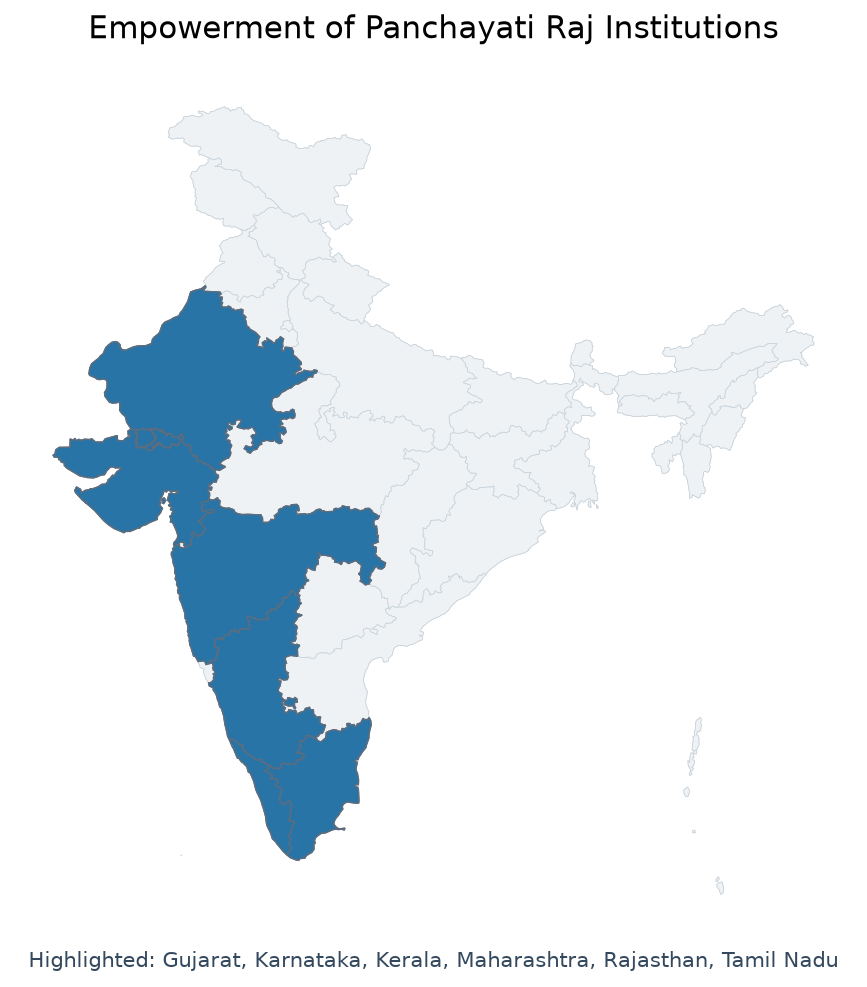
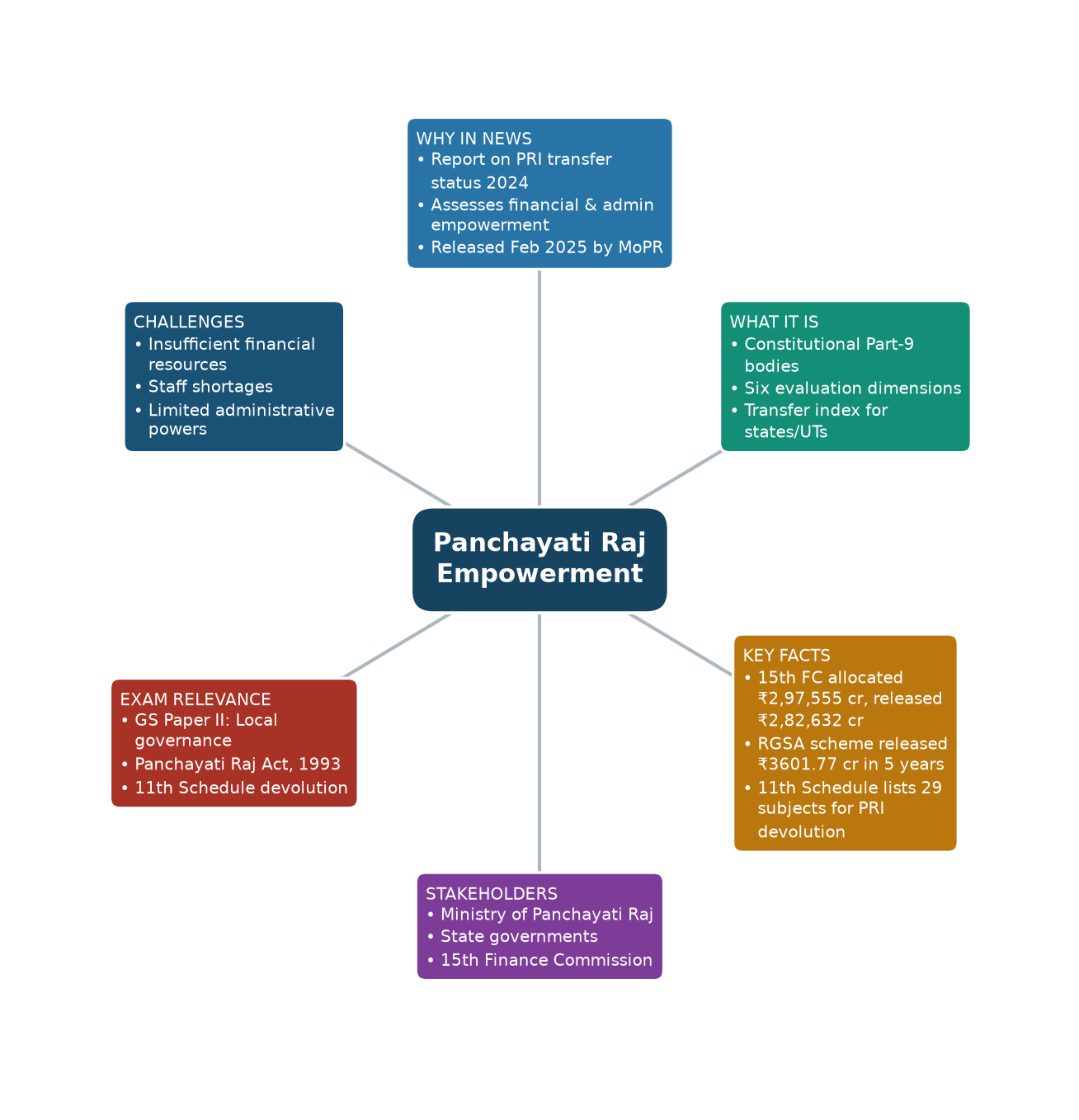
Map & concept mind-map: Empowerment of Panchayati Raj Institutions
Subject Relevance — Where This Topic Fits
- GS Paper II — Constitutional, Political, and Administrative Framework | GS Paper III — Decentralisation, Local Governance, and Rural Development
- Prelims: 73rd Constitutional Amendment Act, 1992, 11th Schedule, 15th Finance Commission, e-Gram Swaraj, Panchayati Raj Institutions (PRIs), State Finance Commissions, Grants-in-Aid
- Essay: Decentralisation as a tool for inclusive governance and social justice, Role of local self-governance in strengthening participatory democracy
Quick Revision: The 73rd Constitutional Amendment Act, 1992, mandates the establishment of PRIs as institutions of self-government and devolution of powers to them under the 11th Schedule, but effective empowerment requires robust fiscal transfers, digital governance, and institutional capacity building.
Why is this in the news?
The Ministry of Panchayati Raj, Government of India, released a report in February 2025 titled ‘Status of Transfer of Functions to Panchayats — A Thematic Evidence-Based Ranking, 2024’, which evaluates the financial and administrative empowerment of Panchayati Raj Institutions (PRIs) across States and Union Territories. The report highlights systemic challenges such as inadequate financial resources, staff shortages, and limited administrative autonomy faced by gram panchayats, thereby impeding effective local development. This underscores the need for constitutional compliance, robust fiscal devolution, and digital governance to realise the vision of participatory democracy enshrined in Part IX of the Constitution.
Background
- The 73rd Constitutional Amendment Act, 1992, inserted Part IX into the Constitution, mandating the establishment of a three-tier Panchayati Raj system (Gram Panchayat, Panchayat Samiti, and Zila Parishad) in every State, except those with Fifth and Sixth Schedule areas.
- Article 243G empowers State Legislatures to devolve powers and responsibilities to PRIs for the preparation of economic development and social justice plans, including subjects listed in the 11th Schedule of the Constitution.
- The 11th Schedule enumerates 29 subjects, such as agriculture, minor irrigation, animal husbandry, fisheries, social forestry, and rural housing, which are to be entrusted to PRIs for local governance and development.
- Digital governance initiatives such as e-Gram Swaraj, integrated with Public Financial Management System (PFMS), Government e-Marketplace (GeM), and AuditOnline, have enhanced transparency, accountability, and audit compliance in PRIs.
What are Panchayati Raj Institutions (PRIs)?
- PRIs are statutory local self-government bodies established under the 73rd Constitutional Amendment Act, 1992, to decentralise governance and empower rural communities.
- They function as institutions of self-government for rural areas, with Gram Panchayats at the village level, Panchayat Samitis at the block level, and Zila Parishads at the district level.
- PRIs derive their authority from State-specific Panchayati Raj Acts, which must comply with constitutional provisions, including Articles 243A to 243O.
- The primary objectives of PRIs include planning for economic development and social justice, implementing welfare schemes, and ensuring participatory decision-making at the grassroots level.
- The 11th Schedule of the Constitution lists 29 subjects that may be devolved to PRIs, covering areas such as agriculture, rural development, drinking water, and public distribution systems.
- PRIs are mandated to prepare annual plans and budgets, maintain accounts, and conduct audits, ensuring financial transparency and accountability.
- State Finance Commissions (SFCs) are constituted every five years to recommend measures for improving the financial position of PRIs, including the devolution of taxes, duties, and grants.
- Despite constitutional provisions, PRIs often face challenges such as inadequate devolution of funds, lack of administrative autonomy, and limited capacity, which hinder effective local governance.
Key Features
| Feature | Significance |
|---|---|
| Constitutional Framework for PRIs (Part IX) | Establishes three-tier local governments—Gram Panchayats, Panchayat Samitis, and Zila Parishads—ensuring democratic decentralisation and grassroots governance as a constitutional mandate. |
| State Subject under Seventh Schedule | Empowers states to legislate on local governance via State Panchayati Raj Acts, allowing customisation of administrative, financial, and functional autonomy based on local needs. |
| Article 243(G) and 11th Schedule | Mandates transfer of 29 subjects to PRIs for planning and implementation of economic development and social justice schemes, fostering inclusive local governance. |
| 15th Finance Commission Allocations (2020-26) | Provides ₹2,82,632 crore to PRIs, enabling financial autonomy but highlighting gaps in utilisation and audit compliance across states. |
| e-GramSwaraj Platform | Integrated digital governance tool for end-to-end planning, budgeting, accounting, monitoring, and online payments, enhancing transparency and reducing leakages in fund flows. |
| National Gram Swaraj Abhiyan (RGSA) | Capacity-building initiative providing ₹3,601.77 crore over five years to train PRI functionaries, improve administrative efficiency, and strengthen local governance structures. |
Why it Matters
Constitutional and Governance Significance
- Constitutionalisation of PRIs under Part IX ensures democratic decentralisation, making local self-governance a fundamental feature of India’s federal structure.
- Article 243(G) and the 11th Schedule operationalise the principle of subsidiarity, ensuring decisions are taken closest to the people, thereby enhancing participatory democracy.
- Empowers marginalised communities by devolving powers to PRIs, aligning with the Directive Principles of State Policy (Article 39, 46) for social justice and equitable development.
Fiscal Federalism and Financial Autonomy
- Finance Commission allocations (₹2,82,632 crore) reflect recognition of PRIs as fiscal entities, though inter-state disparities in fund utilisation persist.
- RGSA funding (₹3,601.77 crore) addresses capacity gaps, but states must ensure timely release and utilisation to prevent under-spending.
- Digital integration (e-GramSwaraj) enhances fiscal transparency, reduces corruption, and ensures audit compliance, critical for financial accountability.
Administrative and Institutional Strengthening
- RGSA’s capacity-building programmes improve governance skills of PRI functionaries, addressing chronic shortages of trained personnel.
- Digital platforms like e-GramSwaraj streamline administrative processes, reducing bureaucratic delays and improving service delivery at the grassroots.
- Audit compliance (90.73% in FY 2024-25) demonstrates progress in financial discipline, though consistency across states remains a challenge.
Socio-Economic Development
- Devolution of subjects under the 11th Schedule enables PRIs to implement localised development schemes, aligning with Sustainable Development Goals (SDGs).
- Financial and administrative empowerment of PRIs facilitates targeted interventions in poverty alleviation, health, and education, reducing rural-urban disparities.
- Strengthened PRIs can better address climate resilience, water management, and agricultural productivity at the community level.
Challenges
1. Inadequate Financial Devolution
- Disparities in 15th FC allocations and utilisation across states highlight unequal fiscal federalism, with some states struggling to utilise funds effectively.
- Inter-state variations in fund release (e.g., delays in certain states) undermine the principle of equitable resource distribution.
UPSC Link: Fiscal Federalism
2. Capacity and Skill Gaps
- Chronic shortages of trained personnel in PRIs hinder effective implementation of devolved functions and schemes.
- Limited administrative and technical expertise among PRI functionaries affects planning, monitoring, and audit processes.
UPSC Link: Local Governance
3. Audit and Compliance Deficits
- Despite 90.73% audit compliance in FY 2024-25, inconsistencies persist, with some states lagging in timely audits and financial reporting.
- Lack of standardised audit frameworks across states complicates comparative assessments and accountability.
UPSC Link: Financial Accountability
4. Digital Divide and Infrastructure Gaps
- Uneven digital penetration in rural areas limits the effectiveness of e-GramSwaraj, particularly in remote and tribal regions.
- Dependence on digital platforms risks excluding illiterate or digitally illiterate PRI members from governance processes.
UPSC Link: Digital Governance
5. Political and Bureaucratic Interference
- State-level bureaucratic resistance and political interference often dilute the autonomy of PRIs, undermining their constitutional mandate.
- Lack of political will to devolve powers fully restricts the functional effectiveness of PRIs.
UPSC Link: Local Governance
6. Monitoring and Evaluation Gaps
- Weak monitoring mechanisms at the state and central levels fail to track the impact of devolved funds and schemes effectively.
- Absence of real-time data systems hampers evidence-based policymaking and corrective interventions.
UPSC Link: Governance Reforms
Challenges — UPSC Perspective
| Issue | Concern |
|---|---|
| Inter-state disparities in fund utilisation | Unequal fiscal federalism undermines equitable development and exacerbates regional imbalances. |
| Chronic shortages of trained personnel | Limited administrative and technical expertise hampers effective implementation of devolved functions. |
| Inconsistent audit compliance | Delays and gaps in financial reporting reduce transparency and accountability in fund utilisation. |
| Digital divide in rural areas | Uneven access to digital infrastructure excludes marginalised communities from governance processes. |
| Political interference in PRI functioning | State-level interference dilutes autonomy and restricts the functional effectiveness of PRIs. |
| Weak monitoring and evaluation mechanisms | Lack of real-time data systems hinders evidence-based policymaking and corrective actions. |
Government Initiatives — Must-Memorise for Prelims
- National Gram Swaraj Abhiyan (RGSA)
- e-GramSwaraj Platform
Way Forward
- Strengthen inter-state coordination mechanisms to ensure equitable and timely release of Finance Commission funds to PRIs.
- Expand RGSA’s capacity-building programmes to cover all PRI functionaries, with a focus on digital literacy and administrative skills.
- Standardise audit frameworks across states to improve consistency, timeliness, and transparency in financial reporting.
- Enhance digital infrastructure in rural areas to bridge the digital divide and ensure inclusive access to e-GramSwaraj.
- Empower PRIs with greater functional autonomy by reducing political and bureaucratic interference through legislative and administrative reforms.
- Establish a real-time monitoring system for fund utilisation and scheme implementation to enable evidence-based governance.
- Promote participatory planning by involving local communities in decision-making processes to enhance ownership and accountability.
- Increase allocations for PRI infrastructure development to address chronic shortages of staff, equipment, and administrative resources.
UPSC Value Addition
Keywords for Mains Answer-Writing
Panchayati Raj Institutions (PRIs) · Constitutional provisions under Part IX · 11th Schedule of the Constitution · 15th Finance Commission · Devolution Index · e-GramSwaraj portal · National Gram Swaraj Abhiyan (NGSA) · Digital governance in local bodies · Fiscal decentralisation · Administrative autonomy of PRIs · Social justice and economic development · Local self-government
Constitutional & Policy Linkages
- Article 243 (Part IX) – Democratic decentralisation and local self-governance
- Article 243(G) – Transfer of powers and responsibilities to PRIs
- Seventh Schedule (State List) – PRIs as state subjects
- Eleventh Schedule – 29 subjects for devolution to PRIs
Concept Flow
Constitutional mandate (Part IX) → State legislations (Seventh Schedule) → Devolution of powers (Article 243(G)) → Finance Commission allocations → Capacity-building (RGSA) → Digital governance (e-GramSwaraj) → Audit compliance → Local development outcomes → Socio-economic justice
Prelims Practice Questions
Q1. Which of the following dimensions is NOT included in the Devolution Index used to assess Panchayati Raj Institutions (PRIs) in India?
- A. Framework
- B. Functions
- C. International relations
- D. Capacity building
Answer: C. International relations — The Devolution Index evaluates PRIs across six dimensions: Framework, Functions, Finance, Personnel, Capacity Building, and Accountability. International relations is not a dimension under this index.
Q2. Under which constitutional provision are Panchayati Raj Institutions (PRIs) established in India?
- A. Article 243 to 243O
- B. Article 324 to 329
- C. Article 14 to 18
- D. Article 51A
Answer: A. Article 243 to 243O — PRIs are established under Part IX of the Constitution, which includes Articles 243 to 243O, detailing their composition, powers, and functions.
Q3. The 15th Finance Commission allocated funds to Panchayati Raj Institutions (PRIs) for the period:
- A. 2015-2020
- B. 2019-2024
- C. 2020-2025
- D. 2021-2026
Answer: C. 2020-2025 — The 15th Finance Commission’s award period for PRI allocations was from 2020-21 to 2025-26, as per the official report.
Q4. Which of the following is a key objective of the National Gram Swaraj Abhiyan (NGSA)?
- A. Enhancing military capabilities in rural areas
- B. Strengthening local governance through capacity building
- C. Promoting urban industrial development
- D. Facilitating foreign direct investment in agriculture
Answer: B. Strengthening local governance through capacity building — The NGSA aims to strengthen local governance by enhancing the capacity of Panchayati Raj Institutions through training and resource allocation.
Mains Practice Question
✍ Critically examine the role of Panchayati Raj Institutions (PRIs) in promoting social justice and economic development at the grassroots level. Assess the challenges faced by PRIs in achieving effective devolution of powers and suggest measures to enhance their administrative and financial autonomy.
Approach: Begin by defining PRIs and their constitutional mandate under Part IX and the 11th Schedule. Highlight their role in decentralised planning, local resource mobilisation, and implementation of welfare schemes. Discuss challenges such as inadequate devolution of powers, financial constraints, lack of trained personnel, and weak accountability mechanisms. Analyse the impact of digital initiatives like e-GramSwaraj and the National Gram Swaraj Abhiyan (NGSA) in addressing these issues. Conclude with recommendations such as strengthening fiscal decentralisation, capacity-building programmes, and ensuring timely audit and transparency in fund utilisation.
Source: PIB (Press Information Bureau)
Generated by AanyaAi for educational purpose.

- तमिलनाडु: कामराज नाश्ता योजना विस्तार का शुभारंभ 22 सितंबर तक टला - September 16, 2026
- Tamil Nadu defers expansion of Kamarajar Breakfast Scheme to Sept 22 - September 16, 2026
- उड़ीसा डीजीपी चयन पर सुप्रीम कोर्ट में आज सुनवाई, जानें पूरा मामला - September 16, 2026

No Comments