


28 Jul Panchayati Raj Institutions Empowerment: Key for Grassroots Governance in UPSC 2026
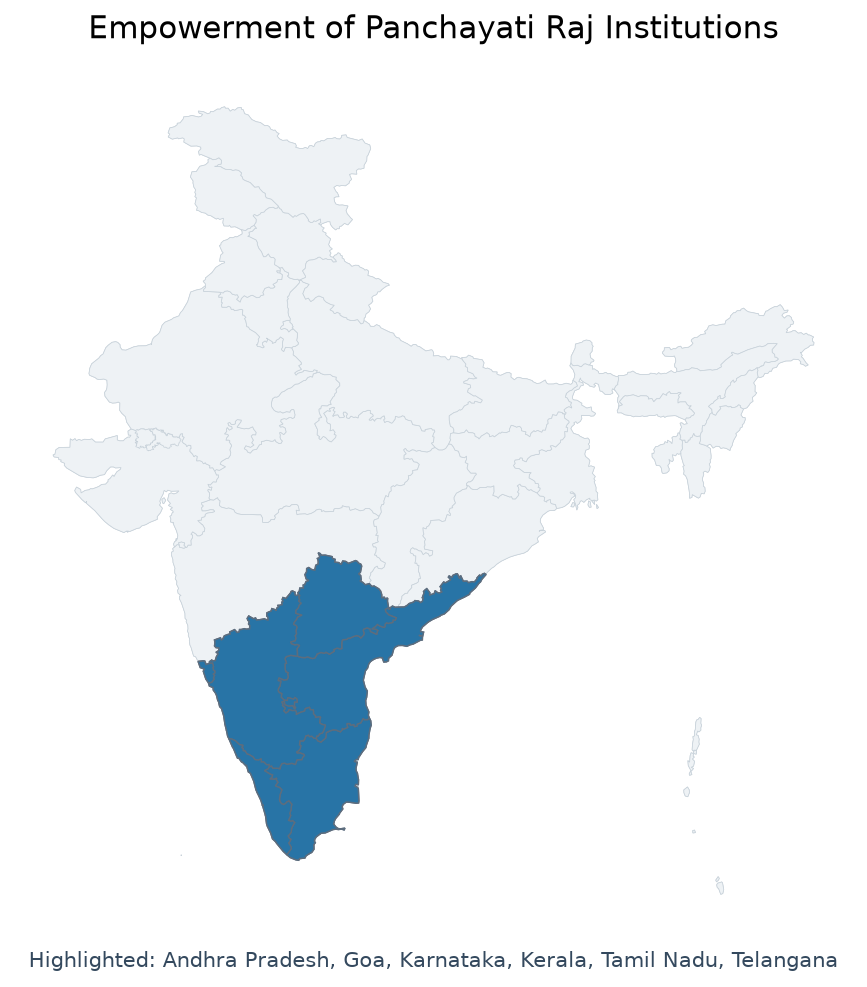
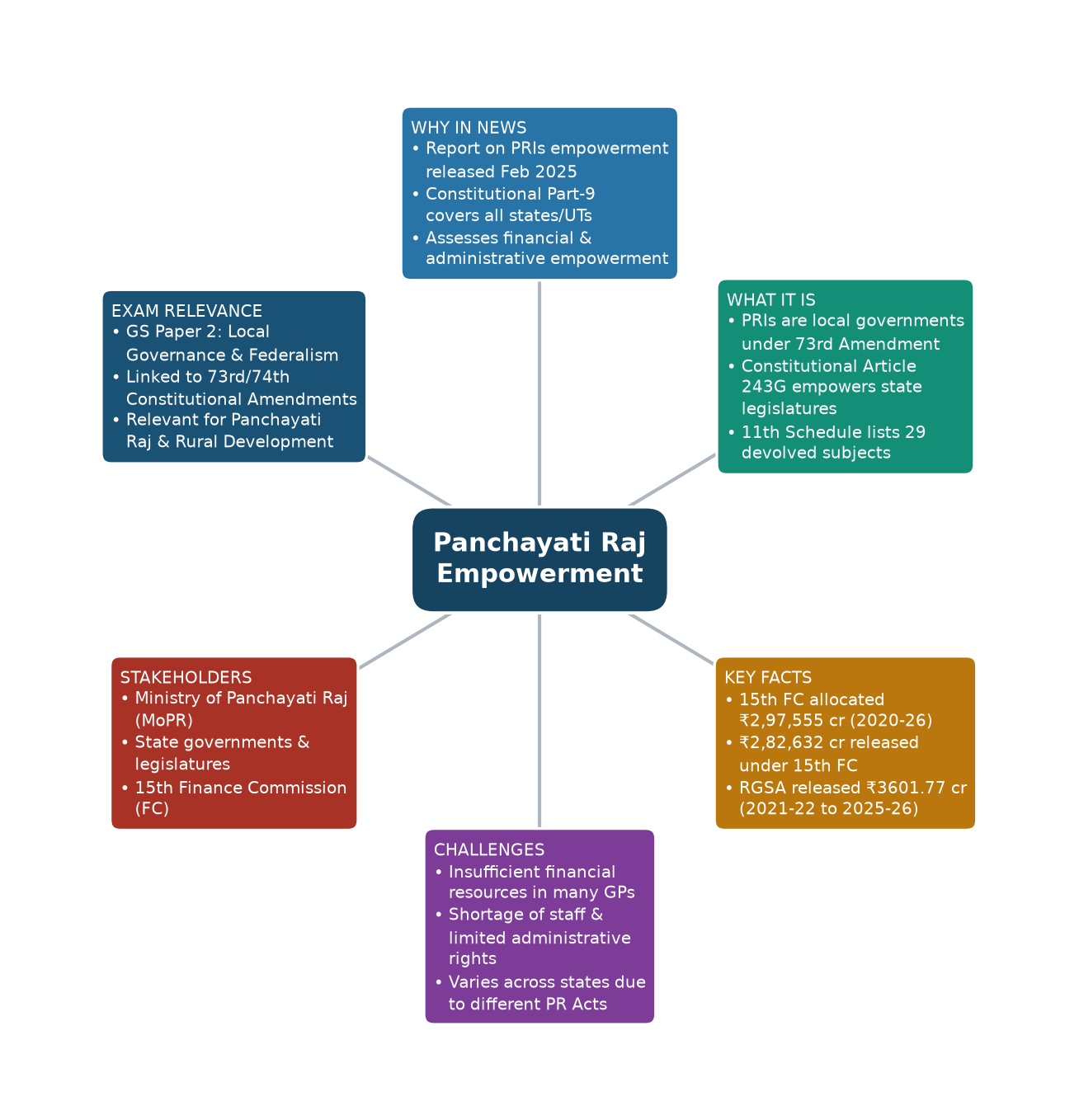
Map & concept mind-map: Empowerment of Panchayati Raj Institutions
Subject Relevance — Where This Topic Fits
- GS Paper II — Constitutional and Non-Constitutional Bodies (State Governments and Local Governance) | GS Paper III — Decentralised Planning, Fiscal Federalism, and E-Governance
- Prelims: Panchayati Raj Institutions (PRIs), 15th Finance Commission, e-Gram Swaraj, Public Financial Management System (PFMS), Constitution of India Part IX, 11th Schedule, Article 243(G), National Gram Swaraj Abhiyan (NGSA), State Finance Commissions
- Essay: Grassroots democracy and participatory governance: The bedrock of sustainable development, Technology as an enabler for inclusive and accountable governance
Quick Revision: PRIs derive their authority from Part IX of the Constitution, with Article 243(G) mandating devolution of 29 subjects in the 11th Schedule; their empowerment hinges on fiscal transfers (15th FC), digital governance (e-Gram Swaraj), and administrative autonomy (State Finance Commissions).
Why is this in the news?
The report highlights systemic challenges such as inadequate financial resources, staff shortages, and limited administrative autonomy faced by PRIs in implementing local development works, underscoring the need for constitutional compliance, fiscal devolution, and digital governance reforms.
Background
- The Panchayati Raj System is a constitutional framework established under Part IX of the Constitution, mandating decentralised governance through three-tier local bodies: Gram Panchayats, Panchayat Samitis, and Zila Parishads.
- Article 243(G) of the Constitution empowers State Legislatures to devolve powers and responsibilities to PRIs for planning and implementing schemes related to economic development and social justice, as listed in the 11th Schedule.
- State-specific Panchayati Raj Acts govern the establishment, functions, and fiscal autonomy of PRIs, reflecting the federal nature of local governance in India.
What are Panchayati Raj Institutions (PRIs)?
- PRIs are statutory local self-government bodies constituted under Part IX of the Constitution to ensure participatory democracy at the grassroots level, with Gram Panchayats as the foundational unit.
- PRIs are responsible for planning and implementing schemes related to economic development and social justice, as enumerated in the 11th Schedule of the Constitution, including agriculture, minor irrigation, animal husbandry, and rural housing.
- Article 243(D) mandates reservation of seats for Scheduled Castes, Scheduled Tribes, and women in PRIs, ensuring inclusive representation in local governance.
- The empowerment of PRIs is contingent upon three pillars: financial devolution (through State Finance Commissions and Finance Commissions), administrative autonomy (through devolution of functions), and capacity building (through schemes like NGSA and RGSA).
- Digital platforms like e-Gram Swaraj integrate planning, budgeting, accounting, monitoring, and auditing, enabling real-time tracking of funds and reducing leakages in PRI governance.
- State Finance Commissions (SFCs) are constitutional bodies mandated to review the financial position of PRIs and recommend measures for fiscal decentralisation, including grants-in-aid and tax-sharing mechanisms.
- Despite constitutional provisions, PRIs face challenges such as inadequate staffing, limited administrative powers, and uneven fiscal transfers, necessitating reforms in devolution mechanisms and institutional strengthening.
Key Features
| Feature | Significance |
|---|---|
| Constitutional Framework (Part IX) | Establishes Panchayati Raj Institutions (PRIs) as a three-tier system for local self-government, ensuring democratic decentralisation and grassroots participation in governance. |
| Devolution Index (2024) | Assesses PRIs across six dimensions—framework, function, finance, personnel, capacity building, and accountability—providing a comparative performance metric for states and UTs. |
| e-GramSwaraj Platform | Integrated digital governance tool enabling end-to-end planning, budgeting, accounting, monitoring, and online payments, enhancing transparency and financial management in PRIs. |
| 15th Finance Commission Grants | Provides untied funds (₹2,97,555 crore allocated) to PRIs for local development, with 90.73% of PRIs submitting audited reports in FY 2024-25, ensuring fiscal accountability. |
| Revised RGSA Scheme (2021-26) | Central sector scheme with ₹3,601.77 crore released over five years to strengthen PRI capacity, governance, and service delivery through training and institutional support. |
Why it Matters
Constitutional and Democratic
- Reinforces the constitutional mandate under Article 243(G) and the Eleventh Schedule, empowering PRIs to plan and execute schemes for economic development and social justice at the local level.
- Enhances participatory democracy by devolving powers to PRIs, ensuring grassroots representation and accountability in local governance.
- Strengthens the federal structure by decentralising administrative and financial powers to states, while ensuring uniformity in PRI functioning through constitutional provisions.
Fiscal and Administrative
- Facilitates untied fiscal transfers to PRIs via the 15th Finance Commission, enabling localised development and reducing dependency on state governments for funds.
- Promotes financial autonomy through e-GramSwaraj, which integrates PFMS, GEM, and AuditOnline for seamless fund flow, transparent procurement, and real-time auditing.
- Addressses systemic gaps in PRI administration by mandating capacity-building initiatives under RGSA, improving human resource management and service delivery.
Technological and Transparency
- Leverages digital governance (e-GramSwaraj) to eliminate leakages, reduce corruption, and ensure timely utilisation of funds, thereby enhancing trust in local institutions.
- Enables data-driven decision-making by providing real-time monitoring of PRI performance, expenditure, and audit compliance across states and UTs.
- Facilitates citizen engagement through digital platforms, promoting transparency and reducing information asymmetry between PRIs and beneficiaries.
Challenges
1. Inadequate Financial Resources
- PRIs face chronic underfunding despite constitutional provisions, with only ₹2,82,632 crore released against ₹2,97,555 crore allocated by the 15th Finance Commission (2020-26).
- Untied grants are often insufficient to cover operational costs, leading to delays in project implementation and reliance on ad-hoc funding mechanisms.
UPSC Link: GS-II: Local Governance; Fiscal Federalism
2. Human Resource Constraints
- Chronic shortage of skilled personnel at the PRI level, particularly in technical and administrative roles, hampers effective implementation of devolved functions.
- High attrition rates and lack of career progression opportunities discourage qualified individuals from joining PRI services, exacerbating capacity gaps.
UPSC Link: GS-II: Human Resource Development; Local Governance
3. Limited Administrative Autonomy
- PRIs often lack functional autonomy due to excessive state control over personnel appointments, fund utilisation, and decision-making processes.
- State-level bureaucratic interference undermines the principle of local self-governance, reducing PRIs to mere implementing agencies rather than autonomous entities.
UPSC Link: GS-II: Constitutional Provisions; Local Governance
4. Digital Divide and Infrastructure Gaps
- Uneven digital penetration across rural areas limits the effectiveness of e-GramSwaraj, with many PRIs lacking reliable internet connectivity or access to digital devices.
- Low digital literacy among PRI officials and beneficiaries poses a barrier to the adoption of digital governance tools, necessitating targeted capacity-building programmes.
UPSC Link: GS-III: Digital Infrastructure; Rural Development
5. Audit and Accountability Deficits
- Despite high audit report submission rates (90.73% in FY 2024-25), the quality of audits remains inconsistent, with many reports lacking granularity or actionable insights.
- Weak enforcement mechanisms for audit findings allow financial irregularities to persist, eroding public trust in PRI governance.
UPSC Link: GS-II: Accountability; Local Governance
Challenges — UPSC Perspective
| Issue | Concern |
|---|---|
| Untied Grants Shortfall | Insufficient funds released compared to allocations, limiting PRI operational flexibility and project execution. |
| Skill Gaps in PRIs | Lack of trained personnel in technical, financial, and administrative domains, impeding effective governance. |
| State Interference | Excessive state control over PRI functions, undermining local autonomy and decision-making. |
| Digital Exclusion | Low digital infrastructure and literacy in rural areas, reducing the efficacy of e-governance initiatives. |
| Audit Quality Issues | Inconsistent audit reports and weak enforcement mechanisms, allowing financial mismanagement to persist. |
Government Initiatives — Must-Memorise for Prelims
- 15th Finance Commission Grants (2020-26)
- Revised National Gram Swaraj Abhiyan (RGSA) (2021-26)
- e-GramSwaraj Platform
Way Forward
- Strengthen untied fiscal transfers to PRIs by ensuring 100% release of allocated funds and linking releases to performance metrics under the Devolution Index.
- Expand RGSA to include targeted capacity-building programmes for PRI officials, focusing on digital literacy, financial management, and project implementation.
- Accelerate the rollout of digital infrastructure in rural areas, including high-speed internet connectivity and subsidised access to digital devices for PRIs.
- Enhance audit mechanisms by mandating third-party audits for high-value projects and integrating real-time monitoring tools with e-GramSwaraj.
- Amend state-level PR Acts to reduce bureaucratic interference, ensuring PRIs have functional autonomy in personnel appointments and fund utilisation.
- Promote citizen-centric governance by integrating PRIs with national digital platforms (e.g., PM-KISAN, MGNREGA) for seamless service delivery and grievance redressal.
- Establish a dedicated fund under RGSA for research and innovation in local governance, encouraging PRIs to adopt best practices from other states.
- Conduct annual reviews of PRI performance using the Devolution Index, with public dissemination of results to foster competitive governance and accountability.
UPSC Value Addition
Keywords for Mains Answer-Writing
Panchayati Raj Institutions · 73rd Constitutional Amendment Act · Devolution Index · Local Governance · 15th Finance Commission · e-GramSwaraj · National Gram Swaraj Abhiyan · Financial Autonomy · Administrative Empowerment · Constitutional Provisions (Part IX) · Eleventh Schedule · State Subject · Audit Transparency · Digital Governance · Local Development Planning
Constitutional & Policy Linkages
- Article 243(G): Powers and responsibilities of PRIs for economic development and social justice.
- Eleventh Schedule: List of 29 subjects devolved to PRIs.
- Part IX: Constitutional framework for Panchayati Raj Institutions.
Concept Flow
Constitutional mandate (Part IX, Article 243(G), Eleventh Schedule) → Establishment of PRIs → Devolution of powers and funds → Implementation challenges (funding gaps, HR constraints) → Digital governance interventions (e-GramSwaraj) → Performance assessment (Devolution Index) → Accountability mechanisms (audits, citizen engagement) → Iterative reforms (RGSA, fiscal transfers).
Prelims Practice Questions
Q1. Which of the following is NOT a dimension assessed under the Devolution Index for Panchayati Raj Institutions (PRIs) as per the report released by the Ministry of Panchayati Raj?
- A. Framework
- B. Functions
- C. International Relations
- D. Capacity Building
Answer: C. International Relations — The Devolution Index evaluates PRIs across six dimensions: Framework, Functions, Finance, Personnel, Capacity Building, and Accountability. International Relations is not part of this assessment.
Q2. Under which constitutional provision are Panchayati Raj Institutions (PRIs) established and empowered in India?
- A. Article 243 to 243O (Part IX)
- B. Article 324 to 329 (Election Commission)
- C. Article 280 (Finance Commission)
- D. Article 300A (Property Rights)
Answer: A. Article 243 to 243O (Part IX) — PRIs are constitutionally established under Part IX (Articles 243 to 243O) of the Indian Constitution, which provides for their establishment, composition, powers, and functions.
Q3. The ‘e-GramSwaraj’ platform, launched by the Ministry of Panchayati Raj, primarily aims to:
- A. Facilitate online voting in local elections
- B. Enable end-to-end planning, budgeting, accounting, monitoring, and online payments for PRIs
- C. Provide telemedicine services in rural areas
- D. Promote digital literacy among school children
Answer: B. Enable end-to-end planning, budgeting, accounting, monitoring, and online payments for PRIs — e-GramSwaraj is an integrated digital platform designed to enhance transparency, accountability, and efficient financial management in PRIs through end-to-end governance processes.
Q4. Which of the following is a key objective of the National Gram Swaraj Abhiyan (NGSA) scheme?
- A. To provide financial assistance to state governments for infrastructure development
- B. To strengthen the capacity of PRIs through training and administrative support
- C. To promote agricultural exports from rural areas
- D. To establish new industrial corridors in rural districts
Answer: B. To strengthen the capacity of PRIs through training and administrative support — The NGSA scheme, a Centrally Sponsored Scheme, aims to strengthen PRIs by providing training, capacity building, and administrative support to enhance local governance.
Mains Practice Question
✍ Critically examine the role of the 73rd Constitutional Amendment Act in empowering Panchayati Raj Institutions (PRIs) in India. How has the Devolution Index framework contributed to assessing the effectiveness of devolution of powers to PRIs? Discuss with reference to recent initiatives like e-GramSwaraj and the National Gram Swaraj Abhiyan (NGSA).
Approach: Begin by outlining the constitutional provisions of the 73rd Amendment Act (Part IX) and its significance in establishing a three-tier system of local governance. Highlight the objectives of the Act, including the devolution of powers, functions, and finances to PRIs. Critically analyze the implementation challenges, such as inadequate financial resources, staff shortages, and limited administrative autonomy, as highlighted in the Devolution Index report. Discuss the role of the Devolution Index in providing a standardized framework for evaluating the performance of PRIs across six dimensions. Evaluate the impact of recent digital initiatives like e-GramSwaraj and NGSA in enhancing transparency, accountability, and financial management in PRIs. Conclude with suggestions for further strengthening PRIs, such as ensuring adequate devolution of funds, capacity building, and leveraging technology for better governance.
Source: PIB (Press Information Bureau)
Generated by AanyaAi for educational purpose.

- यूपी कैबिनेट ने लिया बड़ा फैसला: अग्निवीरों को मिलेगी 20% आरक्षण, मथुरा मिल बनेगी इथेनॉल प्लांट - September 16, 2026
- UP Cabinet Approves 20% Agniveer Quota & Mathura Ethanol Plant: Key Decisions Explained - September 16, 2026
- यूपी कैबिनेट ने अयोध्या में एनएसजी क्षेत्रीय केंद्र के लिए 65 एकड़ भूमि हस्तांतरण को मंजूरी दी - September 16, 2026

No Comments