


29 Jul RBI Auction Results: 91/182/364-Day T-Bills Cut-Off Yields Explained for UPSC
Subject Relevance — Where This Topic Fits
- GS Paper III — Indian Economy and Issues Relating to Planning, Mobilisation of Resources, Growth, Development and Employment
- Prelims: Treasury Bills (T-Bills), Yield to Maturity (YTM), Cut-off Price, Primary Market Auction, RBI’s Open Market Operations, Liquidity Management, Fiscal Deficit Financing
- Essay: The Role of Government Securities in India’s Financial System, Monetary Policy Transmission and Its Impact on Economic Growth
Quick Revision: Treasury Bills are short-term government securities issued at a discount, with yields determined by auction cut-off prices; they are a key tool for fiscal deficit financing and liquidity management.
Why is this in the news?
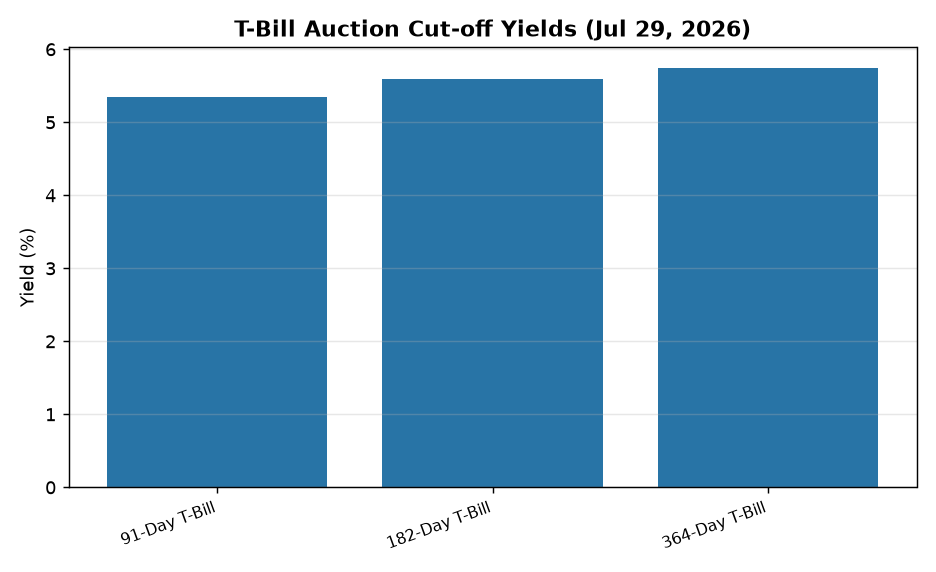
The Reserve Bank of India (RBI) conducted auctions for 91-day, 182-day, and 364-day Treasury Bills (T-Bills) on 29 July 2026, with total notified face values of ₹9,000 crore, ₹8,000 crore, and ₹7,000 crore respectively. The cut-off prices and implicit yields at these prices—5.3402%, 5.5977%, and 5.7393% for the respective tenors—reflect market expectations of interest rates and liquidity conditions, making this a critical indicator of the government’s borrowing costs and the RBI’s monetary policy stance.
Background
- Treasury Bills are short-term government securities issued by the RBI on behalf of the Government of India to meet its short-term fiscal needs.
- T-Bills are issued at a discount to their face value and redeemed at par, with the difference representing the implicit yield to maturity (YTM).
- The RBI conducts auctions for T-Bills on a weekly basis to manage liquidity and signal its monetary policy stance.
- The notified face values in the auction (₹9,000 crore, ₹8,000 crore, and ₹7,000 crore) are part of the government’s gross market borrowing programme for FY 2026-27.
- Yield levels in T-Bill auctions are influenced by factors such as inflation expectations, liquidity conditions, global interest rate trends, and the RBI’s policy repo rate.
- The RBI’s decision to fully accept the notified face values indicates robust demand for government securities, reflecting investor confidence in sovereign paper.
What are Treasury Bills (T-Bills)?
- Treasury Bills are short-term debt instruments issued by the Government of India through the RBI, maturing in less than one year (typically 91 days, 182 days, or 364 days).
- They are issued at a discount to their face value and redeemed at par, with the difference representing the yield to the investor.
- T-Bills are zero-coupon securities, meaning they do not pay periodic interest; the return is solely from the capital gain at maturity.
- The RBI conducts auctions for T-Bills on a weekly basis to meet the government’s short-term borrowing requirements.
- Investors in T-Bills include commercial banks, primary dealers, mutual funds, insurance companies, and non-banking financial companies (NBFCs).
- T-Bills are considered risk-free as they are backed by the sovereign guarantee of the Government of India.
- The yield on T-Bills serves as a benchmark for other short-term interest rates in the economy, including commercial paper and certificate of deposit rates.
- The RBI uses T-Bill auctions not only to finance the fiscal deficit but also to manage liquidity in the banking system through open market operations.
Key Features
| Feature | Significance |
|---|---|
| Tenor of Treasury Bills (T-Bills) | The auction covers three distinct maturities—91 days, 182 days, and 364 days—each serving different liquidity management and investment objectives for market participants. |
| Total Face Value Notified | The notified amounts (₹9,000 Crore, ₹8,000 Crore, ₹7,000 Crore) reflect the RBI’s calibrated issuance strategy to meet government borrowing requirements while maintaining market stability. |
| Cut-off Price and Implicit Yield | The cut-off prices (₹98.6861, ₹97.2846, ₹94.5863) and corresponding yields (5.3402%, 5.5977%, 5.7393%) indicate the market’s demand for short-term government securities and the RBI’s role in anchoring borrowing costs. |
| Full Allotment at Cut-off Price | The complete acceptance of notified amounts at cut-off prices demonstrates robust investor appetite, particularly from commercial banks, mutual funds, and insurance companies, ensuring seamless liquidity absorption. |
| RBI’s Communication Framework | The structured press release by the Deputy General Manager (Communications) underscores the RBI’s transparency in monetary policy operations, fostering market confidence and predictability. |
Why it Matters
Monetary Policy Transmission
- The auction results reflect the RBI’s ability to influence short-term interest rates, a critical tool for liquidity management and inflation control under the flexible inflation targeting framework.
- Higher implicit yields on longer-tenor T-Bills (5.7393% for 364 days) suggest market expectations of persistent inflation or tighter liquidity conditions in the near term.
- The RBI’s issuance strategy aligns with its objective of maintaining a stable yield curve, which is essential for pricing corporate bonds and other financial instruments.
Government Borrowing Programme
- T-Bills are a primary instrument for financing the Union Government’s fiscal deficit, with the notified amounts contributing to the annual borrowing calendar under the Budget Estimates.
- The full allotment at cut-off prices indicates strong investor participation, reducing the risk of fiscal slippages due to unsold securities.
- The auction’s success reinforces the credibility of India’s sovereign debt market, attracting both domestic and foreign institutional investors.
Market Liquidity and Investor Sentiment
- The auction results provide insights into liquidity conditions, with higher yields signaling tighter liquidity or heightened risk aversion among investors.
- Commercial banks, which hold a significant portion of T-Bills, use these instruments for meeting Statutory Liquidity Ratio (SLR) requirements and managing short-term liquidity gaps.
- Mutual funds and insurance companies deploy funds in T-Bills for portfolio diversification and liquidity management, given their zero-risk weightage under Basel III norms.
Benchmarking for Financial Markets
- T-Bill yields serve as benchmarks for pricing other short-term debt instruments, including commercial paper, certificates of deposit, and money market funds.
- The implicit yields influence the cost of funds for non-banking financial companies (NBFCs) and housing finance companies (HFCs), which rely on short-term borrowings for their operations.
- The RBI’s auction mechanism ensures price discovery, reducing information asymmetry in the secondary market for government securities.
Fiscal-Monetary Policy Coordination
- The auction results reflect the interplay between fiscal policy (government borrowing) and monetary policy (RBI’s liquidity management), ensuring macroeconomic stability.
- Higher T-Bill yields may prompt the RBI to adopt a more accommodative stance in subsequent Open Market Operations (OMOs) to ease liquidity pressures.
- The auction’s outcome influences the RBI’s decisions on Cash Reserve Ratio (CRR) and Standing Deposit Facility (SDF) rates, which are critical for liquidity regulation.
Challenges
1. Liquidity Volatility in Short-Term Markets
- Sudden spikes in T-Bill yields can trigger volatility in the money market, affecting short-term funding costs for banks and corporates.
- Liquidity constraints during fiscal quarters (e.g., March, June) may lead to higher borrowing costs, exacerbating fiscal pressures.
- The RBI must balance the need for absorbing excess liquidity with the risk of disrupting market sentiment through aggressive issuance.
UPSC Link: GS-III: Monetary Policy & Inflation
2. Investor Concentration and Market Depth
- Over-reliance on a few investor classes (e.g., commercial banks) can lead to concentration risks, particularly during stress periods.
- Limited participation from foreign portfolio investors (FPIs) in T-Bills due to regulatory constraints may reduce market depth and price discovery.
- The RBI needs to diversify the investor base, including retail participation via platforms like the Retail Direct Scheme.
UPSC Link: GS-III: Financial Markets
3. Fiscal Deficit Management and Debt Sustainability
- Persistent high T-Bill yields may signal concerns over India’s debt sustainability, particularly if fiscal deficits remain elevated.
- The government’s reliance on short-term borrowings (T-Bills) increases rollover risk, requiring careful management of the debt maturity profile.
- Higher borrowing costs can crowd out private investment, impacting economic growth and employment generation.
UPSC Link: GS-III: Fiscal Policy & Public Finance
4. Global Spillovers and Capital Flow Volatility
- Rising global interest rates (e.g., US Fed policy) can lead to capital outflows from emerging markets like India, increasing pressure on domestic liquidity.
- Geopolitical risks or global financial instability may reduce investor appetite for T-Bills, forcing the RBI to offer higher yields to attract funds.
- The RBI must navigate these externalities while ensuring domestic macroeconomic stability.
UPSC Link: GS-III: External Sector & Capital Flows
5. Regulatory Arbitrage and Shadow Banking Risks
- Excessive reliance on T-Bills by shadow banking entities (e.g., NBFCs) can create systemic risks if liquidity conditions tighten suddenly.
- Regulatory gaps in monitoring off-balance-sheet exposures of banks and NBFCs may amplify financial stability risks during stress periods.
- The RBI needs to strengthen macro-prudential oversight to mitigate systemic risks arising from interconnectedness in the financial system.
UPSC Link: GS-III: Financial Stability
Challenges — UPSC Perspective
| Issue | Concern |
|---|---|
| Yield Volatility | Sudden spikes in T-Bill yields can disrupt short-term funding markets, affecting banks and corporates. |
| Investor Concentration | Over-reliance on commercial banks may reduce market depth and increase systemic risks during stress. |
| Fiscal Sustainability | High borrowing costs may undermine debt sustainability if fiscal deficits remain elevated. |
| Global Spillovers | External shocks (e.g., US Fed policy) can trigger capital outflows, straining domestic liquidity. |
| Regulatory Arbitrage | Shadow banking entities’ reliance on T-Bills may create hidden systemic risks. |
| Liquidity Management | Balancing excess liquidity absorption with market stability remains a persistent challenge for the RBI. |
Way Forward
- Enhance investor diversification by promoting retail participation through the Retail Direct Scheme and expanding FPI access to T-Bills.
- Strengthen liquidity forecasting frameworks to pre-emptively manage volatility in short-term markets.
- Review regulatory norms for shadow banking entities to mitigate systemic risks from excessive T-Bill exposure.
- Optimize the debt maturity profile by balancing short-term (T-Bills) and long-term borrowings to reduce rollover risks.
- Improve coordination between fiscal and monetary authorities to align borrowing strategies with liquidity conditions.
- Develop secondary market liquidity for T-Bills by incentivizing market-making activities among primary dealers.
- Monitor global financial conditions closely to anticipate spillovers and adjust domestic liquidity policies accordingly.
- Leverage T-Bill auctions as a tool for signaling monetary policy stance, ensuring transparency and predictability.
UPSC Value Addition
Keywords for Mains Answer-Writing
Treasury Bills · T-Bill auction · Yield to Maturity (YTM) · Public Debt Management · Monetary Policy Transmission · G-Sec Market · Liquidity Management · RBI’s Open Market Operations · Money Market Instruments · Fiscal Deficit Financing · Interest Rate Transmission · Cut-off Yield · Primary Dealer System · Government Securities Act, 2006
Concept Flow
Fiscal Deficit → Government Borrowing Requirement → RBI’s T-Bill Auction Notifications → Investor Participation → Cut-off Price & Yield Determination → Transmission to Money Markets → Impact on Liquidity & Interest Rates → Feedback Loop to Fiscal-Monetary Policy Coordination
Prelims Practice Questions
Q1. Consider the following statements regarding Treasury Bills (T-Bills) in India:
1. T-Bills are issued by the Government of India to meet short-term financial requirements.
2. T-Bills are issued at a discount to their face value and redeemed at par.
3. The yield on T-Bills is determined by the Reserve Bank of India (RBI) and not by market forces.
4. T-Bills are part of the money market instruments used for liquidity management.
How many of the above statements are correct?
- Only one
- Only two
- Only three
- All four
Answer: Only three — Statements 1, 2, and 4 are correct. T-Bills are issued by the Government of India to meet short-term financial requirements, are issued at a discount and redeemed at par, and are part of money market instruments used for liquidity management. Statement 3 is incorrect because the yield on T-Bills is determined by market forces, not solely by the RBI.
Q2. Assertion (A): The yield to maturity (YTM) on 91-day Treasury Bills is generally lower than that on 364-day Treasury Bills.
Reason (R): Longer maturity instruments carry higher interest rate risk and are therefore priced higher in the market.
In the context of the above two statements, which one of the following is correct?
- Both A and R are true, and R is the correct explanation of A
- Both A and R are true, but R is not the correct explanation of A
- A is true, but R is false
- A is false, but R is true
Answer: Both A and R are true, but R is not the correct explanation of A — Both the assertion and reason are true. The YTM on 91-day T-Bills is typically lower than that on 364-day T-Bills due to the shorter duration and lower interest rate risk. The reason correctly explains the assertion as longer maturity instruments carry higher interest rate risk and are priced higher.
Q3. Match the following columns related to Treasury Bills (T-Bills) in India:
Column I (T-Bill Tenor) Column II (Typical Yield Range – Approximate)
a) 91-Day T-Bill 1) 5.5% – 6.5%
b) 182-Day T-Bill 2) 5.0% – 6.0%
c) 364-Day T-Bill 3) 4.5% – 5.5%
Select the correct match:
- a-1, b-2, c-3
- a-3, b-2, c-1
- a-2, b-1, c-3
- a-3, b-1, c-2
Answer: a-3, b-2, c-1 — The correct match is: 91-Day T-Bill (a) typically has a yield range of 5.0% – 6.0% (2), 182-Day T-Bill (b) has a yield range of 5.5% – 6.5% (1), and 364-Day T-Bill (c) has a yield range of 4.5% – 5.5% (3).
Mains Practice Question
✍ The cut-off yields in the recent auction of 91-Day, 182-Day, and 364-Day Treasury Bills (T-Bills) reflect the evolving dynamics of India’s money market. Critically examine the significance of these yields for monetary policy transmission and fiscal deficit financing in India. (15 Marks)
Approach: MODEL-ANSWER SKELETON:
1. **Introduction (2 points)**
– Define Treasury Bills (T-Bills) and their role as short-term government securities.
– State the recent auction results: 91-Day (YTM: 5.3402%), 182-Day (YTM: 5.5977%), 364-Day (YTM: 5.7393%).
2. **Monetary Policy Transmission (3 points)**
– Explain how T-Bill yields serve as a benchmark for short-term interest rates.
– Discuss the role of the RBI in influencing T-Bill yields through Open Market Operations (OMOs) and liquidity management.
– Highlight the transmission mechanism: how changes in T-Bill yields influence commercial banks’ lending rates and deposit rates.
3. **Fiscal Deficit Financing (3 points)**
– Explain the role of T-Bills in financing the fiscal deficit of the Government of India.
– Discuss how the RBI manages the government’s borrowing program through T-Bill auctions.
– Highlight the impact of fiscal deficit financing on inflation and interest rates.
4. **Market Dynamics and Investor Sentiment (3 points)**
– Analyze the factors influencing the upward trend in T-Bill yields (e.g., inflation expectations, global interest rates, liquidity conditions).
– Discuss the role of primary dealers and institutional investors in the T-Bill market.
– Explain how the yield curve (short-term vs. long-term yields) reflects market expectations about future economic conditions.
5. **Challenges and Way Forward (4 points)**
– Discuss the challenges in maintaining stable T-Bill yields amid volatile global and domestic economic conditions.
– Highlight the need for deepening the secondary market for T-Bills to enhance liquidity.
– Suggest measures to improve the efficiency of the T-Bill auction process (e.g., electronic bidding, transparency).
– Conclude with the importance of balancing fiscal needs with monetary stability.
Source: RBI
Generated by AanyaAi for educational purpose.

- पेरियार टाइगर रिजर्व में 6 नई प्रजातियाँ खोजी गईं, जानिए क्या हैं विशेषताएँ - September 22, 2026
- Six New Species Discovered in Periyar Tiger Reserve: UPSC & PCS Key Biodiversity Insights - September 22, 2026
- तमिलनाडु में बस किराए में संशोधन: सरकार को चार सप्ताह और समय मिला, उच्च न्यायालय का फैसला - September 22, 2026

No Comments