


22 Sep Six New Species Discovered in Periyar Tiger Reserve: UPSC & PCS Key Biodiversity Insights
✎ Systematic faunal surveys in protected areas like the Periyar Tiger Reserve are essential for updating species inventories, detecting ecological changes, and informing conservation strategies, with odonates serving as key…
Subject Relevance — Where This Topic Fits
- GS Paper III — Environment, Ecology, Biodiversity and Climate Change
- Prelims: Biodiversity hotspot, Tiger Reserve, Odonata, Endemic species, Elevational gradient, Ecotonal habitat, Faunal survey, Conservation assessment
- Essay: Conservation of biodiversity as a national imperative, The role of systematic ecological surveys in sustainable development
Quick Revision: Systematic faunal surveys in protected areas like the Periyar Tiger Reserve are essential for updating species inventories, detecting ecological changes, and informing conservation strategies, with odonates serving as key bioindicators of aquatic ecosystem health.
Why is this in the news?
A four-day faunal survey conducted in the Periyar Tiger Reserve (PTR) documented six species previously undocumented in the reserve, including one bird (golden-headed cisticola), one butterfly (common onyx), and four odonate species (dragonflies and damselflies). The survey raised the cumulative bird count to 347, butterfly count to 284, and odonate checklist to 111, underscoring the reserve’s ecological significance and the necessity of systematic biodiversity assessments for conservation planning.
Background
- The Periyar Tiger Reserve (PTR), located in the Western Ghats of Keralam, is a globally significant biodiversity hotspot.
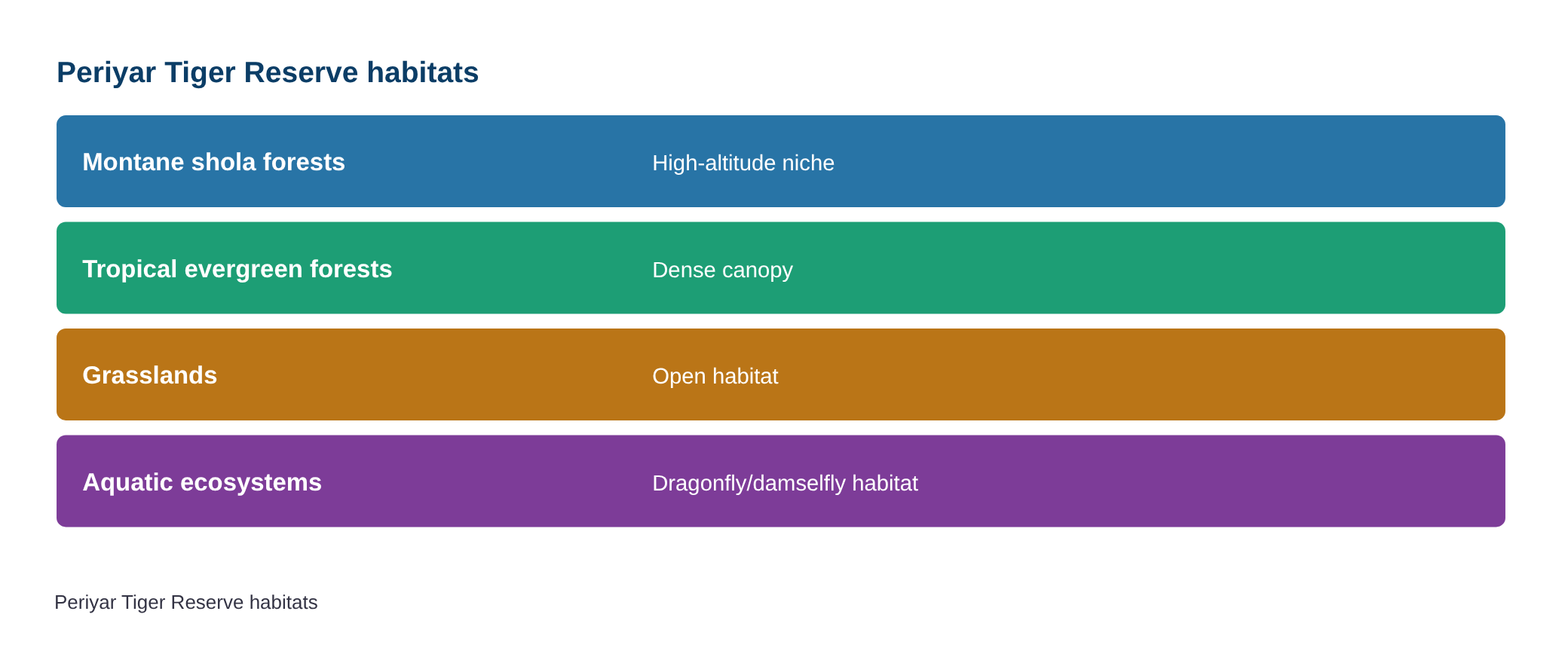
- Protected areas (PAs) in India, including tiger reserves, serve as critical refugia for endemic and threatened species, with PTR being a prime example of a multi-habitat ecosystem encompassing tropical evergreen forests, grasslands, and montane shola forests.
- Systematic faunal surveys are mandated to assess species richness, distribution, and habitat use, thereby informing conservation strategies.
- The Western Ghats hosts over 5,000 species of flowering plants, 139 mammal species, 508 bird species, and 179 amphibian species, many of which are endemic.
- Odonata (dragonflies and damselflies) are bioindicators of aquatic ecosystem health, with their presence or absence reflecting water quality, habitat integrity, and climate variability.
- The PTR has been subject to intensive biodiversity documentation over the past decade, with prior surveys contributing to the discovery of new species and the refinement of its species inventories.
What are the methodological and ecological implications of the Periyar Tiger Reserve faunal survey?
- The survey employed a stratified sampling design, deploying 21 teams across 20 base camps to cover varied elevations (600–2,000 metres), habitats (evergreen forests, grasslands, ecotones), and accessibility gradients, ensuring comprehensive spatial coverage.
- The golden-headed cisticola (Cisticola exilis), a rare passerine bird, is typically associated with higher elevations and grassland ecosystems, indicating the PTR’s role in supporting species with narrow habitat preferences.
- The common onyx butterfly (Horaga onyx) and four odonate species—parakeet darner (Gynacantha millardi), fraser’s clubtail (Acrogomphus fraseri), spiny horntail (Burmagomphus chaukulensis), and nilgiri clawtail (Lamelligomphus nilgiriensis)—were recorded for the first time in PTR, expanding its lepidopteran and odonate inventories.
- The survey documented 174 bird species, raising the reserve’s cumulative bird count to 347, while 192 butterfly species were recorded, increasing the total to 284, and 68 odonate species were documented, raising the odonate checklist to 111, demonstrating the PTR’s rich faunal diversity.
- The inclusion of 75 delegates from 21 NGOs, academic institutions, and forest department officials highlights the collaborative nature of biodiversity assessments.
- The survey’s findings underscore the importance of elevational gradients and ecotonal habitats in supporting diverse wildlife assemblages, as these transitional zones often harbour species with overlapping but distinct ecological requirements.
- Systematic surveys are critical for detecting shifts in species distribution and habitat use, which may indicate environmental changes such as climate variability, habitat degradation, or pollution, thereby informing adaptive conservation management.
- The PTR’s unpolluted water bodies and healthy ecosystems, as noted by researchers, are essential for sustaining aquatic and semi-aquatic species, including odonates, which are highly sensitive to water quality and habitat alterations.
Key Features
| Feature | Significance |
|---|---|
| Golden-headed cisticola (Cisticola exilis) | A rare bird species typically found at higher elevations, indicating the reserve’s elevational gradient supports diverse avian habitats. |
| Common onyx butterfly (Horaga onyx) | A newly recorded butterfly species, raising the reserve’s butterfly count to 284, reflecting the health of floral and faunal interactions. |
| Four odonate species (Parakeet darner, Fraser’s clubtail, Spiny horntail, Nilgiri clawtail) | First-time records of these dragonflies and damselflies in PTR, expanding the odonate checklist to 111 species, underscoring the reserve’s aquatic and riparian ecosystem integrity. |
| Elevational gradient and ecotonal habitats | The reserve’s varied topography and transition zones (evergreen forests, grasslands) provide niche habitats for species with specific ecological requirements. |
| Systematic biodiversity surveys | Regular, multi-institutional surveys over the past decade enable long-term monitoring of species distribution and habitat use, strengthening conservation evidence. |
Why it Matters
Ecological
- Demonstrates the Periyar Tiger Reserve’s role as a biodiversity hotspot, hosting 347 bird, 284 butterfly, and 111 odonate species, with ongoing discoveries indicating underexplored ecological niches.
- Highlights the importance of elevational gradients and ecotonal habitats in supporting species with narrow ecological tolerances, such as the golden-headed cisticola.
- Reinforces the reserve’s status as a critical habitat for both resident and migratory species, given the inclusion of rare and range-restricted taxa.
- Underscores the value of pristine water bodies and unpolluted ecosystems in sustaining diverse faunal assemblages, including odonates dependent on aquatic habitats.
Scientific and Research
- Illustrates the necessity of systematic, multi-institutional biodiversity surveys for documenting species distributions and identifying range extensions.
- Provides empirical data for long-term ecological monitoring, aiding in the assessment of habitat health and species resilience to environmental changes.
- Demonstrates the effectiveness of collaborative research efforts involving NGOs, academic institutions, and forest departments in biodiversity documentation.
- Contributes to the refinement of species inventories, which are essential for conservation planning and management in protected areas.
Conservation and Management
- Strengthens the evidence base for conservation strategies by identifying new species records, which may influence habitat-specific management interventions.
- Highlights the role of tiger reserves in serving as living laboratories for biodiversity research, beyond their primary mandate of tiger conservation.
- Emphasises the need for continuous monitoring to detect shifts in species distributions, which may signal ecological changes or emerging threats.
Challenges
1. Habitat Fragmentation and Isolation
- The reserve’s elevational gradient, while beneficial for biodiversity, may also create isolated habitats, limiting species dispersal and genetic exchange.
- Encroachment or developmental activities in peripheral zones could exacerbate habitat fragmentation, threatening species with narrow ecological niches.
UPSC Link: GS3: Biodiversity conservation, Habitat fragmentation
2. Climate Change Impacts
- Shifts in temperature and precipitation patterns may alter elevational vegetation zones, potentially displacing species adapted to specific climatic conditions.
- Changes in hydrological regimes could affect odonate populations dependent on clean water bodies, with cascading effects on aquatic food webs.
UPSC Link: GS3: Climate change, Species distribution shifts
3. Invasive Species and Pathogens
- The introduction of invasive flora or fauna could disrupt native ecosystems, outcompeting or preying upon newly documented species.
- Emerging diseases or pathogens, facilitated by anthropogenic activities, pose a risk to both resident and migratory species within the reserve.
UPSC Link: GS3: Invasive species, Wildlife diseases
4. Resource Constraints for Monitoring
- Sustaining systematic biodiversity surveys requires sustained funding, technical expertise, and institutional collaboration, which may face resource limitations.
- Logistical challenges, such as accessibility in remote or high-elevation areas, can hinder comprehensive monitoring efforts.
UPSC Link: GS3: Protected area management, Conservation funding
5. Anthropogenic Pressures
- Tourism, agriculture, and infrastructure development in and around the reserve may exert pressure on habitats, particularly ecotonal zones.
- Pollution from agricultural runoff or waste disposal could degrade water quality, impacting aquatic-dependent species like odonates.
UPSC Link: GS3: Ecotourism impacts, Pollution control
Challenges — UPSC Perspective
| Issue | Concern |
|---|---|
| Habitat fragmentation | Isolation of populations due to elevational gradients and peripheral encroachment. |
| Climate change | Alteration of vegetation zones and hydrological regimes, affecting species distributions. |
| Invasive species | Potential disruption of native ecosystems and competition with newly documented species. |
| Resource constraints | Limited funding and expertise for sustained biodiversity monitoring. |
| Anthropogenic pressures | Tourism, agriculture, and pollution threatening habitat integrity. |
Way Forward
- Enhance long-term biodiversity monitoring by integrating citizen science initiatives with systematic surveys to cover under-explored elevations and habitats.
- Develop habitat-specific conservation plans for species with narrow ecological niches, such as the golden-headed cisticola and newly recorded odonates.
- Strengthen inter-institutional collaborations to standardise data collection methods and ensure comparability across surveys.
- Implement climate-resilient habitat management strategies, including the restoration of ecotonal zones and protection of water bodies.
- Conduct targeted studies on the ecological requirements and threats to newly documented species to inform conservation priorities.
- Integrate biodiversity data into the reserve’s management plans to guide habitat restoration, tourism regulation, and anti-poaching efforts.
- Promote awareness among local communities and tourists about the ecological significance of the reserve and the importance of habitat conservation.
UPSC Value Addition
Keywords for Mains Answer-Writing
Biodiversity conservation · Protected Area Network · Tiger Reserves in India · Species discovery and documentation · Western Ghats ecology · Faunal surveys · Ecosystem services · Conservation management · Habitat heterogeneity · Elevational gradient in biodiversity · Odontata diversity · Butterfly diversity · Avian diversity · Western Ghats biodiversity hotspot · Collaborative conservation · Systematic biodiversity assessment
Concept Flow
Periyar Tiger Reserve’s elevational gradient and diverse habitats → Supports niche-specific species assemblages → Systematic biodiversity surveys by multi-institutional teams → Documents new species records and range extensions → Discovery of six new species (bird, butterfly, odonates) → Expands the reserve’s faunal inventory → Evidence of pristine ecosystems and healthy water bodies → Indicates low anthropogenic disturbance → Long-term monitoring data → Informs conservation strategies and habitat management → Identification of challenges (fragmentation, climate change) → Guides adaptive management and policy interventions → Synthesis of findings → Reinforces the reserve’s role in biodiversity conservation and ecological research
Prelims Practice Questions
Q1. Consider the following statements regarding the Periyar Tiger Reserve (PTR):
1. PTR is located in the state of Keralam.
2. PTR is part of the Western Ghats biodiversity hotspot.
3. PTR has documented six new species of mammals in a recent survey.
4. PTR’s elevational gradient supports diverse wildlife assemblages.
How many of the above statements are correct?
- Only one
- Only two
- Only three
- All four
Answer: Only three — Statements 1, 2, and 4 are correct. Statement 3 is incorrect as the recent survey documented new species of birds, butterflies, and odonates, not mammals.
Q2. Assertion (A): Systematic biodiversity surveys are essential for long-term conservation management in tiger reserves.
Reason (R): Such surveys help in understanding changes in species distribution and habitat use.
Options:
A. Both A and R are true, and R is the correct explanation of A.
B. Both A and R are true, but R is NOT the correct explanation of A.
C. A is true, but R is false.
D. A is false, but R is true.
Answer: ? — Both Assertion (A) and Reason (R) are true, and Reason (R) correctly explains Assertion (A). Systematic surveys provide data on species distribution and habitat use, which is critical for conservation planning.
Q3. Match the following species groups with their respective counts documented in the recent Periyar Tiger Reserve survey:
Species Group | Documented Count
1. Bird species | A. 111
2. Butterfly species | B. 284
3. Odonate species | C. 347
4. Spider species | D. 30
Options:
A. 1-C, 2-B, 3-A, 4-D
B. 1-D, 2-A, 3-B, 4-C
C. 1-B, 2-C, 3-D, 4-A
D. 1-A, 2-D, 3-C, 4-B
Answer: ? — The correct match is: 1-C (Bird species: 347), 2-B (Butterfly species: 284), 3-A (Odonate species: 111), 4-D (Spider species: 30).
Mains Practice Question
✍ Critically examine the significance of systematic faunal surveys in tiger reserves for biodiversity conservation in India. Illustrate your answer with reference to the recent discovery of six new species in the Periyar Tiger Reserve. (15 Marks)
Approach: MODEL-ANSWER SKELETON:
1. **Introduction (2 marks)**: Define tiger reserves and their role in biodiversity conservation in India. Mention the Western Ghats as a biodiversity hotspot and the importance of the Protected Area Network (PAN).
2. **Systematic faunal surveys: Objectives and methodology (3 marks)**: Explain the purpose of systematic surveys—baseline data generation, monitoring species distribution, habitat use, and ecosystem health. Reference the collaborative nature of the Periyar survey (75 delegates, 21 NGOs, academic institutions) and its deployment across ecological zones.
3. **Biodiversity documentation and its implications (4 marks)**: Discuss the discovery of six new species (1 bird, 1 butterfly, 4 odonates) and their significance. Link to the elevational gradient in PTR, evergreen forests, grasslands, and ecotonal habitats. Highlight how such discoveries reflect the health of the ecosystem and unpolluted water bodies.
4. **Conservation management and policy relevance (3 marks)**: Explain how systematic surveys strengthen evidence-based conservation. Reference the role of PTR’s field director in using survey data for long-term management. Discuss the necessity of regular surveys in even well-studied areas like Periyar.
5. **Challenges and limitations (2 marks)**: Acknowledge constraints such as logistical challenges in covering varied elevations, habitat accessibility, and the need for sustained funding and institutional collaboration.
6. **Conclusion (1 mark)**: Summarise the critical role of systematic faunal surveys in tiger reserves for biodiversity conservation, policy formulation, and adaptive management. Emphasise the need for scaling such efforts across India’s tiger reserves.
Source: The Hindu
Generated by AanyaAi for educational purpose.
Related guides on our sites
- Best PSIR optional coaching for upsc
- Best economics optional coaching for upsc
- Best PSIR optional teacher for upsc
- Best teacher of PSIR optional for upsc

- Six New Species Discovered in Periyar Tiger Reserve: UPSC & PCS Key Biodiversity Insights - September 22, 2026
- तमिलनाडु में बस किराए में संशोधन: सरकार को चार सप्ताह और समय मिला, उच्च न्यायालय का फैसला - September 22, 2026
- Madras HC gives Tamil Nadu 4 weeks to revise bus fares amid diesel price surge - September 22, 2026

No Comments