


29 Jul Rajya Sabha Passes Bill: Insult to Vande Mataram Now Criminal Offence
Subject Relevance — Where This Topic Fits
- GS Paper II — Polity and Governance: Fundamental Duties, Constitutional Provisions, and Parliamentary Procedures | GS Paper III — Internal Security: Laws for National Symbols and Public Order
- Prelims: Article 51A (Fundamental Duties), Prevention of Insults to National Honour Act, 1971, Vande Mataram, National Anthem, National Flag, Parliamentary Proceedings, Fundamental Rights vs Duties
- Essay: The interplay between national identity, constitutional morality, and legislative intent in safeguarding national symbols, Ethics of dissent versus duty to uphold national symbols in a democratic framework
Quick Revision: The Prevention of Insults to National Honour (Amendment) Bill, 2026 extends criminal liability for insults to *Vande Mataram* to three years imprisonment, aligning it with protections for the national anthem under the 1971 Act, while raising constitutional questions on free speech versus national symbol respect.
Why is this in the news?
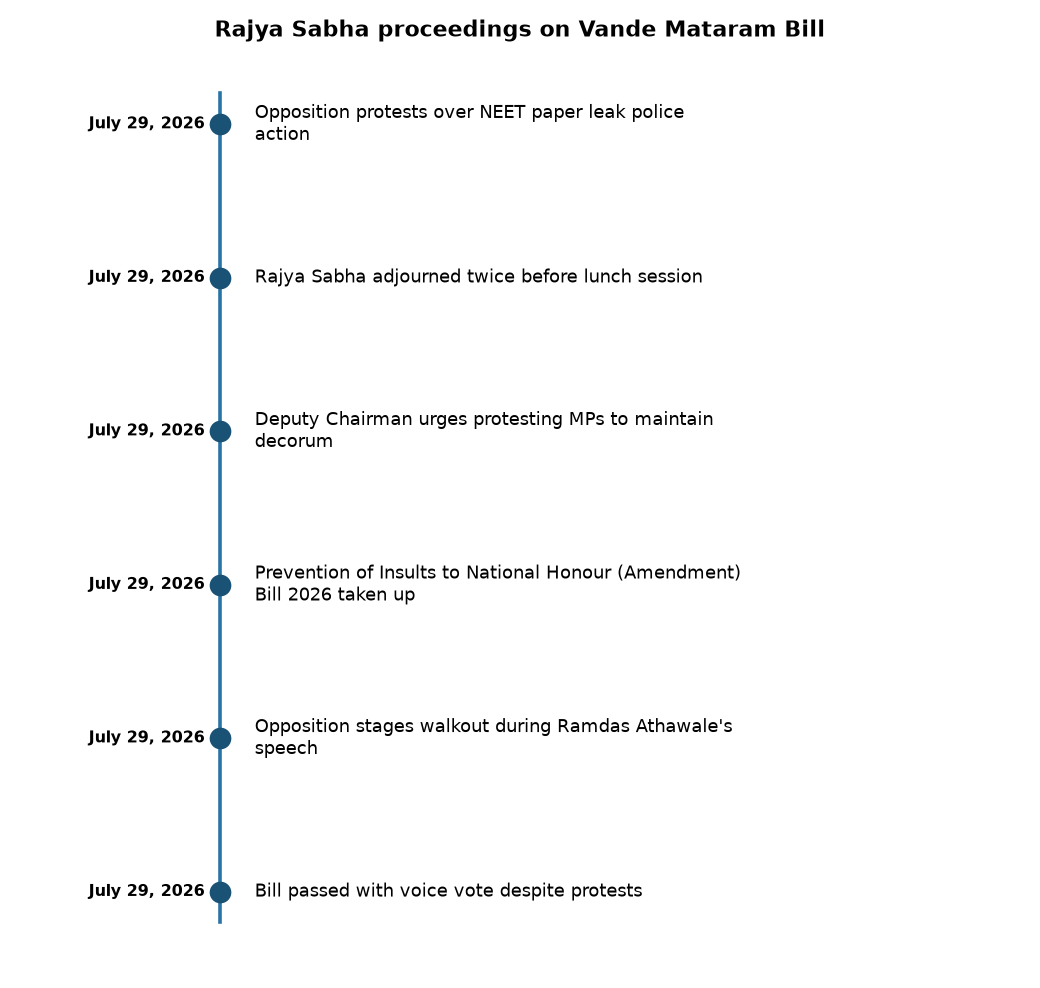
The Rajya Sabha passed the Prevention of Insults to National Honour (Amendment) Bill, 2026 on 29 July 2026, extending criminal liability for insults to the national song *Vande Mataram*, aligning it with protections already accorded to the national anthem and flag. The legislative move sparked political controversy, with Opposition parties staging a walkout protesting police action against NEET paper leak demonstrators, thereby highlighting tensions between legislative intent and procedural democracy.
Background
- The *Vande Mataram* song, composed by Bankim Chandra Chattopadhyay in 1876.
- The Prevention of Insults to National Honour Act, 1971, originally criminalised insults to the national flag, Constitution, and national anthem, but did not explicitly include *Vande Mataram*.
- Parliamentary debates on national symbols often intersect with debates on free speech, cultural nationalism, and the balance between Fundamental Rights (Article 19) and Fundamental Duties (Article 51A).
- Opposition protests in the Rajya Sabha reflected broader societal tensions regarding police action in public demonstrations, linking procedural democracy with legislative priorities.
- The Bill’s passage via voice vote, despite Opposition walkout, underscores the procedural dynamics of parliamentary functioning in contentious legislative matters.
What is the Prevention of Insults to National Honour (Amendment) Bill, 2026?
- The Bill amends the Prevention of Insults to National Honour Act, 1971, to include *Vande Mataram* within the ambit of protected national symbols, alongside the national flag, Constitution, and national anthem.
- It proposes criminalisation of acts of desecration, disrespect, or insult to *Vande Mataram*, with penalties including imprisonment up to three years and/or fine.
- The legislation aligns *Vande Mataram* with the same statutory protections as the national anthem (*Jana Gana Mana*).
- The Bill was introduced in the Rajya Sabha on 24 July 2026 and passed on 29 July 2026 via voice vote, reflecting government’s legislative priority.
- The Bill’s passage occurred amid Opposition protests, highlighting tensions between legislative intent and parliamentary decorum, particularly regarding police action in public demonstrations.
- The legislation raises constitutional questions regarding the balance between free speech (Article 19(1)(a)) and the duty to respect national symbols (Article 51A(a)).
- Critics argue that such legislation may be used to suppress dissent, while proponents assert it strengthens national unity and respect for constitutional symbols.
Key Features
| Feature | Significance |
|---|---|
| Criminalisation of insult to Vande Mataram | Extends statutory protection to the national song, aligning it with the national anthem under the Prevention of Insults to National Honour Act, 1971, thereby criminalising desecration or disrespect with imprisonment up to three years. |
| Amendment to the Prevention of Insults to National Honour Act, 1971 | Introduces specific provisions for Vande Mataram, reflecting its cultural and historical significance in India’s freedom struggle and national identity. |
| Voice vote passage in Rajya Sabha | Demonstrates bipartisan or majority support for the Bill, though Opposition protests indicate ideological divergence on its necessity and constitutional validity. |
| Opposition walkout during debate | Highlights political contention, with parties raising unrelated grievances (e.g., NEET paper leak protests) to stall proceedings, reflecting broader legislative friction. |
| Year-long celebrations of Vande Mataram’s 150th anniversary | Contextualises the Bill as part of national commemorative efforts, reinforcing its symbolic value in India’s socio-political discourse. |
Why it Matters
Constitutional and Legal
- The Bill reinforces the constitutional mandate under Article 51A(a) to respect the Constitution and its ideals, including national symbols, by providing statutory teeth to prevent insults.
- It aligns with the Supreme Court’s interpretation in *Union of India v. Naveen Jindal* (2004), which upheld the right to freedom of expression but balanced it with the duty to respect national symbols.
- The amendment treats Vande Mataram at par with the national anthem (*Jana Gana Mana*), ensuring uniform legal protection for all national symbols under the Prevention of Insults to National Honour Act, 1971.
Political and Social
- The Bill reflects the government’s emphasis on cultural nationalism, positioning Vande Mataram as a unifying symbol amid debates on pluralism and minority rights.
- Opposition protests and walkouts underscore ideological divides, with parties questioning the Bill’s necessity and potential misuse for political polarisation.
- The timing coincides with heightened nationalistic sentiments during the 150th anniversary of Vande Mataram, amplifying its symbolic and emotive resonance.
Administrative and Enforcement
- The criminalisation introduces a deterrent mechanism against desecration, requiring law enforcement agencies to monitor and act on violations, potentially straining administrative resources.
- The provision of imprisonment up to three years may lead to judicial scrutiny over proportionality, especially in cases involving artistic or dissenting expressions.
Challenges
1. Constitutional Validity and Freedom of Expression
- Risk of the Bill being challenged in the Supreme Court for violating Article 19(1)(a) (freedom of speech and expression) if interpreted as overly broad or vague.
- Potential conflict with artistic or critical expressions about national symbols, as seen in past judicial rulings on similar laws.
- Opposition’s argument that the Bill is unconstitutional, citing it as an attempt to impose majoritarian cultural values.
UPSC Link: GS II: Fundamental Rights
2. Political Polarisation and Legislative Disruption
- Ongoing Opposition protests and walkouts disrupt parliamentary proceedings, delaying legislative agendas and eroding consensus-building.
- The Bill’s passage amidst protests may deepen political divides, particularly on issues of nationalism versus pluralism.
- Potential for the Bill to be weaponised in electoral politics, with parties using it to mobilise support or critique opponents.
UPSC Link: GS II: Parliament and State Legislatures
3. Implementation and Enforcement Challenges
- Ambiguity in defining ‘insult’ or ‘desecration’ of Vande Mataram may lead to arbitrary enforcement, raising concerns over due process.
- Law enforcement agencies may face operational challenges in monitoring and prosecuting violations, given the subjective nature of ‘insult’.
- Overlapping jurisdictions between central and state laws could create legal complexities in enforcement.
UPSC Link: GS II: Centre-State Relations
4. Symbolic Overload and Cultural Contestation
- The Bill’s focus on Vande Mataram may overshadow other national symbols (e.g., national flag, anthem) or dilute their significance.
- Risk of marginalising communities that do not identify with Vande Mataram’s cultural or historical narrative, exacerbating socio-political tensions.
- Potential for the Bill to be perceived as an imposition of a single cultural narrative, conflicting with India’s pluralistic ethos.
UPSC Link: GS I: Indian Society
Challenges — UPSC Perspective
| Issue | Concern |
|---|---|
| Vagueness in defining ‘insult’ | May lead to subjective interpretations, enabling misuse by authorities or vigilante groups. |
| Judicial scrutiny over proportionality | Courts may strike down provisions if imprisonment is deemed excessive for the offence. |
| Political weaponisation | Parties may use the Bill to polarise voters or target opponents, undermining its intended purpose. |
| Administrative burden | Increased workload for law enforcement and judiciary to monitor and prosecute violations. |
| Cultural exclusion | Risk of alienating minority groups who do not resonate with Vande Mataram’s narrative. |
Way Forward
- Conduct a comprehensive legal review to ensure the Bill’s provisions are precise, non-arbitrary, and compliant with Article 19(1)(a).
- Engage with Opposition parties to build consensus on the Bill’s necessity and address concerns over its constitutional validity.
- Clarify enforcement guidelines for law enforcement agencies to prevent misuse and ensure uniformity in interpretation.
- Initiate public awareness campaigns to educate citizens on the significance of Vande Mataram and the legal consequences of its desecration.
- Establish a judicial or parliamentary oversight mechanism to review the Bill’s implementation and address grievances.
- Balance the Bill’s cultural nationalism with India’s pluralistic ethos by promoting inclusive narratives around national symbols.
- Monitor judicial interpretations post-enactment to assess the Bill’s impact on freedom of expression and national cohesion.
UPSC Value Addition
Keywords for Mains Answer-Writing
Prevention of Insults to National Honour (Amendment) Bill, 2026 · Vande Mataram · National song statutory protection · Constitutional provisions for national symbols · Freedom fighters and Vande Mataram · Parliamentary procedures and Opposition walkout · Article 51A (Fundamental Duties) · Criminalisation of insult to national symbols · Rajya Sabha legislative process · Supreme Court judgments on national symbols
Constitutional & Policy Linkages
- Article 51A(a): Fundamental duties to respect the Constitution and its ideals.
- Article 19(1)(a): Freedom of speech and expression (with reasonable restrictions).
- Article 19(2): Reasonable restrictions on freedom of expression.
- Article 25: Freedom of conscience and free profession, practice, and propagation of religion (potential conflict with cultural imposition).
Concept Flow
Historical significance of Vande Mataram in India’s freedom struggle → Year-long 150th anniversary celebrations → Government introduces Bill to criminalise insult → Opposition protests and walkout → Rajya Sabha passes Bill via voice vote → Legal challenges over constitutional validity → Potential judicial review → Enforcement and societal impact.
Prelims Practice Questions
Q1. Consider the following statements regarding the Prevention of Insults to National Honour (Amendment) Bill, 2026:
1. The Bill seeks to make insult to the national song ‘Vande Mataram’ a criminal offence punishable with up to three years’ imprisonment.
2. The Bill equates ‘Vande Mataram’ with the national anthem ‘Jana Gana Mana’ for statutory protection.
3. The Bill was introduced in the Lok Sabha on July 24, 2026.
How many of the above statements are correct?
- Only one
- Only two
- All three
- None
Answer: Only two — Statement 1 and 2 are correct as per the Bill’s provisions. Statement 3 is incorrect as the Bill was introduced in the Rajya Sabha, not the Lok Sabha.
Q2. Assertion (A): The Prevention of Insults to National Honour (Amendment) Bill, 2026, seeks to provide statutory protection to the national song ‘Vande Mataram’ similar to the national flag and national anthem.
Reason (R): The Bill is introduced to commemorate the 150th anniversary of ‘Vande Mataram’.
- Both A and R are true, and R is the correct explanation of A
- Both A and R are true, but R is not the correct explanation of A
- A is true, but R is false
- A is false, but R is true
Answer: A is true, but R is false — Assertion (A) is true as the Bill seeks to provide statutory protection to ‘Vande Mataram’. Reason (R) is also true but does not explain the assertion, as the Bill’s purpose is broader than just commemorating the anniversary.
Q3. Match the following national symbols with their respective statutory protections:
Column I
1. National Flag
2. National Anthem
3. National Song
Column II
A. Article 51A(a) of the Constitution
B. The Emblems and Names (Prevention of Improper Use) Act, 1950
C. The Prevention of Insults to National Honour Act, 1971
- 1-A, 2-B, 3-C
- 1-B, 2-C, 3-A
- 1-C, 2-A, 3-B
- 1-B, 2-A, 3-C
Answer: 1-B, 2-A, 3-C — The National Flag is protected under Article 51A(a) of the Constitution. The National Anthem is protected under The Prevention of Insults to National Honour Act, 1971. The National Song ‘Vande Mataram’ is proposed to be included under the same Act via the Amendment Bill, 2026.
Mains Practice Question
✍ Critically examine the constitutional and legal implications of the Prevention of Insults to National Honour (Amendment) Bill, 2026, which seeks to criminalise insult to the national song ‘Vande Mataram’. Analyse the balance between freedom of expression and the protection of national symbols in this context. (15 Marks)
Approach: MODEL-ANSWER SKELETON:
1. **Constitutional Framework**: Cite Article 51A(a) of the Constitution (Fundamental Duty to respect the Constitution and national symbols) and Article 19(1)(a) (Freedom of speech and expression) as the foundational legal context.
2. **Statutory Context**: Explain The Prevention of Insults to National Honour Act, 1971, and its provisions regarding the national flag and anthem. Highlight the proposed amendment to include ‘Vande Mataram’.
3. **Judicial Precedents**: Reference relevant Supreme Court judgments such as *Kesavananda Bharati v. State of Kerala* (1973) on fundamental duties vs. fundamental rights, and *S. Rangarajan v. P. Jagjivan Ram* (1989) on balancing free speech with public order.
4. **Freedom of Expression vs. National Symbols**: Discuss the tension between Article 19(1)(a) and the proposed criminalisation, citing global examples (e.g., flag desecration laws in the USA under *Texas v. Johnson*, 1989).
5. **Legislative Intent**: Analyse the intent behind the Bill, linking it to the 150th anniversary of ‘Vande Mataram’ and its historical significance in the freedom struggle.
6. **Critique**: Evaluate arguments for and against the Bill—national unity vs. potential misuse for political censorship—and suggest safeguards (e.g., judicial review, proportionality).
7. **Conclusion**: Take a reasoned position on whether the Bill strikes a just balance between protecting national symbols and preserving democratic freedoms.
Source: The Hindu
Generated by AanyaAi for educational purpose.

- उत्तराखंड राज्यपाल के 5 वर्ष: पांच मिशन और AI क्रांति का लेखा-जोखा - September 15, 2026
- UPSC Focus: Uttarakhand Governor’s 5-Year Journey & 5 Key Missions Explained - September 15, 2026
- AI का वादा और खतरा: क्या मानवता के लिए खतरा है कृत्रिम बुद्धिमत्ता? - September 15, 2026

No Comments