


29 Jul Key Amendments in Birth-Death Registration Bill 2026: UPSC Polity Insights
Subject Relevance — Where This Topic Fits
- GS Paper II — Constitutional and Statutory Bodies | GS Paper III — Governance, Transparency and Accountability | GS Paper IV — Ethical Governance and Public Service Delivery
- Prelims: Registration of Births and Deaths Act, 1969, District Magistrate (DM), Sub-Divisional Magistrate (SDM), Judicial Magistrate, Vital Statistics, Civil Registration System (CRS), Demographic Data, Administrative Approval Mechanisms
- Essay: The role of administrative efficiency in nation-building: A case for robust civil registration systems, Balancing governance and liberty: The constitutional limits of state intervention in personal documentation
Quick Revision: The Registration of Births and Deaths (Amendment) Bill, 2026, introduces a two-tier approval mechanism for delayed registrations, shifting authority for registrations beyond two years from executive to judicial magistrates to enhance scrutiny and ensure the integrity of vital statistics.
Why is this in the news?
The Registration of Births and Deaths (Amendment) Bill, 2026, introduced in the Lok Sabha on July 29, 2026, seeks to amend the Registration of Births and Deaths Act, 1969 (as amended in 2023) to impose stricter provisions for delayed registration of births and deaths. The Bill introduces a two-tier approval mechanism, shifting authority for registrations delayed beyond two years from executive magistrates to first-class judicial magistrates, thereby enhancing scrutiny and accountability in vital statistics management. This legislative move is significant in the context of India’s evolving demographic governance and the need for accurate, timely, and reliable data for policy formulation and welfare delivery.
Background
- The Registration of Births and Deaths Act, 1969, is a central legislation that provides the legal framework for the registration of births and deaths across India, ensuring that vital events are recorded systematically.
- The Act was amended in 2023 to streamline the registration process and improve data accuracy, reflecting the government’s emphasis on leveraging civil registration systems for evidence-based policymaking.
- Accurate and timely registration of births and deaths is critical for the formulation and implementation of welfare schemes, including those related to child mortality, maternal health, and social security.
- Delayed registrations undermine the integrity of demographic data, leading to gaps in policy planning, resource allocation, and monitoring of developmental indicators.
- The proposed amendments align with global best practices in civil registration and vital statistics (CRVS) systems, which prioritize timeliness, accuracy, and inclusivity in data collection.
- The Bill was introduced amid parliamentary proceedings, with procedural opposition highlighting broader debates on governance, transparency, and legislative scrutiny.
What is the Registration of Births and Deaths (Amendment) Bill, 2026?
- The Bill seeks to amend Section 13(3) of the Registration of Births and Deaths Act, 1969, to introduce stricter provisions for delayed registration of births and deaths.
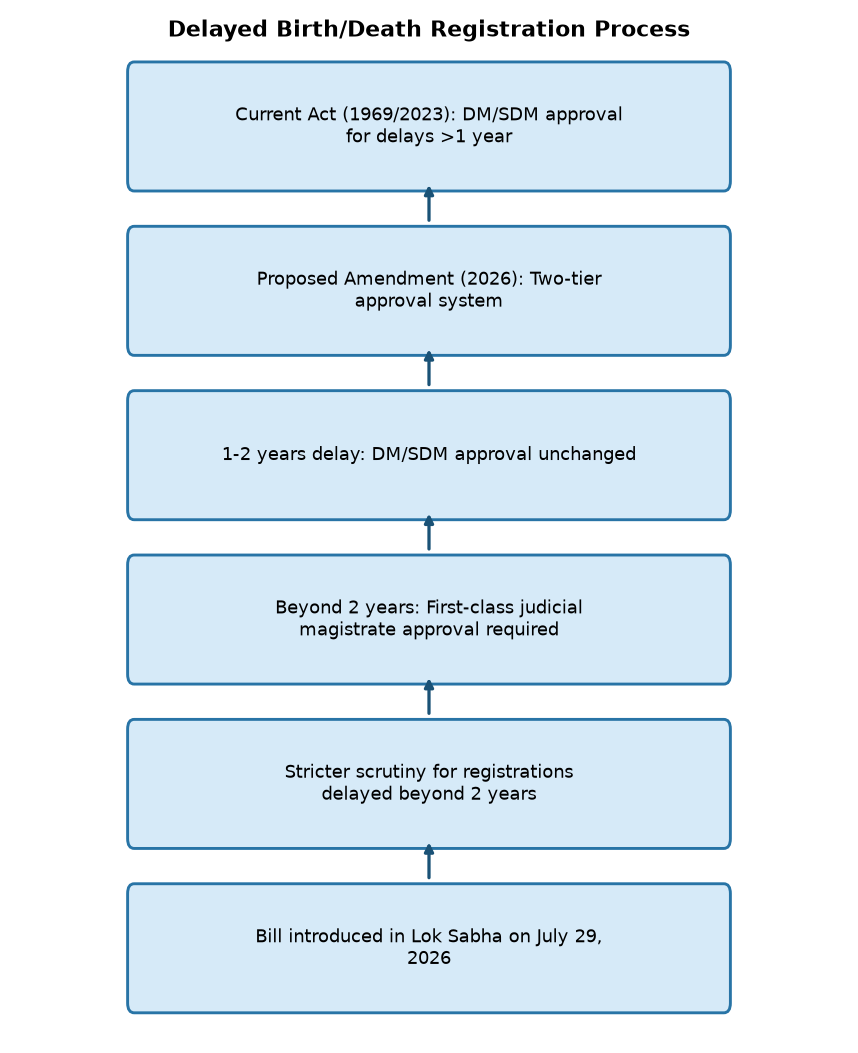
- Under the current provisions, registrations delayed by more than one year require approval from a District Magistrate (DM), Sub-Divisional Magistrate (SDM), or an Executive Magistrate.
- The proposed legislation introduces a two-tier approval mechanism: for delays between one and two years, approval remains with the executive magistrate, while delays beyond two years require approval from a first-class judicial magistrate.
- This shift in authority from the executive to the judiciary for very late registrations is intended to enhance scrutiny, reduce malpractices, and ensure the integrity of vital statistics.
- The Bill does not alter the existing process for timely registrations (within one year of the event), which continue to be handled by local authorities such as municipal corporations or panchayats.
- The amendments aim to address challenges such as underreporting, fraudulent registrations, and delays that distort demographic data and impact policy interventions.
- The Bill reflects the government’s commitment to strengthening the Civil Registration System (CRS) as a foundation for evidence-based governance and welfare delivery.
- The proposed changes are expected to improve the accuracy and reliability of India’s demographic data, which is essential for tracking progress on Sustainable Development Goals (SDGs) and other national priorities.
UPSC Value Addition
Keywords for Mains Answer-Writing
Registration of Births and Deaths Act, 1969 · delayed registration of births and deaths · two-tier approval mechanism · judicial magistrate for delayed registrations · executive magistrate · District Magistrate (DM) · Sub-Divisional Magistrate (SDM) · Registration of Births and Deaths (Amendment) Bill, 2026 · civil registration system · demographic data integrity · administrative accountability · judicial oversight in executive functions
Prelims Practice Questions
Q1. Consider the following statements regarding the Registration of Births and Deaths (Amendment) Bill, 2026:
1. The Bill seeks to amend Section 13(3) of the Registration of Births and Deaths Act, 1969.
2. Registrations delayed beyond two years will require approval from a first-class judicial magistrate.
3. The Bill introduces a two-tier approval mechanism for delayed registrations.
How many of the above statements are correct?
- Only one
- Only two
- All three
- None
Answer: All three — Statements 1 and 3 are correct as the Bill amends Section 13(3) and introduces a two-tier approval mechanism. Statement 2 is incorrect because approval from a judicial magistrate is required only for registrations delayed beyond two years, not for all delayed registrations.
Q2. Assertion (A): The Registration of Births and Deaths (Amendment) Bill, 2026 shifts the authority for very late registrations from the executive to the judiciary.
Reason (R): The Bill mandates approval from a first-class judicial magistrate for registrations delayed beyond two years.
Options:
A. Both A and R are true, and R is the correct explanation of A.
B. Both A and R are true, but R is not the correct explanation of A.
C. A is true, but R is false.
D. A is false, but R is true.
Answer: ? — Both the assertion and reason are true. The Bill indeed shifts authority for very late registrations (beyond two years) from the executive (DM/SDM) to the judiciary (first-class judicial magistrate), and the reason correctly explains the assertion.
Q3. Which of the following authorities is NOT involved in the approval process for delayed registrations of births and deaths under the proposed amendment?
A. District Magistrate (DM)
B. Sub-Divisional Magistrate (SDM)
C. First-class judicial magistrate
D. Chief Secretary of the State
- A
- B
- C
- D
Answer: D — Under the proposed amendment, approval for delayed registrations is granted by the District Magistrate (DM), Sub-Divisional Magistrate (SDM), or a first-class judicial magistrate (for delays beyond two years). The Chief Secretary of the State is not involved in this process.
Mains Practice Question
✍ The Registration of Births and Deaths (Amendment) Bill, 2026 seeks to introduce a two-tier approval mechanism for delayed registrations of births and deaths. Critically examine the implications of this amendment on the civil registration system and administrative accountability in India. (15 Marks)
Approach: MODEL-ANSWER SKELETON:
1. **Introduction**: Briefly outline the purpose of the Registration of Births and Deaths Act, 1969, and the need for amendments to address delayed registrations.
2. **Provisions of the Amendment Bill**:
– Explain the existing provision under Section 13(3) and the proposed two-tier mechanism.
– Differentiate between the approval processes for registrations delayed by 1–2 years (executive magistrate) and beyond two years (judicial magistrate).
3. **Implications on the Civil Registration System**:
– **Integrity of Demographic Data**: Discuss how stricter scrutiny may enhance the accuracy and reliability of demographic data, which is crucial for policy formulation and resource allocation.
– **Administrative Efficiency**: Evaluate whether the shift in authority from executive to judicial magistrates for very late registrations could lead to delays or bottlenecks in the system.
4. **Administrative Accountability**:
– Assess how the amendment strengthens accountability by reducing discretionary powers of local executive authorities.
– Discuss potential challenges, such as increased litigation or administrative burden on judicial magistrates.
5. **Comparative Perspective**:
– Compare India’s approach with global best practices in civil registration systems, such as those in Scandinavian countries or Canada.
6. **Conclusion**:
– Summarize the key benefits and concerns arising from the amendment.
– Provide a balanced view on whether the amendment strikes the right balance between data integrity and administrative feasibility.
Source: The Hindu
Generated by AanyaAi for educational purpose.

- उत्तराखंड सीएम धामी ने चारधाम यात्रा की ऑनलाइन समीक्षा बैठक की, जानिए तैयारी - September 15, 2026
- UPSC Alert: CM Dhami Reviews Char Dham Yatra 2026 Security & Logistics - September 15, 2026
- मेटा ने स्वीकारा: बाल यौन शोषण मामलों की रिपोर्ट पुलिस को करेगी - September 15, 2026

No Comments