


29 Jul INSPIRE Programme: Key Components & Impact on UPSC Aspirants
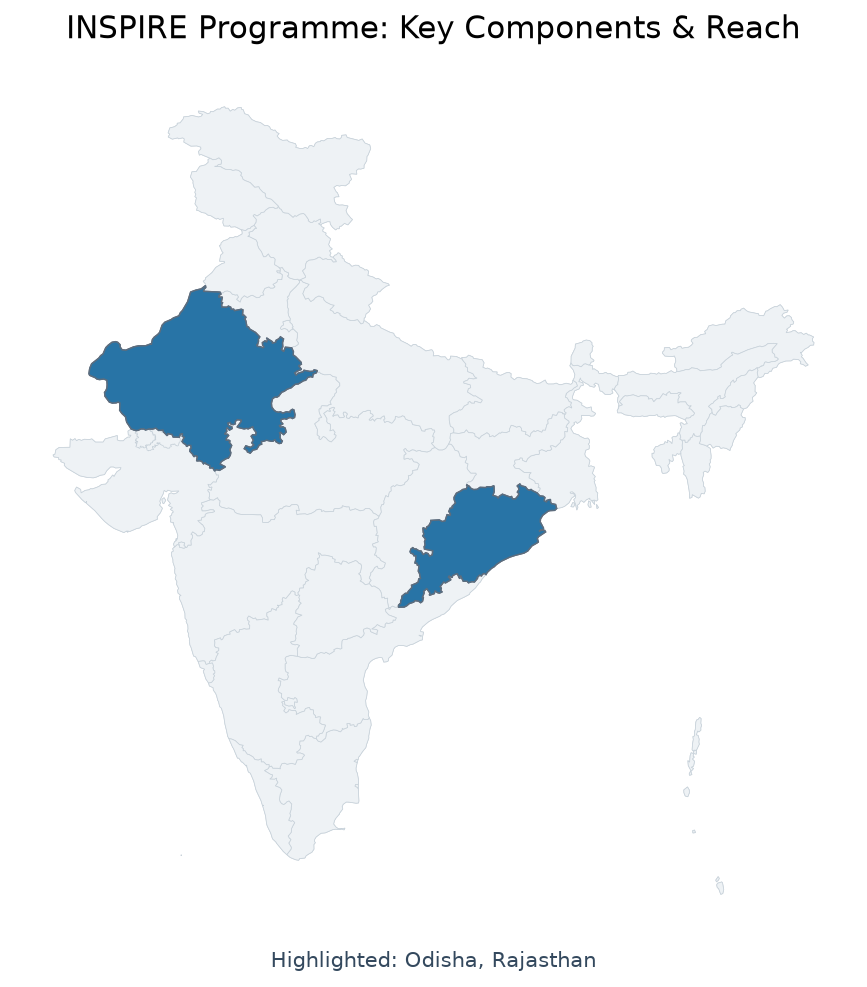
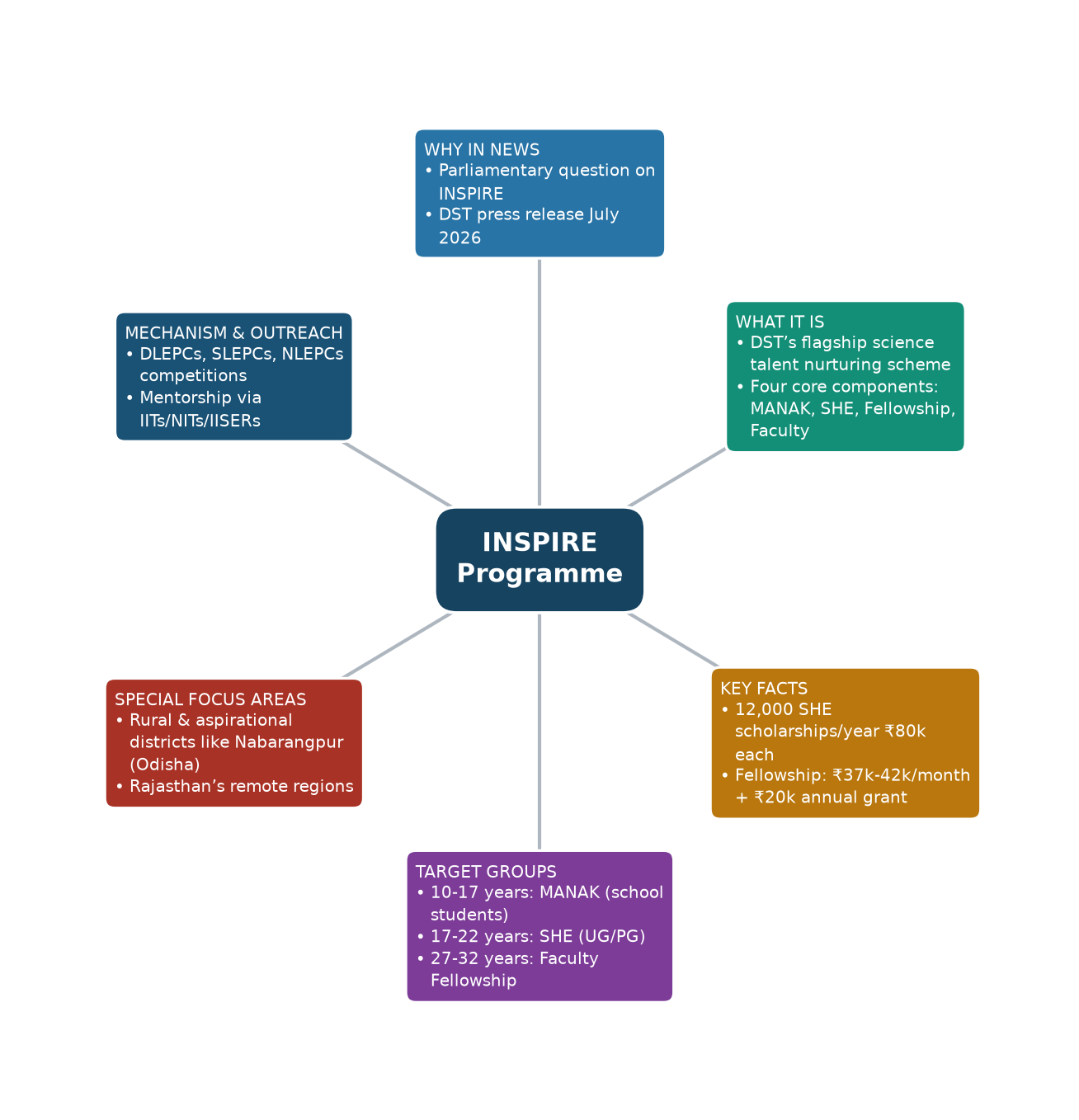
Map & concept mind-map: INSPIRE Programme: Key Components & Reach
Subject Relevance — Where This Topic Fits
- GS Paper II — Governance, Administration and People-centric Policies | GS Paper III — Science and Technology, Environment and Disaster Management | GS Paper III — Development and Management of Social Sector/Services relating to Health, Education, Human Resources
- Prelims: INSPIRE Programme, INSPIRE-MANAK, INSPIRE-SHE, INSPIRE Fellowship, INSPIRE Faculty Fellowship, Science and Technology Policy 2020, National Education Policy 2020, Aspirational Districts Programme, Digital India, Mentorship in STEM
- Essay: The Role of Government in Fostering Innovation and Scientific Temper: Lessons from the INSPIRE Programme, Equity in Education: Bridging the Rural-Urban Divide in Access to Science and Research Opportunities
Quick Revision: INSPIRE is a DST-led initiative with four components—MANAK, SHE, Fellowship, and Faculty Fellowship—designed to nurture scientific talent from school to post-doctoral levels, with a strong focus on inclusivity in rural and aspirational districts.
Why is this in the news?
The INSPIRE programme has been highlighted in a parliamentary question, underscoring its structured approach to identifying, nurturing, and supporting scientific talent across India. The programme’s expansion and inclusion strategies, particularly in rural, remote, and aspirational districts, reflect the government’s commitment to democratising access to science education and research, aligning with broader national objectives of ‘Vigyan se Vikas’ and ‘Atmanirbhar Bharat’ in STEM fields.
Background
- The INSPIRE programme was launched by the Department of Science and Technology (DST), Government of India, as a flagship initiative to attract and retain talent in the field of science and technology.
- The programme addresses the critical gap in India’s STEM pipeline by providing structured support at multiple educational and research stages, from school-level innovation to post-doctoral research.
- Rural and aspirational districts, historically underrepresented in STEM fields, have been prioritised to ensure equitable access to scientific opportunities.
- Digital platforms and mentorship initiatives have been leveraged to enhance outreach and effectiveness.
What is the INSPIRE Programme?
- The INSPIRE (Innovation in Science Pursuit for Inspired Research) programme is an initiative of the Department of Science and Technology (DST), Government of India, designed to nurture scientific talent from school to post-doctoral levels.
- It comprises four key components: INSPIRE-MANAK, INSPIRE-Scholarship for Higher Education (SHE), INSPIRE Fellowship, and INSPIRE Faculty Fellowship, each targeting distinct stages of academic and research progression.
- INSPIRE-MANAK (Million Minds Augmenting National Aspiration and Knowledge) targets students aged 10–17 years (Classes VI–XII) to foster innovation and scientific creativity through project-based learning and competitions at district, state, and national levels.
- INSPIRE-SHE (Scholarship for Higher Education) supports meritorious students aged 17–22 years pursuing undergraduate and postgraduate studies in natural and basic sciences, providing financial assistance of ₹80,000 per annum for up to 12,000 scholarships annually.
- INSPIRE Fellowship encourages outstanding graduates and INSPIRE-SHE scholars to pursue full-time Ph.D. programmes, offering financial support of ₹37,000 per month (JRF) and ₹42,000 per month (SRF), along with House Rent Allowance (HRA) and an annual contingency grant of ₹20,000 for up to five years.
- INSPIRE Faculty Fellowship supports post-doctoral researchers (typically aged 27–32 years, with age relaxations for reserved categories) for a five-year fellowship, providing ₹1,25,000 per month, an annual increment of ₹2,000, and a research grant of ₹35 lakh during the fellowship period.
- The programme employs a multi-pronged strategy to enhance inclusivity, including targeted outreach in rural, remote, and aspirational districts, digital dissemination of information, and capacity-building initiatives for teachers and school authorities.
- Collaborations with premier institutions such as IITs, NITs, IISERs, and other scientific organisations facilitate mentorship programmes, enabling students to develop prototypes and engage in innovation-driven research.
Key Features
| Feature | Significance |
|---|---|
| INSPIRE-MANAK | Targets school students (10-17 years) to foster scientific creativity and innovation through project-based learning, enhancing foundational scientific temperament at grassroots level. |
| INSPIRE-SHE (Scholarship for Higher Education) | Provides financial support (₹80,000/year) to meritorious students (17-22 years) pursuing UG/PG in natural and basic sciences, ensuring equitable access to higher education in STEM fields. |
| INSPIRE Fellowship | Supports full-time Ph.D. research (₹37,000–₹42,000/month + HRA + ₹20,000 annual contingency) for outstanding graduates and scholars, promoting advanced research capacity. |
| INSPIRE Faculty Fellowship | Aids post-doctoral researchers (27-32 years) with ₹1,25,000/month + ₹35 lakh research grant over 5 years, fostering leadership in scientific research and innovation. |
| Targeted Outreach Initiatives | Focuses on rural, aspirational, and remote districts (e.g., Nabarangpur in Odisha) through awareness campaigns, mentorship programs, and district/state/national-level exhibitions to democratize access to scientific opportunities. |
Why it Matters
Scientific Temperament & Innovation Ecosystem
- Systematically identifies and nurtures scientific talent across all age cohorts, from school students to post-doctoral researchers, ensuring continuity in the innovation pipeline.
- Encourages a culture of questioning, experimentation, and problem-solving, which is critical for India’s transition to a knowledge-based economy.
- Bridges the urban-rural divide by extending opportunities to students in remote and aspirational districts, thereby reducing geographical disparities in access to scientific education.
- Facilitates mentorship from premier institutions (IITs, NITs, IISERs) to guide young innovators, enhancing the quality and relevance of research outputs.
Human Capital Development
- Provides structured financial support at multiple educational stages, reducing economic barriers to pursuing STEM careers, particularly for students from underprivileged backgrounds.
- Promotes gender inclusivity by ensuring participation across all demographic segments, including reserved categories with age relaxations for post-doctoral fellowships.
- Enhances the employability of beneficiaries by equipping them with advanced research skills and exposure to cutting-edge scientific methodologies.
National Competitiveness
- Strengthens India’s research and development ecosystem by increasing the number of Ph.D. scholars and post-doctoral researchers, thereby augmenting the national talent pool.
- Aligns with global best practices in science education and research funding, positioning India as a hub for innovation and scientific excellence.
- Supports the ‘Atmanirbhar Bharat’ vision by fostering indigenous research and development, reducing dependence on foreign expertise for critical scientific advancements.
Policy Integration
- Demonstrates a multi-tiered approach to talent identification and nurturing, integrating school-level innovation (MANAK) with higher education (SHE) and advanced research (Fellowships).
- Serves as a model for other government initiatives aimed at reducing educational inequities and promoting meritocracy in STEM fields.
- Complements national missions such as the National Education Policy (NEP) 2020 by emphasizing experiential learning, research orientation, and interdisciplinary collaboration.
Challenges
1. Geographical Disparities in Access
- Despite targeted outreach, remote and aspirational districts continue to face challenges in awareness, infrastructure, and mentorship availability.
- Digital divide exacerbates inequalities, as students in rural areas may lack access to online resources and mentorship platforms.
UPSC Link: GS Paper 2: Governance, GS Paper 3: Science & Tech
2. Sustainability of Research Careers
- Post-doctoral fellows face limited long-term career pathways, with few opportunities for permanent academic or research positions in India.
- High attrition rates in research careers due to inadequate stipends, lack of job security, and limited industry-academia linkages.
UPSC Link: GS Paper 3: Science & Tech, GS Paper 4: Ethics
3. Quality vs. Quantity in Talent Identification
- Balancing the need for broad-based participation with the requirement to identify truly exceptional talent remains a persistent challenge.
- Risk of dilution in the rigor of selection processes due to the scale of programs like INSPIRE-MANAK.
UPSC Link: GS Paper 1: Society, GS Paper 3: Science & Tech
4. Funding and Resource Constraints
- Limited fiscal space may constrain the expansion of fellowship amounts or the number of beneficiaries in the future.
- Dependence on government funding makes the program vulnerable to budgetary fluctuations and policy shifts.
UPSC Link: GS Paper 2: Governance, GS Paper 3: Science & Tech
5. Monitoring and Evaluation Gaps
- Lack of robust longitudinal data on the career trajectories of beneficiaries post-program completion hinders evidence-based policy refinement.
- Inadequate mechanisms to track the real-world impact of innovations developed under INSPIRE-MANAK and other components.
UPSC Link: GS Paper 2: Governance, GS Paper 4: Ethics
Challenges — UPSC Perspective
| Issue | Concern |
|---|---|
| Awareness Deficit in Rural Areas | Low penetration of program information due to language barriers, limited digital literacy, and inadequate outreach by local authorities. |
| Mentorship Shortages | Insufficient availability of qualified mentors, particularly in niche scientific domains, leading to suboptimal guidance for innovators. |
| Infrastructure Gaps | Lack of well-equipped laboratories and research facilities in schools and colleges, especially in aspirational districts. |
| Career Uncertainty Post-Fellowship | Limited job opportunities in academia and industry for Ph.D. holders, discouraging long-term commitment to research. |
| Data Fragmentation | Absence of a centralized database to track beneficiaries, their projects, and career outcomes across all INSPIRE components. |
| Interdisciplinary Barriers | Overemphasis on traditional STEM disciplines may exclude emerging fields like data science, AI, and interdisciplinary research. |
Government Initiatives — Must-Memorise for Prelims
- INSPIRE-MANAK (Million Minds Augmenting National Aspiration and Knowledge)
- INSPIRE Scholarship for Higher Education (SHE)
- INSPIRE Fellowship
- INSPIRE Faculty Fellowship
Way Forward
- Expand digital outreach through AI-driven personalized mentorship platforms and multilingual content to bridge the awareness gap in rural and remote areas.
- Strengthen industry-academia linkages by incentivizing private sector participation in mentorship programs and providing internship opportunities for INSPIRE beneficiaries.
- Introduce a ‘Research Career Ladder’ to offer clear pathways from Ph.D. to permanent academic or industry positions, including post-doctoral fellowships with industry co-funding.
- Establish a centralized digital portal for real-time tracking of beneficiaries, project outcomes, and career trajectories to enable data-driven policy adjustments.
- Enhance fellowship amounts and contingency grants to align with inflation and the cost of living, particularly in high-cost urban centers where research institutions are concentrated.
- Integrate INSPIRE with other national missions (e.g., PMKVY, Atal Innovation Mission) to create a seamless ecosystem for innovation from school to industry.
- Promote interdisciplinary research by relaxing strict disciplinary boundaries in fellowship selection and encouraging collaborative projects across STEM and social sciences.
- Conduct periodic independent evaluations of the program’s impact, including longitudinal studies on the career progression of beneficiaries and the societal benefits of their innovations.
UPSC Value Addition
Keywords for Mains Answer-Writing
INSPIRE programme · Science and Technology Department · Scientific temper · Innovation in Science Pursuit for Inspired Research · INSPIRE-MANAK · INSPIRE-SHE Scholarship · INSPIRE Fellowship · INSPIRE Faculty Fellowship · Scientific talent nurturing · Rural and aspirational districts · District Level Exhibition and Project Competitions (DLEPCs) · Mentorship programmes · Scientific research funding · STEM education
Concept Flow
Identification of scientific talent at school level (INSPIRE-MANAK) → Nurturing creativity through project-based learning → → Selection for higher education support (INSPIRE-SHE) to pursue UG/PG in STEM → → Progression to advanced research via INSPIRE Fellowship for Ph.D. candidates → → Post-doctoral advancement through INSPIRE Faculty Fellowship → → Long-term career integration through industry-academia linkages and mentorship → → Cyclical reinforcement of scientific temper and innovation ecosystem across generations → → National competitiveness and Atmanirbhar Bharat outcomes through a robust talent pipeline.
Prelims Practice Questions
Q1. Consider the following statements about the INSPIRE programme of the Department of Science and Technology:
1. INSPIRE-MANAK targets students aged 10-17 years to foster innovation and scientific creativity.
2. INSPIRE-SHE Scholarship provides financial support of ₹80,000 per annum for undergraduate and postgraduate studies in natural and basic sciences.
3. INSPIRE Faculty Fellowship offers a monthly fellowship of ₹1,25,000 for a duration of five years.
4. INSPIRE Fellowship includes a monthly stipend of ₹37,000 for Junior Research Fellows and ₹42,000 for Senior Research Fellows.
How many of the above statements are correct?
- Only one
- Only two
- Only three
- All four
Answer: All four — Statements 1, 2, and 4 are correct. Statement 3 is incorrect as the INSPIRE Faculty Fellowship offers ₹1,25,000 per month, but this is inclusive of research grant and other allowances, not solely the fellowship amount.
Q2. Assertion (A): The INSPIRE programme primarily focuses on students from urban centres to promote scientific research.
Reason (R): The programme includes initiatives to expand its reach to rural, remote, and aspirational districts such as Nabarangpur in Odisha and parts of Rajasthan.
In the context of the above two statements, which one of the following is correct?
- Both A and R are true and R is the correct explanation of A.
- Both A and R are true but R is not the correct explanation of A.
- A is true but R is false.
- A is false but R is true.
Answer: ? — Assertion (A) is false as the INSPIRE programme explicitly targets rural, remote, and aspirational districts. Reason (R) is true and correctly explains the programme’s outreach strategy.
Mains Practice Question
✍ The INSPIRE programme is a flagship initiative of the Department of Science and Technology aimed at nurturing scientific talent across the country. Critically analyse the structure, components, and impact of the INSPIRE programme in fostering a culture of innovation and scientific research in India. Also, examine the measures taken to enhance its inclusivity and reach in rural and aspirational districts. (15 Marks)
Approach: MODEL-ANSWER SKELETON:
1. Introduction: Define INSPIRE and its objectives under the Department of Science and Technology.
2. Structure and Components:
– INSPIRE-MANAK: Target group (10-17 years), objectives, and activities (DLEPCs, SLEPCs, NLEPCs).
– INSPIRE-SHE Scholarship: Eligibility (17-22 years), financial support (₹80,000/year), and number of scholarships (12,000/year).
– INSPIRE Fellowship: Eligibility (outstanding graduates/postgraduates), financial support (₹37,000 for JRF, ₹42,000 for SRF), duration (5 years), and components (HRA, contingency grant).
– INSPIRE Faculty Fellowship: Eligibility (27-32 years, relaxations for reserved categories), financial support (₹1,25,000/month, ₹35 lakh research grant), and duration (5 years).
3. Inclusivity and Reach: Measures to expand reach to rural, remote, and aspirational districts (e.g., Nabarangpur in Odisha, Rajasthan), including awareness campaigns, mentorship programmes with IITs/NITs/IISERs, and district/state/national level exhibitions.
4. Impact: Quantitative data on participation (e.g., INSPIRE-MANAK: 52,720 in 2021-22, INSPIRE-SHE: 24,276 in 2025-26) and qualitative outcomes (e.g., strengthened scientific temper, increased innovation, and enhanced access to STEM education).
5. Challenges and Criticisms: Potential limitations such as uneven distribution of benefits, need for stronger industry-academia linkages, and ensuring sustainability of innovations.
6. Conclusion: Summarise the programme’s role in building a robust scientific ecosystem and suggest measures for further improvement.
Source: PIB (Press Information Bureau)
Generated by AanyaAi for educational purpose.

- कर्नाटक में ‘वंदे मातरम’ विवाद: राज्यपाल ने सीएम से आदेश वापस लेने को कहा - September 22, 2026
- Karnataka Governor vs CM: Vande Mataram GO row explained for UPSC - September 22, 2026
- मध्यप्रदेश कैबिनेट का बड़ा फैसला: हर विधानसभा में स्पोर्ट्स कॉम्प्लेक्स, 15 हजार बसें 2030 तक - September 22, 2026

No Comments