


30 Jul पीएम श्री योजना: 14,500 स्कूलों को राष्ट्रीय शिक्षा नीति 2020 के तहत सुदृढ़ करना
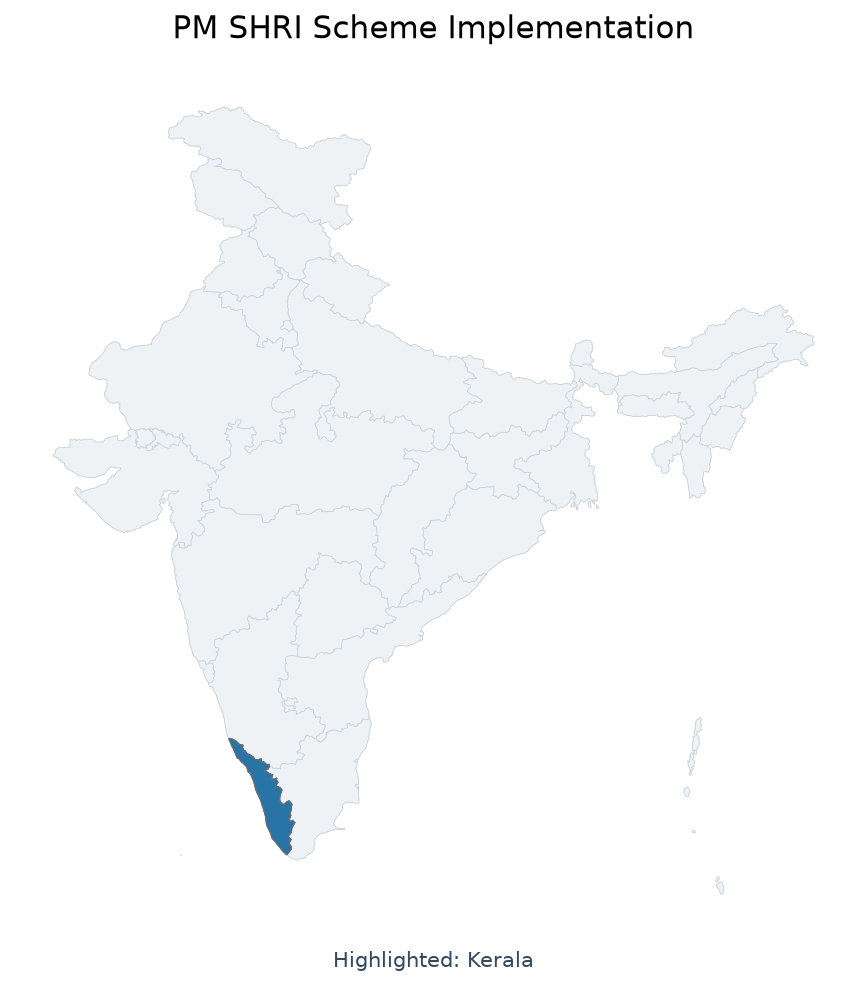
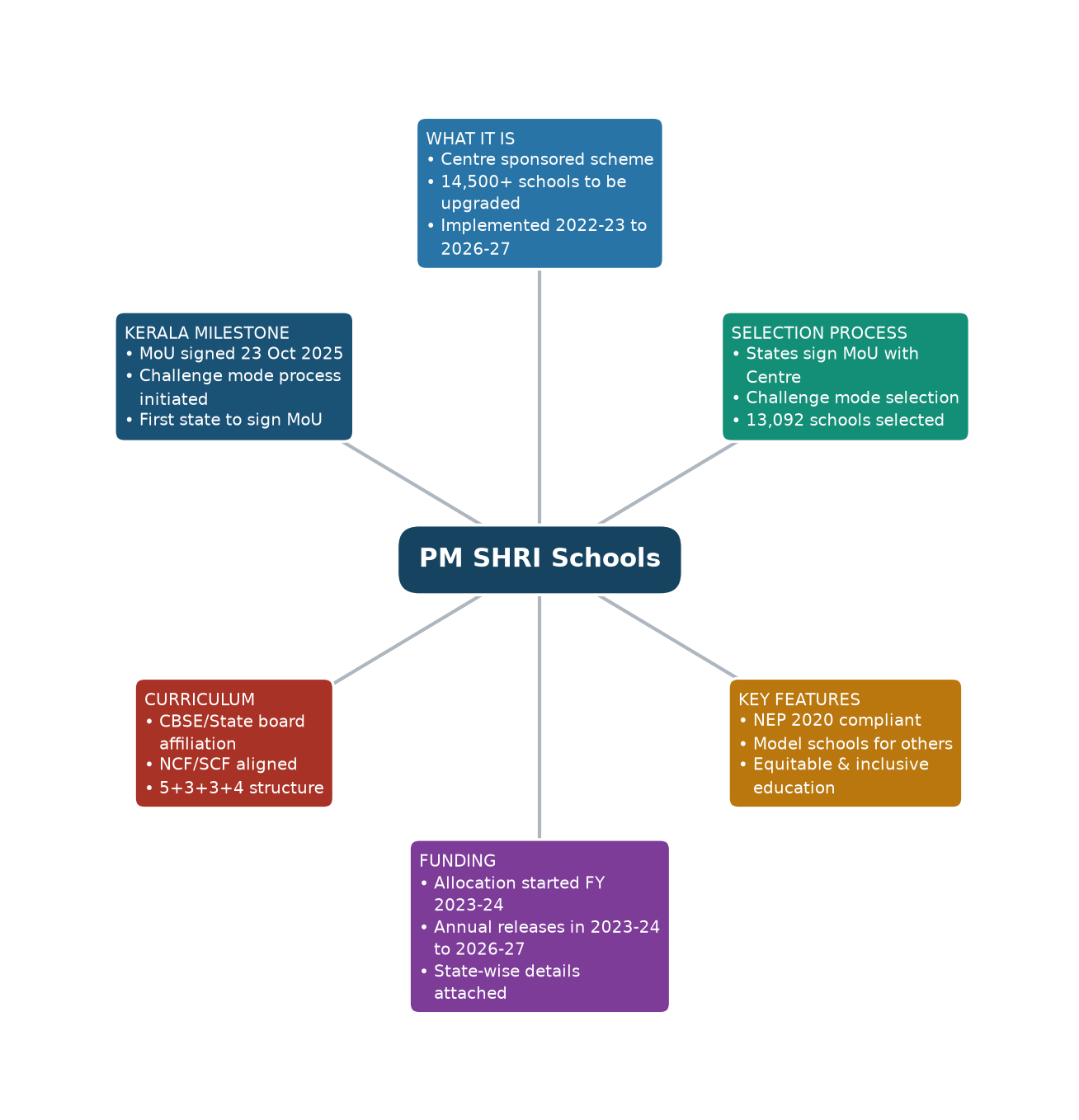
Map & concept mind-map: PM SHRI Scheme Implementation
Subject Relevance — Where This Topic Fits
- GS Paper II — Governance, Administration and Policies | GS Paper III — Human Resource Development
- Prelims: PM SHRI, NEP 2020, CBSE, KVS, NVS, NCERT, 5+3+3+4 Curriculum, Challenge Mode Selection, MoU under Centrally Sponsored Scheme
- Essay: Role of Public Policy in Transforming School Education: A Case Study of PM SHRI Scheme, NEP 2020: A Paradigm Shift Towards Inclusive and Holistic Education
Quick Revision: The PM SHRI Scheme is a Centrally Sponsored Scheme under NEP 2020, aiming to transform 14,500 schools into model institutions through a transparent ‘Challenge Mode’ selection process, annual funding releases, and state-level MoUs, with a focus on equity, inclusivity, and the 5+3+3+4 curricular framework.
Why is this in the news?
The implementation of the Pradhan Mantri Schools for Rising India (PM SHRI) Scheme has gained prominence as a flagship initiative under the National Education Policy (NEP) 2020, aimed at transforming 14,500 schools into model institutions that exemplify the policy’s vision of equitable, inclusive, and joyful learning. With 13,092 schools already selected across states, Union Territories, Kendriya Vidyalayas, Navodaya Vidyalayas, and NCERT institutions, the scheme’s structured rollout—spanning 2022-23 to 2026-27—highlights its role in redefining school education through quality assurance, pedagogical innovation, and systemic leadership. The recent parliamentary reference to the scheme underscores its significance in addressing diverse learner needs and aligning with the 5+3+3+4 curricular framework.
Background
- The National Education Policy (NEP) 2020 was approved by the Union Cabinet on 29 July 2020, replacing the 34-year-old National Policy on Education (NPE), 1986, to address contemporary educational challenges and align India’s education system with global best practices.
- NEP 2020 introduced a 5+3+3+4 school education structure, replacing the traditional 10+2 system, to emphasize foundational, preparatory, middle, and secondary stages with a focus on experiential learning and multidisciplinary approaches.
- The PM SHRI Scheme was launched as a Centrally Sponsored Scheme (CSS) in September 2022 to operationalize NEP 2020’s vision by upgrading 14,500 schools into model institutions that demonstrate excellence in infrastructure, pedagogy, and inclusive practices.
- The scheme operates on a ‘Challenge Mode’ selection process, where schools compete to qualify as PM SHRI institutions based on predefined quality parameters, ensuring transparency and meritocracy.
- Funding under PM SHRI commenced in the financial year 2023-24, with allocations released annually to states, Union Territories, and central institutions like KVS, NVS, and NCERT for phased implementation.
- States and Union Territories sign Memoranda of Understanding (MoUs) with the Centre, committing to specific reforms and quality benchmarks to ensure the success of PM SHRI schools in their jurisdictions.
What is the PM SHRI Scheme?
- The Pradhan Mantri Schools for Rising India (PM SHRI) is a Centrally Sponsored Scheme (CSS) launched in September 2022 under the aegis of the Ministry of Education, Government of India.
- The scheme aims to upgrade 14,500 schools across India into model institutions that exemplify the principles of the National Education Policy (NEP) 2020, including equity, inclusivity, and holistic development.
- Selected schools—13,092 as of the latest data—serve as exemplars, providing leadership to surrounding schools by establishing high standards in infrastructure, pedagogy, and learning outcomes.
- The scheme emphasizes a joyful, inclusive, and equitable learning environment, catering to diverse learner needs, including those from marginalized communities, multilingual backgrounds, and varying academic abilities.
- Selection of schools under PM SHRI follows a transparent ‘Challenge Mode’ process, where institutions compete to qualify based on predefined quality parameters, ensuring meritocracy and accountability.
- Funding for PM SHRI is released annually from 2023-24 to 2026-27, with allocations linked to the achievement of milestones such as infrastructure development, teacher training, and curriculum reform.
- States and Union Territories sign MoUs with the Centre, committing to reforms such as teacher training, curriculum alignment, and inclusive practices, to ensure the successful implementation of PM SHRI schools in their jurisdictions.
Key Features
| Feature | Significance |
|---|---|
| Centre-Sponsored Scheme | Ensures uniform implementation across states with central funding and oversight, reducing disparities in educational quality. |
| Selection via Challenge Mode | Promotes competitive excellence among schools, incentivizing them to meet stringent quality benchmarks. |
| Adherence to NEP 2020 | Aligns with the 5+3+3+4 curricular and pedagogical structure, integrating holistic and experiential learning. |
| Inclusive and Multilingual Framework | Caters to diverse social backgrounds, linguistic needs, and learning capacities, fostering equity. |
| Leadership Role for Adopting Schools | Serves as model institutions, setting benchmarks for neighboring schools to emulate. |
Why it Matters
Educational Transformation
- Demonstrates NEP 2020’s vision of transforming India’s school education system into a globally competitive, equitable, and inclusive model.
- Establishes a network of high-quality schools that can act as catalysts for systemic reform in education delivery.
- Emphasizes experiential and competency-based learning, preparing students for 21st-century challenges.
Equity and Inclusion
- Prioritizes marginalized sections by ensuring accessibility, safety, and personalized support in school environments.
- Encourages multilingual education, respecting India’s linguistic diversity while promoting national integration.
- Reduces regional disparities by extending benefits to all states/UTs through a competitive yet inclusive selection process.
Institutional Capacity Building
- Strengthens governance and administrative frameworks in selected schools through structured MoUs and accountability mechanisms.
- Facilitates teacher training and resource allocation, enhancing pedagogical and infrastructural standards.
- Creates a feedback loop where best practices from PM SHRI schools can be scaled across the education ecosystem.
Strategic Human Capital Development
- Aims to produce a generation of students equipped with critical thinking, creativity, and socio-emotional skills.
- Supports India’s demographic dividend by aligning education outcomes with economic and social development goals.
- Enhances employability and civic engagement by embedding values of sustainability, digital literacy, and global citizenship.
Challenges
1. State-Level Adoption and Compliance
- Reluctance of states to sign MoUs or delay in implementation may lead to uneven coverage and missed opportunities.
- Variations in state capacities to meet PM SHRI benchmarks could create disparities in outcomes.
- Political and bureaucratic inertia may hinder the pace of reforms, particularly in states with weaker governance structures.
UPSC Link: GS2: Centre-State Relations
2. Resource Allocation and Utilization
- Risk of fund diversion or inefficient utilization due to lack of robust monitoring mechanisms.
- Delays in disbursement of central funds may disrupt implementation timelines and school-level planning.
- Need for transparent and accountable financial management to prevent leakages and ensure optimal resource deployment.
UPSC Link: GS3: Resource Mobilization
3. Curriculum and Pedagogical Transition
- Resistance from traditionalists in adapting to NEP 2020’s 5+3+3+4 structure and experiential learning methods.
- Teacher shortages and inadequate training may impede the shift from rote learning to competency-based education.
- Ensuring alignment between state-specific curricula and NEP 2020’s national framework without diluting local relevance.
UPSC Link: GS2: Education Policy
4. Equity in Implementation
- Ensuring that schools in remote, tribal, or socio-economically disadvantaged areas are not left behind in the selection process.
- Addressing language barriers in multilingual states while maintaining the integrity of the curriculum.
- Preventing elitism in PM SHRI schools, where only privileged students benefit, undermining the scheme’s inclusive intent.
UPSC Link: GS1: Social Justice
5. Monitoring and Evaluation
- Developing robust metrics to assess qualitative outcomes such as student well-being, creativity, and critical thinking.
- Balancing quantitative targets (e.g., infrastructure upgrades) with qualitative improvements (e.g., learning outcomes).
- Ensuring third-party audits and public disclosure of progress to maintain transparency and accountability.
UPSC Link: GS4: Ethics in Governance
Challenges — UPSC Perspective
| Issue | Concern |
|---|---|
| State Compliance | Non-signing or delayed MoUs may exclude states from PM SHRI benefits, exacerbating regional disparities. |
| Fund Flow Delays | Central fund disbursement bottlenecks could disrupt school-level implementation timelines. |
| Teacher Training Gaps | Inadequate capacity-building initiatives may hinder the transition to NEP 2020-aligned pedagogy. |
| Curriculum Alignment | State-specific deviations from NEP 2020’s framework risk diluting the scheme’s transformative potential. |
| Inclusion of Marginalized Groups | Ensuring equitable representation in PM SHRI schools remains a persistent challenge. |
Way Forward
- Strengthen state-level coordination through regular reviews and incentivize MoU signings via performance-linked grants.
- Accelerate fund disbursement by digitizing approval processes and establishing real-time tracking of financial flows.
- Expand teacher training programs in collaboration with NCERT, DIETs, and reputed educational institutions to cover NEP 2020’s pedagogical shifts.
- Develop a standardized yet flexible curriculum framework that balances national benchmarks with state-specific adaptations.
- Institutionalize third-party evaluations to assess qualitative outcomes, including student well-being and skill development.
- Enhance transparency by publishing progress reports on the PM SHRI portal, including state-wise performance metrics.
- Promote community engagement to ensure local ownership and address socio-cultural barriers in school participation.
- Leverage technology for remote monitoring of school infrastructure and learning outcomes, particularly in underserved regions.
UPSC Value Addition
Keywords for Mains Answer-Writing
Pradhan Mantri Schools for Rising India (PM SHRI) Scheme · National Education Policy (NEP) 2020 · Holistic and Multidisciplinary Education · Challenging Mode Selection Process · School Transformation Framework · Equitable and Inclusive Schooling · Curriculum Alignment with NCF 2023 · State-Level Implementation through MoUs · 21st Century Skills in School Education · CBSE and State Board Affiliation in PM SHRI Schools
Concept Flow
NEP 2020’s Vision → PM SHRI Scheme (Centre-Sponsored) → Selection via Challenge Mode → Adoption of 5+3+3+4 Framework → Implementation through MoUs → School Transformation → Model for Systemic Reform → Equitable and Inclusive Education Outcomes
Prelims Practice Questions
Q1. Consider the following statements regarding the Pradhan Mantri Schools for Rising India (PM SHRI) Scheme:
1. The scheme aims to strengthen over 14,500 schools across India.
2. The selection of PM SHRI schools follows a transparent ‘Challenging Mode’ process.
3. The scheme mandates the adoption of the National Curriculum Framework (NCF) 2023 in all affiliated schools.
4. The implementation period of the scheme is from 2022-23 to 2026-27.
How many of the above statements are correct?
- Only one
- Only two
- Only three
- All four
Answer: All four — Statements 1, 2, and 4 are correct. Statement 3 is incorrect as the scheme allows states to adapt the curriculum to their specific needs while aligning with NCF 2023 principles.
Q2. Assertion (A): The PM SHRI Scheme is designed to function as model schools under the National Education Policy (NEP) 2020.
Reason (R): The scheme emphasizes equitable, inclusive, and joyful learning environments while integrating 21st-century skills.
Options:
A. Both A and R are true, and R is the correct explanation of A.
B. Both A and R are true, but R is not the correct explanation of A.
C. A is true, but R is false.
D. A is false, but R is true.
Answer: ? — Both A and R are true, and R correctly explains the purpose of A. The scheme’s role as model schools is to demonstrate NEP 2020’s principles, including equitable and inclusive education.
Q3. Match the following columns with reference to the Pradhan Mantri Schools for Rising India (PM SHRI) Scheme:
Column I (Feature) | Column II (Description)
——————-|————————
A. Implementation Period | 1. 2022-23 to 2026-27
B. Selection Process | 2. Transparent ‘Challenging Mode’
C. Curriculum Framework | 3. NCF 2023 and State Adaptation
D. Affiliation | 4. CBSE or State Board
Options:
A. A-1, B-2, C-3, D-4
B. A-2, B-1, C-4, D-3
C. A-3, B-4, C-1, D-2
D. A-4, B-3, C-2, D-1
- A
- B
- C
- D
Answer: A — The correct match is: A-1 (Implementation Period: 2022-23 to 2026-27), B-2 (Selection Process: Transparent ‘Challenging Mode’), C-3 (Curriculum Framework: NCF 2023 and State Adaptation), D-4 (Affiliation: CBSE or State Board).
Mains Practice Question
✍ The Pradhan Mantri Schools for Rising India (PM SHRI) Scheme represents a paradigm shift in India’s school education system by aligning with the National Education Policy (NEP) 2020. Critically examine the scheme’s objectives, implementation framework, and potential challenges in achieving its goals. (15 Marks)
Approach: MODEL-ANSWER SKELETON:
1. **Objectives and Alignment with NEP 2020 (4 marks)**
– Holistic and multidisciplinary education (NEP 2020’s 5+3+3+4 structure).
– Emphasis on equitable, inclusive, and joyful learning environments.
– Integration of 21st-century skills (critical thinking, creativity, collaboration, communication).
– Model schools to demonstrate NEP 2020’s principles and set benchmarks for other schools.
2. **Implementation Framework (5 marks)**
– **Selection Process**: Transparent ‘Challenging Mode’ where schools compete for inclusion; states sign MoUs with the Centre.
– **Curriculum and Pedagogy**: Alignment with NCF 2023 (NCF-FS and NCF-SE) while allowing state-specific adaptations.
– **Infrastructure and Resources**: Focus on modernizing school infrastructure, teacher training, and digital integration.
– **Affiliation**: CBSE or state board affiliation with flexibility in curriculum delivery.
3. **Potential Challenges (6 marks)**
– **State-Level Variations**: Non-signing states may miss out, leading to uneven implementation.
– **Resource Constraints**: Adequate funding, teacher training, and infrastructure development across diverse regions.
– **Curriculum Adaptation**: Balancing NCF 2023 principles with state-specific needs without diluting standards.
– **Monitoring and Evaluation**: Ensuring accountability and transparency in fund utilization and outcomes.
– **Equity Concerns**: Addressing disparities in access to quality education across socio-economic and geographical divides.
4. **Conclusion (Balanced View)**
– The scheme is a progressive step toward realizing NEP 2020’s vision, but its success hinges on robust implementation, adequate resources, and political will.
Source: PIB (Press Information Bureau)
Generated by AanyaAi for educational purpose.

- अगस्त 2026 में खुदरा मुद्रास्फीति 4.82%: सीपीआई एवं खाद्य मुद्रास्फीति के प्रमुख आँकड़े - September 14, 2026
- UPSC Alert: August 2026 CPI Inflation at 4.82% – Key Data for Mains & Prelims - September 14, 2026
- कर्नाटक हाईकोर्ट ने शराब पीकर गाड़ी चलाने वालों पर कसा शिकंजा, मुआवजा 30% घटाया - September 14, 2026

No Comments