


01 Nov ‘आत्मनिर्भर पंचायतों’ निर्माण हेतु केंद्र सरकार का अभियान: पीवीजीएसवाई
✎ PM-VGSY seeks to transform PRIs into 'Viksit Panchayats' by 2047 through decentralised, evidence-based planning, digital integration of schemes, and enhanced Own Source Revenue generation, operationalising the constitutional…
Subject Relevance — Where This Topic Fits
- GS Paper II — Constitutional, Statutory, Regulatory and various Quasi-judicial Bodies | GS Paper III — Rural Development; Panchayati Raj Institutions; Decentralised Planning
- Prelims: Panchayati Raj System, 73rd Constitutional Amendment Act, 1992, Pradhan Mantri Viksit Gram Swaraj Yojana (PM-VGSY), Jan Plan Abhiyaan (JPA), Gram Panchayat Development Plan (GPDP), Own Source Revenue (OSR) of Panchayats, Sixteenth Finance Commission grants to Panchayati Raj Institutions, EV charging infrastructure in rural areas, Convergence Energy Services Limited (CESL), Energy Efficiency Services Limited (EESL)
- Essay: The Role of Local Governance in Realising the Vision of Developed India by 2047, Participatory Democracy and Sustainable Rural Development: A Case for Strengthening Panchayati Raj Institutions
Quick Revision: PM-VGSY seeks to transform PRIs into ‘Viksit Panchayats’ by 2047 through decentralised, evidence-based planning, digital integration of schemes, and enhanced Own Source Revenue generation, operationalising the constitutional mandate of participatory local governance.
Why is this in the news?
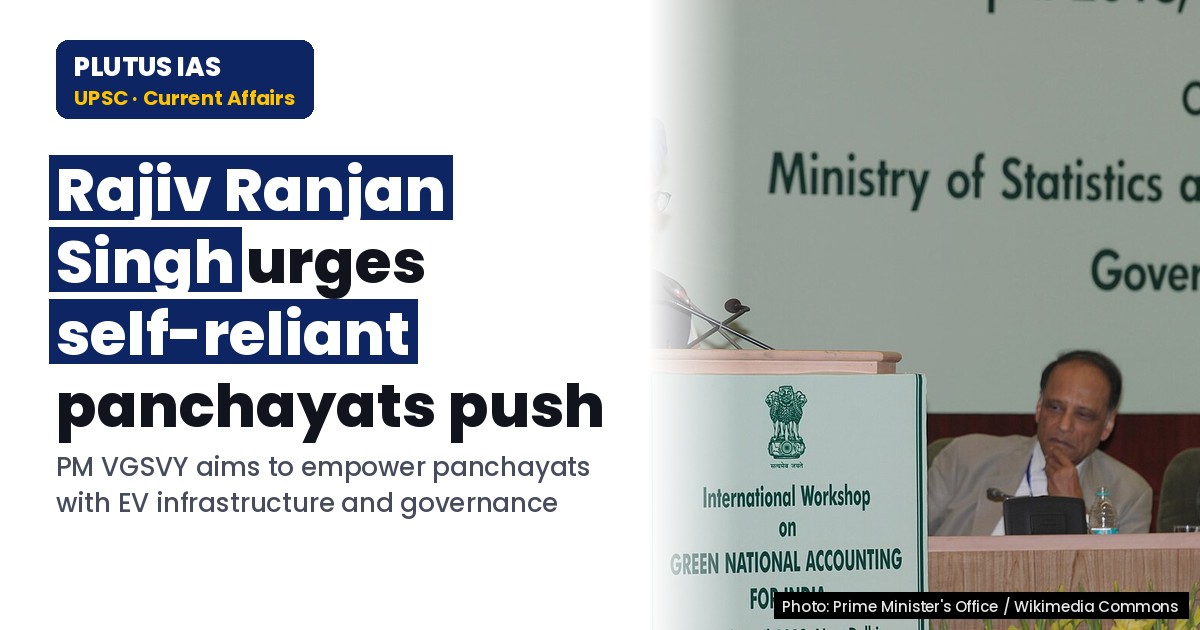
The Union Minister of Panchayati Raj, Fisheries, Animal Husbandry and Dairying, Shri Rajiv Ranjan Singh (Lalan Singh), addressed the National Workshop on Jan Yojana Abhiyan (JYA) 2026-27 in New Delhi on 30 October 2026. The event underscored the operationalisation of the Pradhan Mantri Viksit Gram Swaraj Yojana (PM-VGSY) and the launch of the JYA 2026-27 handbook, while also facilitating a Memorandum of Understanding (MoU) between the Ministry of Panchayati Raj and Convergence Energy Services Limited (CESL) for establishing EV charging and battery swapping stations on panchayat lands across India. These initiatives are aligned with the broader national agenda of achieving ‘Atmanirbhar Panchayats’ and ‘Viksit Panchayats’ as part of the Developed India @2047 vision.
Background
- The 73rd Constitutional Amendment Act, 1992, institutionalised Panchayati Raj Institutions (PRIs) as the third tier of governance, mandating the preparation of Gram Panchayat Development Plans (GPDPs) through participatory processes.
- The Jan Yojana Abhiyan (JYA), initiated in 2018 by the Ministry of Panchayati Raj, is a nationwide campaign aimed at ensuring inclusive, bottom-up planning by integrating citizen participation, digital platforms, and convergence of schemes at the grassroots level.
- The Sixteenth Finance Commission, in its recommendations for the period 2026-31, has allocated a total grant of ₹4,35,236 crore to PRIs across 28 states, reflecting a significant financial commitment to strengthening local governance.
- The Pradhan Mantri Viksit Gram Swaraj Yojana (PM-VGSY), approved by the Union Cabinet, represents a next-generation governance reform initiative aimed at transforming PRIs into ‘Viksit Panchayats’ through structured, evidence-based planning and capacity building.
- The establishment of EV charging and battery swapping infrastructure on panchayat lands, facilitated through a MoU with CESL, aligns with national priorities for sustainable mobility and rural electrification under the broader framework of climate-resilient development.
Pradhan Mantri Viksit Gram Swaraj Yojana (PM-VGSY): Framework and Objectives
- PM-VGSY is a centrally sponsored scheme approved by the Union Cabinet to transform Panchayati Raj Institutions into ‘Viksit Panchayats’ by 2047, in alignment with the national vision of ‘Developed India’.
- The scheme emphasises decentralised, evidence-based planning through the preparation of Gram Panchayat Development Plans (GPDPs) that integrate local priorities, Sustainable Development Goals (SDGs), and convergence of central and state schemes.
- Key objectives include enhancing awareness of government schemes among citizens, fostering grassroots discussions, and building the capacity of panchayat representatives and stakeholders for effective local governance.
- The scheme mandates the creation of a unified digital platform to integrate departmental schemes, ensuring transparency, accountability, and efficient resource utilisation at the grassroots level.
- PM-VGSY recognises the critical role of Own Source Revenue (OSR) in the financial sustainability of panchayats, encouraging them to identify and leverage local revenue streams to reduce dependency on external grants.
- The scheme operationalises the principles of ‘Sabki Yojana, Sabka Vikas’ by ensuring that planning processes are inclusive, participatory, and aligned with the developmental needs of all sections of society.
- It institutionalises the convergence of resources from multiple schemes to maximise impact and avoid duplication of efforts at the local level.
Key Features
| Feature | Significance |
|---|---|
| Pradhan Mantri Viksit Gram Swaraj Yojana (PM VGSVY) | A next-generation governance reform initiative approved by the Union Cabinet, aimed at transforming Gram Panchayats into self-reliant and developed entities, aligning with the vision of ‘Viksit Bharat 2047’. |
| Jan Yojana Abhiyan (JYA) 2026-27 | A participatory planning exercise that places citizens at the centre of the planning process, integrating departmental schemes through a common digital platform to ensure convergence at the grassroots level. |
| Grama Panchayat Development Plan (GPDP) | A structured, evidence-based local development plan prepared by Gram Panchayats, ensuring alignment with Sustainable Development Goals (SDGs) and local priorities for inclusive growth. |
| Self-Reliant Gram Panchayats (Atmanirbhar Panchayats) | A strategic focus on enhancing Own Source Revenue (OSR) generation, leveraging local resources, and fostering convergence among all levels of government to achieve financial autonomy. |
| Convergence of Schemes and Resources | Integration of central and state schemes through a unified digital platform to eliminate duplication, ensure optimal resource utilisation, and enhance the effectiveness of local governance. |
Why it Matters
Governance and Decentralisation
- Strengthens the 73rd Constitutional Amendment Act, 1992, by institutionalising participatory planning and financial devolution to Panchayati Raj Institutions (PRIs).
- Promotes evidence-based planning through the use of digital tools and data analytics, ensuring transparency and accountability in local governance.
- Enhances the role of Gram Sabhas in decision-making, fostering trust and ownership among rural communities.
Economic Empowerment
- Encourages PRIs to explore and utilise Own Source Revenue (OSR) mechanisms, such as local taxes, user fees, and asset monetisation, to reduce dependency on external funding.
- Facilitates the establishment of Electric Vehicle (EV) charging and battery swapping stations on Panchayat lands, promoting sustainable infrastructure development and local entrepreneurship.
- Aligns with the goal of ‘Viksit Bharat 2047’ by fostering self-sufficiency in rural areas, thereby reducing migration to urban centres.
Sustainable Development
- Integrates Sustainable Development Goals (SDGs) into local planning processes, ensuring that rural development is aligned with global and national sustainability targets.
- Promotes the adoption of green technologies, such as EV infrastructure, to reduce carbon emissions and enhance environmental sustainability in rural areas.
- Encourages the preparation of GPDPs that address climate resilience, water conservation, and renewable energy adoption at the grassroots level.
Financial Incentives and Grants
- Links performance grants to the generation of Own Source Revenue (OSR) by PRIs, incentivising financial self-reliance and prudent resource management.
- Recommends a total grant of ₹4,35,236 crore for PRIs by the 16th Finance Commission (2026-31), ensuring fiscal support for rural development initiatives.
Challenges
1. Limited Own Source Revenue (OSR) Generation
- Many PRIs lack the capacity or resources to generate sufficient OSR, leading to over-dependence on central and state transfers.
- Absence of a robust tax base in rural areas, compounded by low awareness among local communities about revenue-generating mechanisms.
- Need for innovative OSR models, such as land monetisation, user fees for public services, and local enterprise promotion.
UPSC Link: GS-II: Fiscal Federalism
2. Digital Divide and Infrastructure Gaps
- Uneven access to digital tools and internet connectivity in rural areas hampers the effective implementation of participatory planning platforms.
- Limited technical expertise among Panchayat officials to utilise digital tools for planning, monitoring, and data management.
- Inadequate infrastructure for EV charging and battery swapping stations in remote and rural Panchayats.
UPSC Link: GS-III: Science & Technology
3. Convergence and Coordination Challenges
- Fragmented implementation of central and state schemes due to overlapping mandates and lack of synchronisation among departments.
- Bureaucratic inertia and resistance to decentralised decision-making at higher levels of government.
- Need for a unified digital platform that integrates all schemes and ensures real-time monitoring of progress.
UPSC Link: GS-II: Centre-State Relations
4. Capacity Building and Human Resource Constraints
- Inadequate training and skill development programmes for Panchayat representatives, leading to poor planning and implementation outcomes.
- High turnover of Panchayat officials, resulting in loss of institutional memory and continuity in governance.
- Lack of specialised expertise in areas such as climate resilience, renewable energy, and digital governance.
UPSC Link: GS-II: Governance
5. Sustainability and Long-Term Viability
- Ensuring the financial sustainability of EV infrastructure projects in rural areas, given the high initial capital costs and uncertain revenue streams.
- Balancing the need for immediate development with long-term environmental and social sustainability goals.
- Addressing the risk of underutilisation of infrastructure due to low awareness or adoption among rural communities.
UPSC Link: GS-III: Environment
Challenges — UPSC Perspective
| Issue | Concern |
|---|---|
| Own Source Revenue (OSR) Generation | Over-dependence on central transfers due to weak local revenue mechanisms. |
| Digital Divide | Limited access to digital tools and expertise in rural Panchayats. |
| Scheme Convergence | Fragmented implementation of central and state schemes leading to inefficiencies. |
| Capacity Building | Inadequate training and high turnover of Panchayat officials. |
| Sustainability of Infrastructure | High costs and low utilisation of EV charging stations in rural areas. |
Government Initiatives — Must-Memorise for Prelims
- Jan Yojana Abhiyan (JYA) 2026-27
- Grama Panchayat Development Plan (GPDP)
- 16th Finance Commission Grants for PRIs (2026-31)
Way Forward
- Strengthen institutional mechanisms for Own Source Revenue (OSR) generation by incentivising local resource mobilisation and tax reforms at the Panchayat level.
- Expand digital infrastructure and capacity-building programmes to bridge the digital divide and ensure effective utilisation of participatory planning platforms.
- Establish a unified digital platform integrating all central and state schemes to facilitate real-time monitoring, convergence, and accountability in local governance.
- Promote public-private partnerships (PPPs) for the establishment and maintenance of EV charging and battery swapping stations in rural Panchayats.
- Enhance the capacity of Panchayat representatives through targeted training programmes in planning, financial management, and sustainable development practices.
- Encourage Gram Sabhas to actively participate in the preparation and monitoring of GPDPs, ensuring alignment with local priorities and SDGs.
- Develop a robust monitoring and evaluation framework to track the progress of PM VGSVY and JYA, with a focus on outcome-based performance metrics.
- Foster convergence among line departments, PRIs, and civil society organisations to ensure holistic and inclusive rural development.
UPSC Value Addition
Keywords for Mains Answer-Writing
Panchayati Raj Institutions (PRIs) · Pradhan Mantri Vikas Gram Swaraj Yojana (PM-VGSVY) · Gram Panchayat Development Plan (GPDP) · Own Source Revenue (OSR) · Participatory Planning Campaign (PPC) · Local Governance · Decentralised Planning · Sustainable Development Goals (SDGs) · Performance Grant for PRIs · Convergence of Schemes · Electric Vehicle (EV) Charging Infrastructure in Rural Areas · Self-Reliant Panchayats · Developed Panchayats · Sixteenth Finance Commission Grants · Energy Efficiency Services Limited (EESL) · Convergence Energy Services Limited (CESL)
Constitutional & Policy Linkages
- Article 243G: Powers, authority and responsibilities of Panchayats
- Article 243W: Powers, authority and responsibilities of Municipalities
- 73rd Constitutional Amendment Act, 1992: Institutionalisation of PRIs
Concept Flow
Decentralisation of governance through PRIs → Strengthening of Gram Sabhas and participatory planning → Generation of Own Source Revenue (OSR) → Financial autonomy and self-reliance of Panchayats → Integration of central and state schemes through a unified digital platform → Convergence of resources and elimination of duplication → Efficient utilisation of funds for rural development → Capacity-building of Panchayat representatives → Effective preparation and implementation of GPDPs → Alignment with Sustainable Development Goals (SDGs) and local priorities → Promotion of sustainable infrastructure (e.g., EV charging stations) → Reduction in carbon emissions and environmental sustainability → Alignment with ‘Viksit Bharat 2047’ vision → Performance grants linked to OSR generation → Incentivisation of financial prudence and self-sufficiency → Long-term viability of Panchayat-level initiatives
Prelims Practice Questions
Q1. Consider the following statements regarding the Pradhan Mantri Vikas Gram Swaraj Yojana (PM-VGSVY):
1. It is a centrally sponsored scheme aimed at transforming Gram Panchayats into self-reliant and developed entities.
2. The scheme mandates the preparation of Gram Panchayat Development Plans (GPDP) aligned with Sustainable Development Goals (SDGs).
3. The scheme provides for performance grants to Gram Panchayats based on their Own Source Revenue (OSR) generation.
4. The scheme is implemented under the administrative control of the Ministry of Rural Development.
How many of the above statements are correct?
- Only one
- Only two
- Only three
- All four
Answer: Only three — Statements 1, 2, and 3 are correct as per the official description of PM-VGSVY. Statement 4 is incorrect because the scheme is implemented under the Ministry of Panchayati Raj, not the Ministry of Rural Development.
Q2. Assertion (A): The Participatory Planning Campaign (PPC) is a flagship initiative under the Ministry of Panchayati Raj to promote inclusive and evidence-based local planning.
Reason (R): The PPC framework integrates schemes from central and state governments into a unified digital platform for Gram Panchayat Development Plans (GPDP).
In the context of the above two statements, which one of the following is correct?
- Both A and R are true, and R is the correct explanation of A.
- Both A and R are true, but R is not the correct explanation of A.
- A is true, but R is false.
- A is false, but R is true.
Answer: Both A and R are true, but R is not the correct explanation of A. — Both the Assertion (A) and Reason (R) are factually accurate. The PPC is indeed a flagship initiative promoting inclusive planning, and the integration of schemes via a digital platform is a key feature of the framework.
Q3. Match the following initiatives/agencies with their respective ministries/departments:
Column I (Initiative/Agency)
A. Pradhan Mantri Vikas Gram Swaraj Yojana (PM-VGSVY)
B. Participatory Planning Campaign (PPC)
C. Convergence Energy Services Limited (CESL)
D. Sixteenth Finance Commission Grants
Column II (Ministry/Department)
1. Ministry of Panchayati Raj
2. Ministry of Power
3. Fifteenth Finance Commission
4. Ministry of Finance
- A-1, B-1, C-2, D-4
- A-4, B-1, C-2, D-3
- A-1, B-2, C-3, D-4
- A-2, B-1, C-4, D-3
Answer: A-1, B-1, C-2, D-4 — A. PM-VGSVY is implemented under the Ministry of Panchayati Raj (1). B. PPC is also under the Ministry of Panchayati Raj (1). C. CESL is a subsidiary of Energy Efficiency Services Limited (EESL), which operates under the Ministry of Power (2). D. The Sixteenth Finance Commission is a constitutional body under the Ministry of Finance (4).
Mains Practice Question
✍ Critically examine the significance of the Pradhan Mantri Vikas Gram Swaraj Yojana (PM-VGSVY) in transforming Panchayati Raj Institutions (PRIs) into self-reliant and developed entities. How does the scheme address the challenges of decentralised planning, Own Source Revenue (OSR) generation, and convergence of schemes? Also, analyse the role of the Participatory Planning Campaign (PPC) in facilitating this transformation. (15 Marks)
Approach: Define PRIs and their constitutional status under the 73rd Amendment Act, 1992. Highlight the need for self-reliant and developed Panchayats in achieving the vision of ‘Viksit Bharat 2047’. {‘dimension_1’: “Significance of PM-VGSVY: Explain the scheme’s objectives, including the transformation of PRIs into self-reliant entities, alignment with SDGs, and preparation of GPDPs. Cite the scheme’s linkage with the 73rd Amendment and the vision of ‘Sabka Vikas, Sabka Prayas’.”, ‘dimension_2’: ‘Decentralised Planning and OSR Generation: Discuss the challenges in decentralised planning, such as lack of capacity, resource constraints, and weak OSR generation. Explain how PM-VGSVY addresses these by mandating GPDP preparation, promoting OSR growth, and incentivising performance through grants.’, ‘dimension_3’: “Convergence of Schemes: Analyse the scheme’s role in integrating central and state schemes via a digital platform (e.g., e-Gram Swaraj). Highlight the importance of convergence in avoiding duplication and ensuring optimal resource utilisation.”, ‘dimension_4’: ‘Role of PPC: Explain the Participatory Planning Campaign as a grassroots-level initiative to promote inclusive planning, citizen participation, and evidence-based decision-making. Discuss its alignment with PM-VGSVY and its contribution to building self-reliant Panchayats.’, ‘dimension_5’: ‘Challenges and Way Forward: Critically examine the challenges in implementation, such as bureaucratic hurdles, lack of awareness, and weak institutional capacity. Suggest measures like capacity-building, digital empowerment, and stronger convergence mechanisms to address these issues.’} Summarise the transformative potential of PM-VGSVY and PPC in strengthening PRIs. Emphasise the need for sustained political will, institutional reforms, and citizen engagement to realise the vision of self-reliant and developed Panchayats.
Source: PIB (Press Information Bureau)
Generated by AanyaAi for educational purpose.
Related guides on our sites
- Anthropology VS PSIR
- Best PSIR optional coaching
- Best PSIR optional coaching online
- Best PSIR optional teacher

- ‘आत्मनिर्भर पंचायतों’ निर्माण हेतु केंद्र सरकार का अभियान: पीवीजीएसवाई - November 1, 2026
- मद्रास हाईकोर्ट अधिवक्ताओं ने 1965 के फैसले को चुनौती दी, जानिए क्या है पूरा मामला - November 1, 2026
- ‘विकसित भारत युवा संवाद’: 11,000 युवाओं ने सीखे मतदान के अधिकार - October 31, 2026

No Comments