


30 Jul Supreme Court Upholds Pellet Gun Use Till Legal Provisions Challenged
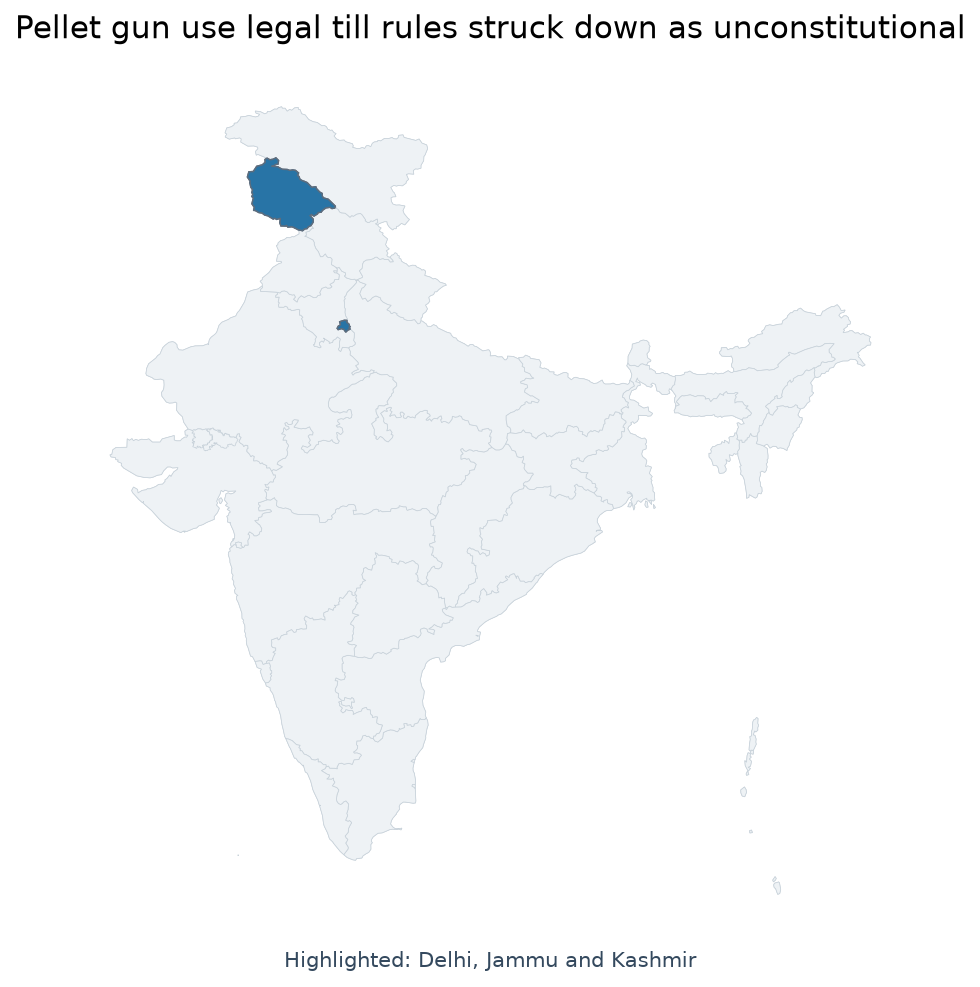
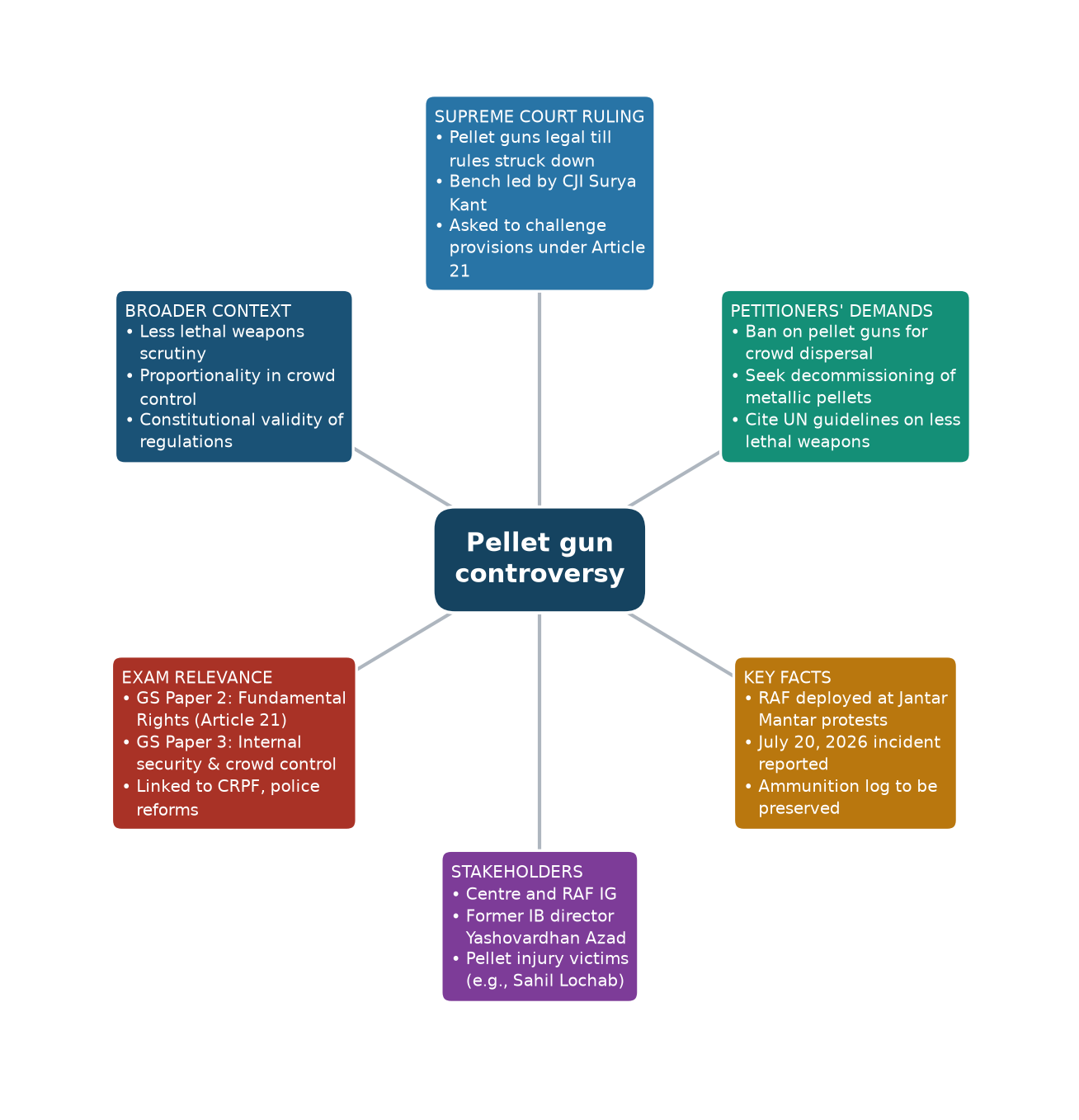
Map & concept mind-map: Pellet gun use legal till rules struck down as unconstitutional
Subject Relevance — Where This Topic Fits
- GS Paper II — Governance, Constitution, Polity, Social Justice | GS Paper III — Internal Security, Police Reforms
- Prelims: Pellet guns, Rapid Action Force (RAF), Less-lethal weapons, Article 21 of the Constitution, Proportionality principle, Bureau of Police Research and Development (BPRD), Standard Operating Procedure (SOP) for crowd control
- Essay: Balancing law and order with fundamental rights: The ethical and constitutional dilemma of crowd-control measures, Technological neutrality in governance: Weighing innovation against human rights in policing
Why is this in the news?
The Supreme Court of India, while hearing petitions seeking a blanket ban on pellet guns, clarified that the legality of pellet guns hinges on the constitutional validity of the provisions permitting their use in exceptional crowd-control scenarios. The Court underscored the need for petitioners to challenge the enabling legal provisions rather than seeking ad hoc bans, while also directing the preservation of ammunition logs of RAF personnel deployed during recent protests at Jantar Mantar. This ruling assumes significance in the context of ongoing debates on police reforms, proportionality in use of force, and adherence to constitutional safeguards in law enforcement.
Background
- Pellet guns are kinetic energy projectiles fired from pump-action or projectile-action guns, classified as ‘less-lethal’ weapons intended for crowd dispersal without causing fatal injuries.
- The use of pellet guns in India has been contentious, particularly in conflict zones like Jammu and Kashmir, where their deployment has been linked to severe injuries, including ocular trauma and fatalities.
- The Bureau of Police Research and Development (BPRD) is the nodal agency responsible for formulating Standard Operating Procedures (SOPs) for crowd control, including the use of less-lethal weapons.
- The United Nations Guidelines on Less Lethal Weapons in Law Enforcement caution against the use of projectile-activated guns, especially when loaded with wholly or partly metallic pellets, due to the risk of indiscriminate and disproportionate harm.
- Recent protests at Jantar Mantar, including those by the Coakroach Janta Party (CJP), have reignited debates on the appropriateness of pellet guns in civilian crowd-control scenarios.
- The Supreme Court’s observation that the BPRD’s SOP is a ‘proposal’ rather than an operational document highlights the ambiguity in the legal framework governing crowd-control tactics.
What are Pellet Guns and the Legal Framework Governing Their Use?
- Pellet guns are kinetic energy projectiles fired from pump-action or projectile-action guns, intended to incapacitate crowds without causing fatal injuries. They are classified as ‘less-lethal’ weapons under policing protocols.
- The Supreme Court has reiterated that the constitutional validity of pellet gun use must be tested under Article 21 (Right to Life and Personal Liberty) through challenges to the enabling legal provisions, rather than ad hoc bans.
- The principle of ‘proportionality’ in law enforcement requires that the force used be necessary, reasonable, and the least intrusive means to achieve a legitimate objective, a test pellet guns often fail when used at close range or against large crowds.
- The United Nations Guidelines on Less Lethal Weapons explicitly warn against the use of projectile-activated guns with metallic pellets for crowd dispersal, citing risks of severe injury and violation of human rights.
- The Rapid Action Force (RAF), a specialised unit of the Central Reserve Police Force (CRPF), is authorised for deployment in crowd-control situations, including protests, and is equipped with pellet guns among other less-lethal tools.
- The Supreme Court’s directive to preserve ammunition logs of RAF personnel during the Jantar Mantar protests underscores the need for transparency and accountability in the use of such weapons.
Key Features
| Feature | Significance |
|---|---|
| Pellet guns as ‘less-lethal’ weapons | Designated as non-lethal alternatives to firearms for crowd control, but capable of causing severe injuries, particularly ocular trauma, when misused in civilian assemblies. |
| Standard Operating Procedure (SOP) for crowd control | Prescribes graded response to unlawful assemblies, including announcement of dispersal and application of appropriate force; pellet guns are cited as one option under this framework. |
| Bureau of Police Research and Development (BPRD) guidelines | Provides operational protocols for law enforcement; petitioners argue pellet guns are not included in the prescribed SOP, rendering their use legally untenable. |
| Ammunition log preservation directive | Supreme Court’s direction to the Centre to preserve logs of RAF personnel deployed at Jantar Mantar protests ensures transparency and accountability in the use of force. |
| Proportionality and necessity principle | Constitutional test under Article 21 requiring that any use of force by state agencies must be demonstrably necessary, proportionate, and reasonable to the threat posed. |
Why it Matters
Legal and Constitutional Implications
- The Supreme Court’s observation that pellet gun use is legal until the enabling rules are struck down underscores the primacy of statutory provisions over judicial intervention in operational matters of law enforcement.
- The case highlights the tension between the state’s duty to maintain public order and the constitutional right to life and personal liberty (Article 21), necessitating a balance between security imperatives and civil liberties.
- The petitioners’ reliance on United Nations Guidelines on Less Lethal Weapons introduces international human rights standards into domestic jurisprudence, reinforcing the argument for stricter regulation of such weapons.
- The court’s willingness to examine specific instances of misuse rather than impose a blanket ban reflects a nuanced approach to judicial review of executive actions in sensitive areas like crowd control.
Operational and Institutional Challenges
- The absence of pellet guns in the BPRD’s prescribed SOP raises questions about the legal basis for their deployment, potentially exposing law enforcement agencies to liability for unauthorized use of force.
- The reliance on pellet guns by Rapid Action Force (RAF) personnel at Jantar Mantar protests, despite the lack of explicit authorization in the SOP, suggests systemic gaps in training and operational protocols.
- The preservation of ammunition logs is a critical step toward ensuring accountability, but its effectiveness depends on rigorous audit mechanisms and transparency in reporting by law enforcement agencies.
- The case underscores the need for periodic review and updating of SOPs to align with evolving legal standards, technological advancements, and human rights norms.
Human Rights and Civil Liberties
- The use of pellet guns, particularly in civilian assemblies, has been linked to severe injuries, including ocular damage, which can result in permanent disability and lifelong trauma for victims.
- The petitioners’ argument that pellet guns fail the constitutional tests of necessity, proportionality, and reasonableness aligns with international human rights frameworks, including the UN Basic Principles on the Use of Force and Firearms by Law Enforcement Officials.
- The case raises concerns about the disproportionate impact of such weapons on vulnerable sections of society, including women, children, and the elderly, who may be more susceptible to indiscriminate injuries.
Challenges
1. Legal Ambiguity in Deployment of Pellet Guns
- The lack of explicit authorization for pellet guns in the BPRD’s SOP creates a legal vacuum, exposing law enforcement agencies to potential challenges under Article 21 of the Constitution.
- The absence of clear statutory provisions governing the use of pellet guns in crowd control situations complicates accountability and invites judicial scrutiny of executive actions.
- The Supreme Court’s directive to challenge the enabling provisions rather than seek a blanket ban places the onus on petitioners to demonstrate the unconstitutionality of the rules permitting pellet gun use.
UPSC Link: GS II: Fundamental Rights
2. Systemic Gaps in Crowd Control Mechanisms
- The reliance on pellet guns despite their exclusion from the prescribed SOP indicates a disconnect between policy and practice, highlighting the need for robust training and adherence to operational protocols.
- The lack of standardized training on alternative crowd control measures, such as water cannons, tear gas, and baton charges, exacerbates the risk of indiscriminate use of force.
- The absence of real-time monitoring and reporting mechanisms for crowd control operations undermines transparency and accountability in law enforcement.
UPSC Link: GS III: Internal Security
3. Accountability and Transparency in Use of Force
- The preservation of ammunition logs is a necessary but insufficient step toward ensuring accountability; comprehensive audit mechanisms are required to verify the legality and proportionality of force used.
- The lack of independent oversight bodies to investigate allegations of misuse of force by law enforcement agencies perpetuates a culture of impunity.
- The case highlights the need for public reporting mechanisms to document injuries and fatalities resulting from crowd control operations, ensuring that victims receive timely medical and legal assistance.
UPSC Link: GS II: Fundamental Rights
4. Balancing Public Order and Civil Liberties
- The state’s duty to maintain public order must be balanced against the constitutional right to peaceful assembly and protest, as enshrined in Article 19(1)(a) and Article 21.
- The use of pellet guns in civilian assemblies risks undermining public trust in law enforcement and exacerbating social tensions, particularly in conflict-prone regions.
- The case underscores the need for a multi-stakeholder approach, involving civil society, human rights organizations, and legal experts, to develop inclusive and humane crowd control policies.
UPSC Link: GS II: Fundamental Rights
Challenges — UPSC Perspective
| Issue | Concern |
|---|---|
| Legal basis for pellet gun use | The absence of pellet guns in the BPRD’s prescribed SOP creates a legal ambiguity, exposing law enforcement agencies to potential constitutional challenges. |
| Operational protocols | The reliance on pellet guns despite their exclusion from the SOP indicates systemic gaps in training and adherence to operational protocols. |
| Accountability mechanisms | The preservation of ammunition logs is a necessary but insufficient step; comprehensive audit mechanisms are required to ensure transparency and accountability. |
| Human rights compliance | The use of pellet guns in civilian assemblies risks violating the constitutional tests of necessity, proportionality, and reasonableness under Article 21. |
| Public trust and social cohesion | Indiscriminate use of force risks undermining public trust in law enforcement and exacerbating social tensions, particularly in conflict-prone regions. |
| International human rights standards | The deployment of pellet guns raises concerns about compliance with UN Guidelines on Less Lethal Weapons, which caution against their use on crowds. |
Way Forward
- Amend the BPRD’s Standard Operating Procedure (SOP) for crowd control to explicitly include or exclude pellet guns, ensuring legal clarity and operational consistency.
- Establish an independent oversight body to investigate allegations of misuse of force by law enforcement agencies, ensuring accountability and transparency.
- Develop and implement standardized training programs for law enforcement personnel on alternative crowd control measures, such as water cannons, tear gas, and baton charges.
- Introduce real-time monitoring and reporting mechanisms for crowd control operations, including mandatory documentation of injuries and fatalities.
- Conduct a comprehensive review of the legal provisions governing the use of pellet guns, in consultation with human rights organizations and legal experts, to align with constitutional and international standards.
- Strengthen public reporting mechanisms to document and address allegations of misuse of force, ensuring that victims receive timely medical and legal assistance.
- Promote community engagement and dialogue to build trust between law enforcement agencies and civil society, particularly in conflict-prone regions.
- Encourage the development and deployment of non-lethal technologies that minimize the risk of severe injuries, such as rubber bullets or bean bag rounds.
UPSC Value Addition
Keywords for Mains Answer-Writing
Pellet guns · Less-lethal weapons · Right to life under Article 21 · Proportionality principle in law enforcement · Standard Operating Procedures (SOPs) for crowd control · Bureau of Police Research and Development (BPRD) · Rapid Action Force (RAF) · Judicial review of executive actions · Constitutional validity of police weapons · Human rights in law enforcement
Constitutional & Policy Linkages
- Article 21 (Right to Life and Personal Liberty) — Proportionality and necessity in use of force
Concept Flow
Civilian assembly declared unlawful → Announcement of dispersal → Application of graded force → Use of pellet guns (if permitted by SOP) → Potential for severe injuries → Constitutional challenge under Article 21 → Judicial scrutiny of proportionality and necessity → Directive to preserve ammunition logs → Systemic review of SOP and operational protocols → Amendments to align with constitutional and international standards.
Prelims Practice Questions
Q1. Consider the following statements regarding the use of pellet guns by law enforcement agencies in India: 1. Pellet guns are classified as ‘less-lethal’ weapons under the UN Guidelines on Less Lethal Weapons in Law Enforcement. 2. The Bureau of Police Research and Development (BPRD) prescribes the Standard Operating Procedure (SOP) for crowd control, which explicitly includes the use of pellet guns. 3. The Supreme Court of India has held that the use of pellet guns is legal until the legal provisions permitting their use are declared unconstitutional. How many of the above statements are correct?
- Only one
- Only two
- All three
- None
Answer: None — Statement 1 is correct as pellet guns are often categorized as ‘less-lethal’ weapons. Statement 2 is incorrect; the BPRD document is a proposal and does not explicitly include pellet guns in the operational SOP. Statement 3 is correct as the Supreme Court has indicated that pellet guns remain legal until the legal provisions permitting their use are struck down.
Q2. Assertion (A): The Supreme Court of India has directed the Centre to preserve the ammunition log of RAF personnel deployed during the Jantar Mantar protests. Reason (R): The Court is examining specific instances of misuse of pellet guns during civilian assemblies.
- Both A and R are true, and R is the correct explanation of A
- Both A and R are true, but R is NOT the correct explanation of A
- A is true, but R is false
- A is false, but R is true
Answer: A is true, but R is false — The Supreme Court did direct the preservation of ammunition logs, but the primary purpose is to examine the constitutional validity of pellet gun use, not merely to investigate misuse in a specific instance.
Q3. Match the following columns with respect to crowd control measures and legal frameworks in India: Column I: A. Bureau of Police Research and Development (BPRD) B. Rapid Action Force (RAF) C. Supreme Court of India D. UN Guidelines on Less Lethal Weapons Column II: 1. Prescribes Standard Operating Procedures (SOPs) for crowd control 2. Deploys personnel for crowd control during protests 3. Examines constitutional validity of pellet gun use 4. Provides guidelines on the use of less-lethal weapons
- A-1, B-2, C-3, D-4; A-2, B-1, C-4, D-3; A-3, B-4, C-1, D-2; A-4, B-3, C-2, D-1
Answer: A-1, B-2, C-3, D-4; A-2, B-1, C-4, D-3; A-3, B-4, C-1, D-2; A-4, B-3, C-2, D-1 — A matches with 1 (BPRD prescribes SOPs), B matches with 2 (RAF deploys personnel), C matches with 3 (Supreme Court examines constitutional validity), and D matches with 4 (UN Guidelines provide framework for less-lethal weapons).
Mains Practice Question
✍ Critically examine the constitutional validity of the use of pellet guns by law enforcement agencies in India for crowd control. Also, discuss the principles of necessity, proportionality, and reasonableness in this context. (15 Marks)
Approach: MODEL-ANSWER SKELETON:
1. **Introduction**: Define pellet guns as kinetic energy projectiles classified as ‘less-lethal’ weapons, clarify their use in crowd control, and state the constitutional context (Article 21: Right to Life and Personal Liberty).
2. **Legal Framework**:
– Cite the Supreme Court’s observation in the present case that pellet gun use is legal until the legal provisions permitting their use are held unconstitutional.
– Reference the UN Guidelines on Less Lethal Weapons (2020) which caution against using projectile-activated guns loaded with metallic pellets for crowd dispersal due to risks of fatal injuries.
– Mention the Standard Operating Procedures (SOPs) prescribed by the Bureau of Police Research and Development (BPRD) and the role of the Rapid Action Force (RAF).
3. **Constitutional Principles**:
– **Necessity**: Examine whether pellet guns are the least intrusive means to achieve a legitimate aim (crowd dispersal) when alternatives exist (e.g., water cannons, baton charges, tear gas).
– **Proportionality**: Assess whether the harm caused (e.g., severe eye injuries, fatalities) is proportionate to the objective of maintaining public order.
– **Reasonableness**: Discuss whether the deployment of pellet guns is reasonable in a democratic society, balancing law enforcement needs with human rights.
4. **Judicial Precedents**:
– Reference the Supreme Court’s jurisprudence on Article 21 (e.g., *Maneka Gandhi v. Union of India*, *Puttaswamy v. Union of India*) and the doctrine of judicial review of executive actions.
– Highlight the Court’s directive to preserve ammunition logs and examine specific instances of misuse.
5. **Counterarguments and Balancing Views**:
– Acknowledge the State’s argument that pellet guns are a ‘less-lethal’ alternative to firearms in exceptional situations.
– Contrast with the petitioners’ stance that metallic pellets cause irreversible harm, violating Article 21.
6. **Conclusion**: Summarize the tension between law enforcement imperatives and constitutional rights, and argue for a phased phasing out of pellet guns unless strict safeguards are implemented. Suggest alternatives like rubber bullets or enhanced training for law enforcement agencies.
Source: The Indian Express
Generated by AanyaAi for educational purpose.

- नासा-इसरो सहयोग: अंतरिक्ष अनुसंधान में नया मोड़, जानिए क्या है अगला कदम? - September 20, 2026
- NASA highlights ISRO partnership for future space missions in UPSC focus - September 20, 2026
- सीजी सरकार की श्रीरामलला दर्शन योजना: धमतरी के 2,176 श्रद्धालुओं को मिला अयोध्या दर्शन का अवसर - September 20, 2026

No Comments