


30 Jul PMKSY Progress: 4.09 Lakh Ha Irrigation Added in Last 3 Years
Subject Relevance — Where This Topic Fits
- GS Paper III — Agriculture, Water Resources, and Rural Development | GS Paper III — Government Schemes and Policies
- Prelims: PMKSY, AIBP, HKKP, CADWM, SMI, RRR, Micro-Irrigation, Watershed Development, Water-Use Efficiency, Pradhan Mantri Krishi Sinchayee Yojana (PMKSY) 2015-16, Jal Shakti Ministry, Land Resources Department (DoLR), Department of Agriculture and Farmers’ Welfare (DoA&FW)
- Essay: Agricultural Water Management: Balancing Productivity and Sustainability, Government Initiatives for Doubling Farmers’ Income: A Critical Analysis
Quick Revision: PMKSY, launched in 2015-16, is an umbrella scheme aimed at enhancing water-use efficiency and expanding irrigation coverage through AIBP, HKKP, and WDC, with micro-irrigation promoted under the PDMC scheme.
Why is this in the news?
The Press Information Bureau (PIB) released a progress report on 30 July 2026 detailing the achievements of the Pradhan Mantri Krishi Sinchayee Yojana (PMKSY) under the Ministry of Jal Shakti. The report highlights the expansion of irrigation coverage, creation of irrigation capacity, and the augmentation of water-use efficiency through various sub-components of PMKSY, including Accelerated Irrigation Benefits Programme (AIBP), Har Khet Ko Pani (HKKP), and Watershed Development Component (WDC). The data underscores the scheme’s role in enhancing agricultural productivity and addressing last-mile connectivity challenges in irrigation.
Background
- PMKSY was launched in 2015-16 as an umbrella scheme to ensure ‘Per Drop More Crop’ by enhancing water-use efficiency and expanding irrigation coverage across India.
- The scheme is implemented by multiple departments: the Department of Water Resources, River Development and Ganga Rejuvenation (under the Ministry of Jal Shakti) for AIBP and HKKP; the Land Resources Department (DoLR) for the Watershed Development Component (WDC); and the Department of Agriculture and Farmers’ Welfare (DoA&FW) for micro-irrigation under the ‘Per Drop More Crop’ (PDMC) scheme.
- AIBP focuses on the completion of ongoing major and medium irrigation projects, while HKKP aims to provide assured irrigation to every farm through command area development, surface minor irrigation, and repair, renovation, and restoration of water bodies.
- The progress report highlights state-wise achievements, including Telangana and Bharatpur, with specific emphasis on the lack of projects in the Dahod Lok Sabha constituency.
- The scheme is a critical component of India’s strategy to achieve Sustainable Development Goals (SDG) 2 (Zero Hunger) and SDG 6 (Clean Water and Sanitation) by improving water management in agriculture.
What is the Pradhan Mantri Krishi Sinchayee Yojana (PMKSY)?
- PMKSY is a centrally sponsored umbrella scheme launched by the Government of India in 2015-16 to address the twin challenges of water scarcity and low irrigation coverage in Indian agriculture.
- The scheme operates on the principle of ‘More Crop Per Drop’ to enhance water-use efficiency and ensure ‘Har Khet Ko Pani’ (water for every farm).
- PMKSY comprises three major components: Accelerated Irrigation Benefits Programme (AIBP), Har Khet Ko Pani (HKKP), and Watershed Development Component (WDC).
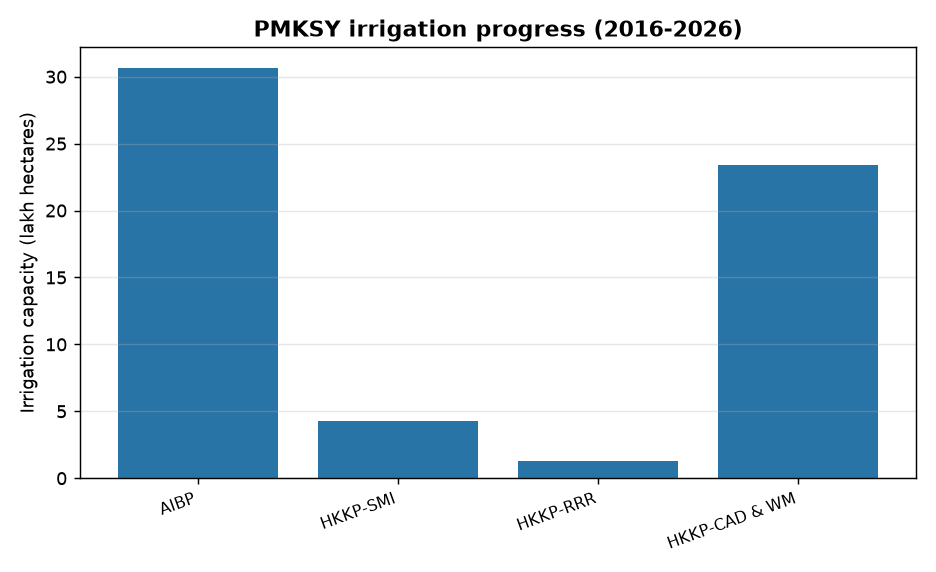
- AIBP focuses on the completion of ongoing major and medium irrigation projects to create new irrigation capacity. As of the 2026 progress report, AIBP has created 30.66 lakh hectares of irrigation capacity since 2016, with 4.09 lakh hectares added in the last three years.
- HKKP is implemented through three sub-components: Command Area Development and Water Management (CADWM), Surface Minor Irrigation (SMI), and Repair, Renovation, and Restoration (RRR) of water bodies. CADWM has developed 23.42 lakh hectares of command areas since 2016, with 3.76 lakh hectares added in the last three years.
- The Watershed Development Component (WDC) is implemented by the Land Resources Department (DoLR) to promote sustainable land and water management through watershed development projects. As of 2026, 9,434 watershed development projects have been initiated under WDC.
- The ‘Per Drop More Crop’ (PDMC) scheme, now aligned under Pradhan Mantri-National Agricultural Development Scheme (PM-RKVY), promotes micro-irrigation to reduce water wastage and enhance crop productivity. Since 2015-16, PDMC has brought 114.60 lakh hectares under micro-irrigation.
Key Features
| Feature | Significance |
|---|---|
| Accelerated Irrigation Benefits Programme (AIBP) | Creates large-scale irrigation infrastructure (dams, canals) to enhance command area coverage and augment water storage capacity, directly increasing net irrigated area. |
| Har Khet Ko Pani (HKKP) – Command Area Development & Water Management (CADWM) | Improves on-farm water distribution efficiency through field channels, drainage networks, and modernisation of irrigation systems, reducing conveyance losses. |
| Har Khet Ko Pani (HKKP) – Surface Minor Irrigation (SMI) | Promotes decentralised irrigation through small dams, ponds, and lift irrigation schemes, enhancing localised water security and reducing dependence on large projects. |
| Har Khet Ko Pani (HKKP) – Repair, Renovation & Restoration (RRR) | Revives defunct or underutilised water bodies (tanks, lakes) to restore their irrigation potential, aiding drought-prone regions and improving groundwater recharge. |
| Watershed Development Component (WDC) | Adopts a micro-watershed approach to conserve soil moisture, prevent erosion, and recharge aquifers, indirectly supporting irrigation through improved hydrological balance. |
| Micro Irrigation (Per Drop More Crop – PDMC) | Promotes drip and sprinkler systems to enhance water-use efficiency, reduce input costs, and increase crop yields, particularly in water-scarce regions. |
Why it Matters
Economic
- Enhances agricultural productivity by expanding and stabilising irrigation coverage, reducing crop losses due to water stress, and enabling multiple cropping cycles.
- Reduces input costs for farmers through improved water-use efficiency and lower energy expenditure for irrigation, particularly in micro-irrigation systems.
- Boosts rural incomes by increasing farm output and enabling diversification into high-value crops, thereby contributing to agricultural GDP growth.
Environmental
- Improves water-use efficiency by reducing conveyance and field application losses, thereby mitigating water scarcity in agriculture.
- Promotes groundwater recharge through watershed development and RRR of water bodies, countering depletion trends in over-exploited aquifers.
- Supports climate-resilient agriculture by enhancing drought resilience and reducing vulnerability to erratic monsoons.
Social
- Enhances food security by ensuring reliable irrigation for staple crops, thereby reducing dependence on monsoon variability and stabilising food supply chains.
- Improves livelihoods in rural areas by creating employment in irrigation infrastructure development, maintenance, and allied agricultural activities.
- Reduces farmer distress by mitigating water scarcity risks, particularly in drought-prone regions like Bundelkhand and Telangana.
Institutional
- Strengthens inter-departmental coordination between the Ministry of Jal Shakti, Ministry of Agriculture, and state governments for integrated water resource management.
- Fosters participatory irrigation management through Water User Associations (WUAs), enhancing local ownership and operational efficiency of irrigation systems.
- Leverages technology (GIS, remote sensing) for real-time monitoring of irrigation projects, improving transparency and accountability in implementation.
Challenges
1. Fragmented Land Holdings
- Small and fragmented land holdings limit the adoption of micro-irrigation and on-farm water management practices, reducing the scalability of HKKP components.
- Encourages consolidation of land holdings through cooperative farming models or farmer producer organisations (FPOs) to enhance irrigation efficiency.
UPSC Link: Land Reforms (GS-II)
2. Groundwater Depletion
- Over-extraction of groundwater for irrigation, particularly in states like Punjab and Rajasthan, undermines the long-term sustainability of irrigation systems.
- Promote groundwater recharge through watershed development, RRR of water bodies, and adoption of micro-irrigation to reduce dependency on tube wells.
UPSC Link: Groundwater Management (GS-III)
3. Last-Mile Connectivity Gaps
- Incomplete field channels, poor maintenance of irrigation infrastructure, and lack of farmer participation hinder the full utilisation of created irrigation capacity.
- Strengthen Water User Associations (WUAs) and adopt a ‘convergence’ approach with MGNREGS for last-mile connectivity improvements.
UPSC Link: Irrigation Efficiency (GS-III)
4. Climate Change Vulnerability
- Increased frequency of droughts, erratic rainfall, and extreme weather events threaten the reliability of irrigation systems and crop yields.
- Integrate climate-resilient practices such as drought-tolerant crop varieties, soil moisture conservation, and adaptive irrigation scheduling into PMKSY components.
UPSC Link: Climate Change (GS-III)
5. Financial Constraints
- Limited budgetary allocations and delays in fund disbursement slow down project implementation, particularly in states with weak fiscal capacity.
- Explore public-private partnerships (PPPs) and innovative financing mechanisms (e.g., climate bonds) to augment resources for irrigation infrastructure.
UPSC Link: Public Finance (GS-III)
6. Inter-State Water Disputes
- Conflicts over river water sharing (e.g., Cauvery, Krishna) delay the implementation of inter-state irrigation projects under AIBP.
- Strengthen inter-state water governance through river basin organisations and adopt a ‘benefit-sharing’ framework to resolve disputes.
UPSC Link: Inter-State Relations (GS-II)
Challenges — UPSC Perspective
| Issue | Concern | |
|---|---|---|
| Low adoption of micro-irrigation | Only 114.60 lakh hectares covered under PDMC since 2015-16, far below potential of ~69 million hectares. | Limited awareness among farmers and high initial capital costs deter adoption. |
| Underutilisation of RRR projects | Only 1.27 lakh hectares restored under HKKP-RRR since 2016, despite large number of defunct water bodies. | Lack of convergence with state irrigation departments and poor maintenance post-restoration. |
| Delayed project completion | Average gestation period of 5-7 years for major irrigation projects under AIBP, leading to cost overruns. | Bureaucratic delays, land acquisition hurdles, and environmental clearances slow implementation. |
| Poor maintenance of irrigation infrastructure | Aging canals and field channels suffer from siltation and structural damage, reducing water conveyance efficiency. | Inadequate allocation of funds for Operation & Maintenance (O&M) in state budgets. |
| Limited farmer participation | Weak institutional mechanisms for farmer engagement in planning and monitoring of irrigation projects. | Need for capacity-building programmes to educate farmers on irrigation best practices. |
| Data gaps in irrigation monitoring | Lack of real-time data on irrigation coverage, water use efficiency, and project outcomes hinders evidence-based policymaking. | Adopt GIS-based monitoring systems and integrate with PMKSY dashboard for transparent tracking. |
Government Initiatives — Must-Memorise for Prelims
- Pradhan Mantri Krishi Sinchayee Yojana (PMKSY)
- Accelerated Irrigation Benefits Programme (AIBP)
- Har Khet Ko Pani (HKKP)
- Watershed Development Component (WDC)
- Pradhan Mantri National Agricultural Development Scheme (PM-NAD)
Way Forward
- Strengthen convergence between PMKSY components (AIBP, HKKP, PDMC, WDC) and other schemes like MGNREGS for integrated water resource management.
- Enhance farmer awareness and capacity-building programmes on micro-irrigation, water conservation, and efficient irrigation practices through Krishi Vigyan Kendras (KVKs).
- Accelerate last-mile connectivity improvements by leveraging MGNREGS funds for field channel construction and maintenance under HKKP-CADWM.
- Promote groundwater recharge through watershed development and RRR of water bodies, with a focus on over-exploited aquifer regions.
- Adopt climate-resilient irrigation strategies, including drought-proofing measures and adaptive water scheduling, to mitigate climate change impacts.
- Improve inter-departmental coordination between the Ministry of Jal Shakti, Ministry of Agriculture, and state governments for streamlined implementation.
- Enhance real-time monitoring of irrigation projects using GIS, remote sensing, and AI-driven analytics for data-driven decision-making.
- Explore innovative financing mechanisms such as climate bonds and PPPs to augment resources for irrigation infrastructure development.
UPSC Value Addition
Keywords for Mains Answer-Writing
Pradhan Mantri Krishi Sinchayee Yojana (PMKSY) · Accelerated Irrigation Benefits Programme (AIBP) · Har Khet Ko Pani (HKKP) · Command Area Development and Water Management (CADWM) · Surface Minor Irrigation (SMI) · Repair, Renovation and Restoration (RRR) of Water Bodies · Micro-Irrigation under ‘Per Drop More Crop’ (PDMC) · Watershed Development Component (WDC) · Irrigation efficiency and water conservation · Last-mile connectivity in irrigation infrastructure · Telangana irrigation projects · Dahod district irrigation coverage
Concept Flow
Inadequate irrigation coverage → Low agricultural productivity and farmer distress → Launch of PMKSY (2015-16) as umbrella scheme → Implementation of AIBP and HKKP components → Expansion of irrigation capacity and water-use efficiency → Enhanced crop yields and rural incomes → Improved food security and climate resilience → Feedback loop for further demand for irrigation infrastructure.
Prelims Practice Questions
Q1. Consider the following statements regarding the Pradhan Mantri Krishi Sinchayee Yojana (PMKSY):
1. PMKSY is an umbrella scheme launched in 2015-16 to enhance irrigation coverage and efficiency.
2. The ‘Har Khet Ko Pani’ (HKKP) component includes Command Area Development and Water Management (CADWM), Surface Minor Irrigation (SMI), and Repair, Renovation and Restoration (RRR) of water bodies.
3. The ‘Accelerated Irrigation Benefits Programme’ (AIBP) is solely implemented by the Ministry of Agriculture and Farmers’ Welfare.
4. The ‘Per Drop More Crop’ (PDMC) scheme, dedicated to micro-irrigation, is now implemented under the Pradhan Mantri Krishi Vikas Yojana (PMKVY).
How many of the above statements are correct?
- Only one
- Only two
- Only three
- All four
Answer: Only three — Statements 1 and 2 are correct. Statement 3 is incorrect as AIBP is implemented by the Department of Water Resources, River Development and Ganga Rejuvenation under the Ministry of Jal Shakti. Statement 4 is correct as PDMC is now under PMKVY.
Q2. Assertion (A): The ‘Repair, Renovation and Restoration’ (RRR) component of PMKSY-HKKP aims to revive traditional water bodies for irrigation.
Reason (R): The RRR component focuses on modernizing irrigation infrastructure to enhance water-use efficiency.
Options:
A. Both A and R are true, and R is the correct explanation of A.
B. Both A and R are true, but R is not the correct explanation of A.
C. A is true, but R is false.
D. A is false, but R is true.
Answer: ? — Assertion (A) is true as RRR targets revival of traditional water bodies. Reason (R) is also true but is not the correct explanation of A, as RRR’s primary objective is revival, not modernization of infrastructure.
Q3. Match the following components of PMKSY with their implementing agencies:
Component:
1. Accelerated Irrigation Benefits Programme (AIBP)
2. Command Area Development and Water Management (CADWM)
3. Surface Minor Irrigation (SMI)
4. Watershed Development Component (WDC)
Implementing Agency:
A. Department of Land Resources
B. Department of Water Resources, River Development and Ganga Rejuvenation
C. Ministry of Agriculture and Farmers’ Welfare (via PMKVY for PDMC)
D. Ministry of Jal Shakti
- 1-D, 2-B, 3-B, 4-A
- 1-B, 2-D, 3-D, 4-A
- 1-D, 2-B, 3-D, 4-A
- 1-B, 2-A, 3-D, 4-C
Answer: 1-D, 2-B, 3-B, 4-A — 1. AIBP is implemented by the Department of Water Resources, River Development and Ganga Rejuvenation (Ministry of Jal Shakti) — D.
2. CADWM is implemented by the same department — B.
3. SMI is also implemented by the Department of Water Resources — B.
4. WDC is implemented by the Department of Land Resources — A.
Mains Practice Question
✍ The Pradhan Mantri Krishi Sinchayee Yojana (PMKSY) represents a paradigm shift in India’s irrigation policy by integrating multiple components to enhance water-use efficiency and agricultural productivity. Critically examine the institutional architecture and implementation challenges of PMKSY, with particular reference to its components and recent progress data. (15 Marks)
Approach: MODEL-ANSWER SKELETON:
1. **Introduction (2 marks)**: Define PMKSY, its launch year (2015-16), and its umbrella nature covering AIBP, HKKP, WDC, and PDMC. State the core objectives: expanding irrigation coverage, improving last-mile connectivity, promoting micro-irrigation, and enhancing water-use efficiency.
2. **Institutional Architecture (4 marks)**:
– **AIBP**: Implemented by the Department of Water Resources, River Development and Ganga Rejuvenation (Ministry of Jal Shakti). Focus on major and medium irrigation projects.
– **HKKP Components**:
– CADWM: Integrated with AIBP for command area development.
– SMI: Focus on minor irrigation schemes.
– RRR: Revival of traditional water bodies.
– **WDC**: Implemented by the Department of Land Resources under the Ministry of Rural Development.
– **PDMC**: Originally under PMKSY, now under PMKVY (Ministry of Agriculture and Farmers’ Welfare).
3. **Implementation Challenges (5 marks)**:
– **Inter-ministerial coordination**: Fragmentation between Jal Shakti, Agriculture, and Rural Development ministries.
– **Last-mile connectivity**: Delays in project completion due to land acquisition, environmental clearances, and bureaucratic hurdles.
– **Data from the press release**: Progress in Telangana (e.g., 204.74 lakh hectares under AIBP, 25.55 lakh hectares under RRR) highlights state-specific disparities and implementation bottlenecks.
– **Funding and resource allocation**: Central assistance figures (e.g., ₹21,823.46 crore for AIBP) underscore the need for sustained budgetary support.
– **Technological integration**: Modernization of irrigation networks (e.g., pressurized pipe systems) requires technical expertise and investment.
4. **Recent Progress and Data Analysis (3 marks)**:
– Cite the progress data (e.g., 30.66 lakh hectares added under AIBP since 2016, 3.76 lakh hectares under CADWM in the last three years).
– Highlight gaps: Limited progress in certain regions (e.g., Dahod LS constituency with no projects under AIBP/HKKP).
– Emphasize the role of state-level implementation agencies in addressing regional disparities.
5. **Conclusion (1 mark)**: Summarize the need for integrated, state-specific strategies to overcome institutional and operational challenges, ensuring PMKSY achieves its goals of irrigation efficiency and water conservation.
Source: PIB (Press Information Bureau)
Generated by AanyaAi for educational purpose.

- नागरिक उड्डयन मंत्रालय ने विशेष अभियान 5.0 में हासिल की बड़ी उपलब्धि - September 17, 2026
- Civil Aviation Ministry’s Progress Under SCDPM 5.0: Key Achievements for UPSC - September 17, 2026
- स्वामित्व योजना: मध्यप्रदेश में 50 लाख संपत्तियों की मुफ्त रजिस्ट्री शुरू, जानिए पूरा विवरण - September 17, 2026

No Comments