


30 Jul UPSC Alert: India’s Underwater Cultural Heritage Exploration 2026-30
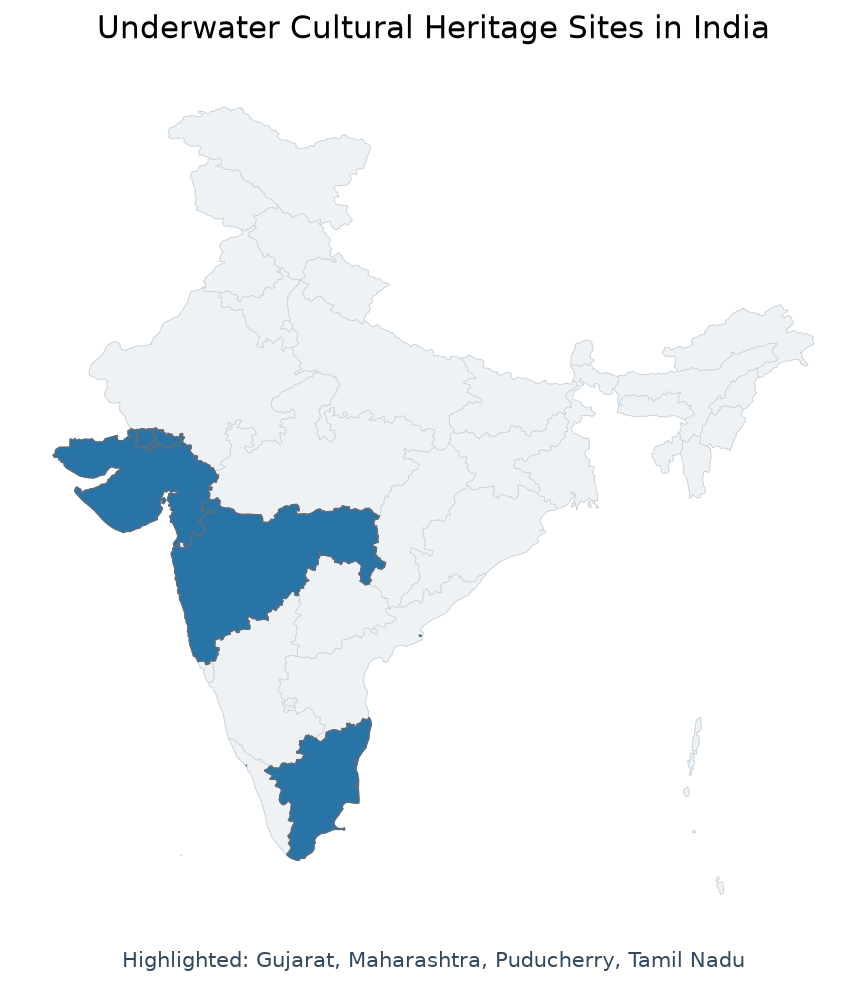
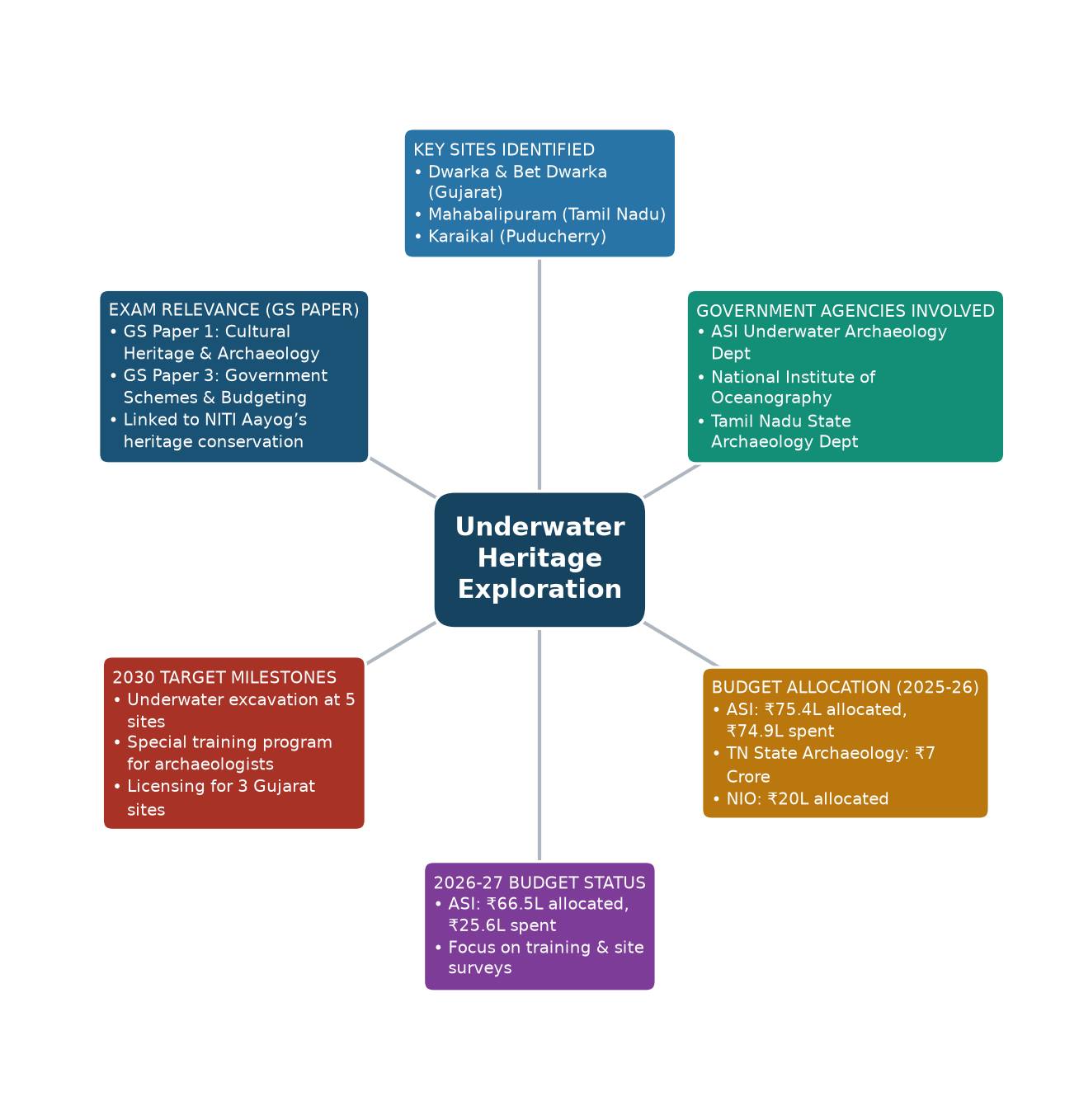
Map & concept mind-map: Underwater Cultural Heritage Sites in India
Subject Relevance — Where This Topic Fits
- GS Paper I — Indian Heritage and Culture | GS Paper I — Modern Indian History | GS Paper II — Government Policies and Interventions
- Prelims: Underwater Cultural Heritage (UCH), Maritime Archaeology, ASI Underwater Archaeology Wing, Pumpuhar, Bet Dwarka, Maritime Heritage, UNESCO 2001 Convention on Underwater Cultural Heritage
- Essay: The Role of Archaeology in Reconstructing India’s Maritime Past, Preservation of Cultural Heritage in the Face of Climate Change and Anthropogenic Pressures
Quick Revision: Underwater Cultural Heritage (UCH) in India is being systematically explored by the ASI’s Underwater Archaeology Wing, with key sites like Dwarka, Bet Dwarka, and Mahabalipuram prioritised for research by 2030, supported by dedicated budgetary allocations and inter-institutional collaborations.
Why is this in the news?
The Press Information Bureau (PIB) release dated 30 July 2026 highlights India’s expanding initiatives in underwater cultural heritage exploration, with the Archaeological Survey of India (ASI) and affiliated institutions conducting research and excavation at key maritime archaeological sites such as Dwarka, Bet Dwarka, Mahabalipuram, and Karaikal. The announcement underscores the government’s commitment to systematic underwater archaeological surveys, capacity-building for archaeologists, and the allocation of dedicated budgets for maritime heritage conservation, aligning with India’s broader cultural diplomacy and heritage preservation goals.
Background
- The concept of underwater cultural heritage (UCH) encompasses submerged archaeological sites, shipwrecks, and human-made structures that provide critical insights into maritime trade, coastal settlements, and historical events.
- India’s maritime heritage spans millennia, with evidence of ancient ports such as Lothal (Gujarat), Poompuhar (Tamil Nadu), and Muziris (Kerala) reflecting its role as a global trade hub.
- The UNESCO Convention on the Protection of the Underwater Cultural Heritage (2001) provides an international legal framework for the preservation of UCH, though India is not yet a signatory.
- The ASI’s Underwater Archaeology Wing, established in the 1980s, has been instrumental in documenting and preserving submerged heritage sites, including the discovery of ancient anchors and pottery off the coast of Gujarat.
- Recent technological advancements in sonar, remote sensing, and underwater drones have revolutionised maritime archaeology, enabling non-invasive exploration of deep-sea sites.
- India’s coastal states, including Tamil Nadu, Gujarat, and Maharashtra, are home to numerous potential UCH sites, many of which remain unexplored due to logistical and financial constraints.
What is Underwater Cultural Heritage and India’s Role in Its Preservation?
- Underwater Cultural Heritage (UCH) refers to all traces of human existence having a cultural, historical, or archaeological character that have been partially or totally underwater for at least 100 years, including shipwrecks, submerged cities, and port structures.
- India’s maritime archaeology efforts are coordinated by the ASI’s Underwater Archaeology Wing, which conducts surveys, excavations, and conservation of submerged sites using advanced marine archaeology techniques.
- Key sites under active research include Dwarka and Bet Dwarka (Gujarat), where submerged structures and artefacts dating to the Harappan and later periods are being studied to trace the evolution of coastal settlements.
- Mahabalipuram (Tamil Nadu) and Karaikal (Puducherry) are being explored for their potential links to ancient Chola maritime trade networks and temple architecture.
- The government has expanded collaboration with state archaeology departments (e.g., Tamil Nadu) and institutions like the National Institute of Oceanography (NIO) to enhance research capabilities and resource allocation.
- Budgetary allocations for 2025-26 and 2026-27 reflect a prioritisation of UCH, with the ASI’s Underwater Archaeology Wing receiving ₹75.4 lakh and ₹66.5 lakh respectively, while Tamil Nadu has allocated ₹7 crore for combined terrestrial and underwater excavations.
- Capacity-building initiatives, such as specialised training programmes for archaeologists, are being implemented to develop a skilled workforce for underwater heritage management.
Key Features
| Feature | Significance |
|---|---|
| Underwater Archaeology Division of ASI | Conducts research and exploration in submerged cultural heritage sites such as Dwarka, Bet Dwarka, Mahabalipuram, and Karaikal, ensuring systematic documentation and preservation of maritime heritage. |
| Licensing to State Agencies | Government has granted licenses to Tamil Nadu State Archaeology Department (Poompuhar) and National Institute of Oceanography (Bet Dwarka, Chhari, Gangata Bet) for underwater excavations, decentralizing expertise and resources. |
| Budget Allocation for ASI (2025-26 & 2026-27) | Demonstrates government commitment to underwater archaeology, with allocations of ₹75.4 lakh and ₹66.5 lakh respectively, though expenditure remains high, indicating operational efficiency. |
| Specialized Training Program | ASI’s initiative to train archaeologists in underwater survey techniques, enhancing human resource capacity for submerged site investigations. |
| Targeted Sites for 2030 Exploration | Identification of six key sites (Dwarka, Bet Dwarka, Vijaydurg, Janjira, Karaikal, Mahabalipuram) for systematic underwater exploration by 2030, aligning with national heritage priorities. |
Why it Matters
Cultural Heritage Preservation
- Underwater archaeology safeguards India’s maritime cultural legacy, including ancient ports, shipwrecks, and submerged structures, which are vulnerable to erosion and human interference.
- Enhances understanding of historical trade routes, maritime traditions, and coastal civilizations, particularly in regions like Gujarat, Tamil Nadu, and Puducherry.
- Supports UNESCO’s 2001 Convention on the Protection of the Underwater Cultural Heritage by promoting systematic exploration and documentation.
Scientific and Technological Advancement
- Fosters interdisciplinary collaboration between archaeology, oceanography, and marine engineering, driving innovation in remote sensing and underwater survey techniques.
- Contributes to climate science by studying submerged coastal sites, which provide paleoclimatic data and insights into sea-level changes over millennia.
- Encourages development of indigenous technologies for underwater exploration, reducing dependence on foreign expertise.
Economic and Tourism Potential
- Underwater heritage sites can be developed as eco-tourism destinations, generating revenue and employment in coastal regions (e.g., Dwarka, Mahabalipuram).
- Promotes ‘heritage tourism’ as a sustainable alternative to mass tourism, aligning with the ‘Dekho Apna Desh’ initiative.
- Attracts global research collaborations, positioning India as a leader in maritime archaeology.
Policy and Governance Framework
- Demonstrates a structured approach to heritage management, with clear budget allocations, inter-agency coordination, and long-term planning (e.g., 2030 targets).
- Highlights the role of state governments (e.g., Tamil Nadu) and autonomous institutions (e.g., NIO) in heritage conservation, decentralizing administrative control.
- Aligns with the National Mission on Cultural Mapping and the National Maritime Heritage Complex (NMHC) in Lothal, Gujarat.
Challenges
1. Technical and Logistical Constraints
- Limited availability of specialized equipment (e.g., side-scan sonar, ROVs) and trained personnel for underwater archaeology in India.
- High operational costs of deep-sea exploration, including vessel rentals, diving equipment, and data processing.
- Monsoon seasons and adverse weather conditions disrupt fieldwork schedules in coastal regions.
UPSC Link: GS Paper 3: Science & Tech
2. Environmental and Ecological Risks
- Disturbance to marine ecosystems during excavations may harm biodiversity, particularly in coral reefs or mangrove areas.
- Climate change-induced sea-level rise and increased storm frequency threaten the preservation of submerged sites.
- Pollution (e.g., plastic waste, chemical runoff) accelerates degradation of underwater cultural assets.
UPSC Link: GS Paper 3: Environment
3. Legal and Ethical Dilemmas
- Ambiguity in ownership rights over underwater cultural heritage, especially in disputed maritime zones or international waters.
- Ethical concerns regarding the commercial exploitation of heritage sites (e.g., treasure hunting vs. scientific study).
- Need for stricter enforcement of the Ancient Monuments and Archaeological Sites and Remains Act, 1958, to prevent looting.
UPSC Link: GS Paper 2: Governance
4. Data Security and Interpretation Challenges
- Risk of data loss or corruption due to harsh underwater conditions, necessitating robust backup systems.
- Interpretation of underwater findings is complex, requiring cross-disciplinary expertise (e.g., archaeology, geology, history).
- Lack of standardized protocols for reporting and archiving underwater archaeological data.
UPSC Link: GS Paper 1: History
5. Public Awareness and Stakeholder Engagement
- Low public awareness about underwater heritage, leading to apathy or indifference toward conservation efforts.
- Resistance from local communities or fishermen who may view exploration as disruptive to livelihoods.
- Need for community participation in heritage preservation to ensure sustainable outcomes.
UPSC Link: GS Paper 4: Ethics
Challenges — UPSC Perspective
| Issue | Concern |
|---|---|
| Equipment Shortage | Insufficient advanced tools (e.g., sonar, ROVs) for deep-sea exploration. |
| High Operational Costs | Expensive logistics (vessels, diving gear) limit fieldwork frequency. |
| Climate Vulnerability | Monsoons and storms disrupt excavation schedules. |
| Marine Ecosystem Impact | Risk of biodiversity loss during underwater surveys. |
| Legal Ambiguities | Unclear ownership rights over submerged cultural assets. |
| Data Management Gaps | Lack of standardized protocols for underwater data collection. |
Way Forward
- Augment ASI’s Underwater Archaeology Division with state-of-the-art equipment (e.g., multibeam sonar, autonomous underwater vehicles) through public-private partnerships.
- Develop a national framework for underwater heritage conservation, integrating inputs from the National Maritime Heritage Complex (NMHC) and UNESCO guidelines.
- Establish a dedicated training institute for underwater archaeology, in collaboration with the Indian Navy, NIO, and international bodies like the Nautical Archaeology Society.
- Implement community-based monitoring programs in coastal regions to report unauthorized activities near heritage sites.
- Promote ‘citizen science’ initiatives, involving local fishermen and divers in preliminary site surveys to enhance reach and awareness.
- Strengthen inter-state coordination (e.g., Gujarat, Tamil Nadu, Maharashtra) for shared resources and expertise in underwater exploration.
- Integrate underwater heritage sites into the ‘Dekho Apna Desh’ tourism circuit, with eco-friendly access models to minimize ecological impact.
UPSC Value Addition
Keywords for Mains Answer-Writing
Underwater Cultural Heritage · Maritime Archaeology · UNESCO Convention 2001 · Indian National Shipwreck Database · Maritime Heritage Sites · ASI Underwater Archaeology Wing · Pompuhar · Dwarka and Bet Dwarka · UNESCO 2001 Convention on Underwater Cultural Heritage · Maritime Archaeology Training Programme · National Institute of Oceanography · Tamil Nadu State Archaeology Department
Concept Flow
Ancient maritime trade and coastal settlements → Submersion due to sea-level rise/tectonic shifts → Modern underwater archaeology as a discipline → Government-led exploration (ASI, NIO) → Systematic documentation and preservation → Integration into tourism and education → Long-term cultural and economic benefits.
Prelims Practice Questions
Q1. Consider the following statements regarding Underwater Cultural Heritage in India:
1. The ASI’s Underwater Archaeology Wing is currently conducting research and exploration at Dwarka and Bet Dwarka in Gujarat.
2. The National Institute of Oceanography has been granted a license for underwater excavation at Bet Dwarka and Chhari and Gangata Bet in Gujarat.
3. The UNESCO Convention on Underwater Cultural Heritage, 2001, has been ratified by India.
4. The Tamil Nadu State Archaeology Department has allocated ₹7 crore for underwater archaeological excavations at Pompuhar.
How many of the above statements are correct?
- Only one
- Only two
- Only three
- All four
Answer: All four — Statements 1, 2, and 4 are correct as per the PIB release. Statement 3 is incorrect because India has not ratified the UNESCO Convention on Underwater Cultural Heritage, 2001.
Q2. Assertion (A): The ASI’s Underwater Archaeology Wing has initiated a special programme to train archaeologists in surveying submerged sites.
Reason (R): This programme aims to enhance the capacity of Indian archaeologists to document and preserve underwater cultural heritage.
Options:
A. Both A and R are true, and R is the correct explanation of A.
B. Both A and R are true, but R is not the correct explanation of A.
C. A is true, but R is false.
D. A is false, but R is true.
Answer: ? — Both Assertion (A) and Reason (R) are true, and R correctly explains A as per the PIB release.
Q3. Match the following underwater archaeological sites with their respective states/UTs:
Column I (Site) Column II (State/UT)
A. Dwarka and Bet Dwarka 1. Tamil Nadu
B. Mahabalipuram 2. Puducherry
C. Karaikal 3. Gujarat
D. Pompuhar 4. Maharashtra
Options:
A. A-3, B-1, C-2, D-4
B. A-3, B-1, C-2, D-1
C. A-1, B-3, C-2, D-4
D. A-2, B-1, C-3, D-4
Answer: ? — Dwarka and Bet Dwarka are in Gujarat (A-3), Mahabalipuram in Tamil Nadu (B-1), Karaikal in Puducherry (C-2), and Pompuhar in Tamil Nadu (D-1).
Mains Practice Question
✍ The conservation and exploration of underwater cultural heritage in India is gaining momentum through initiatives by the Archaeological Survey of India (ASI) and other institutions. Critically examine the significance of underwater archaeology for India’s cultural heritage and the challenges it faces. Also, discuss the legal and institutional framework governing underwater cultural heritage in India. (15 Marks)
Approach: MODEL-ANSWER SKELETON:
1. **Significance of Underwater Archaeology** (6 points, 100 words):
– Preservation of submerged historical sites (e.g., Dwarka, Mahabalipuram) linked to ancient trade, maritime activity, and cultural exchanges.
– Documentation of maritime heritage (ships, ports, artifacts) critical for reconstructing India’s maritime history.
– Contribution to UNESCO’s 2001 Convention on Underwater Cultural Heritage, which India has not ratified but aligns with its principles.
– Enhancement of tourism and cultural diplomacy through heritage sites like Bet Dwarka.
– Scientific value: understanding climate change, coastal erosion, and anthropogenic impacts on submerged sites.
– Interdisciplinary collaboration: integration of archaeology, oceanography, and conservation science.
2. **Challenges** (5 points, 80 words):
– Technical: Limited expertise in underwater archaeology; need for advanced equipment and training (ASI’s special programme addresses this).
– Financial: Budget constraints (e.g., ₹75.4 lakh allocated to ASI’s Underwater Archaeology Wing in 2025-26, with minimal expenditure).
– Legal: Absence of a dedicated national legislation; reliance on the Ancient Monuments and Archaeological Sites and Remains Act, 1958, which is inadequate for underwater sites.
– Environmental: Threats from pollution, fishing, and coastal development.
– Ethical: Balancing exploration with preservation to avoid commercial exploitation.
3. **Legal and Institutional Framework** (4 points, 70 words):
– **ASI’s Underwater Archaeology Wing**: Conducts research and training; identified sites like Dwarka and Mahabalipuram for exploration by 2030.
– **National Institute of Oceanography (NIO)**: Licensed for excavations at Bet Dwarka and other Gujarat sites.
– **State Departments**: Tamil Nadu State Archaeology Department allocated ₹7 crore for underwater excavations at Pompuhar.
– **International Alignment**: India’s efforts align with the UNESCO 2001 Convention, though ratification is pending; domestic laws lack specific provisions for underwater heritage.
Balance of Views:
– Proponents argue that underwater archaeology is essential for holistic heritage conservation.
– Critics highlight the need for stronger legal safeguards and international cooperation to address transboundary sites.
Source: PIB (Press Information Bureau)
Generated by AanyaAi for educational purpose.

- नमस्ते योजना से स्वच्छता कर्मियों को मिली सुरक्षा, गरिमा और आजीविका सहायता - September 22, 2026
- कर्नाटक में ‘वंदे मातरम’ विवाद: राज्यपाल ने सीएम से आदेश वापस लेने को कहा - September 22, 2026
- Karnataka Governor vs CM: Vande Mataram GO row explained for UPSC - September 22, 2026

No Comments