


30 Jul RERA Implementation: Key Provisions & UPSC Exam Perspective 2026
Subject Relevance — Where This Topic Fits
- GS Paper II — Constitutional and Non-Constitutional Bodies | GS Paper III — Infrastructure, Investment Models and Economic Policies
- Prelims: RERA, Seventh Schedule, Concurrent List, State List, Entry 18, Entry 6, Entry 7, Entry 46, homebuyers, promoters, regulatory authority, fast-track dispute resolution, Central Advisory Council (CAC), adjudicating officer
- Essay: Regulatory frameworks and consumer protection in India: Balancing state autonomy and central oversight, The role of statutory bodies in ensuring transparency and accountability in economic sectors
Quick Revision: RERA, enacted under Concurrent List powers, mandates project registration, escrow account maintenance, and fast-track dispute resolution to safeguard homebuyers’ interests and ensure transparency in the real estate sector.
Why is this in the news?
The Press Information Bureau (PIB) of the Ministry of Housing and Urban Affairs has issued a press release on 30 July 2026 highlighting the implementation status of the Real Estate (Regulation and Development) Act, 2016 (RERA). The release underscores the constitutional framework governing RERA, the institutional mechanisms for dispute resolution, and the measures taken to enhance transparency and accountability in the real estate sector, particularly in safeguarding the interests of homebuyers. This development is significant as it reflects the ongoing efforts to strengthen RERA’s operational efficiency and address challenges in project registration across states and Union Territories.
Background
- The Constitution of India allocates ‘land’ and ‘colonisation’ as State subjects under Entry 18 of List II (State List) in the Seventh Schedule, thereby vesting primary legislative and administrative authority in state governments.
- However, the Parliament enacted RERA, 2016, leveraging concurrent powers under List III (Concurrent List) to regulate contractual relationships between homebuyers and promoters in the real estate sector.
- RERA was enacted to address systemic issues in the real estate sector, including delays in project delivery, diversion of funds, and lack of transparency, which had eroded consumer confidence among homebuyers.
- The Act mandates the registration of all real estate projects with the Regulatory Authority prior to any advertisement, marketing, booking, or sale, ensuring regulatory oversight from the inception of the project.
- A Central Advisory Council (CAC) under the chairmanship of the Union Minister of Housing and Urban Affairs has been constituted to advise the central government on the implementation of RERA and the protection of homebuyers’ interests.
- The Ministry of Housing and Urban Affairs has been engaging with state governments, homebuyers’ associations, real estate developers, and regulatory authorities to streamline RERA’s implementation and address operational challenges.
What is the Real Estate (Regulation and Development) Act, 2016 (RERA)?
- RERA is a comprehensive legislation enacted by Parliament in 2016 to regulate the real estate sector and protect the interests of homebuyers by ensuring transparency, accountability, and timely delivery of projects.
- The Act applies to both residential and commercial real estate projects, including ongoing and new projects, and mandates their registration with the State/Union Territory Regulatory Authority before any marketing or sale.
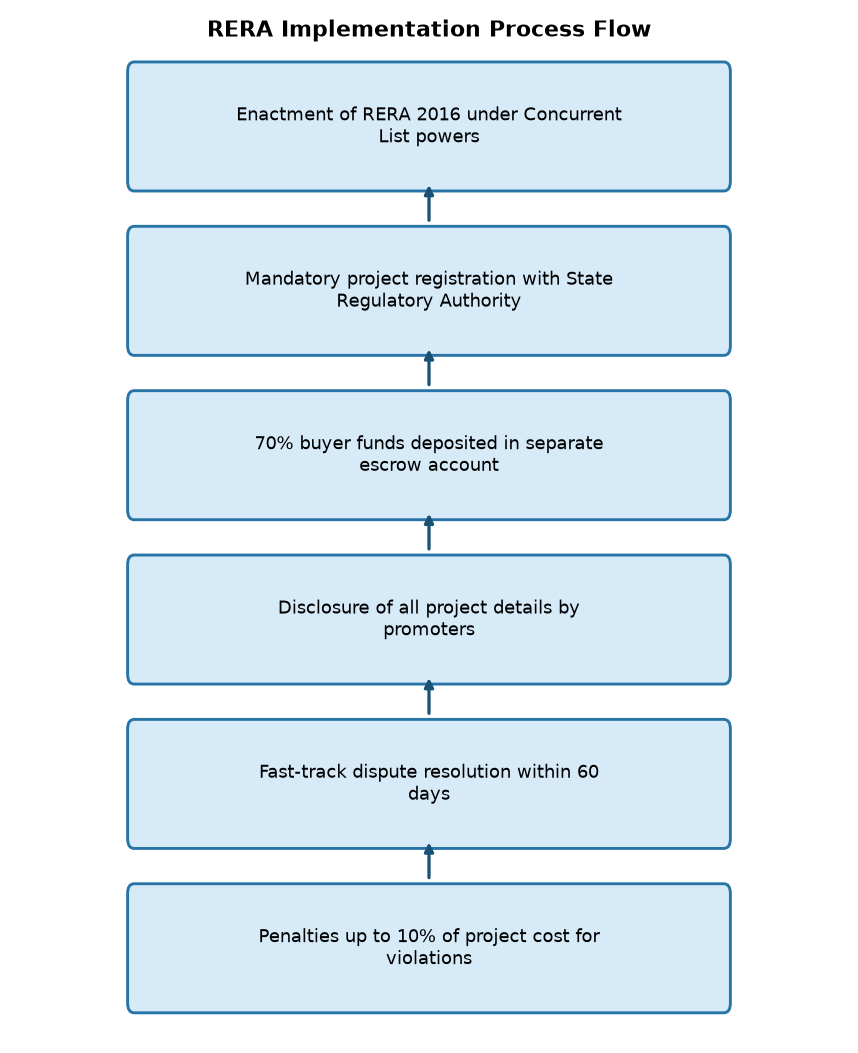
- Key provisions include mandatory disclosure of project details by promoters, such as land title, approvals, layout plans, and completion timelines, to enhance transparency and informed decision-making by homebuyers.
- Promoters are required to deposit 70% of the funds received from homebuyers into a separate escrow account, which can only be utilised for land acquisition and project construction, preventing fund diversion and ensuring project continuity.
- RERA establishes a fast-track dispute resolution mechanism with a stipulated timeline of 60 days for the adjudication of complaints, thereby reducing delays and enhancing efficiency in grievance redressal.
- The Act empowers the Regulatory Authority to impose penalties, including fines up to 10% of the estimated project cost, for violations such as non-registration of projects or non-disclosure of required information.
- RERA provides for the establishment of State/Union Territory Regulatory Authorities and Appellate Tribunals to oversee compliance, adjudicate disputes, and ensure adherence to the Act’s provisions.
- The Central Advisory Council (CAC) serves as a platform for consultation between the central government, state governments, homebuyers, and industry stakeholders to address implementation challenges and recommend policy improvements.
Key Features
| Feature | Significance |
|---|---|
| Mandatory registration of projects | Ensures transparency by requiring all real estate projects to be registered with the Regulatory Authority before any advertisement, booking, or sale. |
| Separate escrow account for buyer funds (70% rule) | Prevents diversion of funds by mandating that 70% of buyer payments be deposited in a separate account exclusively for land acquisition and construction costs. |
| Disclosure of project details | Compels promoters to disclose all relevant project information, including approvals, layout plans, and completion timelines, reducing information asymmetry. |
| Fast-track dispute resolution (60-day limit) | Provides a time-bound mechanism for resolving disputes between promoters and buyers, enhancing legal certainty and reducing delays. |
| Penalties and enforcement (up to 10% of project cost) | Deters non-compliance by imposing financial penalties on promoters for violations of RERA provisions. |
Why it Matters
Economic
- Enhances investor confidence in the real estate sector by reducing fraudulent practices and ensuring timely project delivery.
- Stimulates formal credit flow to the sector by improving transparency and reducing risk for financial institutions.
- Contributes to GDP growth by addressing stalled projects and accelerating construction activity through regulatory oversight.
Legal & Regulatory
- Balances the constitutional division of powers by harmonising state-level land regulation with parliamentary authority under the Concurrent List (Entries 6, 7, 46).
- Establishes a uniform regulatory framework across states, reducing jurisdictional arbitrage and ensuring consistent protection for homebuyers.
- Empowers adjudicating officers and appellate tribunals to enforce compliance, reducing reliance on civil courts for contract enforcement.
Social
- Protects homebuyers from exploitation by ensuring fair contractual terms, timely possession, and compensation for delays or defaults.
- Promotes equitable access to housing by deterring speculative practices and prioritising genuine end-users.
- Reduces litigation burden on consumers by providing a dedicated dispute resolution mechanism.
Challenges
1. State-level implementation gaps
- Variations in enforcement across states due to differing administrative capacities and political priorities.
- Delays in setting up State Real Estate Regulatory Authorities (RERAs) and Appellate Tribunals, leading to inconsistent application of the Act.
- Resistance from vested interests in the real estate sector, including promoters and local authorities, to adopt stringent compliance measures.
UPSC Link: GS-II: Federalism, State vs Centre
2. Jurisdictional conflicts
- Overlap between RERA and other laws such as the Consumer Protection Act, 2019, leading to confusion in dispute resolution pathways.
- Ambiguities in the definition of ‘ongoing projects’ and their transition under RERA, causing legal disputes over applicability.
- Coordination challenges between central and state authorities in resolving inter-state project disputes.
UPSC Link: GS-II: Judiciary, Concurrent List
3. Operational and resource constraints
- Inadequate staffing and technical infrastructure in state RERAs to handle the volume of registrations and disputes efficiently.
- Limited awareness among homebuyers about their rights under RERA, resulting in underutilisation of the Act’s protections.
- Financial constraints faced by state governments in funding RERA operations, particularly in smaller states or Union Territories.
UPSC Link: GS-II: Governance, Public Administration
4. Market distortions
- Potential short-term disruption in the real estate market due to stricter compliance requirements, affecting liquidity and project launches.
- Risk of cartelisation among large developers to circumvent RERA provisions, particularly in pricing and project approvals.
- Impact on affordable housing segments, where compliance costs may deter smaller developers from participating.
UPSC Link: GS-III: Growth, Investment Models
Challenges — UPSC Perspective
| Issue | Concern |
|---|---|
| Delayed establishment of State RERAs | Inconsistent enforcement and reduced effectiveness of the Act across regions. |
| Inadequate escrow account monitoring | Risk of fund diversion despite the 70% rule, undermining buyer protection. |
| Lack of standardised project definitions | Ambiguities in what constitutes a ‘new’ or ‘ongoing’ project, leading to legal disputes. |
| Limited consumer awareness | Homebuyers remain unaware of RERA provisions, reducing their ability to seek redressal. |
| Inter-state coordination failures | Difficulty in resolving disputes involving projects spanning multiple states. |
Way Forward
- Strengthen inter-state coordination mechanisms to harmonise RERA implementation and resolve jurisdictional conflicts.
- Enhance capacity-building for state RERA officials through training programmes on dispute resolution, project monitoring, and enforcement.
- Launch nationwide awareness campaigns targeting homebuyers, developers, and real estate agents to educate them about RERA rights and obligations.
- Establish a centralised digital platform for real-time tracking of project registrations, fund utilisation, and dispute status to improve transparency.
- Encourage states to adopt uniform Standard Operating Procedures (SOPs) for RERA operations, including timelines for approvals and penalties.
- Incentivise compliance by linking state-level approvals or subsidies to RERA registration and adherence to its provisions.
- Conduct periodic audits of state RERAs to assess performance and address systemic bottlenecks in enforcement.
UPSC Value Addition
Keywords for Mains Answer-Writing
RERA Act 2016 · Real Estate Regulatory Authority · Homebuyers’ protection · Concurrent List Entry 6, 7, 46 · Fast-track dispute resolution mechanism · 70% project funds in escrow account · Central Advisory Council under RERA · Transparency and accountability in real estate · Constitutional provisions for land regulation · State vs Central jurisdiction in real estate
Constitutional & Policy Linkages
- {‘Article/Schedule’: ‘Seventh Schedule, List-II (State List), Entry 18’, ‘note’: ‘Land and colonisation fall under state jurisdiction.’}
- {‘Article/Schedule’: ‘Seventh Schedule, List-III (Concurrent List), Entries 6, 7, 46’, ‘note’: ‘Parliamentary authority to legislate on contracts and economic regulation.’}
Concept Flow
Constitutional ambiguity → State control over land (Entry 18, List-II) vs Centre’s need for uniform regulation → Parliament legislates RERA under Concurrent List powers (Entries 6, 7, 46) → Balancing federalism and consumer protection. → Information asymmetry in real estate → Promoters exploit buyers through delayed possession, fund diversion, and opaque pricing → RERA mandates registration, disclosure, and escrow accounts → Reduces fraud and enhances transparency. → Delayed project delivery → Homebuyers face financial and emotional distress → RERA introduces fast-track dispute resolution (60-day limit) and penalties (up to 10% of project cost) → Deters malpractice and ensures accountability. → Fragmented state-level enforcement → Inconsistent protection for homebuyers across regions → Centre establishes Central Advisory Council (CAC) and conducts dialogues with states → Promotes uniform implementation and addresses operational challenges. → Operational constraints in state RERAs → Understaffing, lack of awareness, and resource gaps → Capacity-building and digital monitoring initiatives → Improves efficiency and reduces delays in dispute resolution.
Prelims Practice Questions
Q1. Consider the following statements regarding the Real Estate (Regulation and Development) Act, 2016 (RERA):
1. RERA is enacted under the Concurrent List of the Seventh Schedule of the Indian Constitution.
2. The Act mandates that 70% of the funds collected from homebuyers must be deposited in a separate escrow account.
3. The Act provides for a fast-track dispute resolution mechanism with a time limit of 60 days for settlement of cases.
4. The Act empowers the State governments to regulate and approve all real estate projects without any central oversight.
How many of the above statements are correct?
- Only one
- Only two
- Only three
- All four
Answer: Only three — Statements 1, 2, and 3 are correct as RERA is enacted under the Concurrent List (Entry 6, 7, 46), mandates 70% funds in escrow, and provides a 60-day dispute resolution mechanism. Statement 4 is incorrect as the Act requires project registration with the Regulatory Authority, which may involve central oversight.
Q2. Assertion (A): The Real Estate (Regulation and Development) Act, 2016 (RERA) is a central legislation that overrides state laws on land and real estate.
Reason (R): The Constitution of India places ‘land’ and ‘colonisation’ under the State List, but RERA is enacted under the Concurrent List to regulate contractual relations between promoters and homebuyers.
Options:
A. Both A and R are true, and R is the correct explanation of A.
B. Both A and R are true, but R is not the correct explanation of A.
C. A is true, but R is false.
D. A is false, but R is true.
- A
- B
- C
- D
Answer: C — Assertion (A) is true as RERA is a central legislation regulating real estate. Reason (R) is also true and correctly explains why RERA can override state laws despite land being a state subject, as it is enacted under the Concurrent List to protect homebuyers’ interests.
Q3. Which of the following is NOT a provision under the Real Estate (Regulation and Development) Act, 2016 (RERA)?
A. Mandatory registration of real estate projects with the Regulatory Authority before advertisement or sale.
B. Deposit of 70% of project funds in a separate escrow account for land cost and construction.
C. Empowerment of the State governments to impose a penalty of up to 20% of the project cost for violations.
D. Establishment of a fast-track dispute resolution mechanism with a 60-day time limit for case settlement.
- A
- B
- C
- D
Answer: C — Option C is incorrect as RERA empowers the Regulatory Authority to impose a penalty of up to 10% of the project cost for violations, not the State governments. Options A, B, and D are correct provisions under RERA.
Mains Practice Question
✍ The Real Estate (Regulation and Development) Act, 2016 (RERA) was enacted to address systemic failures in the real estate sector and protect homebuyers’ interests. Critically examine the efficacy of RERA in achieving its stated objectives, with reference to its institutional framework, enforcement mechanisms, and recent judicial interpretations. Also, analyse the challenges in its implementation and suggest measures to enhance its effectiveness. (15 Marks)
Approach: MODEL-ANSWER SKELETON:
1. **Introduction (2 marks)**
– Context: Systemic failures in real estate (delayed possession, diversion of funds, lack of transparency).
– Objective of RERA: Transparency, accountability, and protection of homebuyers’ interests.
– Constitutional basis: Concurrent List (Entries 6, 7, 46) enabling central legislation despite land being a state subject.
2. **Institutional Framework (3 marks)**
– **Regulatory Authorities**: State-level RERA bodies for project registration, dispute resolution, and enforcement.
– **Central Advisory Council (CAC)**: Advisory body under the Ministry of Housing and Urban Affairs to guide policy.
– **Fast-track Dispute Resolution**: 60-day time limit for case settlement (Section 37).
– **Escrow Mechanism**: 70% of homebuyers’ funds in a separate account for land and construction (Section 4(2)(l)).
3. **Enforcement Mechanisms (3 marks)**
– **Project Registration**: Mandatory registration before advertisement, booking, or sale (Section 3).
– **Penalties**: Up to 10% of project cost for violations (Section 61).
– **Interest and Compensation**: Promoters liable to pay interest and compensation for delays (Section 18).
– **Recovery of Dues**: Dues treated as arrears of land revenue (Section 40).
4. **Judicial Interpretations (3 marks)**
– **Landmark Judgments**:
– *Ireo Grace Realtech Pvt. Ltd. v. Abhishek Khanna* (2021): Clarified the scope of ‘ongoing projects’ under RERA.
– *Col. Vinod Awasthy v. Union of India* (2020): Upheld the constitutional validity of RERA.
– *Imperia Structures Ltd. v. Anil Patni* (2020): Emphasized the mandatory nature of RERA’s provisions.
– **Recent Trends**: Courts have upheld RERA’s supremacy over state laws and contractual clauses favoring promoters.
5. **Challenges in Implementation (2 marks)**
– **State-Level Variations**: Inconsistent implementation across states (e.g., delays in setting up RERA authorities).
– **Promoter Compliance**: High rates of non-compliance due to weak enforcement.
– **Homebuyer Awareness**: Lack of awareness among homebuyers about their rights under RERA.
– **Judicial Backlog**: Slow disposal of cases despite the 60-day limit.
6. **Measures to Enhance Effectiveness (2 marks)**
– **Strengthening RERA Authorities**: Adequate staffing, training, and financial autonomy for state-level bodies.
– **Digital Platforms**: Integration of RERA with state land records and municipal systems for real-time monitoring.
– **Public Awareness Campaigns**: Collaborate with consumer forums and media to educate homebuyers.
– **Strict Penalties**: Impose stricter penalties for non-compliance, including blacklisting of defaulting promoters.
– **Inter-State Coordination**: Establish a centralised database of projects and promoters to track violations.
7. **Conclusion (2 marks)**
– RERA has made significant strides in improving transparency and accountability in the real estate sector.
– However, challenges in enforcement and state-level implementation persist.
– Strengthening institutional capacity, judicial efficiency, and public awareness is essential for RERA to achieve its full potential.
Source: PIB (Press Information Bureau)
Generated by AanyaAi for educational purpose.


No Comments