


30 Jul UPSC Exam: AI & Digital Tech Boost for MSMEs Productivity
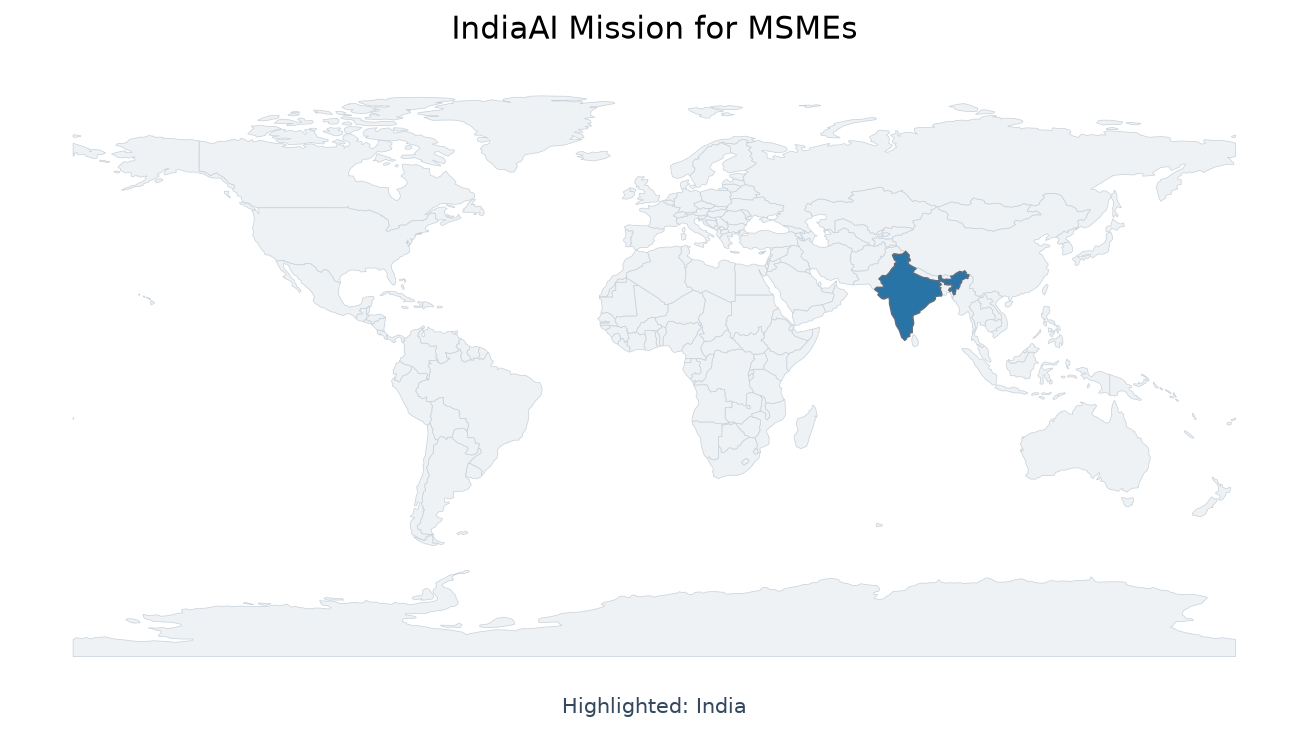
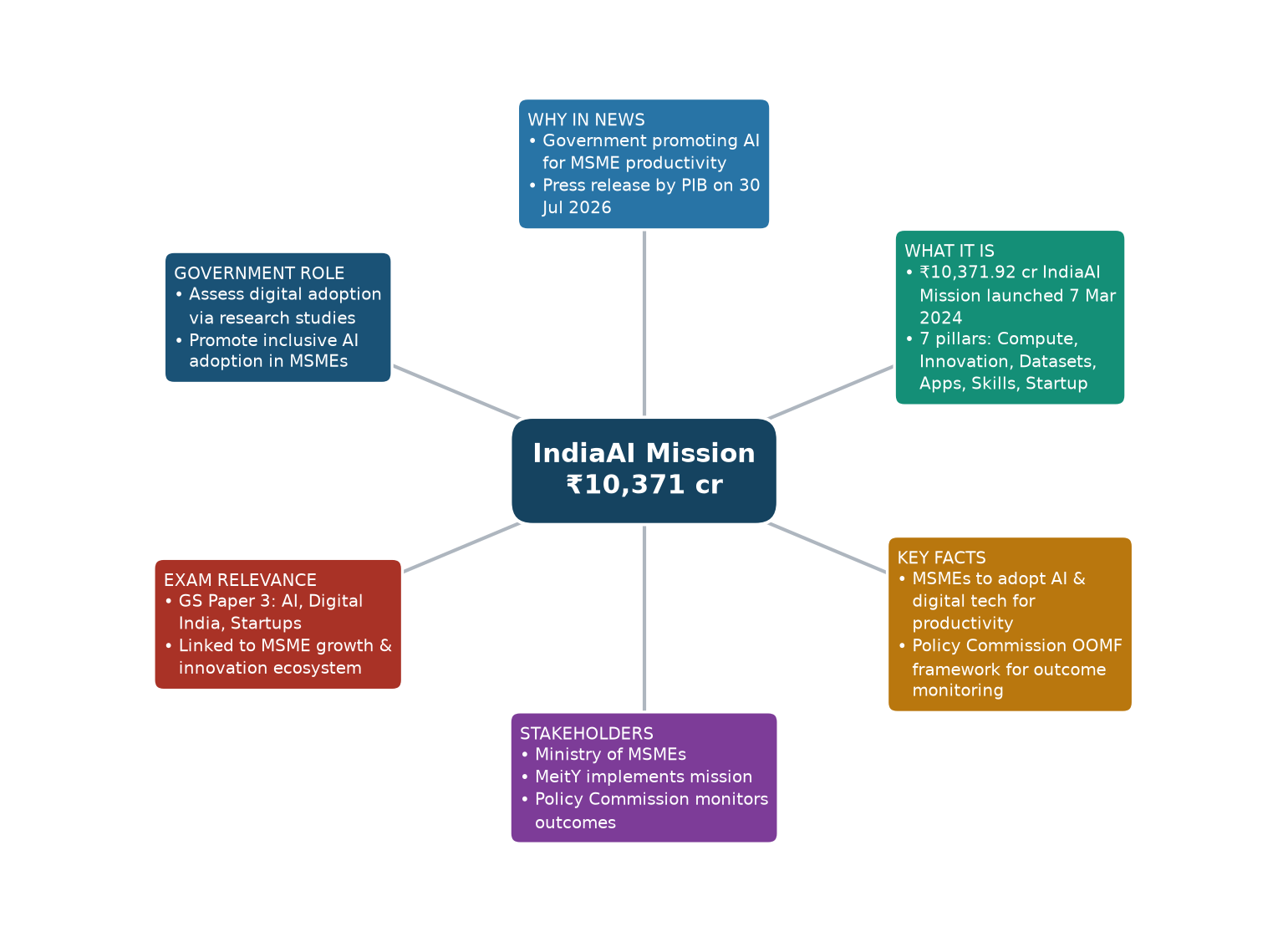
Map & concept mind-map: IndiaAI Mission for MSMEs
Subject Relevance — Where This Topic Fits
- GS Paper III — Indian Economy: Issues relating to Planning, Mobilization of Resources, Growth, Development and Employment | GS Paper III — Technology Missions and Government Schemes
- Prelims: MSMEs, Artificial Intelligence (AI), Digital Public Infrastructure (DPI), IndiaAI Mission, Outcome-Output Monitoring Framework (OOMF), National AI Portal, Skill India Mission, Startup India
- Essay: Technological Transformation and Inclusive Growth in India, Role of Government in Fostering Innovation and Competitiveness
Quick Revision: The IndiaAI Mission (₹10,371.92 crore) aims to democratise AI benefits for MSMEs through seven pillars, ensuring productivity gains, ethical deployment, and inclusive growth, with real-time monitoring via NITI Aayog’s OOMF framework.
Why is this in the news?
The Union Government has intensified efforts to promote the adoption of Artificial Intelligence (AI) and digital technologies among MSMEs to enhance productivity and global competitiveness. This initiative is operationalised under the IndiaAI Mission, a ₹10,371.92 crore programme approved by the Ministry of Electronics and Information Technology (MeitY) on 7 March 2024, aimed at democratising AI benefits across all sectors, including MSMEs.
Background
- MSMEs contribute approximately 30% to India’s GDP and account for over 40% of exports, yet face productivity gaps due to limited adoption of advanced technologies.
- The IndiaAI Mission (2024) aims to position India as a global leader in AI by fostering innovation, skilling, and ethical AI deployment.
- The IndiaAI Mission is structured around seven pillars: Compute Capacity, Innovation Centres, Datasets Platform, Application Development, Future Skills, Startup Financing, and Trusted and Responsible AI.
- The government assesses digital adoption levels and identifies bottlenecks through evaluation studies in collaboration with industry and research institutions.
- Policy frameworks such as the Output-Outcome Monitoring Framework (OOMF) by NITI Aayog are used to evaluate the efficacy of government interventions in digital transformation.
What is the IndiaAI Mission?
- A ₹10,371.92 crore mission approved by MeitY on 7 March 2024 to democratise AI benefits across India, with a focus on MSMEs, startups, and underserved sectors.
- Operationalised through seven strategic pillars: (1) AI Compute Capacity to enhance high-performance computing access, (2) AI Innovation Centres for R&D, (3) AI Datasets Platform for curated, high-quality datasets, (4) AI Application Development for sector-specific solutions, (5) AI Future Skills for workforce upskilling, (6) AI Startup Financing for early-stage funding, and (7) Trusted and Responsible AI to ensure ethical and secure deployment.
- Aims to bridge the digital divide by providing MSMEs with affordable access to AI tools, thereby improving operational efficiency, reducing costs, and enhancing product quality.
- Includes mechanisms for real-time monitoring of digital adoption trends in MSMEs through collaborative studies with industry associations and academic institutions.
- The IndiaAI Startup Financing pillar provides grants, seed funding, and venture capital support to AI-driven startups, particularly those catering to MSME needs.
- The Trusted and Responsible AI pillar focuses on developing frameworks for bias mitigation, data privacy, and explainable AI to ensure ethical AI deployment.
- The mission’s success is measured using the Output-Outcome Monitoring Framework (OOMF) by NITI Aayog, which tracks key performance indicators (KPIs) such as AI adoption rates, productivity gains, and employment generation in MSMEs.
Key Features
| Feature | Significance |
|---|---|
| IndiAI Mission (₹10,371.92 crore) | A centrally funded, multi-pillar mission under MeitY to democratise AI adoption across sectors, including MSMEs, with a focus on inclusive, responsible, and socially impactful growth. |
| IndiAI Compute Capacity | Provision of high-performance computing infrastructure to MSMEs, enabling large-scale data processing, predictive analytics, and real-time decision-making for productivity enhancement. |
| IndiAI Innovation Centres | Establishment of dedicated hubs for AI research, prototyping, and co-creation with industry-academia collaboration to foster indigenous AI solutions tailored for MSMEs. |
| IndiAI Dataset Platform | Creation of curated, sector-specific datasets to train AI models, ensuring data availability and quality for MSMEs to develop customised AI applications without prohibitive costs. |
| IndiAI Future Skills | Upskilling and reskilling programmes in AI, machine learning, and digital technologies for MSME workforce, bridging the digital divide and enhancing human-AI collaboration. |
| Secure & Trustworthy AI | Development of ethical frameworks, standards, and governance mechanisms to ensure AI systems deployed by MSMEs are transparent, accountable, and compliant with regulatory norms. |
| Output-Outcome Monitoring Framework (OOMF) | Institutionalised evaluation mechanism by NITI Aayog to assess the impact of AI adoption in MSMEs, enabling evidence-based policy refinement and targeted interventions. |
Why it Matters
Economic Productivity & Competitiveness
- AI adoption in MSMEs can enhance operational efficiency by 20-30% through automation of repetitive tasks, predictive maintenance, and demand forecasting.
- Digital technologies such as IoT, cloud computing, and blockchain can reduce transaction costs and improve supply chain transparency for MSMEs.
- Increased productivity directly contributes to higher GDP growth, job creation, and export competitiveness of India’s manufacturing and services sectors.
- AI-driven customisation enables MSMEs to cater to niche markets, enhancing their market share and profitability.
Strategic Autonomy & Industrialisation
- Reduction in import dependence for advanced manufacturing technologies by fostering indigenous AI and digital solutions for MSMEs.
- Strengthening of India’s position in global value chains through adoption of Industry 4.0 technologies, aligning with ‘Atmanirbhar Bharat’ objectives.
- Enhancement of India’s technological sovereignty by reducing reliance on foreign AI platforms and proprietary software for critical MSME operations.
Inclusive & Equitable Growth
- AI democratisation ensures that even micro and small enterprises in tier-2/3 cities and rural areas can access cutting-edge technologies, reducing regional disparities.
- Skill development initiatives under IndiAI Mission target marginalised groups, including women entrepreneurs and SC/ST-owned MSMEs, promoting social inclusion.
- AI-driven credit scoring and fintech solutions can expand access to formal financing for traditionally underserved MSME segments.
Policy & Governance Innovation
- The OOMF framework institutionalises data-driven policy evaluation, ensuring that public funds are allocated based on measurable outcomes and impact assessments.
- Collaborative governance models involving MeitY, NITI Aayog, and industry stakeholders set a precedent for multi-stakeholder policy implementation in emerging technologies.
- Ethical AI frameworks developed under the mission can serve as a global benchmark for responsible AI adoption in MSMEs.
Challenges
1. Digital Divide & Infrastructure Gaps
- Only 30% of MSMEs in India currently utilise digital technologies, with significant disparities between urban and rural enterprises.
- Limited access to high-speed internet, cloud computing, and AI-ready infrastructure in remote and hinterland regions hinders adoption.
- High initial capital expenditure for AI integration poses a barrier for micro and small enterprises with constrained financial resources.
UPSC Link: GS3: Infrastructure – Energy, Ports, Roads, Airports & Railways
2. Skill Deficit & Workforce Readiness
- Shortage of AI/ML professionals in India, with only 4% of engineering graduates possessing relevant skills for AI deployment in MSMEs.
- Lack of awareness among MSME owners about the potential applications of AI and digital tools in their specific sectors.
- Resistance to change among traditional workforce due to fear of job displacement and lack of digital literacy.
UPSC Link: GS2: Government Policies & Interventions for Development in various sectors
3. Data Governance & Privacy Concerns
- MSMEs often lack structured data collection mechanisms, leading to poor-quality datasets for AI model training.
- Concerns over data sovereignty, cross-border data flows, and compliance with global data protection regulations (e.g., GDPR) deter adoption.
- Cybersecurity risks, including data breaches and ransomware attacks, pose existential threats to digitally integrated MSMEs.
UPSC Link: GS3: Science & Technology – Developments and their Applications
4. Regulatory & Ethical Ambiguities
- Absence of a unified AI policy framework in India leads to regulatory uncertainties for MSMEs adopting AI technologies.
- Lack of clear guidelines on liability in case of AI-driven errors or failures, creating legal ambiguities for MSMEs.
- Ethical concerns around bias in AI algorithms, particularly in credit scoring and hiring processes, require robust oversight mechanisms.
UPSC Link: GS2: Statutory, Regulatory & Various Quasi-judicial Bodies
5. Market Fragmentation & Ecosystem Gaps
- MSMEs operate in highly fragmented markets with limited collaboration opportunities for shared AI infrastructure or resources.
- Insufficient venture capital and angel funding for AI startups catering specifically to MSME needs, stifling innovation.
- Absence of standardised AI adoption frameworks tailored to diverse MSME sectors, leading to ad-hoc and inefficient implementations.
UPSC Link: GS3: Indian Economy & Issues relating to Planning, Mobilisation of Resources
Challenges — UPSC Perspective
| Issue | Concern |
|---|---|
| Limited Digital Literacy | MSME owners and workers lack awareness of AI benefits and digital tools, impeding adoption. |
| High Cost of AI Integration | Initial investment in AI infrastructure, software, and training is prohibitive for micro and small enterprises. |
| Data Quality & Availability | Poor data collection practices and unstructured datasets hinder effective AI model training and deployment. |
| Cybersecurity Vulnerabilities | Digitally integrated MSMEs face heightened risks of cyberattacks, data breaches, and operational disruptions. |
| Regulatory Uncertainty | Lack of clear AI governance frameworks creates legal and compliance challenges for MSMEs. |
| Talent Shortage | Scarcity of AI/ML professionals with domain expertise in MSME-specific applications. |
Way Forward
- Establish sector-specific AI innovation clusters in collaboration with MSME associations and technical institutions to accelerate adoption.
- Launch targeted skill development programmes under IndiAI Mission, focusing on AI literacy for MSME owners and workers in regional languages.
- Develop a national AI readiness index for MSMEs to benchmark digital maturity and identify gaps for targeted interventions.
- Create a centralised AI-as-a-Service (AIaaS) platform to provide affordable, customisable AI solutions to MSMEs on a subscription model.
- Strengthen cybersecurity frameworks for MSMEs by mandating compliance with ISO/IEC 27001 standards and offering subsidised audits.
- Incentivise public-private partnerships for AI infrastructure sharing, such as cloud computing and high-performance computing access.
- Formulate a unified AI policy framework with clear guidelines on data governance, ethical AI, and liability to reduce regulatory ambiguities.
- Expand funding mechanisms under IndiAI Mission to include grants and low-interest loans for MSMEs adopting AI technologies.
UPSC Value Addition
Keywords for Mains Answer-Writing
MSME sector productivity · Artificial Intelligence adoption in MSMEs · Digital transformation of small enterprises · IndiaAI Mission · AI democratization for socio-economic inclusion · MSME digitalization assessment · Policy Commission’s Output-Outcome Monitoring Framework (OOMF) · Indigenous AI innovation ecosystem · AI-driven competitiveness enhancement · Public-private partnership in AI adoption
Concept Flow
Limited digital adoption in MSMEs → Lower productivity and competitiveness → Government intervention via IndiAI Mission → Provision of AI infrastructure and skills → Enhanced AI adoption → Increased productivity and job creation → Sustainable economic growth and industrialisation
Prelims Practice Questions
Q1. Consider the following statements regarding the IndiaAI Mission:
1. The mission is being implemented by the Ministry of Electronics and Information Technology (MeitY).
2. It includes a dedicated pillar for AI start-up financing.
3. The mission’s primary objective is to restrict AI adoption to large-scale industries only.
4. The total approved outlay for the mission is ₹10,371.92 crore.
How many of the above statements are correct?
- Only one
- Only two
- Only three
- All
Answer: Only three — Statements 1, 2, and 4 are correct. Statement 3 is incorrect as the mission aims to democratize AI benefits across all sectors, including MSMEs.
Q2. Assertion (A): The IndiaAI Mission includes a pillar for ‘Secure and Trusted AI’.
Reason (R): The mission seeks to ensure that AI adoption is socially responsible and inclusive.
Options:
A. Both A and R are true, and R is the correct explanation of A.
B. Both A and R are true, but R is not the correct explanation of A.
C. A is true, but R is false.
D. A is false, but R is true.
Answer: ? — Both A and R are true. The inclusion of ‘Secure and Trusted AI’ as a pillar aligns with the mission’s broader goal of fostering responsible and inclusive AI adoption.
Mains Practice Question
✍ Critically examine the role of the IndiaAI Mission in enhancing the productivity and competitiveness of MSMEs in India. Also, analyse the institutional mechanisms in place to assess the digital adoption progress among MSMEs. (15 Marks)
Approach: MODEL-ANSWER SKELETON:
1. **Introduction (2 Marks)**: Define the IndiaAI Mission and its objectives, with a brief mention of the ₹10,371.92 crore outlay and its implementation by MeitY. Highlight the mission’s seven pillars, including AI compute capacity, innovation centres, and start-up financing.
2. **AI Adoption in MSMEs (4 Marks)**:
– Discuss how AI and digital technologies can enhance productivity, supply chain efficiency, and market reach for MSMEs.
– Cite examples of AI applications such as predictive maintenance, demand forecasting, and automated customer service.
– Reference the mission’s goal of democratizing AI benefits across all sectors, including MSMEs.
3. **Institutional Mechanisms for Assessment (4 Marks)**:
– Explain the role of research studies and the Policy Commission’s Output-Outcome Monitoring Framework (OOMF) in evaluating digital adoption in MSMEs.
– Discuss how OOMF provides a structured approach to monitor the impact of government interventions.
4. **Challenges and Critique (3 Marks)**:
– Highlight potential barriers to AI adoption in MSMEs, such as lack of awareness, high costs, and skill gaps.
– Critically examine whether the mission’s focus on AI democratization is sufficient to address these challenges.
5. **Conclusion (2 Marks)**: Summarize the mission’s potential to transform MSMEs and suggest complementary policy measures, such as targeted skill development programs and financial incentives.
Source: PIB (Press Information Bureau)
Generated by AanyaAi for educational purpose.

- मोदी ने सेमीकॉन इंडिया में 7.8% विकास और सेमीकंडक्टर क्रांति का ऐलान किया - September 17, 2026
- PM Modi highlights India’s 7.8% growth & semiconductor push at SEMICON India 2026 - September 17, 2026
- गृहमंत्रालय ने ठुकराया दारा सिंह का रिहाई निवेदन, जानिए पूरा मामला - September 17, 2026

No Comments