


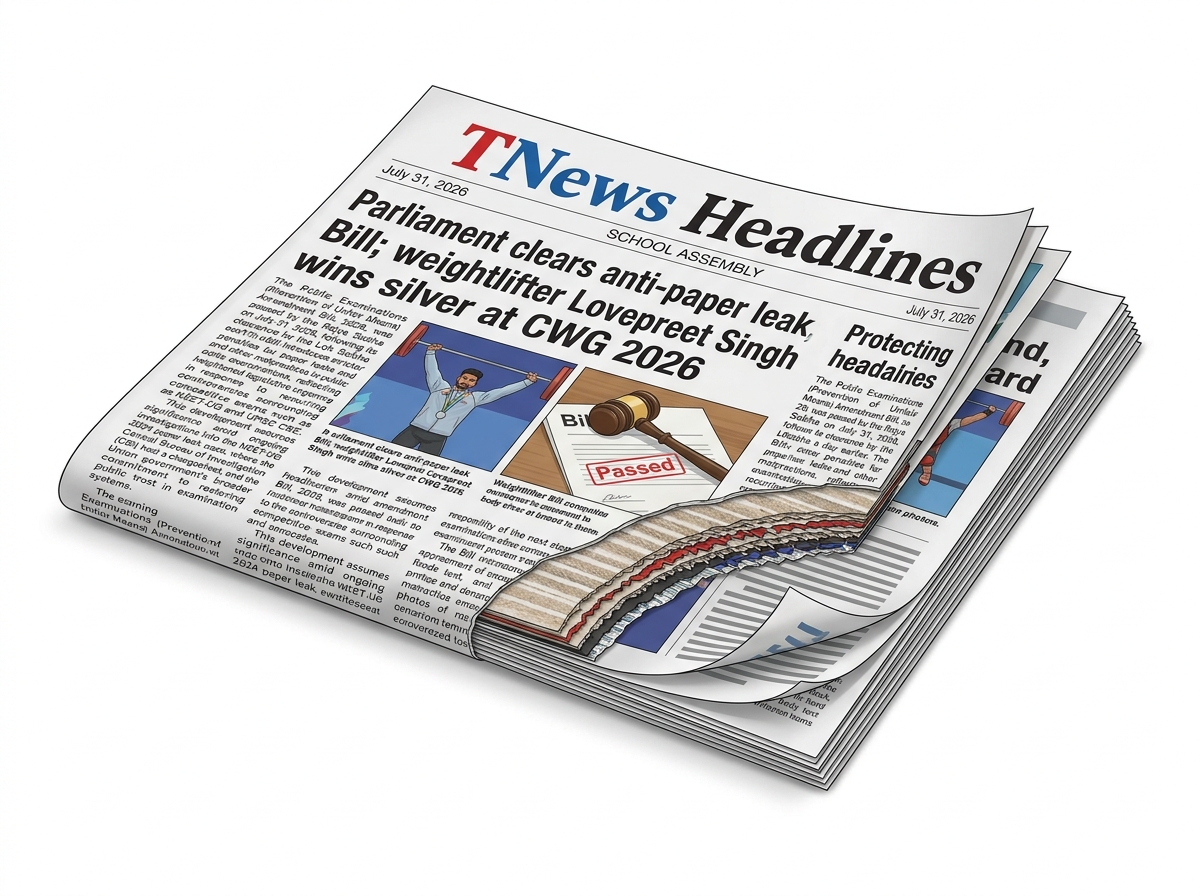
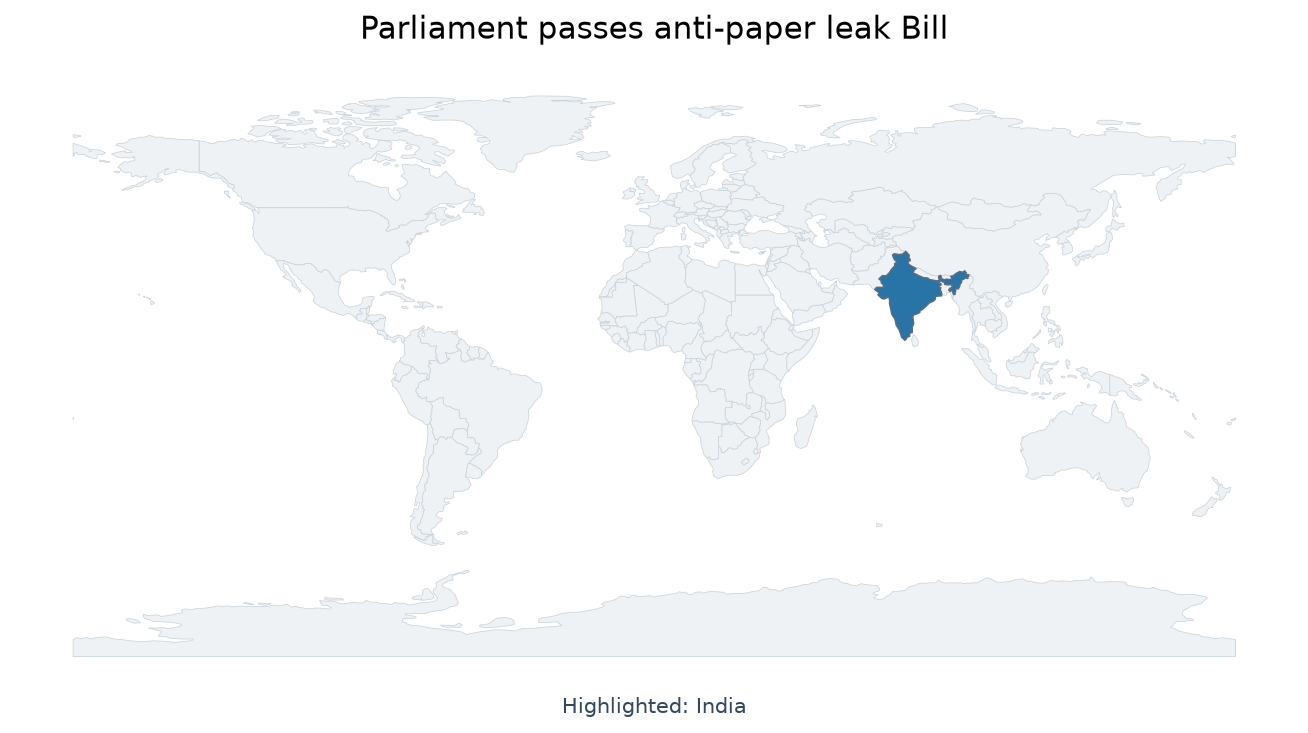
31 Jul Parliament Passes Anti-Paper Leak Bill 2026: Key Provisions for UPSC Aspirants
✎ The Public Examinations (Prevention of Unfair Means) Amendment Bill, 2026, introduces stringent penalties, digital safeguards, and institutional accountability to combat paper leaks and malpractice in competitive examinations…
Subject Relevance — Where This Topic Fits
- GS Paper II — Governance, Transparency and Accountability | GS Paper III — Issues Relating to Development and Management of Social Sector/Services relating to Education | GS Paper IV — Ethics, Integrity and Aptitude
- Prelims: Public Examinations (Prevention of Unfair Means) Act, 2024, NEET-UG paper leak, UPSC Civil Services Examination malpractice, National Testing Agency (NTA), Union Public Service Commission (UPSC), Common University Entrance Test (CUET), Computer-Based Testing (CBT), National Recruitment Agency (NRA)
- Essay: Ethical governance and the role of technology in ensuring transparency in public examinations, The paradox of high stakes and systemic vulnerabilities in India’s examination ecosystem
Quick Revision: The Public Examinations (Prevention of Unfair Means) Amendment Bill, 2026, introduces stringent penalties, digital safeguards, and institutional accountability to combat paper leaks and malpractice in competitive examinations, reinforcing the integrity of India’s examination ecosystem.
Why is this in the news?
The Public Examinations (Prevention of Unfair Means) Amendment Bill, 2026, was passed by the Rajya Sabha on July 31, 2026, following its clearance by the Lok Sabha a day earlier. The Bill introduces stricter penalties for paper leaks and other malpractices in public examinations, reflecting heightened legislative urgency in response to recurring controversies surrounding competitive exams such as NEET-UG and UPSC CSE. This development assumes significance amid ongoing investigations into the NEET-UG 2024 paper leak case, where the Central Bureau of Investigation (CBI) has filed a chargesheet, and the Union government’s broader commitment to restoring public trust in examination systems.
Background
- The NEET-UG 2024 examination was cancelled in several centres due to alleged paper leaks, leading to widespread protests and judicial scrutiny, including a Supreme Court-monitored investigation.
- The National Testing Agency (NTA), established in 2017, conducts major entrance examinations such as NEET-UG, JEE Main, and CUET, and has faced criticism over transparency and security protocols.
- The Union government has proposed the establishment of a National Recruitment Agency (NRA) to streamline recruitment for non-gazetted posts, aiming to reduce the burden on UPSC and SSC.
- State-level examination bodies, such as the Assam Public Service Commission (APSC) and Bihar Public Service Commission (BPSC), have also faced scrutiny over malpractice allegations, necessitating a uniform legal framework.
What is the Public Examinations (Prevention of Unfair Means) Amendment Bill, 2026?
- The Amendment Bill, 2026, seeks to strengthen existing provisions by introducing stricter penalties and expanding the scope of ‘unfair means’ to include digital manipulation and organised malpractices.
- Key amendments include enhanced imprisonment terms (up to 10 years) and fines (up to ₹1 crore) for individuals and institutions involved in paper leaks or facilitating malpractice, with provisions for confiscation of property.
- The Bill mandates the establishment of a dedicated ‘Examination Integrity Unit’ under the Ministry of Education to investigate and prosecute malpractice cases, ensuring faster disposal of complaints.
- It introduces provisions for ‘zero-tolerance’ policies in examination centres, including mandatory CCTV surveillance, biometric verification, and real-time monitoring of question paper distribution.
- The Bill also empowers examination authorities to cancel results, debar candidates, and blacklist coaching centres found guilty of malpractice, with a centralised database of offenders.
- Digital examination frameworks, such as Computer-Based Testing (CBT), are prioritised to reduce human intervention and mitigate risks of leaks, aligning with the government’s push for ‘exam reforms’.
- The Bill aligns with global best practices, such as those adopted by the Educational Testing Service (ETS) in the United States, which employs advanced algorithms to detect irregularities in answer patterns.
- State governments are encouraged to adopt the Act’s provisions through model rules, ensuring uniformity in examination governance across the country.
Key Features
| Feature | Significance |
|---|---|
| Public Examinations (Prevention of Unfair Means) Amendment Bill, 2026 | Introduces stringent penalties, including imprisonment up to 10 years, for involvement in paper leaks, aiming to restore credibility in competitive examinations. |
| Online document verification for NEET UG counselling | Enhances transparency and reduces physical reporting burdens, aligning with digital governance goals. |
| One-time physical reporting in NEET UG counselling | Balances digital efficiency with necessary in-person verification to prevent fraud. |
| Vande Bharat freight train trial runs | Demonstrates India’s progress in high-speed rail logistics, supporting economic integration and supply chain efficiency. |
| CBI chargesheet in NEET UG paper leak case | Exemplifies institutional response to malpractice, reinforcing public trust in examination integrity. |
Why it Matters
Economic
- The anti-paper leak Bill safeguards the integrity of examinations like UPSC, NEET, and JEE, which are gateways to lucrative careers in public service and healthcare, thereby protecting human capital investment.
- High-speed freight rail (Vande Bharat) reduces logistics costs and transit time, potentially lowering inflationary pressures on essential goods by improving supply chain efficiency.
- Disruptions in the Red Sea route may compel India to diversify crude imports, increasing costs but reducing dependency on geopolitically volatile regions.
Strategic/Security
- The amendment Bill addresses systemic vulnerabilities in examination processes, which can be exploited by anti-national elements to undermine governance.
- West Asia conflicts and US-Iran tensions heighten energy security concerns, necessitating diversified import strategies for India.
Social
- Paper leaks disproportionately affect marginalised sections, who lack resources to contest unfair outcomes, exacerbating socio-economic inequalities.
- Floods in Assam and Odisha highlight the need for climate-resilient infrastructure and disaster preparedness, particularly for vulnerable communities.
Governance
- The Bill reinforces the state’s role in ensuring fair competition, aligning with constitutional principles of equality (Article 14) and proportionality in punishment.
- Digital verification in NEET counselling exemplifies the judicious use of technology to balance efficiency and accountability in public service delivery.
Challenges
1. Examination Malpractice and Institutional Corruption
- Paper leaks undermine meritocracy, eroding public trust in institutions and discouraging genuine aspirants.
- Investigative agencies face resource constraints in tracking digital footprints of organised syndicates operating across borders.
- Legal ambiguities in defining ‘unfair means’ may lead to prolonged litigation, delaying justice.
UPSC Link: GS-II: Role of institutions in combating corruption
2. Climate-Induced Disasters and Infrastructure Gaps
- Frequent floods in Assam and Odisha expose deficiencies in drainage systems and early warning mechanisms.
- Disaster management agencies struggle with real-time data integration and inter-state coordination.
- Climate change exacerbates riverine flooding, necessitating long-term mitigation strategies beyond relief operations.
UPSC Link: GS-III: Disaster Management
3. Energy Security and Geopolitical Risks
- Red Sea disruptions threaten stable crude supplies, increasing import costs and fiscal pressures.
- Over-reliance on specific regions (e.g., Middle East) for energy imports heightens vulnerability to geopolitical shocks.
- India’s strategic petroleum reserves may prove insufficient during prolonged supply chain disruptions.
UPSC Link: GS-II: India’s energy diplomacy
4. Digital Governance and Cybersecurity
- Online document verification systems are susceptible to hacking, identity theft, and data breaches.
- Lack of standardised digital identity frameworks complicates verification processes across states.
- Public resistance to digital transitions may hinder adoption without robust awareness campaigns.
UPSC Link: GS-III: Cybersecurity and digital governance
5. Judicial and Bureaucratic Delays
- Legal proceedings in paper leak cases often span years, delaying justice and perpetuating impunity.
- Bureaucratic inertia in implementing digital reforms slows the transition to modern governance systems.
- Resource constraints in investigative agencies limit their ability to prosecute complex, transnational crimes.
UPSC Link: GS-II: Judicial reforms and administrative efficiency
Challenges — UPSC Perspective
| Issue | Concern |
|---|---|
| Paper leaks in competitive exams | Erodes meritocracy and public trust; deters genuine aspirants from participating. |
| Floods in Assam and Odisha | Disrupts livelihoods, damages infrastructure, and strains disaster management resources. |
| Red Sea supply chain disruptions | Increases crude import costs and risks energy security vulnerabilities. |
| Digital verification in NEET counselling | Raises concerns about data privacy, hacking risks, and accessibility for rural candidates. |
| Geopolitical tensions in West Asia | Threatens energy supplies and regional stability, impacting global oil markets. |
Way Forward
- Strengthen the National Cyber Crime Reporting Portal to track and investigate digital malpractices in examinations.
- Expand the coverage of the Public Examinations (Prevention of Unfair Means) Act to include state-level competitive exams.
- Integrate AI-driven anomaly detection in examination systems to flag irregularities in real time.
- Develop climate-resilient infrastructure in flood-prone regions, including river embankments and early warning systems.
- Diversify crude import sources to reduce dependency on geopolitically volatile regions, leveraging long-term contracts with Russia and Latin America.
- Enhance inter-state coordination in disaster management through the National Disaster Management Authority’s (NDMA) framework.
- Launch public awareness campaigns to educate candidates on digital verification processes and cybersecurity best practices.
- Fast-track the establishment of a National Digital Identity Authority to standardise verification across government services.
UPSC Value Addition
Keywords for Mains Answer-Writing
Public Examinations (Prevention of Unfair Means) Amendment Bill, 2026 · Constitutional morality in governance · Ethical standards in public examinations · Parliamentary scrutiny of anti-corruption legislation · Federalism and concurrent jurisdiction in criminal law · Examination reforms and accountability · Judicial review of legislative competence · Role of the Rajya Sabha in law-making · Ethical lapses in competitive examinations · Administrative accountability mechanisms
Constitutional & Policy Linkages
- [‘Article 14: Equality before law and equal protection of laws’]
- [‘Article 21: Right to life and personal liberty (includes examination integrity as a facet of dignity)’]
- [‘Article 38: Directive Principles of State Policy (promotion of welfare and reduction of inequalities)’]
Concept Flow
Examination malpractice scandals → Public outrage and erosion of trust → Legislative response (anti-paper leak Bill) → Institutional implementation challenges → Need for digital reforms and cybersecurity measures → Long-term impact on governance and meritocracy. → Climate change → Increased frequency of extreme weather events (floods in Assam/Odisha) → Human displacement and economic losses → Government response (relief and rehabilitation) → Requirement for climate-resilient infrastructure and policy reforms. → Geopolitical tensions in West Asia → Disruptions in global oil supply chains → India’s energy security risks → Diversification of import sources → Impact on fiscal policy and inflation management. → Digital governance initiatives (online verification) → Efficiency gains in public service delivery → Cybersecurity vulnerabilities → Need for robust data protection frameworks → Public trust in digital systems.
Prelims Practice Questions
Q1. Consider the following statements regarding the Public Examinations (Prevention of Unfair Means) Amendment Bill, 2026:
1. The Bill seeks to amend the Public Examinations (Prevention of Unfair Means) Act, 2024.
2. It proposes stricter penalties for paper leaks and unfair means in public examinations.
3. The Bill was passed by the Rajya Sabha through a division of votes.
4. The Bill introduces provisions for the establishment of a National Examination Security Authority.
How many of the above statements are correct?
- Only one
- Only two
- Only three
- All four
Answer: Only three — Statements 1 and 2 are correct. Statement 3 is incorrect as the Bill was passed by voice vote. Statement 4 is incorrect as the Bill does not explicitly mention a National Examination Security Authority.
Q2. Assertion (A): The Public Examinations (Prevention of Unfair Means) Amendment Bill, 2026, aims to enhance the integrity of competitive examinations in India.
Reason (R): The Bill proposes stringent penalties, including imprisonment and fines, for individuals involved in paper leaks and other malpractices.
Code:
- Both A and R are true, and R is the correct explanation of A
- Both A and R are true, but R is not the correct explanation of A
- A is true but R is false
- A is false but R is true
Answer: Both A and R are true, and R is the correct explanation of A — Both the assertion and reason are true. The Bill indeed aims to enhance examination integrity (A), and the stringent penalties proposed (R) are a key mechanism to achieve this objective, making R the correct explanation of A.
Q3. Match the following provisions with their respective legislative intent under the Public Examinations (Prevention of Unfair Means) Amendment Bill, 2026:
Column I (Provision) | Column II (Legislative Intent)
———————|—————————
A. Stricter penalties for paper leaks | 1. Enhancing examination integrity
B. Establishment of a National Examination Security Authority | 2. Deterrence against malpractices
C. Mandatory reporting of examination irregularities | 3. Institutional oversight and enforcement
D. Provision for compensation to affected candidates | 4. Accountability and redressal mechanisms
Select the correct match:
- A-2, B-3, C-1, D-4
- A-1, B-2, C-3, D-4
- A-4, B-1, C-2, D-3
- A-2, B-3, C-4, D-1
Answer: A-2, B-3, C-1, D-4 — A matches with 2 (deterrence), B with 3 (institutional oversight), C with 1 (enhancing integrity), and D with 4 (accountability and redressal).
Mains Practice Question
✍ Examine the constitutional and ethical dimensions of the Public Examinations (Prevention of Unfair Means) Amendment Bill, 2026. Critically analyse its provisions in the context of constitutional morality and the federal structure of governance. Also, discuss the implications of the Bill for examination reforms and administrative accountability in India. (15 Marks)
Approach: MODEL-ANSWER SKELETON:
1. **Constitutional and Ethical Dimensions (5 Marks)**
– Define constitutional morality (Granville Austin) and its relevance to governance.
– Highlight the ethical imperative of fair examinations as a public good (Article 14, 15, 21).
– Discuss the Bill’s alignment with constitutional principles of justice and equality.
2. **Federal Structure and Legislative Competence (5 Marks)**
– Examine the Bill’s legal basis under the Concurrent List (Entry 66, List I and Entry 25, List III, Seventh Schedule).
– Analyse the role of the Rajya Sabha in ensuring federal consensus (Article 249, 252).
– Discuss the balance between central oversight and state autonomy in examination administration.
3. **Examination Reforms and Administrative Accountability (5 Marks)**
– Evaluate the Bill’s provisions for deterrence (penalties, imprisonment, fines) and institutional oversight (e.g., National Examination Security Authority).
– Discuss the need for transparency in examination processes (e.g., NEET-UG paper leak case, CBI chargesheet).
– Highlight the role of the judiciary in ensuring accountability (e.g., judicial review of legislative competence).
4. **Conclusion (Balanced View)**
– Weigh the Bill’s potential to restore public trust in examinations against concerns of over-centralisation.
– Suggest measures for effective implementation (e.g., digital monitoring, whistle-blower protection).
Source: The Indian Express
Generated by AanyaAi for educational purpose.

- दिल्ली में 99% पीजी में नहीं है फायर एनओसी, 30% को नहीं मिला लेआउट अप्रूवल: एमसीडी सर्वे - September 15, 2026
- महत्वपूर्ण: MSC एल्सा 3 जहाज के डूबने के दीर्घकालिक प्रभावों का आकलन करेगा केंद्र, जानिए पूरा मामला - September 15, 2026
- केरल की इकोसेंस छात्रवृत्तियां: 46,000 छात्रों को अपशिष्ट प्रबंधन में सशक्त बना रही हैं - September 14, 2026

No Comments