


31 Jul Lok Sabha Passes Birth-Death Registration Amendment Bill 2026: Key Changes Explained
✎ The Births and Deaths (Amendment) Bill, 2026 tightens late registration timelines by requiring a First-Class Judicial Magistrate's order for delays exceeding two years, replacing the earlier provision of District Magistrate…
Subject Relevance — Where This Topic Fits
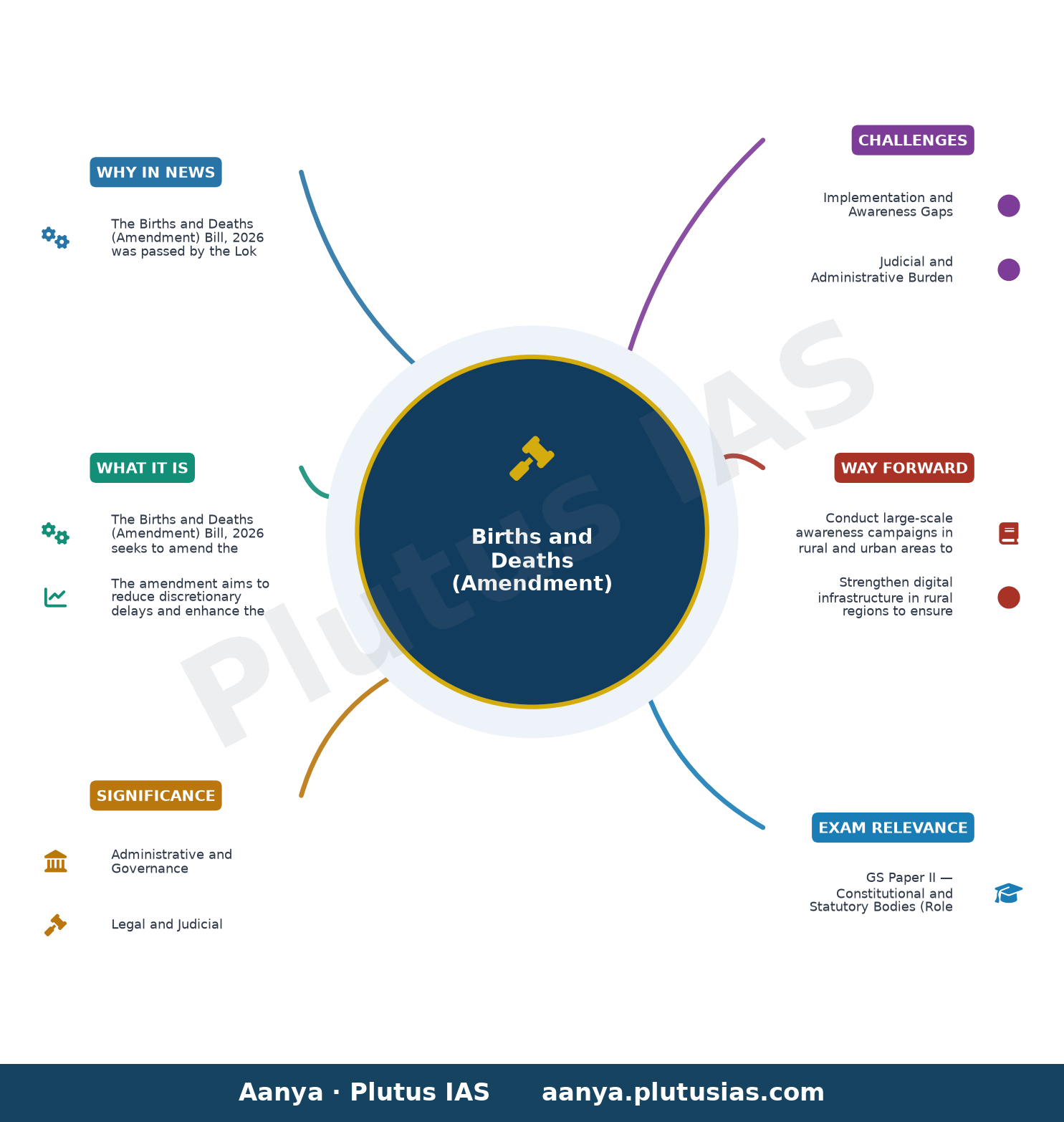
- GS Paper II — Constitutional and Statutory Bodies (Role of Parliament)
- Prelims: Civil Registration System (CRS), Birth and Death Registration Act, 1969, Judicial Magistrate, Executive Magistrate, Amendments in Statutory Provisions
Quick Revision: The Births and Deaths (Amendment) Bill, 2026 tightens late registration timelines by requiring a First-Class Judicial Magistrate’s order for delays exceeding two years, replacing the earlier provision of District Magistrate approval.
Why is this in the news?
The Births and Deaths (Amendment) Bill, 2026 was passed by the Lok Sabha on 31 July 2026 amid opposition protests during the Monsoon Session of Parliament. The Bill amends the Births and Deaths Registration Act, 1969, with a primary focus on tightening timelines for late registration of births and deaths, thereby enhancing the efficiency and reliability of the Civil Registration System (CRS) in India.
Background
- The Births and Deaths Registration Act, 1969, governs the registration of births and deaths across India, ensuring the maintenance of vital statistics for administrative, legal, and developmental purposes.
- The Act mandates the registration of births and deaths within specified timeframes to maintain accurate demographic records, which are critical for policy formulation, welfare schemes, and resource allocation.
- The Civil Registration System (CRS) in India operates under the administrative supervision of the Office of the Registrar General of India (RGI), Ministry of Home Affairs.
- The existing Act allows for late registration of births and deaths with the approval of designated authorities, such as District Magistrates or Executive Magistrates, depending on the delay period.
- The amendment introduces stricter timelines for late registration, particularly for delays exceeding two years, requiring the intervention of a First-Class Judicial Magistrate, thereby enhancing accountability and reducing discretionary delays.
What is the Births and Deaths (Amendment) Bill, 2026?
- The Births and Deaths (Amendment) Bill, 2026 seeks to amend the Births and Deaths Registration Act, 1969, to streamline the process of late registration of births and deaths in India.
- The amendment aims to reduce discretionary delays and enhance the accuracy and reliability of vital statistics, which are essential for governance, planning, and welfare delivery.
- The Bill does not alter the core provisions of the 1969 Act regarding mandatory registration timelines for births and deaths within 21 days of occurrence.
- The amendment is expected to improve the integrity of the Civil Registration System (CRS) by ensuring timely and legally validated registration of vital events.
- The Bill was passed by the Lok Sabha without discussion, reflecting procedural efficiency but also raising concerns about the lack of parliamentary scrutiny on substantive legislative changes.
- The amendment aligns with global best practices in civil registration, where stringent timelines and judicial oversight are employed to prevent fraud and ensure data accuracy.
Key Features
| Feature | Significance |
|---|---|
| Extension of registration deadline for delayed births/deaths from 1 year to 2 years | Balances administrative feasibility with the need for accurate vital statistics; reduces pressure on magistrates for minor delays while maintaining oversight for extreme delays. |
| Requirement of First-Class Judicial Magistrate’s order for registrations delayed beyond 2 years | Ensures judicial scrutiny for exceptional cases, preventing arbitrary or delayed registrations that could distort demographic data. |
| Retention of existing provisions for registrations delayed up to 1 year | Maintains continuity with the 1969 Act, ensuring no abrupt disruption in administrative processes. |
| No change in time limits for normal registrations (within 21 days of birth/death) | Preserves the urgency of timely registration, which is critical for healthcare planning, social security, and legal documentation. |
| Provision for digital or online registration mechanisms (implied by amendment context) | Enhances accessibility, reduces bureaucratic hurdles, and aligns with the government’s Digital India initiatives for efficient service delivery. |
Why it Matters
Administrative and Governance
- Enhances the reliability of India’s vital statistics, which are foundational for policy formulation, resource allocation, and monitoring of social welfare schemes such as the Public Distribution System (PDS) and Ayushman Bharat.
- Strengthens the legal framework for recording demographic events, reducing fraud in identity documentation and preventing misuse of unregistered births/deaths for illicit purposes.
- Aligns with the United Nations Sustainable Development Goal 17.18, which advocates for the availability of timely, reliable, and disaggregated data for sustainable development.
Legal and Judicial
- Introduces a tiered system of judicial oversight, ensuring that extreme delays in registration are scrutinised by higher judicial authorities, thereby reducing arbitrariness in administrative decisions.
- Clarifies the jurisdiction of magistrates, reducing ambiguity in the application of the law and potential litigation arising from delayed registrations.
Social and Demographic
- Improves the accuracy of demographic data, which is essential for evidence-based policymaking in areas such as healthcare, education, and social security.
- Supports the implementation of targeted welfare schemes by ensuring that beneficiaries are correctly identified and registered in official records.
Economic
- Reduces the economic burden on the exchequer by preventing the misuse of unregistered births/deaths in claims for social security benefits or subsidies.
- Facilitates better economic planning by providing reliable data on population growth, mortality rates, and fertility trends.
Challenges
1. Implementation and Awareness Gaps
- Rural and marginalised communities may face challenges in accessing registration services due to geographical barriers, lack of digital literacy, or inadequate infrastructure.
- Low awareness among citizens about the revised timelines and procedures for delayed registrations could lead to non-compliance and legal complications.
UPSC Link: GS-II: Governance
2. Judicial and Administrative Burden
- Increased reliance on First-Class Judicial Magistrates for delayed registrations may strain the judicial system, particularly in districts with high caseloads.
- Administrative delays in processing applications for delayed registrations could defeat the purpose of the amendment.
UPSC Link: GS-II: Judiciary
3. Data Privacy and Security
- Digitalisation of registration processes, while beneficial, raises concerns about data privacy and cybersecurity, particularly given the sensitive nature of vital statistics.
- Ensuring the integrity and confidentiality of digital records requires robust IT infrastructure and strict compliance with data protection laws.
UPSC Link: GS-III: Science & Tech
4. Political and Procedural Challenges
- The passage of the Bill amid protests highlights the need for broader political consensus on legislative processes, particularly for Bills with significant administrative implications.
- Lack of prior consultation with stakeholders, including state governments and civil society, may lead to implementation challenges.
UPSC Link: GS-II: Polity
Challenges — UPSC Perspective
| Issue | Concern |
|---|---|
| Limited awareness among citizens | Non-compliance due to ignorance of revised timelines and procedures. |
| Judicial backlog | Increased caseload on First-Class Judicial Magistrates for delayed registrations. |
| Digital divide | Rural and marginalised communities may struggle to access online registration services. |
| Data privacy risks | Potential breaches in the security of digital vital records. |
| Administrative inefficiencies | Delays in processing applications for delayed registrations. |
Way Forward
- Conduct large-scale awareness campaigns in rural and urban areas to educate citizens about the revised timelines and procedures for delayed registrations.
- Strengthen digital infrastructure in rural regions to ensure equitable access to online registration services.
- Train judicial and administrative officials to handle the increased workload for delayed registrations efficiently.
- Establish a grievance redressal mechanism for citizens facing difficulties in registration processes.
- Collaborate with state governments to ensure seamless implementation, including the provision of mobile registration units for remote areas.
- Develop a robust data privacy framework to safeguard digital vital records from cyber threats.
- Monitor the implementation of the amendment through regular audits and feedback from stakeholders.
UPSC Value Addition
Keywords for Mains Answer-Writing
Births and Deaths Registration (Amendment) Bill, 2026 · Registration of Births and Deaths Act, 1969 · Judicial Magistrate · Magistrate’s order for delayed registration · Civil Registration System (CRS) · Demographic data accuracy · Public order and governance · Parliamentary procedures and legislative scrutiny · Social welfare and data-driven policymaking · Rule of law and administrative efficiency
Concept Flow
Birth/Death occurs → Delay in registration → Need for amendment to 1969 Act → Extension of deadline from 1 year to 2 years → Requirement of First-Class Judicial Magistrate’s order for delays beyond 2 years → Enhanced judicial oversight → Improved reliability of vital statistics → Better policy formulation and resource allocation.
Prelims Practice Questions
Q1. Consider the following statements regarding the Births and Deaths Registration (Amendment) Bill, 2026:
1. The Bill seeks to amend the Registration of Births and Deaths Act, 1969.
2. It proposes to make the registration of births and deaths mandatory within 30 days of the event.
3. The Bill mandates that registration beyond two years requires the order of a First-Class Judicial Magistrate.
4. The Bill was passed in the Lok Sabha without any discussion or debate.
How many of the above statements are correct?
- Only one
- Only two
- Only three
- All four
Answer: All four — Statements 1, 3, and 4 are correct. Statement 2 is incorrect because the Bill does not prescribe a 30-day mandatory registration period; it addresses delayed registrations beyond one year (existing law) and two years (proposed amendment).
Q2. Assertion (A): The Births and Deaths Registration (Amendment) Bill, 2026, aims to enhance the accuracy of demographic data in India.
Reason (R): The Bill introduces stricter timelines and judicial oversight for delayed registrations of births and deaths.
- Both A and R are true, and R is the correct explanation of A
- Both A and R are true, but R is not the correct explanation of A
- A is true, but R is false
- A is false, but R is true
Answer: Both A and R are true, but R is not the correct explanation of A — The Bill seeks to improve demographic data accuracy by tightening registration norms (A). The stricter timelines and judicial oversight (R) directly serve this purpose, making R the correct explanation of A.
Q3. Match the following provisions under the Registration of Births and Deaths Act, 1969 with their corresponding amendments proposed in the Births and Deaths Registration (Amendment) Bill, 2026:
Column I (Existing Provision) Column II (Proposed Amendment)
A. Delayed registration beyond one year requires order of 1. District Magistrate
B. Delayed registration beyond two years requires order of 2. First-Class Judicial Magistrate
C. Mandatory registration within 30 days of birth/death 3. Not prescribed in the Bill
D. Online registration facility 4. Already operational
Select the correct match:
- A-1, B-2, C-3, D-4
- A-2, B-1, C-3, D-4
- A-1, B-2, C-4, D-3
- A-2, B-1, C-4, D-3
Answer: A-2, B-1, C-3, D-4 — The existing provision (A) requires an order from the District Magistrate for delayed registration beyond one year. The proposed amendment (B) requires an order from a First-Class Judicial Magistrate for registrations delayed beyond two years. The Bill does not prescribe a 30-day mandatory registration period (C), and online registration facilities are already operational (D).
Mains Practice Question
✍ The Births and Deaths Registration (Amendment) Bill, 2026, seeks to amend the Registration of Births and Deaths Act, 1969, by introducing stricter timelines and judicial oversight for delayed registrations. Critically examine the legislative intent behind these amendments and their implications for India’s Civil Registration System (CRS) and governance. Also, discuss the challenges in ensuring universal registration of births and deaths in India. (15 Marks)
Approach: MODEL-ANSWER SKELETON:
1. **Legislative Intent and Key Provisions**
– Objective: Enhance accuracy of demographic data for evidence-based policymaking and welfare schemes.
– Key changes:
– Registration beyond two years requires order of a First-Class Judicial Magistrate (earlier: District Magistrate for one year).
– Strengthening of the CRS to reduce underreporting and improve data quality.
– Connection to Article 21 (Right to Life) and Directive Principles of State Policy (Article 38, 41, 46) for social justice.
2. **Implications for CRS and Governance**
– **Data Accuracy**: CRS is the backbone for planning schemes like PM-KISAN, Ayushman Bharat, and PDS. Accurate data ensures targeted delivery.
– **Legal and Administrative Efficiency**: Judicial oversight may reduce arbitrariness in delayed registrations but could burden courts.
– **Inter-State Coordination**: The Bill aligns with the National Population Register (NPR) and Census efforts, though implementation challenges persist.
3. **Challenges in Universal Registration**
– **Awareness and Accessibility**: Rural and tribal areas face literacy gaps, lack of infrastructure, and cultural practices (e.g., home births).
– **Administrative Bottlenecks**: Delayed digitization, lack of trained personnel, and corruption in registration offices.
– **Legal and Social Barriers**: Birth registration is often delayed due to lack of awareness about its importance (e.g., for school admissions, Aadhaar linkage).
– **Gender Disparities**: Female births are underreported in some regions due to socio-cultural biases.
4. **Comparative Perspective**
– **Global Best Practices**: Countries like Sweden and Japan have near-universal registration due to strong civic culture and digital integration.
– **India’s Progress**: Despite improvements (e.g., CRS-2015), challenges remain in real-time data sharing between states and the Centre.
5. **Way Forward**
– Strengthening grassroots awareness campaigns (e.g., through ASHA workers, Anganwadi centres).
– Leveraging technology (Aadhaar, mobile apps) for real-time registration.
– Decentralizing registration centres and incentivizing local bodies for better compliance.
– Addressing socio-cultural barriers through targeted interventions (e.g., community leaders, NGOs).
Balance of Views:
– **Proponents**: Argue that stricter timelines and judicial oversight will curb fraud and improve data integrity.
– **Critics**: Highlight potential judicial burden and the need for administrative reforms over punitive measures.
Source: amarujala.com
Generated by AanyaAi for educational purpose.

- Rediscovered plant ‘Haplothismia exannulata’ inspires Wildlife Week in Kerala - October 5, 2026
- खाद्य मुद्रास्फीति का शिकार: खाद्य तेलों की बढ़ती कीमतें क्यों हैं चिंता का विषय - October 5, 2026
- Next-Gen GST: Boosting India’s Economy for Viksit Bharat Aspirants - October 5, 2026

No Comments