


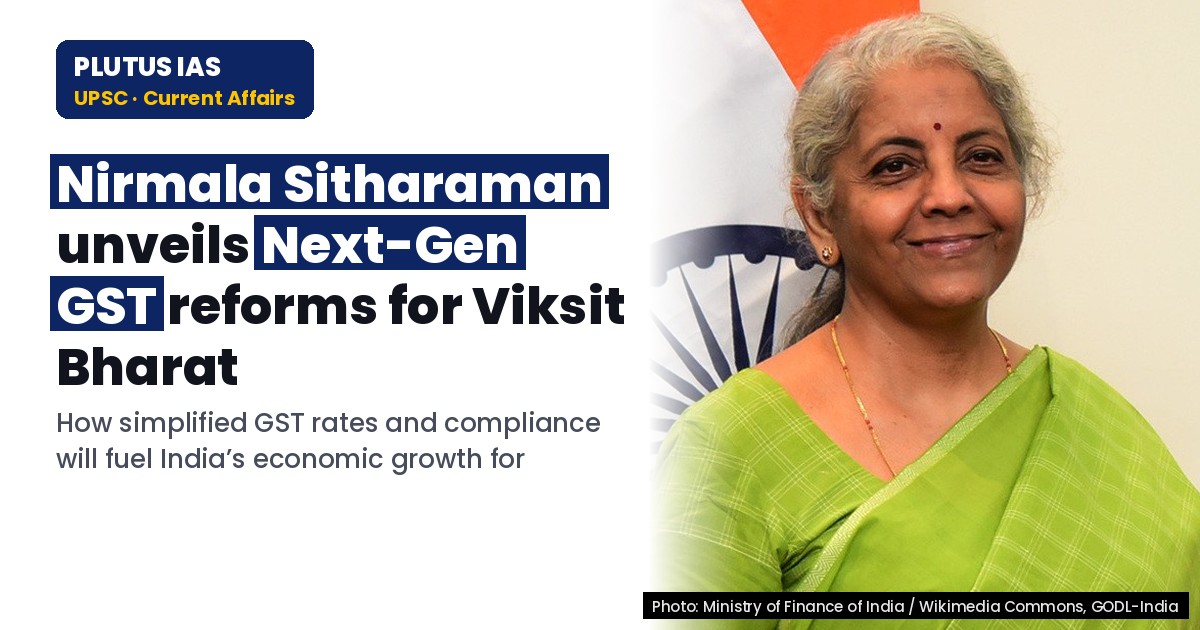
05 Oct Next-Gen GST: Boosting India’s Economy for Viksit Bharat Aspirants
✎ The Next-Gen GST reform aims to rationalise tax rates, simplify compliance through technological integration, and foster inclusive growth by reducing distortions in the indirect tax system.
Subject Relevance — Where This Topic Fits
- GS Paper II — Functions and Responsibilities of the Union and the States, Issues and Challenges Pertaining to the Federal Structure | GS Paper III — Indian Economy and issues relating to Planning, Mobilisation of Resources, Growth, Development and Employment
- Prelims: GST Council, Goods and Services Tax (GST), Input Tax Credit (ITC), Composition Scheme, E-way Bill, GST Network (GSTN), Viksit Bharat, Indirect Taxation
- Essay: Economic Reforms and Governance: Balancing Efficiency with Equity, The Role of Technology in Transforming Public Service Delivery
Quick Revision: The Next-Gen GST reform aims to rationalise tax rates, simplify compliance through technological integration, and foster inclusive growth by reducing distortions in the indirect tax system.
Why is this in the news?
The Next-Gen GST reform, implemented in phases since September 2025, represents a significant evolution of India’s indirect tax system, aimed at rationalising tax rates, simplifying compliance, and fostering economic growth. The reform’s impact on revenue collections, sectoral growth, and consumer welfare has been highlighted by recent data, underscoring its relevance for India’s developmental trajectory as articulated in the ‘Viksit Bharat’ vision.
Background
- The Goods and Services Tax (GST) was introduced in India on July 1, 2017, subsuming multiple indirect taxes to create a unified national market and eliminate cascading effects of taxation.
- The GST framework operates under the aegis of the GST Council, a constitutional body comprising the Union Finance Minister and State Finance Ministers, which decides tax rates, exemptions, and procedural norms.
- Over nine years of implementation, the GST system has undergone multiple rate revisions, procedural amendments, and technological upgrades to address challenges such as compliance complexity, revenue leakage, and sectoral disparities.
- The Next-Gen GST reform was conceptualised to address persistent issues of rate multiplicity, compliance burdens, and inter-state disparities, aligning with the broader objective of economic formalisation and ease of doing business.
- The reform process has been collaborative, involving the Centre, States, and industry stakeholders, reflecting the federal character of India’s tax architecture.
- Recent data indicates a 25.8% growth in reported taxable supplies between October 2025 and July 2026, alongside a 11.6% increase in gross GST collections during April–September 2026, suggesting a positive correlation between reform measures and economic activity.
What is the Next-Gen GST Reform?
- The Next-Gen GST reform is a multi-phase initiative aimed at rationalising tax rates, reducing compliance burdens, and enhancing the efficiency of the GST system through structural adjustments and technological integration.
- The reform seeks to simplify the rate structure by reducing the number of slabs and aligning rates with the principles of equity, efficiency, and revenue buoyancy, thereby minimising distortions in consumer choice and business operations.
- Compliance simplification is a core objective, achieved through the integration of advanced technologies such as artificial intelligence, machine learning, and data analytics to automate processes like return filing, refunds, and audits.
- The reform introduces measures to streamline the Input Tax Credit (ITC) mechanism, ensuring seamless flow of credits across the supply chain and reducing working capital constraints for businesses.
- Process reforms under consideration include the rationalisation of e-way bills, simplification of registration procedures, and the introduction of a unified GST portal to enhance user experience and reduce transaction costs.
- The reform places a strong emphasis on inter-state coordination to eliminate disparities in tax administration, ensuring a level playing field for businesses operating across different States.
- The Next-Gen GST framework is designed to be dynamic, allowing for periodic reviews and adjustments based on feedback from taxpayers, industry associations, and State governments to ensure continuous improvement.
- The reform aligns with the ‘Viksit Bharat’ vision by fostering an enabling environment for enterprises of all sizes, particularly MSMEs, to thrive through reduced compliance costs and improved access to markets.
Key Features
| Feature | Significance |
|---|---|
| Rationalisation and reduction of GST rates | Simplifies tax structure, reduces compliance burden, and enhances transparency by minimising rate slabs and exemptions. |
| Next-Gen GST compliance reforms | Introduces digital infrastructure upgrades to streamline filing, refunds, and audits, reducing taxpayer friction. |
| Sector-neutral growth in taxable supplies | Ensures equitable economic participation across industries, fostering inclusive growth. |
| State-led implementation and coordination | Leverages federalism by aligning State priorities with national tax policy, ensuring uniform application. |
| Real-time data integration and analytics | Enables predictive compliance enforcement and targeted policy interventions based on economic trends. |
Why it Matters
Economic
- Stimulates domestic demand by reducing tax incidence on essential goods and services, thereby enhancing household purchasing power.
- Enhances formalisation of the economy by bringing more enterprises into the tax net, broadening the tax base.
- Supports fiscal federalism by ensuring revenue buoyancy for States while maintaining national cohesion in tax policy.
Strategic
- Aligns with the ‘Viksit Bharat’ vision by creating an enabling environment for micro, small, and medium enterprises (MSMEs) to scale.
- Reduces cascading tax effects, improving cost competitiveness of Indian goods in global markets.
- Facilitates seamless inter-State trade by minimising tax arbitrage and compliance complexities.
Administrative
- Reduces litigation and disputes by clarifying rate structures and compliance procedures.
- Enhances transparency and accountability in tax administration through digital tracking and audit trails.
- Improves taxpayer trust by ensuring timely refunds and predictable tax obligations.
Social
- Generates resources for public welfare schemes by maintaining robust GST collections despite rate reductions.
- Promotes equitable growth by ensuring that tax relief reaches consumers and producers across regions and sectors.
Challenges
1. Revenue Neutrality and Fiscal Sustainability
- Balancing rate reductions with revenue protection to avoid shortfalls in State finances.
- Ensuring that GST collections grow commensurate with economic expansion to fund developmental expenditures.
UPSC Link: GS-III: Fiscal Policy & Taxation
2. Digital Divide and Compliance Gaps
- Addressing disparities in digital literacy and access among taxpayers, particularly in rural and semi-urban areas.
- Mitigating resistance to digital compliance among small businesses unfamiliar with technology.
UPSC Link: GS-III: Digital Economy
3. Inter-State Coordination and Policy Harmonisation
- Resolving disagreements among States on rate structures, exemptions, and revenue-sharing mechanisms.
- Ensuring uniform implementation of compliance reforms across diverse administrative jurisdictions.
UPSC Link: GS-II: Federalism
4. Inflationary Pressures and Price Stability
- Monitoring the pass-through of tax reductions to consumer prices to prevent unintended inflationary effects.
- Avoiding supply chain disruptions during the transition to new compliance systems.
UPSC Link: GS-III: Inflation & Price Control
5. Tax Evasion and Revenue Leakages
- Strengthening anti-evasion measures, including data analytics and third-party verification, to curb underreporting.
- Addressing the challenge of fake invoices and circular trading in high-tax sectors.
UPSC Link: GS-III: Tax Administration
Challenges — UPSC Perspective
| Issue | Concern |
|---|---|
| Revenue shortfalls due to rate cuts | Risk of fiscal imbalances if collections do not grow proportionately with economic activity. |
| Compliance fatigue among small taxpayers | Potential drop in voluntary compliance if digital systems are perceived as overly complex. |
| Disparities in State revenue growth | Variations in economic activity may widen fiscal gaps between States. |
| Data privacy and cybersecurity risks | Vulnerabilities in digital tax systems may expose sensitive taxpayer information. |
| Resistance to change in traditional sectors | Informal and unorganised sectors may struggle to adapt to formal compliance requirements. |
Way Forward
- Accelerate the rollout of AI-driven compliance tools to reduce manual intervention and errors in tax filings.
- Establish a dedicated GST compliance helpline and grievance redressal mechanism for taxpayers.
- Conduct periodic reviews of rate structures to ensure alignment with inflation and sectoral needs.
- Expand digital literacy programmes for MSMEs and rural enterprises to enhance participation in the formal economy.
- Strengthen inter-State data-sharing mechanisms to detect and prevent tax evasion across jurisdictions.
- Introduce dynamic pricing models for essential goods to ensure immediate pass-through of tax reductions to consumers.
- Enhance transparency by publishing quarterly reports on GST collections, refunds, and sectoral growth trends.
- Promote industry-led feedback loops to identify compliance bottlenecks and refine policy implementation.
UPSC Value Addition
Keywords for Mains Answer-Writing
Goods and Services Tax (GST) · Next-Gen GST reforms · GST Council · indirect taxation rationalisation · tax compliance simplification · Viksit Bharat economic vision · GST revenue buoyancy · federal fiscal cooperation · indirect tax rate rationalisation · taxable supplies growth · GST refunds and net collections · consumer relief through GST · sectoral and regional inclusivity in GST · GST implementation challenges · fiscal federalism in India
Constitutional & Policy Linkages
- [‘Article 279A’, “GST Council’s role in tax rate determination”]
- [‘Article 269A’, ‘Levy and collection of GST by Union and States’]
- [‘Seventh Schedule’, ‘Division of taxation powers between Union and States’]
Concept Flow
GST implementation (2017) → Uniform tax framework established → Rate rationalisation and compliance reforms (2025-26) → Reduced tax burden and streamlined processes → Expansion of taxable supplies (25.8% growth) → Formalisation of economy and revenue buoyancy → Increased GST collections (11.6% growth) → Enhanced fiscal capacity for development → Consumer price relief (26.7% B2C growth) → Higher household purchasing power → Economic inclusivity (all sectors and States) → Balanced regional and sectoral growth → Next-Gen GST reforms → Sustained growth and Viksit Bharat alignment
Prelims Practice Questions
Q1. Consider the following statements regarding the Goods and Services Tax (GST) in India:
1. The GST was introduced in India in 2017 to replace multiple indirect taxes with a single unified tax system.
2. The GST Council is a constitutional body chaired by the Prime Minister of India.
3. The GST Council has the power to recommend changes in the GST rates and exemptions.
4. The GST Council’s decisions require the approval of a two-thirds majority of the total weighted votes.
How many of the above statements are correct?
- Only one
- Only two
- Only three
- All
Answer: All — Statements 1, 3, and 4 are correct. Statement 2 is incorrect because the GST Council is chaired by the Union Finance Minister, not the Prime Minister.
Q2. Assertion (A): The Next-Gen GST reforms aim to rationalise tax rates and simplify compliance.
Reason (R): The reforms are designed to enhance taxpayer relief and expand the tax base by reducing complexity in the GST framework.
Options:
A. Both A and R are true, and R is the correct explanation of A.
B. Both A and R are true, but R is not the correct explanation of A.
C. A is true, but R is false.
D. A is false, but R is true.
Answer: ? — Both Assertion (A) and Reason (R) are true, and Reason (R) correctly explains Assertion (A). The Next-Gen GST reforms explicitly target rate rationalisation and compliance simplification to achieve taxpayer relief and broader tax base expansion.
Q3. Match the following pairs related to GST reforms and their objectives:
Column I (Reform Measure) | Column II (Objective)
—————————————————–|—————————————————
A. Rate rationalisation | 1. Expanding the tax base and reducing complexity
B. Simplified compliance procedures | 2. Reducing tax burden on consumers and businesses
C. Expansion of taxable supplies across sectors | 3. Enhancing ease of filing and payment
D. GST refund mechanism streamlining | 4. Increasing reported economic activity
Select the correct match from the options below:
- A-2, B-3, C-4, D-1
- A-1, B-3, C-4, D-2
- A-2, B-1, C-4, D-3
- A-3, B-2, C-1, D-4
Answer: A-2, B-3, C-4, D-1 — The correct matches are: A-2 (Rate rationalisation aims to reduce tax burden), B-3 (Simplified compliance enhances ease of filing), C-4 (Expansion of taxable supplies increases reported economic activity), and D-1 (Streamlined refunds reduce complexity and expand the tax base).
Mains Practice Question
✍ Critically examine the constitutional and institutional framework of the Goods and Services Tax (GST) in India, with particular reference to the role of the GST Council. How far have the Next-Gen GST reforms succeeded in achieving their twin objectives of rate rationalisation and compliance simplification? Also, discuss the implications of these reforms for fiscal federalism in India. (15 Marks)
Approach: MODEL-ANSWER SKELETON:
1. **Constitutional and Institutional Framework** (4 points):
– GST introduced via the 101st Constitutional Amendment Act, 2016, inserting Articles 246A, 269A, and 279A.
– GST Council: Composition (Union Finance Minister as Chairperson, State Finance Ministers as members), voting mechanism (weighted voting: 1/3rd weight for Centre, 2/3rd for States), and decision-making threshold (3/4th majority).
– Federal character: Balances Centre-State fiscal autonomy while ensuring cooperative federalism.
– Legal basis: Article 279A(1) mandates the Council to make recommendations on GST-related matters.
2. **Next-Gen GST Reforms: Objectives and Achievements** (5 points):
– **Rate Rationalisation**: Reduction in slabs (from 5 to 4 in 2021, further simplification in 2025), removal of inverted duty structures, and alignment of rates with economic priorities.
– **Compliance Simplification**: Introduction of GSTN portal, e-invoicing, automated refunds, and faceless assessment mechanisms.
– **Impact on Tax Base**: Post-reform data (Oct 2025–Jul 2026) shows 25.8% growth in taxable supplies, 26.7% rise in B2C sales, and 11.6% increase in gross GST collections (Apr–Sep 2026).
– **Consumer Relief**: Lower rates reflected in prices, enhancing household purchasing power.
– **Sectoral and Regional Inclusivity**: Growth reported across all 11 sector groups and major States, indicating broad-based economic expansion.
3. **Challenges and Criticisms** (3 points):
– **Rate Complexity**: Persistence of multiple slabs (0%, 5%, 12%, 18%, 28%) and exemptions, leading to classification disputes.
– **Compliance Burden**: Small businesses face challenges with e-invoicing thresholds and technology adoption.
– **Revenue Neutrality**: States’ concerns over loss of fiscal autonomy and revenue shortfalls post-implementation.
4. **Implications for Fiscal Federalism** (3 points):
– **Cooperative Federalism**: GST Council’s consensus-based decision-making strengthens Centre-State collaboration.
– **Revenue Sharing**: 42% of GST revenue (post-compensation cess) is shared with States, ensuring fiscal transfers.
– **Long-term Adjustments**: Need for institutional mechanisms to address States’ revenue concerns (e.g., GST compensation cess phasing out in 2027).
5. **Conclusion** (1 point):
– Next-Gen GST reforms have made significant strides in rationalising rates and simplifying compliance, but challenges remain in achieving uniformity and addressing States’ fiscal anxieties. The reforms underscore the importance of adaptive federalism in India’s indirect tax regime.
Source: The Hindu
Generated by AanyaAi for educational purpose.
Related guides on our sites
- Best economics services coaching
- Best economics optional coaching
- Best economics optional coaching for upsc
- best teacher of economics optional

- Next-Gen GST: Boosting India’s Economy for Viksit Bharat Aspirants - October 5, 2026
- केरल उच्च न्यायालय ने 14 साल पुराने सैनिक लापता मामले में सीबीआई जांच का दिया आदेश - October 5, 2026
- ECI’s constitutional mandate under strain: UPSC & State PCS analysis - October 5, 2026

No Comments