


31 Jul 1.4 lakh Indians evacuated during US-Iran war: Lok Sabha data
✎ India’s evacuation operations during the 2026 US-Iran conflict demonstrated the efficacy of its consular crisis management framework, with 1,40,605 nationals repatriated through coordinated transit visas, non-scheduled flights…
Subject Relevance — Where This Topic Fits
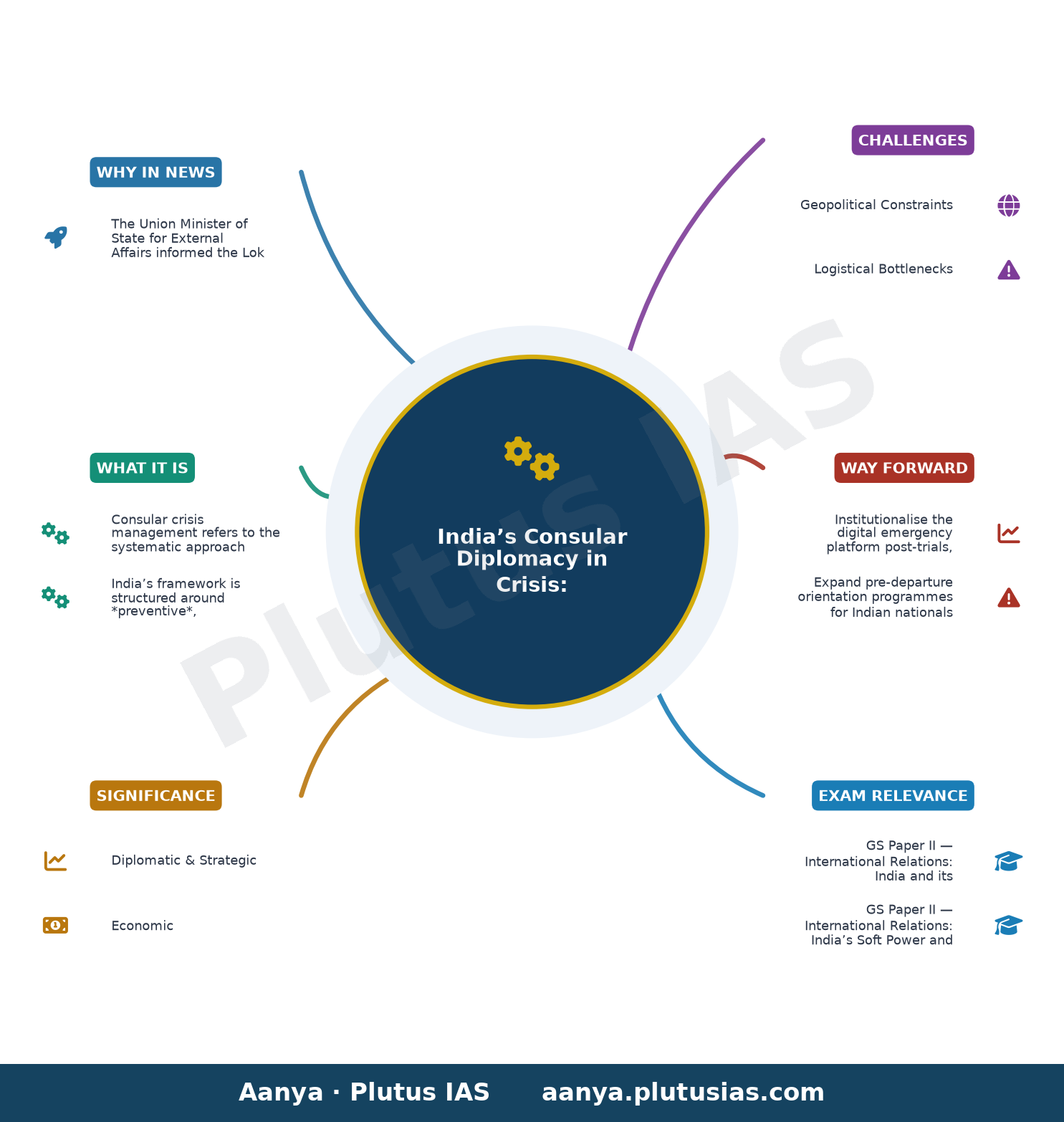
- GS Paper II — International Relations: India and its Neighbourhood; Consular Diplomacy; Crisis Management | GS Paper II — International Relations: India’s Soft Power and Diaspora Engagement
- Prelims: Visa regimes, Non-scheduled flights, Transit visas, Cross-border movement, 24×7 helpline, Evacuation operations, Control Rooms, Indian Missions
- Essay: The Role of Diplomacy in Protecting Citizens Abroad, Crisis Management: Lessons from India’s Evacuation Operations
Quick Revision: India’s evacuation operations during the 2026 US-Iran conflict demonstrated the efficacy of its consular crisis management framework, with 1,40,605 nationals repatriated through coordinated transit visas, non-scheduled flights, and cross-border movements, primarily via Qatar and Kuwait.
Why is this in the news?
The Union Minister of State for External Affairs informed the Lok Sabha that Indian diplomatic missions facilitated the return of approximately 1,40,605 Indian nationals during the escalation of hostilities between the United States and Iran in 2026. This figure underscores the operational capacity of India’s consular diplomacy and the strategic importance of West Asia in safeguarding its diaspora. The data reveals the concentration of evacuation efforts in Qatar and Kuwait, highlighting the logistical coordination required to navigate geopolitical constraints such as airspace restrictions and transit bottlenecks.
Background
- The 2026 US-Iran conflict triggered regional instability, disrupting airspace and land routes in West Asia and necessitating large-scale evacuation operations.
- West Asia hosts one of the largest Indian diaspora populations, with over 8.5 million Indians residing across the Gulf Cooperation Council (GCC) countries and neighbouring states.
- India’s evacuation protocols are governed by the *Consular Services Handbook* (2021) and the *Evacuation Operations Manual* (2023), which outline multi-layered response mechanisms for crises abroad.
- Historical precedents include Operation Rahat (2015) during the Yemen conflict and Operation Sukoon (2006) during the Lebanon war, which established institutional frameworks for rapid consular action.
- The 2026 crisis occurred amid evolving geopolitical alignments in West Asia, where traditional alliances (e.g., with the GCC) are being recalibrated in response to shifting power dynamics involving the US, Iran, and China.
- The evacuation operations coincided with the final trials of a new digital emergency response platform aimed at streamlining real-time coordination between missions, control rooms, and affected nationals.
What is Consular Crisis Management in the Context of Evacuation Operations?
- Consular crisis management refers to the systematic approach adopted by a state to protect, assist, and repatriate its nationals during emergencies abroad, encompassing natural disasters, armed conflicts, or political upheavals.
- India’s framework is structured around *preventive*, *responsive*, and *recovery* phases, with the Ministry of External Affairs (MEA) serving as the nodal authority for coordination.
- Key operational tools include: (a) *advisories* to nationals, (b) *24×7 control rooms* in India and abroad, (c) *transit visa facilitation* via third countries, (d) *non-scheduled flight operations*, and (e) *cross-border movement assistance* where air routes are disrupted.
- The role of Indian Missions extends beyond evacuation to include *community engagement* (e.g., WhatsApp groups, social media updates) and *collaboration with host governments* to secure permissions for overflight or transit.
- Transit visas, such as those facilitated via Saudi Arabia for nationals returning from Kuwait or Bahrain, exemplify *diplomatic reciprocity* and *third-country cooperation* in crisis scenarios.
- The 2026 operations highlighted the criticality of *airspace management*, as evidenced by Qatar’s partial reopening enabling the evacuation of 1,00,000 nationals—the highest among all countries.
- The digital emergency response platform under final trials aims to integrate *real-time data analytics*, *AI-driven alerts*, and *multi-channel communication* (SMS, WhatsApp, email) to reduce response times.
- Post-evacuation, the MEA conducts *debriefings* with returnees to assess gaps in the system and refine protocols for future crises.
Key Features
| Feature | Significance |
|---|---|
| Multi-country coordination | Demonstrates India’s ability to orchestrate large-scale repatriation across multiple geographies under crisis conditions, leveraging diplomatic and logistical networks. |
| Real-time monitoring mechanism | Ensures timely advisories and updates to Indian nationals abroad, reducing exposure to hostile environments during geopolitical flashpoints. |
| 24×7 control rooms | Provides uninterrupted support to stranded nationals, families, and evacuation coordinators, minimising response delays in dynamic conflict zones. |
| Digital emergency platform | Aims to streamline evacuation operations through automation, reducing human error and improving data-driven decision-making in emergencies. |
| Community liaison networks | Facilitates rapid dissemination of critical information to Indian diaspora groups, enhancing situational awareness and voluntary compliance with safety protocols. |
Why it Matters
Diplomatic & Strategic
- Reinforces India’s capacity to protect its citizens in high-risk regions, thereby bolstering soft power and global trust in Indian diplomacy.
- Demonstrates operational readiness of Indian missions to handle large-scale humanitarian crises, including those involving non-state actors.
- Highlights India’s strategic partnerships with Gulf states (Qatar, Kuwait, Bahrain) and Armenia, which are critical for overland and air transit during regional conflicts.
Economic
- Prevents potential economic losses from stranded labour and professionals, particularly in West Asia’s oil-rich economies where Indian nationals constitute a significant workforce.
- Mitigates remittance disruptions by ensuring the continuity of Indian nationals’ employment and income streams during crises.
Humanitarian
- Upholds India’s commitment to the safety and dignity of its citizens abroad, aligning with constitutional principles of welfare and protection.
- Reduces vulnerability of low-skilled workers, students, and professionals in conflict zones, who often lack resources for self-evacuation.
Technological
- The proposed digital emergency platform represents a forward-looking integration of technology in crisis management, potentially setting a benchmark for future evacuations.
- Leverages multilingual communication tools (WhatsApp, toll-free helplines) to ensure inclusivity across diverse linguistic and socio-economic groups.
Challenges
1. Geopolitical Constraints
- Airspace closures and sanctions (e.g., partial reopening in Qatar) can severely restrict evacuation routes, necessitating overland alternatives.
- Hostile states may impose transit restrictions, complicating the movement of Indian nationals through third countries (e.g., Saudi transit visas via Bahrain).
UPSC Link: GS-II: India and its neighbourhood
2. Logistical Bottlenecks
- Limited non-scheduled flight operations in conflict zones (e.g., Kuwait) can delay repatriation, especially for large cohorts.
- Cross-border movements (e.g., Iraq-Armenia) require coordination with multiple authorities, increasing operational complexity.
UPSC Link: GS-III: Infrastructure and logistics
3. Communication Gaps
- Language barriers and digital divides among Indian nationals (e.g., blue-collar workers) may hinder access to emergency helplines and advisories.
- Social media platforms, while useful, can also spread misinformation, necessitating robust verification mechanisms.
UPSC Link: GS-II: Effect of policies and politics of developed and developing countries
4. Resource Allocation
- High operational costs of evacuation (e.g., charter flights, transit visas) strain limited diplomatic budgets during prolonged crises.
- Prioritisation dilemmas arise when resources are insufficient to evacuate all nationals simultaneously.
UPSC Link: GS-III: Government budgeting and fiscal policy
5. Legal and Consular Hurdles
- Visa denials or delays in transit countries (e.g., Saudi Arabia) can obstruct evacuation corridors, requiring high-level diplomatic interventions.
- Protecting dual nationals or those with unclear legal statuses complicates consular assistance.
UPSC Link: GS-II: Bilateral, regional and global groupings and agreements
Challenges — UPSC Perspective
| Issue | Concern |
|---|---|
| Airspace restrictions | Limits available evacuation routes, forcing reliance on overland or maritime transit. |
| Transit visa delays | Host countries may impose bureaucratic hurdles, delaying movement of evacuees. |
| Non-scheduled flight scarcity | Conflict zones often lack commercial flight availability, necessitating costly charter operations. |
| Cross-border coordination | Requires simultaneous engagement with multiple governments, increasing diplomatic workload. |
| Digital divide | Stranded nationals may lack access to online advisories or helplines due to language or connectivity barriers. |
| Resource constraints | High costs of evacuation operations may divert funds from other critical diplomatic functions. |
Way Forward
- Institutionalise the digital emergency platform post-trials, integrating it with existing consular databases for real-time tracking of nationals.
- Expand pre-departure orientation programmes for Indian nationals travelling to high-risk regions, including crisis response training.
- Strengthen bilateral agreements with transit countries (e.g., Saudi Arabia) to expedite visa issuance during emergencies.
- Establish regional evacuation hubs in West Asia and the Caucasus to pre-position resources (e.g., charter flights, medical kits).
- Enhance multilingual outreach (e.g., regional language helplines) to ensure accessibility for blue-collar workers and low-literacy groups.
- Conduct periodic joint exercises with host countries to simulate evacuation scenarios, improving inter-agency coordination.
- Develop a tiered advisory system (e.g., colour-coded alerts) to streamline decision-making during evolving crises.
UPSC Value Addition
Keywords for Mains Answer-Writing
Indian diplomatic missions · evacuation operations · West Asia Crisis 2026 · transit visas · cross-border movements · non-scheduled flights · 24×7 control rooms · digital emergency response platform · Lok Sabha statement · Ministry of External Affairs · Indian nationals abroad · evacuation mechanism · emergency communication · geopolitical crises · diplomatic preparedness
Constitutional & Policy Linkages
- [‘Article 51(c): Promotion of international peace’, ‘Upholds India’s commitment to protecting its citizens while adhering to global norms.’]
Concept Flow
Geopolitical tensions (US-Iran conflict) → Airspace/sanctions (e.g., Qatar) → Restricted evacuation routes → Overland/transit alternatives (e.g., Saudi visas via Bahrain) → Coordinated diplomatic efforts → Safe repatriation of nationals.
Prelims Practice Questions
Q1. Consider the following statements regarding the evacuation of Indian nationals during the West Asia Crisis 2026:
1. The highest number of Indian nationals were assisted through Qatar.
2. Kuwait facilitated the return of 30,000 Indian nationals using Saudi transit visas and non-scheduled flights.
3. The evacuation operations were coordinated solely through bilateral agreements with host countries.
How many of the above statements are correct?
- Only one
- Only two
- All three
- None
Answer: Only two — Statement 1 and 2 are correct as per the Lok Sabha statement. Statement 3 is incorrect because the government also utilised multilateral mechanisms, 24×7 control rooms, and digital platforms for coordination.
Q2. Assertion (A): During the West Asia Crisis 2026, Indian missions facilitated the return of 1,40,605 Indian nationals.
Reason (R): The Ministry of External Affairs established 24×7 control rooms in India and abroad to coordinate evacuation operations.
In the context of the above two statements, which one of the following is correct?
- Both A and R are true and R is the correct explanation of A.
- Both A and R are true but R is not the correct explanation of A.
- A is true but R is false.
- A is false but R is true.
Answer: Both A and R are true but R is not the correct explanation of A. — Both A and R are true. While A states the total number of evacuees, R explains the mechanism used to achieve this, but R does not directly explain the figure in A.
Q3. Match the following countries with the number of Indian nationals assisted during the West Asia Crisis 2026:
Column I (Country) | Column II (Number of Indian nationals assisted)
— | —
A. Qatar | 1. 30,000
B. Kuwait | 2. 3,225
C. Iraq | 3. 1,00,000
D. Armenia | 4. 3,008
E. Bahrain | 5. 2,500
Answer: ? —
Mains Practice Question
✍ The Government of India’s evacuation operations during the West Asia Crisis 2026 exemplify the institutional capacity and diplomatic preparedness of Indian missions in safeguarding citizens abroad. Critically analyse the mechanisms deployed by the Ministry of External Affairs to ensure the safe return of Indian nationals, with reference to the role of transit visas, cross-border movements, and digital platforms. (15 Marks)
Approach: MODEL-ANSWER SKELETON:
1. **Introduction (2 marks)**: Define the context of the West Asia Crisis 2026 and the scale of evacuation (1,40,605 Indian nationals). Highlight the constitutional and statutory framework governing the protection of Indian nationals abroad (Article 29, Citizenship Act 1955, and the MEA’s mandate under the Government of India (Allocation of Business) Rules, 1961).
2. **Mechanisms for Evacuation (5 marks)**:
– **Transit Visas and Bilateral Diplomacy**: Explain the role of transit visas facilitated by Saudi Arabia for nationals returning via Bahrain, Kuwait, and Qatar. Cite the use of non-scheduled flights and partial airspace reopening in Qatar.
– **Cross-border Movements**: Detail the assistance provided for cross-border movements from Iraq and Armenia, including coordination with host-country authorities.
– **24×7 Control Rooms**: Describe the establishment of control rooms in India and abroad to monitor, coordinate, and disseminate real-time information (e.g., helplines, WhatsApp numbers, and multilingual support).
3. **Digital Platform for Evacuation (3 marks)**:
– Discuss the government’s development of a digital emergency response solution to streamline evacuation operations, including its features (e.g., real-time tracking, communication hubs, and integration with consular services).
4. **Challenges and Limitations (3 marks)**:
– Highlight constraints such as geopolitical tensions, airspace restrictions, and logistical bottlenecks in conflict zones.
– Critique the reliance on non-scheduled flights and partial airspace openings as temporary solutions.
5. **Conclusion (2 marks)**: Evaluate the efficacy of these mechanisms in ensuring the safety and timely return of Indian nationals. Suggest measures for long-term preparedness, such as pre-negotiated evacuation protocols with regional partners and enhanced consular capacity.
Source: The Indian Express
Generated by AanyaAi for educational purpose.

- महाराष्ट्र में त्योहार जुलूसों पर बॉम्बे हाईकोर्ट का बड़ा फैसला: पटाखे, लेजर और संगीत पर रोक - September 24, 2026
- Bombay HC Bans Firecrackers, Music in Maharashtra Processions: Key UPSC Analysis - September 24, 2026
- तमिलनाडु में महिला कर्मचारियों के लिए सवैतनिक माहवारी अवकाश नीति पर HC का आदेश - September 24, 2026

No Comments