


31 Jul 1.4 Lakh Indians Evacuated Amid US-Iran War: Centre’s Response
✎ The 2026 evacuation operation highlights that India’s consular diplomacy in West Asia relies on a combination of bilateral transit agreements, digital governance, and multi-agency coordination to safeguard its diaspora during…
Subject Relevance — Where This Topic Fits
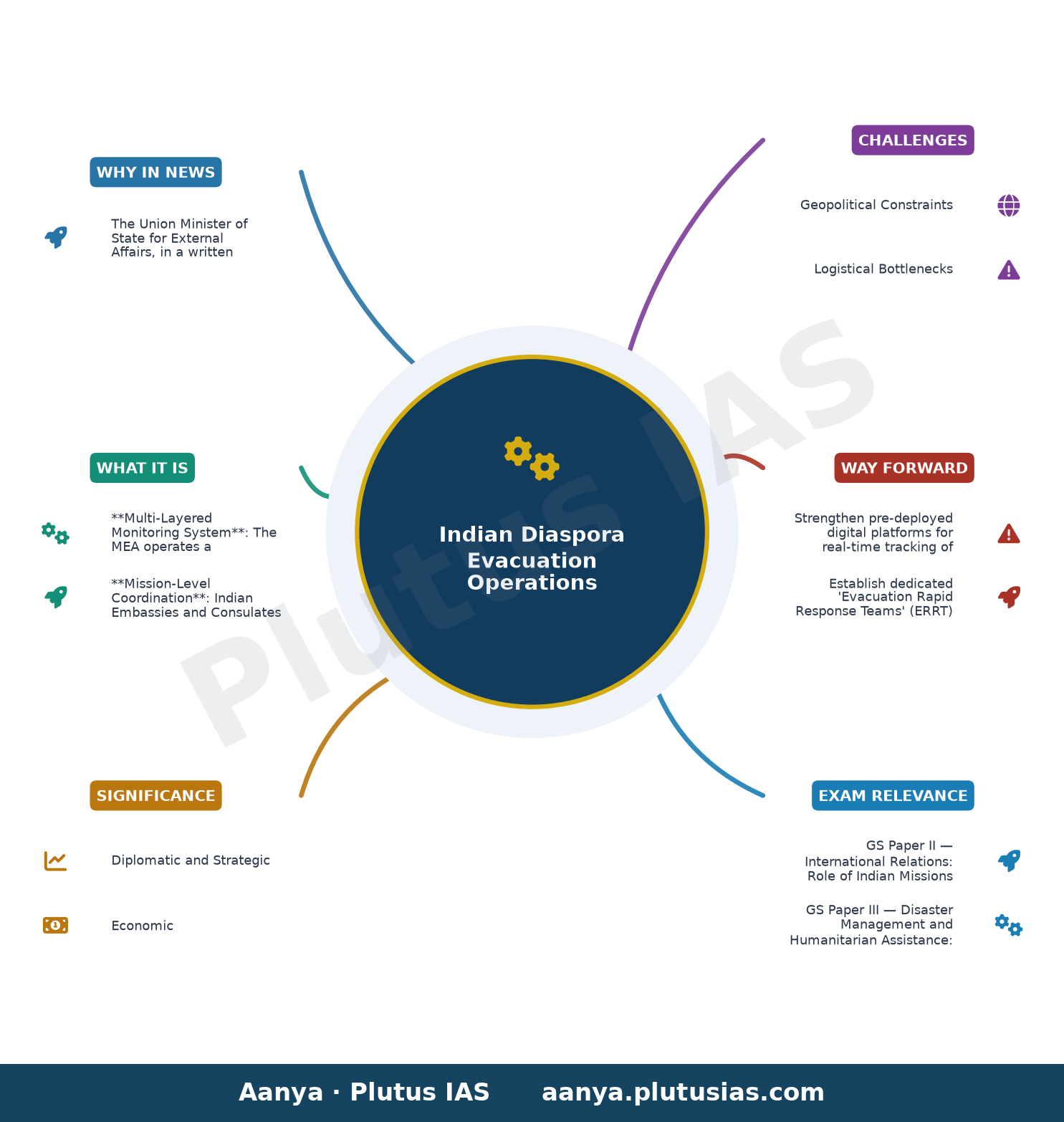
- GS Paper II — International Relations: Role of Indian Missions Abroad, Consular Diplomacy, Crisis Management, and Bilateral Agreements with Gulf States | GS Paper III — Disaster Management and Humanitarian Assistance: Evacuation Protocols, Multi-Agency Coordination, and Digital Governance in Crisis Response
- Prelims: Consular diplomacy, Visa facilitation agreements, Non-scheduled flights, Cross-border evacuations, 24×7 control rooms, Digital emergency response platforms, Gulf Cooperation Council (GCC) transit visas, Lok Sabha written statements
- Essay: The role of diplomacy in safeguarding citizens abroad during geopolitical crises, Technology and governance in crisis management: Lessons from the 2026 US-Iran war evacuation
Quick Revision: The 2026 evacuation operation highlights that India’s consular diplomacy in West Asia relies on a combination of bilateral transit agreements, digital governance, and multi-agency coordination to safeguard its diaspora during geopolitical crises.
Why is this in the news?
The Union Minister of State for External Affairs, in a written statement to the Lok Sabha on 31 July 2026, disclosed that Indian diplomatic missions facilitated the safe return of approximately 1.4 lakh Indian nationals during the escalation of hostilities between the United States and Iran in 2026. This operation underscores the operational preparedness of India’s consular machinery, the strategic importance of Gulf transit arrangements, and the evolving role of digital platforms in emergency response. The disclosure highlights both the scale of India’s diaspora and the logistical challenges inherent in cross-border evacuations under geopolitical duress.
Background
- The 2026 US-Iran crisis escalated following a series of military engagements in the Persian Gulf, including attacks on shipping lanes and infrastructure, which threatened the safety of foreign nationals, including over 8 million Indians residing or working in West Asia.
- The Strait of Hormuz, a critical chokepoint for global oil trade, witnessed heightened tensions, prompting several Gulf states to temporarily restrict airspace or implement stringent entry protocols.
- India maintains one of the largest expatriate communities in the Gulf region, with significant populations in Qatar, Kuwait, Iraq, and Bahrain, making rapid evacuation essential during regional instability.
- Historically, India has conducted large-scale evacuations during conflicts such as the Gulf War (1990–91), the Iraq War (2003), and the Yemen crisis (2015), evolving its protocols in response to emerging threats and technological advancements.
- The Government of India has institutionalized multi-agency coordination through the Ministry of External Affairs (MEA), Ministry of Civil Aviation, Ministry of Defence, and state governments to manage such crises.
- The evacuation operation occurred against the backdrop of India’s ‘Act East’ and ‘Neighbourhood First’ policies, which emphasize diaspora welfare and regional stability.
What is the Indian Diaspora Evacuation Mechanism During Geopolitical Crises?
- **Multi-Layered Monitoring System**: The MEA operates a structured monitoring mechanism to track geopolitical developments in real time, issuing advisories to Indian nationals via multiple channels (email, 24×7 helplines, social media, and WhatsApp).
- **Mission-Level Coordination**: Indian Embassies and Consulates in affected regions act as the primary interface, liaising with host governments to secure transit visas, accommodation, and transportation for stranded nationals.
- **Cross-Border Facilitation**: In cases where airspace is restricted (e.g., Qatar in 2026), missions coordinate land and sea routes, including cross-border movements through adjacent countries (e.g., Iraq to Armenia).
- **Transit Visa Arrangements**: India leverages bilateral agreements with Gulf states (e.g., Saudi Arabia) to facilitate transit visas for Indian nationals transiting through third countries to reach India.
- **Non-Scheduled Flight Operations**: During crises, the MEA collaborates with the Ministry of Civil Aviation to operate special flights (chartered or Vande Bharat-like missions) from affected regions to India.
- **Community Outreach**: Missions maintain regular contact with Indian community associations (e.g., Indian Workers’ Welfare Associations) to disseminate timely updates and gather ground-level intelligence.
- **24×7 Control Rooms**: Dedicated control rooms in India and abroad serve as nerve centers for coordination, providing round-the-clock assistance to stranded nationals and their families.
Key Features
| Feature | Significance |
|---|---|
| Multi-country coordination | Demonstrated India’s diplomatic reach and crisis-response capability across multiple nations, leveraging embassies, consulates, and host-country transit arrangements. |
| Transit visa facilitation | Enabled safe passage of Indian nationals through third countries (e.g., Saudi transit visas via Bahrain/Kuwait), reducing direct exposure to conflict zones. |
| 24×7 Control Rooms | Ensured real-time communication, coordination, and support for stranded nationals, families, and evacuation teams during dynamic crisis conditions. |
| Digital emergency platform | Aims to streamline evacuation operations through real-time data sharing, reducing delays and improving resource allocation in future crises. |
| Community engagement | Regular contact with Indian diaspora groups facilitated rapid dissemination of advisories and evacuation updates, enhancing trust and compliance. |
Why it Matters
Diplomatic and Strategic
- Validated India’s ‘Neighbourhood First’ and ‘Act East’ policy frameworks by prioritising the safety of Indian nationals in West Asia during geopolitical instability.
- Highlighted India’s capacity to conduct large-scale non-combatant evacuation operations (NEO) independently, reinforcing its role as a responsible regional power.
- Demonstrated adaptability in leveraging diplomatic channels (e.g., Qatar’s partial airspace reopening) to mitigate disruptions caused by external conflicts.
- Reinforced India’s image as a protector of its diaspora, a critical factor in maintaining soft power and economic ties with the Gulf region.
Economic
- Prevented potential economic losses from disruptions in remittances, labour market participation, and trade flows involving Indian nationals in the Gulf.
- Mitigated risks to India’s energy security by ensuring the uninterrupted return of skilled and semi-skilled workers, who are vital to sectors like construction, healthcare, and logistics.
- Avoided additional strain on India’s foreign exchange reserves by preventing unplanned large-scale repatriation costs (e.g., charter flights, emergency accommodations).
Humanitarian
- Ensured the physical safety and psychological well-being of 1.4 lakh Indian nationals, including women, children, and elderly, during a high-risk geopolitical crisis.
- Provided structured support mechanisms (e.g., helplines, WhatsApp groups) to address the diverse needs of stranded nationals, including those with medical or legal emergencies.
- Demonstrated India’s commitment to its citizens abroad, aligning with constitutional obligations under Article 29 and Article 30 (cultural and educational rights of minorities).
Challenges
1. Geopolitical Constraints
- Airspace closures (e.g., partial reopening in Qatar) and transit restrictions imposed by third countries limited evacuation routes, necessitating rapid diplomatic negotiations.
- Host-country policies (e.g., Saudi transit visa requirements) added layers of complexity, requiring pre-emptive coordination to avoid bottlenecks.
- Escalation risks in the US-Iran conflict (e.g., strikes, blockades) posed direct threats to evacuation corridors, demanding real-time risk assessment.
UPSC Link: GS II: India and its Neighbourhood
2. Logistical Bottlenecks
- Large-scale repatriation (1.4 lakh nationals) strained India’s evacuation infrastructure, including limited flight capacities and ground transport in conflict-adjacent regions.
- Cross-border movements (e.g., Iraq to Armenia) required coordination with multiple national authorities, increasing the risk of delays or miscommunication.
- Non-scheduled flights (e.g., Kuwait) incurred higher operational costs, necessitating budgetary flexibility and inter-ministerial approvals.
UPSC Link: GS III: Disaster Management
3. Information Asymmetry
- Rapidly evolving conflict dynamics led to misinformation or delayed updates, complicating advisories for Indian nationals in high-risk zones.
- Language barriers and digital divides among diaspora groups (e.g., labourers vs. professionals) hindered effective communication of evacuation protocols.
- Lack of a unified digital dashboard for real-time tracking of nationals during crises delayed decision-making in critical phases.
UPSC Link: GS II: International Relations
4. Resource Allocation
- Balancing evacuation priorities (e.g., vulnerable groups vs. able-bodied nationals) required ethical and logistical trade-offs, especially in resource-constrained environments.
- Emergency accommodations and medical support for stranded nationals demanded rapid deployment of personnel and supplies, straining local consular resources.
- Coordination between central ministries (e.g., MEA, MoCA, MoHFW) and state governments added bureaucratic layers, risking delays in execution.
UPSC Link: GS III: Government Policies
5. Psychosocial Impact
- Prolonged uncertainty and displacement led to heightened stress, trauma, and financial hardship among affected nationals, requiring post-evacuation counselling and rehabilitation.
- Families of stranded nationals faced prolonged separation, exacerbating emotional distress and complicating reunification efforts post-evacuation.
- Stigma and discrimination against certain diaspora groups (e.g., low-skilled workers) in host countries risked underreporting of distress cases.
UPSC Link: GS IV: Ethics
Challenges — UPSC Perspective
| Issue | Concern |
|---|---|
| Airspace restrictions | Limited evacuation routes due to partial closures, necessitating diplomatic negotiations for transit rights. |
| Transit visa delays | Host-country transit requirements (e.g., Saudi visas) added procedural hurdles, risking bottlenecks in repatriation. |
| Non-scheduled flight costs | Higher operational expenses for charter flights strained budgetary allocations and required inter-ministerial approvals. |
| Cross-border coordination | Multi-country movements (e.g., Iraq to Armenia) required synchronised efforts with multiple national authorities. |
| Digital divide | Language barriers and limited internet access among diaspora groups hindered effective communication of advisories. |
| Psychosocial support | Post-evacuation trauma and financial hardship among affected nationals demanded structured rehabilitation mechanisms. |
Way Forward
- Strengthen pre-deployed digital platforms for real-time tracking of Indian nationals in high-risk regions, integrating AI-driven risk assessment tools.
- Establish dedicated ‘Evacuation Rapid Response Teams’ (ERRT) within Indian missions, trained in crisis management and equipped with modular logistics support.
- Expand bilateral and multilateral agreements with Gulf nations to streamline transit visa processes and pre-approved evacuation corridors.
- Develop a tiered advisory system (colour-coded) for Indian nationals abroad, with automated alerts based on conflict escalation levels.
- Enhance post-evacuation support mechanisms, including mental health services, skill-mapping for reintegration, and financial aid for affected families.
- Conduct regular joint exercises with host countries to simulate large-scale NEOs, testing logistical, diplomatic, and technological readiness.
- Incorporate diaspora feedback mechanisms to refine evacuation protocols, addressing gaps in communication and resource allocation.
- Integrate India’s evacuation frameworks with regional organisations (e.g., GCC, OIC) to foster collective crisis-response mechanisms.
UPSC Value Addition
Keywords for Mains Answer-Writing
Indian diaspora protection · evacuation operations · Indian Missions and Posts · emergency response mechanisms · transit visas · West Asia crisis 2026 · citizen welfare abroad · Lok Sabha statement on evacuation · digital emergency platform · 24×7 control rooms
Concept Flow
Geopolitical tensions (US-Iran conflict) → Airspace/transit restrictions → Risk assessment by MEA → Advisory issuance to Indian nationals → Coordination with host-country missions → Transit visa facilitation → Logistics planning (flights, transport) → Real-time tracking via digital platforms → Evacuation execution → Post-evacuation support and rehabilitation
Prelims Practice Questions
Q1. Consider the following statements regarding the evacuation of Indian nationals during the West Asia Crisis 2026:
1. The highest number of Indian nationals were assisted through Qatar due to partial reopening of its airspace.
2. Saudi transit visas were facilitated for Indian nationals returning via Bahrain and Kuwait.
3. The evacuation process was coordinated exclusively through diplomatic missions in India without involving community groups abroad.
How many of the above statements are correct?
- Only one
- Only two
- All three
- None
Answer: Only two — Statements 1 and 2 are correct as per the Lok Sabha statement. Statement 3 is incorrect because the government explicitly stated that Indian Missions stayed in regular contact with Indian community groups to share updates.
Q2. Assertion (A): During the West Asia Crisis 2026, the Indian government set up 24×7 Control Rooms both in India and abroad to coordinate evacuation operations.
Reason (R): The Control Rooms were established to provide information, assistance, and support to stranded Indian nationals and their families.
Options:
A. Both A and R are true, and R is the correct explanation of A.
B. Both A and R are true, but R is NOT the correct explanation of A.
C. A is true, but R is false.
D. A is false, but R is true.
- A
- B
- C
- D
Answer: A — Both Assertion (A) and Reason (R) are true, and R correctly explains A as the Control Rooms were set up specifically to provide assistance and coordinate evacuations.
Q3. Match the following countries with the number of Indian nationals assisted during the West Asia Crisis 2026:
Column I (Country) | Column II (Number of Indian Nationals Assisted)
— | —
A. Qatar | 1. 30,000
B. Kuwait | 2. 248
C. Iraq | 3. 1,00,000
D. Oman | 4. 3,225
- A-3, B-1, C-4, D-2
- A-1, B-3, C-2, D-4
- A-2, B-4, C-1, D-3
- A-4, B-2, C-3, D-1
Answer: A-3, B-1, C-4, D-2 — Qatar assisted 1,00,000 nationals, Kuwait assisted 30,000, Iraq assisted 3,225, and Oman assisted 248 nationals.
Mains Practice Question
✍ The Government of India’s evacuation operations during the West Asia Crisis 2026 exemplify a robust mechanism for the protection of Indian nationals abroad. Critically analyse the institutional framework, operational strategies, and technological interventions deployed to ensure the safe return of citizens. (15 Marks)
Approach: MODEL-ANSWER SKELETON:
1. **Institutional Framework**:
– Role of Indian Missions and Posts (Embassies/Consulates) in coordinating evacuations.
– Multi-layered monitoring mechanism for emerging situations (as stated by MoS Kirti Vardhan Singh).
– Regular engagement with Indian community groups for real-time updates.
2. **Operational Strategies**:
– Facilitation of transit visas (e.g., Saudi transit visas for Bahrain/Kuwait routes).
– Arrangement of non-scheduled flights and cross-border movements (e.g., Iraq-Armenia routes).
– Use of local accommodation and transportation support.
– Establishment of 24×7 Control Rooms in India and abroad for coordination.
3. **Technological Interventions**:
– Development of a digital emergency response platform (in final trials) to streamline evacuations.
– Deployment of multilingual 24×7 emergency numbers, social media, toll-free helplines, and WhatsApp for communication.
4. **Critical Analysis**:
– Strengths: Proactive advisories, structured mechanisms, and community engagement.
– Challenges: Logistical bottlenecks, airspace restrictions (e.g., Qatar), and coordination across multiple countries.
– Comparative perspective: Lessons from past evacuations (e.g., Vande Bharat Mission during COVID-19).
5. **Conclusion**:
– The framework demonstrates India’s commitment to citizen welfare abroad but highlights the need for continuous technological upgradation and inter-agency coordination.
Source: The Indian Express
Generated by AanyaAi for educational purpose.

- केरल लोक सेवा आयोग ने उच्च न्यायालय में दायर किया मामला, सदस्यों के खिलाफ मामला रद्द करने की मांग - September 23, 2026
- KPSC Challenges Prosecution Sanction in Kerala High Court: Key UPSC Polity Insight - September 23, 2026
- केरल में एंटीमाइक्रोबियल रेजिस्टेंस: सरकारी रिपोर्ट में चौंकाने वाले आँकड़े सामने - September 23, 2026

No Comments