


31 Jul Mission Saksham Anganwadi & Poshan 2.0: All Beneficiaries to Get Supplementary Nutrition
✎ Mission Saksham Anganwadi and Nutrition 2.0 expands supplementary nutrition coverage under POSHAN 2.0 to all eligible beneficiaries (children 6 months–6 years, pregnant/lactating women, adolescent girls 14–18 years) using THR…
Subject Relevance — Where This Topic Fits
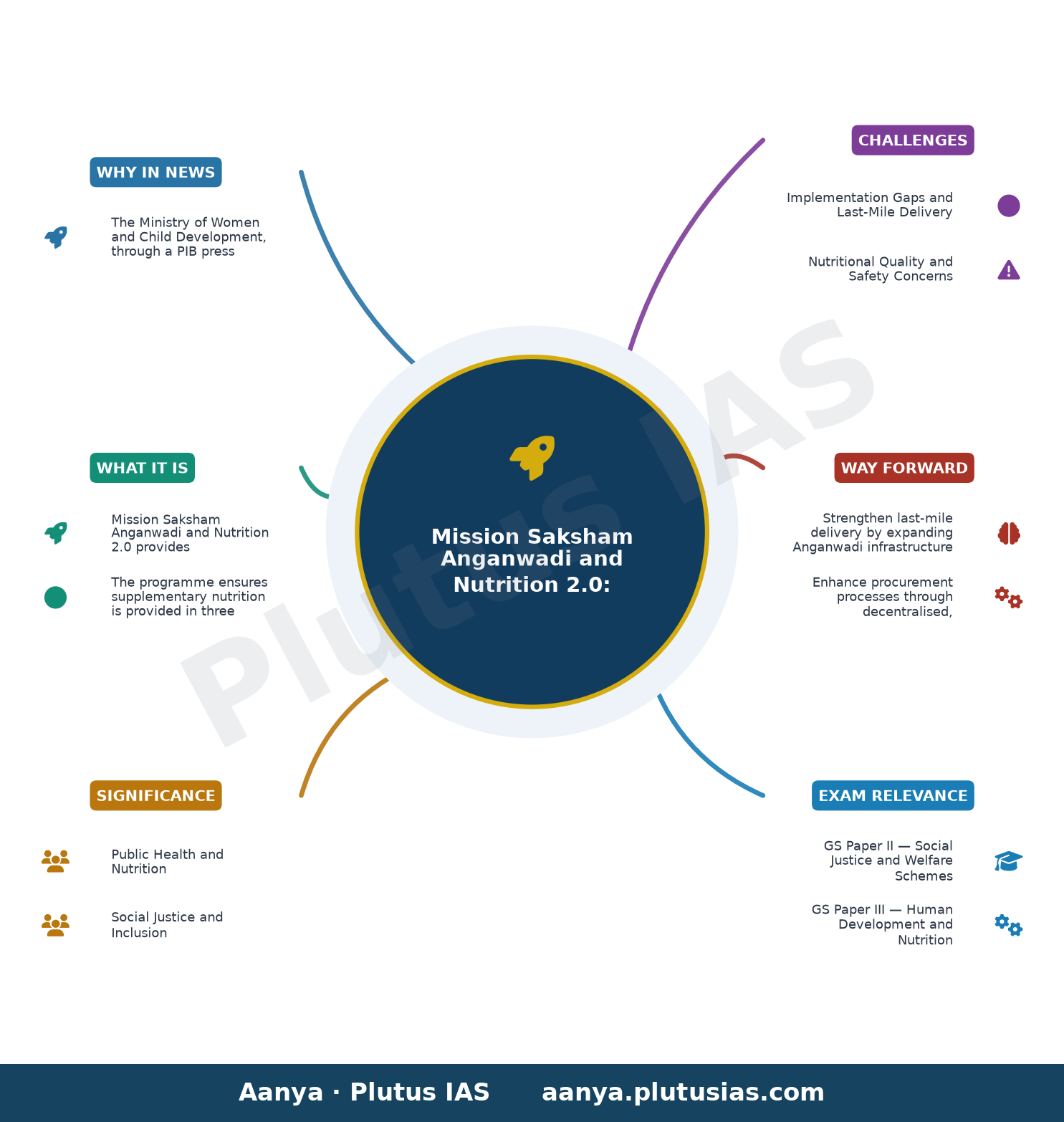
- GS Paper II — Social Justice and Welfare Schemes | GS Paper III — Human Development and Nutrition | GS Paper IV — Ethical Governance in Public Service Delivery
- Prelims: POSHAN 2.0, Supplementary Nutrition, ICDS, NFSA 2013, Face Recognition System (FRS), Take-Home Ration (THR), Severe Acute Malnutrition (SAM), Recommended Dietary Allowance (RDA), Micro-nutrient Deficiencies
- Essay: Role of Nutrition in Human Capital Formation, Challenges in Public Health Delivery Systems in India
Quick Revision: Mission Saksham Anganwadi and Nutrition 2.0 expands supplementary nutrition coverage under POSHAN 2.0 to all eligible beneficiaries (children 6 months–6 years, pregnant/lactating women, adolescent girls 14–18 years) using THR, morning snacks, and hot meals, with nutritional norms aligned to NFSA 2013 (Schedule-II, 2023) and FRS-enabled delivery for targeted distribution.
Why is this in the news?
The Ministry of Women and Child Development, through a PIB press release dated 31 July 2026, announced the expansion of supplementary nutrition coverage under Mission Saksham Anganwadi and Nutrition 2.0 to all eligible beneficiaries, including children aged 6 months to 6 years, pregnant and lactating women, adolescent girls (14–18 years), and severely malnourished children. This initiative aligns with revised nutritional norms under the National Food Security Act (NFSA), 2013 (Schedule-II, January 2023), and integrates advanced delivery mechanisms such as face recognition systems for targeted distribution of Take-Home Ration (THR) to ensure dietary diversity and address micro-nutrient deficiencies.
Background
- The Integrated Child Development Services (ICDS) scheme, launched in 1975, is India’s flagship programme for early childhood care and development, targeting children under six, pregnant and lactating women, and adolescent girls.
- POSHAN Abhiyaan (Prime Minister’s Overarching Scheme for Holistic Nutrition) was launched in 2018 to address malnutrition through multi-sectoral convergence, with Mission Poshan 2.0 (2021) integrating supplementary nutrition, early childhood care, and adolescent nutrition under a unified framework.
- The National Food Security Act (NFSA), 2013, mandates the provision of nutritional support to pregnant women, lactating mothers, and children under six, with Schedule-II (revised January 2023) specifying enhanced nutritional norms for supplementary feeding programmes.
- Severe Acute Malnutrition (SAM) remains a critical challenge in India, with approximately 2.9% of children under five classified as severely wasted (NFHS-5, 2019–21), necessitating targeted interventions like THR with higher caloric and protein content.
- The use of biometric authentication (Face Recognition System) in welfare delivery systems has been progressively adopted to enhance transparency and reduce leakages in public service delivery, particularly in schemes like PDS and ICDS.
What is Mission Saksham Anganwadi and Nutrition 2.0?
- Mission Saksham Anganwadi and Nutrition 2.0 provides supplementary nutrition delivery.
- The programme ensures supplementary nutrition is provided in three formats: Take-Home Ration (THR) for children aged 6–23 months using FRS, morning snacks, and hot-cooked meals.
- Nutritional norms are aligned with the Recommended Dietary Allowance (RDA) and revised NFSA Schedule-II (2023), providing age-specific caloric and protein intake: 200 kcal + 8–10g protein for 6–12-month-old children, 400 kcal + 15–20g protein for 1–3-year-olds and 3–6-year-olds, along with seven essential micro-nutrients (calcium, zinc, iron, dietary folate, vitamin A, vitamin B6, vitamin B12).
- The programme aims to bridge the gap between RDA and average daily intake for all beneficiaries, and SAM children (6 months to 5 years) are provided additional nutrition as THR.
- Supplementary nutrition is delivered through a decentralised menu-planning approach, empowering states and UTs to design localised recipes using regionally available foods (millets, pulses, vegetables, nuts) to enhance dietary diversity and acceptability.
- Biometric authentication via Face Recognition System (FRS) at Anganwadi centres ensures targeted and leak-proof distribution of THR to mothers/guardians of children aged 6–23 months, reducing pilferage and improving last-mile delivery.
- The programme emphasises convergence with health services, including growth monitoring, immunisation, and referral linkages for children identified with malnutrition or micro-nutrient deficiencies.
- Comprehensive guidelines issued by the Ministry of Women and Child Development mandate adherence to quality standards, procurement norms, and monitoring mechanisms to ensure nutritional efficacy and transparency in implementation.
Key Features
| Feature | Significance |
|---|---|
| Provision of Supplementary Nutrition to All Beneficiaries | Ensures compliance with the National Food Security Act (NFSA), 2013, and addresses the gap between Recommended Dietary Allowance (RDA) and Average Daily Intake (ADI) for vulnerable groups. |
| Multi-modal Delivery Mechanism | Includes Take-Home Ration (THR), morning snacks, and hot-cooked meals, catering to diverse nutritional needs and accessibility constraints. |
| Face Recognition System (FRS) for THR Distribution | Enhances transparency and reduces leakages in the distribution of THR to children aged 6–23 months by ensuring accurate beneficiary identification. |
| Revised Nutritional Norms (2023) | Shifts from calorie-centric to balanced, diet-diversity-based norms, incorporating quality proteins, healthy fats, and essential micronutrients (e.g., iron, zinc, vitamin A). |
| Localised Menu Design and Cultural Adaptability | Promotes dietary acceptability by incorporating locally available foods (e.g., millets, pulses, nuts) and aligning with regional food habits and cultural preferences. |
| Focus on Severely Acute Malnourished (SAM) Children | Provides additional THR to SAM children (6 months–5 years) to address acute malnutrition and support recovery. |
| Comprehensive Guidelines for Quality Assurance | Mandates adherence to prescribed nutritional standards, food safety protocols, and regular monitoring to ensure high-quality supplementary nutrition. |
Why it Matters
Public Health and Nutrition
- Addresses the critical issue of child and maternal malnutrition in India, which remains a major challenge despite economic growth.
- Aligns with global commitments such as the Sustainable Development Goals (SDGs), particularly SDG 2 (Zero Hunger) and SDG 3 (Good Health and Well-being).
- Reduces stunting, wasting, and underweight prevalence among children under five, contributing to improved cognitive and physical development.
- Supports maternal health by providing targeted nutrition to pregnant and lactating women, reducing risks of anaemia and low birth weight.
Social Justice and Inclusion
- Ensures equitable access to nutrition for marginalised and vulnerable groups, including tribal, rural, and economically weaker sections.
- Promotes gender equity by addressing nutritional needs of adolescent girls (14–18 years), reducing anaemia and school dropout rates.
- Leverages technology (FRS) to minimise exclusion errors and enhance last-mile delivery efficiency.
Administrative and Governance Reforms
- Demonstrates a shift from supply-driven to demand-driven and outcome-focused service delivery in welfare schemes.
- Enhances inter-departmental coordination between the Ministry of Women and Child Development (MWCD), state governments, and local bodies.
- Introduces robust monitoring mechanisms to track nutritional outcomes and scheme performance.
Economic and Developmental Impact
- Reduces long-term healthcare costs by preventing nutrition-related diseases and disabilities in early childhood.
- Improves school attendance and learning outcomes, contributing to human capital formation and economic productivity.
- Supports the achievement of demographic dividend by ensuring a healthy and skilled workforce.
Challenges
1. Implementation Gaps and Last-Mile Delivery
- Inadequate infrastructure in remote and tribal areas may hinder the effective distribution of supplementary nutrition.
- Delays in fund disbursement and procurement of THR can disrupt the supply chain and reduce beneficiary coverage.
- Insufficient training of Anganwadi workers on nutritional standards and FRS usage may lead to operational inefficiencies.
UPSC Link: GS-II: Welfare schemes for vulnerable sections
2. Nutritional Quality and Safety Concerns
- Risk of substandard or adulterated THR due to poor procurement practices or lack of stringent quality control measures.
- Variations in local food availability may lead to inconsistent nutritional content in supplementary diets.
- Inadequate storage facilities in Anganwadi centres can compromise the shelf life and safety of perishable food items.
UPSC Link: GS-II: Food security and nutrition
3. Behavioural and Cultural Barriers
- Low awareness among beneficiaries about the importance of supplementary nutrition and its correct usage.
- Resistance to dietary diversification due to traditional food preferences, particularly in rural and tribal communities.
- Stigma associated with malnutrition may discourage beneficiaries from availing supplementary nutrition services.
UPSC Link: GS-II: Social sector services
4. Monitoring and Accountability Mechanisms
- Lack of real-time data on nutritional outcomes and beneficiary feedback limits evidence-based policy adjustments.
- Weak grievance redressal mechanisms may reduce beneficiary trust and participation in the scheme.
- Insufficient convergence with health programmes (e.g., Poshan Tracker) may result in fragmented service delivery.
UPSC Link: GS-II: Governance and accountability
5. Fiscal Sustainability and Resource Allocation
- High financial burden on the exchequer due to the expansion of supplementary nutrition coverage and revised nutritional norms.
- Dependence on centralised funding may lead to delays in state-level implementation and resource mismatches.
- Competing priorities in public expenditure may divert attention and resources away from nutrition programmes.
UPSC Link: GS-III: Budget and fiscal policy
6. Technological and Digital Divide
- Limited digital literacy among Anganwadi workers and beneficiaries may hinder the effective use of FRS and digital monitoring tools.
- Poor internet connectivity in rural areas can disrupt real-time data collection and beneficiary authentication.
- Cybersecurity risks in FRS may compromise beneficiary data privacy and system integrity.
UPSC Link: GS-III: Science and technology in governance
Challenges — UPSC Perspective
| Issue | Concern |
|---|---|
| Infrastructure Deficits | Inadequate storage, transportation, and Anganwadi centre facilities in remote areas. |
| Procurement and Supply Chain Delays | Bureaucratic hurdles and inefficiencies in THR procurement and distribution. |
| Quality Control Failures | Adulteration, substandard products, and lack of standardised testing protocols. |
| Cultural and Behavioural Resistance | Low acceptance of diversified diets due to traditional food habits and lack of awareness. |
| Monitoring and Evaluation Gaps | Absence of real-time data, weak feedback mechanisms, and poor convergence with health programmes. |
| Fiscal Constraints | High cost of supplementary nutrition and competing demands on public resources. |
Government Initiatives — Must-Memorise for Prelims
- Integrated Child Development Services (ICDS) Scheme
- Poshan Abhiyaan (National Nutrition Mission)
- National Food Security Act (NFSA), 2013
- Saksham Anganwadi and Poshan 2.0 (SAP 2.0)
Way Forward
- Strengthen last-mile delivery by expanding Anganwadi infrastructure and leveraging technology (e.g., FRS, mobile apps) for real-time monitoring.
- Enhance procurement processes through decentralised, community-based models to ensure timely and quality THR distribution.
- Conduct regular training programmes for Anganwadi workers on nutritional standards, FRS usage, and beneficiary engagement.
- Promote dietary diversification through awareness campaigns, culinary demonstrations, and community participation in menu design.
- Establish robust grievance redressal mechanisms and beneficiary feedback systems to improve programme responsiveness.
- Foster convergence between MWCD, Ministry of Health and Family Welfare, and state governments for integrated service delivery.
- Invest in digital infrastructure (e.g., internet connectivity, data security) to support FRS and monitoring tools in rural areas.
- Allocate adequate fiscal resources and ensure timely fund disbursement to prevent supply chain disruptions.
UPSC Value Addition
Keywords for Mains Answer-Writing
Mission Saksham Anganwadi and Poshan 2.0 · Supplementary Nutrition · Take-Home Ration (THR) · Recommended Dietary Allowance (RDA) · Face Recognition System (FRS) · Nutritional norms under NFSA 2013 · Severe Acute Malnutrition (SAM) · Dietary diversity · Micro-nutrient supplementation · Women and Child Development Ministry
Concept Flow
Malnutrition among children and women → Recognition of gaps in RDA vs. ADI → Policy response: NFSA 2013 and Mission Saksham Anganwadi and Nutrition 2.0 → Implementation via THR, hot-cooked meals, and snacks → Technological intervention: FRS for beneficiary authentication → Nutritional outcomes: reduction in stunting, wasting, and anaemia → Long-term impact: improved human capital and economic productivity
Prelims Practice Questions
Q1. Consider the following statements regarding Mission Saksham Anganwadi and Poshan 2.0:
1. It provides supplementary nutrition to children aged 6 months to 6 years, pregnant women, lactating mothers, and adolescent girls (14-18 years).
2. Supplementary nutrition is provided in the form of Take-Home Ration (THR), morning snacks, and hot cooked meals.
3. The nutritional norms are based solely on caloric intake and do not include micro-nutrient supplementation.
4. The scheme uses Face Recognition System (FRS) for distribution of THR to children aged 6-23 months.
How many of the above statements are correct?
- Only one
- Only two
- Only three
- All four
Answer: All four — Statements 1, 2, and 4 are correct. Statement 3 is incorrect as the scheme includes provision for 7 essential micro-nutrients alongside caloric intake.
Q2. Assertion (A): Mission Saksham Anganwadi and Poshan 2.0 aims to bridge the gap between Recommended Dietary Allowance (RDA) and Average Daily Intake (ADI).
Reason (R): The scheme provides supplementary nutrition to address nutritional deficiencies in vulnerable populations.
Options:
A. Both A and R are true, and R is the correct explanation of A.
B. Both A and R are true, but R is not the correct explanation of A.
C. A is true, but R is false.
D. A is false, but R is true.
- A
- B
- C
- D
Answer: B — Both the assertion and reason are true, and the reason correctly explains the assertion. The scheme specifically targets the gap between RDA and ADI through supplementary nutrition.
Q3. Match the following nutritional norms for children under Mission Saksham Anganwadi and Poshan 2.0 with their respective age groups:
Column I (Age Group) | Column II (Nutritional Norms)
1. 6-12 months | A. 400 kcal and 15-20g protein
2. 1-3 years | B. 200 kcal and 8-10g protein
3. 3-6 years | C. 400 kcal and 15-20g protein
4. 6-23 months | D. 200 kcal and 8-10g protein
Options:
A. 1-B, 2-A, 3-C, 4-D
B. 1-A, 2-B, 3-C, 4-D
C. 1-D, 2-A, 3-C, 4-B
D. 1-B, 2-C, 3-A, 4-D
- A
- B
- C
- D
Answer: B — The correct match is: 6-12 months (B), 1-3 years (A), 3-6 years (C), and 6-23 months (D).
Mains Practice Question
✍ The supplementary nutrition framework under Mission Saksham Anganwadi and Poshan 2.0 represents a paradigm shift from calorie-centric to diet-quality-centric approaches in addressing malnutrition. Critically examine this statement with reference to the scheme’s provisions, nutritional norms, and the role of dietary diversity. Also, assess the significance of the Face Recognition System (FRS) in ensuring last-mile delivery of nutrition. (15 Marks)
Approach: MODEL-ANSWER SKELETON:
1. **Introduction (2 Marks)**
– Briefly introduce Mission Saksham Anganwadi and Poshan 2.0 as a convergence of the ICDS and Poshan Abhiyaan.
– State the objective of bridging the gap between RDA and ADI through supplementary nutrition.
2. **Calorie-Centric to Diet-Quality-Centric Shift (5 Marks)**
– **Old norms**: Primarily focused on caloric intake (e.g., 200 kcal for 6-12 months, 400 kcal for 1-6 years).
– **New norms**: Include provision for 7 essential micro-nutrients (calcium, zinc, iron, folate, vitamins A, B6, B12) alongside proteins and calories.
– **Dietary diversity**: Emphasis on local foods (millets, pulses, nuts, vegetables) to ensure balanced nutrition.
– **SAM children**: Additional THR for severely malnourished children.
– **Legal basis**: Aligns with revised Schedule-II of NFSA 2013 (January 2023).
3. **Role of Dietary Diversity (4 Marks)**
– **Definition**: Inclusion of diverse food groups to meet macro and micro-nutrient needs.
– **Implementation**: States given flexibility to design menus based on local food habits and cultural preferences.
– **Outcomes**: Enhances acceptability, reduces monotony, and improves nutritional outcomes.
– **Example**: Use of millets (e.g., bajra, jowar) to address micronutrient deficiencies.
4. **Face Recognition System (FRS) for Delivery (2 Marks)**
– **Purpose**: Ensures accurate identification of beneficiaries (children 6-23 months) for THR distribution.
– **Mechanism**: Biometric authentication at Anganwadi centers to prevent leakages and ensure transparency.
– **Significance**: Reduces pilferage, enhances accountability, and improves last-mile delivery.
5. **Conclusion (2 Marks)**
– Summarize the shift from quantity to quality in nutrition.
– Highlight the importance of FRS in ensuring scheme effectiveness.
– Conclude with the need for continuous monitoring and community participation for sustainable outcomes.
Source: PIB (Press Information Bureau)
Generated by AanyaAi for educational purpose.

- हाईकोर्ट की चेतावनी: अधूरा फोरलेन, पूरा टोल वसूली पर जवाब तलब - September 23, 2026
- HC Slams Govt: Full Toll Despite Incomplete 4-Lane NH, Issues Notice to Centre & State - September 23, 2026
- आरबीआई ने सरकारी प्रतिभूतियों की ओएमओ बिक्री की घोषणा, जानिए पूरा विवरण - September 23, 2026

No Comments