


31 Jul PM Awas Yojana-Gramin 2026: 35.54 Lakh Houses Completed, 1.06 Crore Left
✎ PMAY-G is a demand-driven, beneficiary-centric scheme that provides ₹1.20–₹1.30 lakh per household for pucca house construction in rural India, with mandatory convergence with SBM-G, JJM, PMUY, and MGNREGA to ensure holistic…
Subject Relevance — Where This Topic Fits
- GS Paper II — Governance, Government Policies and Interventions for Development in various sectors | GS Paper III — Rural Development, Welfare Schemes for Vulnerable Sections
- Prelims: PMAY-G, Awaas+ App, SBM-G, Jal Jeevan Mission, PMUY, MGNREGA convergence, Unit Assistance, SECC 2011, Land Titling, Rural Housing Fund, Geo-tagging, Direct Benefit Transfer
- Essay: Role of convergence in achieving Sustainable Development Goals (SDGs) in rural India, Inclusive growth and socio-economic empowerment through housing schemes
Quick Revision: PMAY-G is a demand-driven, beneficiary-centric scheme that provides ₹1.20–₹1.30 lakh per household for pucca house construction in rural India, with mandatory convergence with SBM-G, JJM, PMUY, and MGNREGA to ensure holistic rural development.
Why is this in the news?
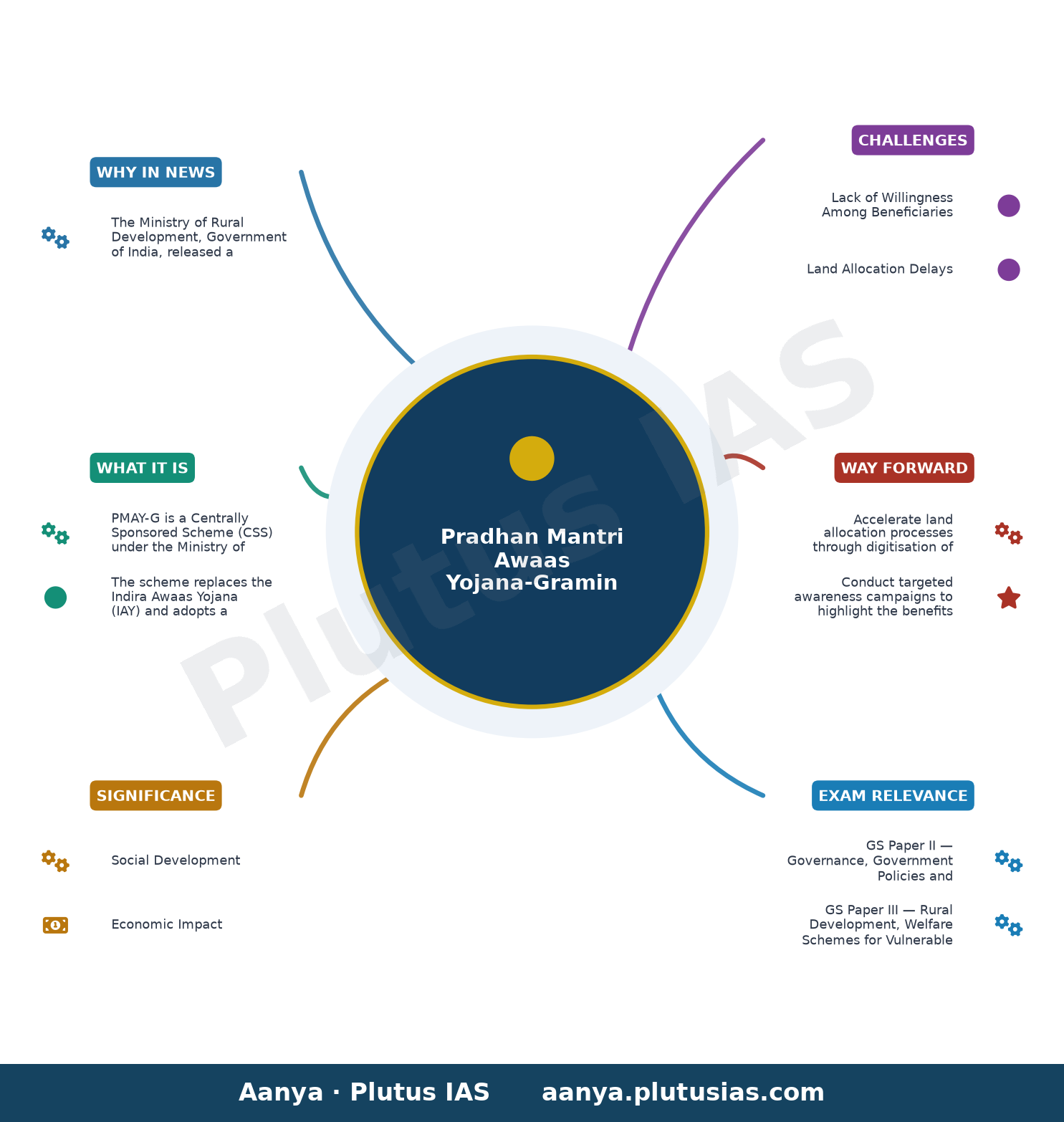
The Ministry of Rural Development, Government of India, released a press note on 31 July 2026 highlighting the progress of the Pradhan Mantri Awaas Yojana-Gramin (PMAY-G) as of June 2026. The report underscores the approval of 33.54 lakh new houses and the completion of 35.54 lakh houses (including previous years’ approvals) during 2025-26. Cumulatively, 4.18 crore houses have been allocated as targets, of which 3.92 crore have been approved, 3.11 crore completed, and 1.06 crore remain pending. The progress report also elucidates implementation bottlenecks and the scheme’s convergence with other flagship programs, reflecting its multidimensional impact on rural welfare.
Background
- Launched on 20 November 2016, replacing the erstwhile Indira Awaas Yojana (IAY), PMAY-G is a flagship Centrally Sponsored Scheme under the Ministry of Rural Development aimed at providing ‘Housing for All’ in rural India by 2022, later extended to 2029.
- The scheme targets the socio-economically disadvantaged groups (SEDGs) identified through the Socio-Economic Caste Census (SECC) 2011, with priority given to households with no adult member aged 16-59, SC/ST, landless laborers, and those living in kutcha houses.
- PMAY-G is implemented through a demand-driven approach, where eligible households apply for assistance, and the Gram Panchayats play a pivotal role in identifying beneficiaries and ensuring transparency through the Awaas+ mobile application and geo-tagging of assets.
- Convergence with other schemes such as Swachh Bharat Mission-Gramin (SBM-G), Jal Jeevan Mission (JJM), PM Ujjwala Yojana (PMUY), and MGNREGA is a cornerstone of PMAY-G, ensuring holistic rural development by addressing sanitation, water supply, energy access, and livelihoods.
- As of 31 July 2026, the scheme has achieved significant milestones, including the completion of 3.10 crore toilets, 2.45 crore water connections, 3.08 crore electricity connections, 2.91 crore LPG connections, and the integration of 1.35 crore beneficiary families into Self-Help Groups (SHGs).
What is Pradhan Mantri Awaas Yojana-Gramin (PMAY-G)?
- PMAY-G is a Centrally Sponsored Scheme (CSS) under the Ministry of Rural Development, Government of India, aimed at providing pucca houses with basic amenities to all eligible rural households by 2029.
- The scheme replaces the Indira Awaas Yojana (IAY) and adopts a demand-driven, beneficiary-centric approach, ensuring transparency and accountability through the Awaas+ mobile application and geo-tagging of houses.
- Eligibility is determined using the Socio-Economic Caste Census (SECC) 2011 data, with priority given to households belonging to Scheduled Castes (SCs), Scheduled Tribes (STs), landless laborers, and those living in kutcha houses.
- Financial assistance is provided in three instalments directly to the beneficiary’s bank account via Direct Benefit Transfer (DBT), with the unit cost ranging from ₹1.20 lakh to ₹1.30 lakh depending on the region (plain, hilly, northeastern, or Union Territories).
- The scheme mandates convergence with other flagship programs such as Swachh Bharat Mission-Gramin (SBM-G) for toilet construction (₹12,000 per household), Jal Jeevan Mission (JJM) for piped water supply, PM Ujjwala Yojana (PMUY) for LPG connections, and MGNREGA for unskilled wage employment during house construction.
- PMAY-G also promotes social and economic empowerment by integrating beneficiary families, particularly women, into Self-Help Groups (SHGs), thereby enhancing their decision-making capacity and financial independence.
- Monitoring and evaluation are conducted through a robust digital platform, including the Awaas+ app, geo-tagging, and real-time dashboards, ensuring transparency and timely redressal of grievances.
- The scheme has two phases: Phase-I (2016-2022) aimed at achieving ‘Housing for All’ in rural India, and Phase-II (2020-2029) focusing on the completion of pending houses and convergence with other welfare programs.
Key Features
| Feature | Significance |
|---|---|
| Unit Assistance under PMAY-G | Provides ₹1.20 lakh in plain areas and ₹1.30 lakh in NE, hill states, and UTs like J&K and Ladakh to construct pucca houses, ensuring housing security for rural BPL families. |
| Convergence with SBM-G | Offers ₹12,000 additional support for toilet construction under Swachh Bharat Mission-Gramin, promoting sanitation and reducing open defecation. |
| Convergence with MGNREGA/VBG-RAMJI | Ensures unskilled wage employment for labour days at prevailing rates for housing construction, enhancing livelihood support. |
| Convergence with Jal Jeevan Mission (JJM) | Provides piped water supply to PMAY-G houses through schemes like Har Ghar Nal Se Jal, improving health and hygiene. |
| Convergence with Electrification and PMUY | Facilitates electricity connections and LPG connections via relevant ministries, ensuring energy security and reducing indoor air pollution. |
| Women Empowerment via SHGs | Incorporates women members of beneficiary families into Self-Help Groups (SHGs), fostering social and economic empowerment at the grassroots level. |
Why it Matters
Social Development
- Addresses the critical housing shortage in rural India, particularly for Below Poverty Line (BPL) families, by providing durable pucca houses.
- Enhances sanitation through convergence with SBM-G, reducing disease burden and improving public health outcomes.
- Promotes gender equality by integrating women into SHGs, thereby enhancing their decision-making power and economic independence.
- Ensures access to essential services like piped water, electricity, and LPG, elevating quality of life in rural areas.
Economic Impact
- Stimulates rural employment through MGNREGA convergence, providing wage labour opportunities in housing construction and allied sectors.
- Boosts local economies via increased demand for construction materials, labour, and allied services, fostering backward and forward linkages.
- Reduces expenditure on healthcare due to improved sanitation and reduced indoor air pollution from LPG usage, indirectly benefiting household budgets.
Governance and Implementation
- Demonstrates the Centre-State coordination model, where states act as primary implementing agencies, ensuring decentralised and context-specific execution.
- Showcases the efficacy of convergence-based approaches in rural welfare, integrating multiple schemes to deliver holistic benefits.
- Highlights the role of digital monitoring tools like dashboards in tracking progress, ensuring transparency and accountability in fund utilisation.
Challenges
1. Lack of Willingness Among Beneficiaries
- Some beneficiaries exhibit reluctance to accept housing due to perceived inadequacy of unit assistance or preference for alternative housing arrangements.
- This delays project completion and necessitates targeted awareness campaigns to highlight the benefits of PMAY-G houses.
UPSC Link: GS-II: Welfare Schemes
2. Land Allocation Delays
- States face challenges in timely land allocation to landless beneficiaries, particularly in densely populated or disputed areas.
- This bottleneck requires expedited land records digitisation and streamlined land acquisition processes.
UPSC Link: GS-II: Land Reforms
3. Disputed Succession and Legal Issues
- In cases of deceased beneficiaries, disputes over inheritance delay the transfer of ownership and completion of houses.
- Strengthening legal frameworks for succession and expediting dispute resolution mechanisms are critical for resolving such cases.
UPSC Link: GS-II: Legal Framework
4. Supply Chain Bottlenecks
- Shortages in construction materials, particularly in remote areas, impede timely completion of houses.
- This necessitates robust supply chain management and local procurement strategies to ensure material availability.
UPSC Link: GS-III: Infrastructure
5. Election Cycles and Administrative Delays
- Frequent elections and administrative changes disrupt project continuity, leading to delays in approvals and fund disbursements.
- Implementing time-bound project timelines and insulating implementation from electoral cycles are essential for efficiency.
UPSC Link: GS-II: Governance
6. Credit Verification Delays
- Delays in updating credit confirmations in state IFMIS systems hinder timely fund disbursements to beneficiaries.
- Digitising and streamlining financial verification processes can mitigate this challenge.
UPSC Link: GS-III: Financial Inclusion
Challenges — UPSC Perspective
| Issue | Concern |
|---|---|
| Lack of Willingness Among Beneficiaries | Delays in acceptance and completion of houses due to perceived inadequacy or alternative preferences. |
| Land Allocation Delays | Hinders timely construction, particularly for landless beneficiaries in densely populated areas. |
| Disputed Succession and Legal Issues | Causes delays in ownership transfer and project completion due to inheritance disputes. |
| Supply Chain Bottlenecks | Leads to material shortages, impeding timely construction in remote areas. |
| Election Cycles and Administrative Delays | Disrupts project continuity and fund disbursements due to administrative changes. |
| Credit Verification Delays | Slows down financial disbursements due to outdated verification systems in state IFMIS. |
Government Initiatives — Must-Memorise for Prelims
- Pradhan Mantri Awas Yojana-Gramin (PMAY-G)
- Swachh Bharat Mission-Gramin (SBM-G)
- Mahatma Gandhi National Rural Employment Guarantee Scheme (MGNREGA)
- Village and Basic Grant-Rural Area Mission for Job Inclusion (VBG-RAMJI)
- Jal Jeevan Mission (JJM)
- Har Ghar Nal Se Jal (HGNSJ)
- Pradhan Mantri Ujjwala Yojana (PMUY)
Way Forward
- Accelerate land allocation processes through digitisation of land records and streamlined acquisition mechanisms to address delays.
- Conduct targeted awareness campaigns to highlight the benefits of PMAY-G houses and address beneficiary reluctance.
- Strengthen legal frameworks for succession and expedite dispute resolution to resolve inheritance-related bottlenecks.
- Enhance supply chain resilience by establishing local procurement hubs and ensuring timely availability of construction materials.
- Implement time-bound project timelines and insulate implementation from electoral cycles to maintain continuity.
- Digitise and streamline credit verification processes in state IFMIS systems to expedite fund disbursements.
- Expand training programs for rural masons and artisans to improve construction quality and reduce delays.
- Enhance convergence between PMAY-G and other schemes (JJM, PMUY, etc.) to deliver holistic benefits to beneficiaries.
UPSC Value Addition
Keywords for Mains Answer-Writing
Pradhan Mantri Awas Yojana-Gramin (PMAY-G) · Rural housing deficit · Convergence with other schemes · Self-Help Groups (SHGs) · Jal Jeevan Mission · PM Ujjwala Yojana · Mahatma Gandhi National Rural Employment Guarantee Scheme (MGNREGS) · Financial convergence · Implementation challenges · Rural infrastructure development · Women empowerment through SHGs · Scheduled Castes and Scheduled Tribes housing · Unit Assistance under PMAY-G · State-level implementation bottlenecks · Monitoring and review mechanisms
Constitutional & Policy Linkages
- [‘Article 21’, ‘Right to Life and Dignity’]
- [‘Directive Principles of State Policy (DPSP)’, ‘Article 41: Right to Work and Public Assistance’]
Concept Flow
Identification of housing shortage in rural India under PMAY-G → Allocation of cumulative target of 4.18 crore houses to states/UTs → Convergence with SBM-G, MGNREGA, JJM, PMUY, and SHGs for holistic benefits → Implementation challenges: land allocation, legal disputes, supply chain, beneficiary reluctance → Monitoring via dashboards and regular reviews by the Ministry → Progress: 3.92 crore houses sanctioned, 3.11 crore completed, 1.06 crore pending → Way forward: expedite pending houses, address bottlenecks, enhance convergence
Prelims Practice Questions
Q1. Consider the following statements regarding Pradhan Mantri Awas Yojana-Gramin (PMAY-G):
1. Under PMAY-G, financial assistance of ₹1.20 lakh is provided to beneficiaries in plain areas.
2. The scheme includes a provision for convergence with the Swachh Bharat Mission-Gramin (SBM-G) for toilet construction.
3. PMAY-G mandates that 50% of the beneficiaries must belong to Scheduled Castes and Scheduled Tribes.
4. The scheme provides for the construction of pucca houses with a minimum plinth area of 25 square meters.
How many of the above statements are correct?
- Only one
- Only two
- Only three
- All four
Answer: Only three — Statements 1 and 2 are correct as per the PMAY-G guidelines. Statement 3 is incorrect as there is no mandatory 50% reservation for SCs and STs under PMAY-G. Statement 4 is incorrect as the minimum plinth area is 25 square meters, not the house size.
Q2. Assertion (A): The Pradhan Mantri Awas Yojana-Gramin (PMAY-G) provides financial assistance for the construction of toilets under convergence with the Swachh Bharat Mission-Gramin (SBM-G).
Reason (R): The Swachh Bharat Mission-Gramin (SBM-G) aims to improve sanitation and hygiene in rural areas, and its convergence with PMAY-G ensures holistic rural development.
- Both A and R are true, and R is the correct explanation of A
- Both A and R are true, but R is not the correct explanation of A
- A is true, but R is false
- A is false, but R is true
Answer: Both A and R are true, and R is the correct explanation of A — Both A and R are true, and R correctly explains A. The convergence between PMAY-G and SBM-G ensures that beneficiaries receive financial assistance for both housing and toilet construction, aligning with the objectives of both schemes.
Q3. Match the following schemes with their corresponding objectives:
Column I (Scheme) | Column II (Objective)
— | —
A. Pradhan Mantri Awas Yojana-Gramin (PMAY-G) | 1. Provision of LPG connections to Below Poverty Line (BPL) households
B. Swachh Bharat Mission-Gramin (SBM-G) | 2. Construction of pucca houses for rural poor
C. Jal Jeevan Mission (JJM) | 3. Ensuring 100% safe and adequate drinking water supply in rural areas
D. Pradhan Mantri Ujjwala Yojana (PMUY) | 4. Elimination of open defecation and improvement of sanitation
Choose the correct match:
- A-2, B-4, C-3, D-1
- A-1, B-2, C-3, D-4
- A-3, B-1, C-2, D-4
- A-4, B-3, C-1, D-2
Answer: A-2, B-4, C-3, D-1 — The correct match is A-2 (PMAY-G for rural housing), B-4 (SBM-G for sanitation), C-3 (JJM for safe drinking water), and D-1 (PMUY for LPG connections).
Mains Practice Question
✍ The Pradhan Mantri Awas Yojana-Gramin (PMAY-G) represents a transformative intervention in addressing rural housing deficits and allied infrastructure in India. Critically examine the progress of PMAY-G, highlighting its convergence with other flagship schemes and the implementation challenges faced. Also, assess the role of PMAY-G in promoting gender equity and social inclusion. (15 Marks)
Approach: MODEL-ANSWER SKELETON:
1. **Introduction (2 Marks)**
– Briefly define PMAY-G: A centrally sponsored scheme launched in 2016 to provide pucca houses to rural poor, with a target of 4.18 crore houses.
– Mention the financial assistance: ₹1.20 lakh (plain areas) and ₹1.30 lakh (special category states).
2. **Progress and Convergence (4 Marks)**
– **Progress**: Cite data (35.54 lakh houses completed as of June 2026, 1.06 crore pending).
– **Convergence**: Explain linkages with:
– Swachh Bharat Mission-Gramin (SBM-G): ₹12,000 for toilet construction.
– MGNREGS: Unskilled wage employment for housing construction.
– Jal Jeevan Mission (JJM): Nal se Jal connections.
– PM Ujjwala Yojana (PMUY): LPG connections.
– SHGs: Empowerment of women beneficiaries.
– **Data**: 3.10 crore toilets, 2.45 crore water connections, 3.08 crore electricity connections, 2.91 crore LPG connections, and 1.35 crore SHG linkages.
3. **Implementation Challenges (5 Marks)**
– **Lack of land titles**: Delay in land allocation to landless beneficiaries.
– **Disputes**: Succession disputes among deceased beneficiaries.
– **Reluctance**: Beneficiary reluctance due to migration or financial constraints.
– **Administrative bottlenecks**: Delays in credit confirmation, IFMS updates, and elections affecting implementation.
– **Material shortages**: Unavailability of construction materials in remote areas.
– **Monitoring gaps**: Need for robust real-time monitoring systems.
4. **Gender Equity and Social Inclusion (3 Marks)**
– **Women empowerment**: 1.35 crore women linked to SHGs, promoting financial independence.
– **SC/ST focus**: Provisions for marginalized communities (e.g., priority in allocation).
– **Inclusivity**: Addressing regional disparities (e.g., higher unit assistance in hilly states).
5. **Conclusion (1 Mark)**
– PMAY-G’s success lies in its convergence approach and focus on inclusivity, but implementation bottlenecks must be addressed through better monitoring, faster dispute resolution, and enhanced beneficiary participation.
Source: PIB (Press Information Bureau)
Generated by AanyaAi for educational purpose.


No Comments