


31 Jul PM Awas Yojana-Gramin 2026: 35.54 Lakh Houses Completed, Key Challenges & Progress
✎ PMAY-G provides ₹1.20–1.30 lakh per house, converges with SBM-G (₹12,000 for toilets), MGNREGS (labour), JJM (water), and PMUY (LPG), and targets 4.18 crore houses by 2029 with 1.06 crore pending as of July 2026.
Subject Relevance — Where This Topic Fits
- GS Paper II — Governance, Welfare Schemes and their Performance | GS Paper III — Rural Development and Employment Generation
- Prelims: PMAY-G, convergence under SBM-G, MGNREGA, JJM, PMUY, SHGs, convergence dashboard, rural housing targets, financial assistance norms
- Essay: Rural housing as a catalyst for inclusive growth and social justice, Convergence of welfare schemes: A model for holistic rural development
Quick Revision: PMAY-G provides ₹1.20–1.30 lakh per house, converges with SBM-G (₹12,000 for toilets), MGNREGS (labour), JJM (water), and PMUY (LPG), and targets 4.18 crore houses by 2029 with 1.06 crore pending as of July 2026.
Why is this in the news?
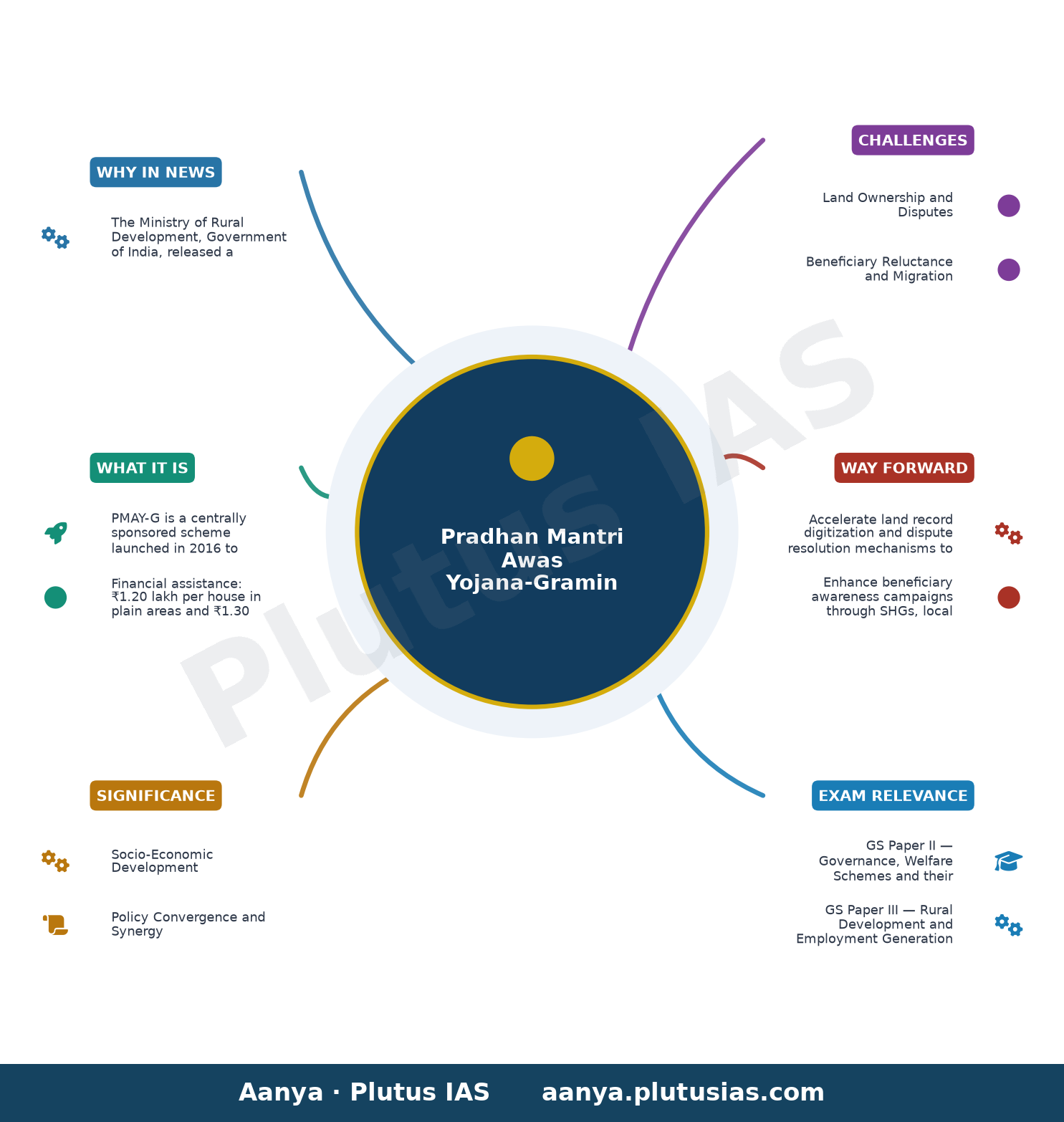
The Ministry of Rural Development, Government of India, released a progress report on Pradhan Mantri Awas Yojana-Gramin (PMAY-G) as of 31 July 2026, highlighting cumulative achievements, state-wise targets, and implementation challenges. The report underscores the need for accelerated construction to meet the remaining 1.06 crore housing units by March 2029, while also detailing convergence with other welfare schemes to enhance the socio-economic outcomes of beneficiary households.
Background
- PMAY-G was launched in November 2016 as a flagship scheme under the Ministry of Rural Development to provide ‘Housing for All’ in rural India by 2022, later extended to 2029.
- The scheme aims to address the housing shortage in rural areas by providing financial assistance for the construction of pucca houses with basic amenities.
- PMAY-G is a centrally sponsored scheme with a cost-sharing ratio of 60:40 between the Centre and states, except for North-Eastern and Himalayan states where it is 90:10.
- The scheme targets to cover 4.18 crore rural households, of which 3.92 crore have been sanctioned and 3.11 crore have been completed as of July 2026.
- The scheme operates in convergence with other welfare programs such as Swachh Bharat Mission-Gramin (SBM-G), Mahatma Gandhi National Rural Employment Guarantee Scheme (MGNREGS), Jal Jeevan Mission (JJM), and Pradhan Mantri Ujjwala Yojana (PMUY) to ensure holistic rural development.
What is Pradhan Mantri Awas Yojana-Gramin (PMAY-G)?
- PMAY-G is a centrally sponsored scheme launched in 2016 to provide pucca houses with basic amenities to all eligible rural households by 2029.
- Financial assistance: ₹1.20 lakh per house in plain areas and ₹1.30 lakh in North-Eastern states, Himalayan states (Himachal Pradesh, Uttarakhand), and Union Territories of Jammu & Kashmir and Ladakh.
- Eligibility: Beneficiaries are identified based on the Socio-Economic Caste Census (SECC) 2011 data and must be landless or living in dilapidated houses.
- Convergence with other schemes: PMAY-G integrates with SBM-G for toilet construction (₹12,000 per household), MGNREGS for unskilled labour (up to 90-95 person-days per house), JJM for piped water supply, and PMUY for LPG connections.
- Implementation: State governments and Union Territory administrations act as primary implementing agencies, with monitoring at the central level through the PMAY-G dashboard.
- Progress as of July 2026: 3.92 crore houses sanctioned, 3.11 crore completed, and 1.06 crore pending against a cumulative target of 4.18 crore houses.
- Key challenges: Delays due to beneficiary reluctance, disputed land inheritance, delays in land allocation, credit confirmation delays in state IFMIS, elections, and material shortages.
Key Features
| Feature | Significance |
|---|---|
| Financial Assistance | Provides ₹1.20 lakh in plain areas and ₹1.30 lakh in special category states/UTs to eligible rural households for house construction under PMAY-G. |
| Convergence with SBM-G | Additional ₹12,000 per household for toilet construction under Swachh Bharat Mission-Gramin (SBM-G) to ensure sanitation facilities. |
| MGNREGA Convergence | Provides unskilled wage employment for up to 90-95 days per household under MGNREGA to support housing construction. |
| Water Supply Integration | Convergence with Jal Jeevan Mission (JJM) ensures piped water supply to all PMAY-G houses, enhancing living standards. |
| Energy and Fuel Access | Ensures electricity connections and LPG supply under PMUY for beneficiary households, promoting energy security. |
| Women Empowerment | Mandates inclusion of women members in Self-Help Groups (SHGs) to foster social and economic empowerment of rural women. |
Why it Matters
Socio-Economic Development
- Addresses the critical housing shortage in rural India, directly contributing to the goal of ‘Housing for All’ by 2029.
- Enhances living conditions by integrating sanitation, water supply, energy, and fuel access, thereby reducing rural-urban migration pressures.
- Stimulates local economies through employment generation under MGNREGA and demand for construction materials, fostering rural industrialization.
- Promotes gender equality by prioritizing women’s participation in SHGs and ensuring their names are included in land titles where applicable.
Policy Convergence and Synergy
- Demonstrates the effectiveness of inter-ministerial convergence in achieving holistic rural development, exemplified by linkages with JJM, SBM-G, and MGNREGA.
- Serves as a model for integrating multiple welfare schemes to maximize impact and ensure no beneficiary is left behind.
- Highlights the role of decentralized governance, as states and UTs are primary implementing agencies, ensuring localized solutions and accountability.
Strategic and Governance Implications
- Strengthens rural infrastructure, which is a prerequisite for agricultural productivity, rural entrepreneurship, and overall economic resilience.
- Facilitates better monitoring and evaluation through digital dashboards, enabling real-time tracking of progress and addressing bottlenecks promptly.
- Ensures transparency and efficiency in fund disbursement and utilization, reducing leakages and corruption through direct benefit transfers (DBT) and Aadhaar seeding.
Challenges
1. Land Ownership and Disputes
- Delays in land allocation to landless beneficiaries due to unclear land records, inheritance disputes, or lack of legal clarity on ownership.
- Disputes over succession among deceased beneficiaries hinder timely completion of houses, particularly in states with complex inheritance laws.
UPSC Link: GS-II: Rural Development Policies
2. Beneficiary Reluctance and Migration
- Reluctance of beneficiaries to participate due to lack of awareness, financial constraints, or preference for alternative housing options.
- Permanent migration of beneficiaries to urban areas for employment reduces the utility of rural housing schemes, leading to underutilization of allocated funds.
UPSC Link: GS-II: Welfare Schemes Implementation
3. Bureaucratic and Administrative Delays
- Delays in updating credit confirmations in state IFMIS systems, leading to stalled fund disbursements and construction activities.
- Frequent elections at local, state, or national levels disrupt administrative processes and divert resources away from implementation.
UPSC Link: GS-II: Governance and Public Administration
4. Resource Constraints
- Shortage of construction materials, particularly in remote or hilly regions, increases costs and delays project timelines.
- Inadequate availability of skilled and semi-skilled labor (e.g., rural masons) in certain regions hampers the pace of house construction.
UPSC Link: GS-III: Infrastructure and Resource Management
5. Monitoring and Accountability Gaps
- Inconsistent reporting mechanisms across states/UTs lead to discrepancies in progress data and hinder accurate assessment.
- Weak grievance redressal mechanisms and lack of community participation in monitoring reduce accountability and transparency.
UPSC Link: GS-II: E-Governance and Transparency
Challenges — UPSC Perspective
| Issue | Concern |
|---|---|
| Land Ownership Disputes | Delays in land allocation and inheritance conflicts stall construction. |
| Beneficiary Reluctance | Lack of awareness or preference for urban migration reduces scheme uptake. |
| Administrative Delays | IFMIS updates, election cycles, and fund disbursement bottlenecks slow progress. |
| Resource Shortages | Scarcity of construction materials and skilled labor increases costs and timelines. |
| Monitoring Gaps | Inconsistent reporting and weak grievance mechanisms hinder accurate tracking. |
| Convergence Challenges | Poor coordination between PMAY-G and allied schemes (e.g., JJM, SBM-G) reduces synergy. |
Government Initiatives — Must-Memorise for Prelims
- Pradhan Mantri Awaas Yojana-Gramin (PMAY-G)
- Swachh Bharat Mission-Gramin (SBM-G)
- Mahatma Gandhi National Rural Employment Guarantee Scheme (MGNREGS)
- Jal Jeevan Mission (JJM)
- Pradhan Mantri Ujjwala Yojana (PMUY)
Way Forward
- Accelerate land record digitization and dispute resolution mechanisms to expedite land allocation for landless beneficiaries.
- Enhance beneficiary awareness campaigns through SHGs, local leaders, and digital platforms to improve participation and reduce reluctance.
- Strengthen inter-ministerial convergence by establishing dedicated coordination cells at state/UT levels to streamline fund flow and implementation.
- Invest in skill development programs for rural masons and construction workers to address labor shortages and improve construction quality.
- Leverage technology for real-time monitoring via GIS-based dashboards and mobile applications to track progress and address bottlenecks proactively.
- Ensure timely disbursement of funds by streamlining IFMIS updates and reducing bureaucratic red tape through automated approvals.
- Promote community-led monitoring by involving Gram Sabhas and SHGs in the planning, implementation, and evaluation phases of the scheme.
- Address resource constraints by establishing regional supply chains for construction materials and incentivizing local production.
UPSC Value Addition
Keywords for Mains Answer-Writing
Pradhan Mantri Awas Yojana-Gramin (PMAY-G) · Housing for All Mission · Rural Housing Scheme · Convergence with other schemes · Self-Help Groups (SHGs) · Jal Jeevan Mission (JJM) · Pradhan Mantri Ujjwala Yojana (PMUY) · Rural Infrastructure Development · Financial Assistance for Housing · Implementation Challenges in Rural Schemes
Concept Flow
Rural Housing Shortage → Policy Response (PMAY-G) → Financial Assistance & Convergence (SBM-G, MGNREGA, JJM) → Implementation by States/UTs → Monitoring & Grievance Redressal → Outcome: Improved Rural Living Standards → Land Ownership Disputes → Delay in Land Allocation → Stalled Construction → Underutilization of Funds → Target Misses → Need for Legal Reforms & Dispute Resolution → Beneficiary Reluctance → Low Participation → Reduced Scheme Impact → Migration to Urban Areas → Need for Awareness & Incentives → Administrative Delays → IFMIS Updates & Election Cycles → Fund Disbursement Bottlenecks → Construction Delays → Need for Streamlined Processes → Resource Shortages → High Construction Costs → Extended Timelines → Need for Local Supply Chains & Skill Development → Monitoring Gaps → Inaccurate Progress Data → Poor Accountability → Need for Digital Tools & Community Participation
Prelims Practice Questions
Q1. Consider the following statements regarding the Pradhan Mantri Awas Yojana-Gramin (PMAY-G):
1. Under PMAY-G, financial assistance of ₹1.30 lakh is provided in hilly states like Himachal Pradesh and Uttarakhand.
2. The scheme includes convergence with the Swachh Bharat Mission-Gramin (SBM-G) for toilet construction.
3. PMAY-G provides LPG connections under the Pradhan Mantri Ujjwala Yojana (PMUY) to all beneficiaries.
4. The scheme mandates the inclusion of beneficiary families in Self-Help Groups (SHGs) for social empowerment.
How many of the above statements are correct?
- Only one
- Only two
- Only three
- All four
Answer: All four — Statements 1, 2, and 4 are correct. Statement 3 is incorrect as PMUY provides LPG connections, but it is not mandatory for all PMAY-G beneficiaries under the scheme.
Q2. Assertion (A): The Pradhan Mantri Awas Yojana-Gramin (PMAY-G) aims to provide ‘Housing for All’ by 2029.
Reason (R): The scheme includes a cumulative target of 4.18 crore houses, of which 3.11 crore have been completed as of July 2026.
Options:
A. Both A and R are true, and R is the correct explanation of A.
B. Both A and R are true, but R is not the correct explanation of A.
C. A is true, but R is false.
D. A is false, but R is true.
Answer: ? — Both the assertion and reason are true. The scheme’s objective is to provide housing for all by 2029, and the cumulative target of 4.18 crore houses aligns with this goal. The reason correctly explains the assertion.
Q3. Match the following schemes with their respective objectives:
Column I
1. Pradhan Mantri Awas Yojana-Gramin (PMAY-G)
2. Swachh Bharat Mission-Gramin (SBM-G)
3. Jal Jeevan Mission (JJM)
4. Pradhan Mantri Ujjwala Yojana (PMUY)
Column II
A. Provision of piped drinking water to rural households
B. Financial assistance for rural housing
C. Provision of LPG connections to Below Poverty Line families
D. Construction of individual household latrines
Options:
A. 1-B, 2-D, 3-A, 4-C
B. 1-A, 2-B, 3-C, 4-D
C. 1-C, 2-A, 3-D, 4-B
D. 1-D, 2-C, 3-B, 4-A
- A
- B
- C
- D
Answer: A — The correct match is: 1-B (PMAY-G provides financial assistance for rural housing), 2-D (SBM-G focuses on constructing individual household latrines), 3-A (JJM aims to provide piped drinking water), and 4-C (PMUY provides LPG connections).
Mains Practice Question
✍ The Pradhan Mantri Awas Yojana-Gramin (PMAY-G) represents a paradigm shift in India’s rural housing policy by integrating multiple welfare schemes. Critically examine the design and implementation of PMAY-G, highlighting its convergence with other flagship programmes such as the Jal Jeevan Mission, Swachh Bharat Mission-Gramin, and Pradhan Mantri Ujjwala Yojana. Also, analyse the key challenges in achieving the remaining targets of 1.06 crore houses by 2029. (15 Marks)
Approach: MODEL-ANSWER SKELETON:
1. **Introduction (2 marks)**:
– Briefly outline PMAY-G as a component of the ‘Housing for All’ mission, launched in 2016.
– State its objective: to provide pucca houses with basic amenities to all rural households by 2029.
– Mention the financial assistance: ₹1.20 lakh (plains) and ₹1.30 lakh (hilly states, NE, J&K, Ladakh).
2. **Design and Convergence (5 marks)**:
– **Financial Assistance**: Unit support under PMAY-G.
– **Convergence with SBM-G**: Additional ₹12,000 for toilet construction.
– **Convergence with MGNREGA/VB-GRAM**: Provision of 90-95 days of unskilled wage employment for house construction.
– **Convergence with JJM**: Provision of piped drinking water under ‘Har Ghar Nal Se Jal’.
– **Convergence with PMUY**: LPG connections for beneficiaries.
– **SHG Integration**: Inclusion of women in SHGs for social empowerment.
– Cite data: As of July 2026, 3.10 crore houses have toilets, 2.45 crore have water connections, 3.08 crore have electricity, and 2.91 crore have LPG connections.
3. **Implementation Challenges (5 marks)**:
– **Lack of Willingness**: Beneficiaries’ reluctance to construct houses.
– **Land Allocation Delays**: Issues in land allocation to landless beneficiaries.
– **Disputed Succession**: Legal disputes over inheritance of deceased beneficiaries.
– **Fund Flow Delays**: Delays in credit confirmation from state IFMIS.
– **Logistical Issues**: Unavailability of construction materials.
– **Political Interference**: Impact of elections on implementation.
– **Geographical Barriers**: Hilly and remote areas face additional challenges.
4. **Way Forward (3 marks)**:
– Strengthen monitoring through dashboards and regular reviews.
– Accelerate land allocation and fund disbursement.
– Enhance beneficiary awareness and training for rural masons.
– Address legal disputes through fast-track courts or alternative dispute resolution mechanisms.
– Promote convergence with other schemes more effectively at the grassroots level.
Source: PIB (Press Information Bureau)
Generated by AanyaAi for educational purpose.

- PM Vishwakarma Yojana Completes 3 Years: 30 Lakh Artisans Registered - September 16, 2026
- डीएफपीडी विशेष अभियान 6: 2 से 31 अक्टूबर 2026 तक स्वच्छता एवं दक्षता अभियान - September 16, 2026
- DFPD’s Special Campaign 6: Key Focus Areas for UPSC & State PCS - September 16, 2026

No Comments