


31 Jul LJP’s Bill for Constitutional Status to National Youth Commission Explained for UPSC
✎ The National Commission for Youth Bill, 2026, seeks to institutionalise a permanent, Constitutionally empowered body to address youth unemployment and skill gaps, filling a critical governance void left by the disbanded 2002–2004…
Subject Relevance — Where This Topic Fits
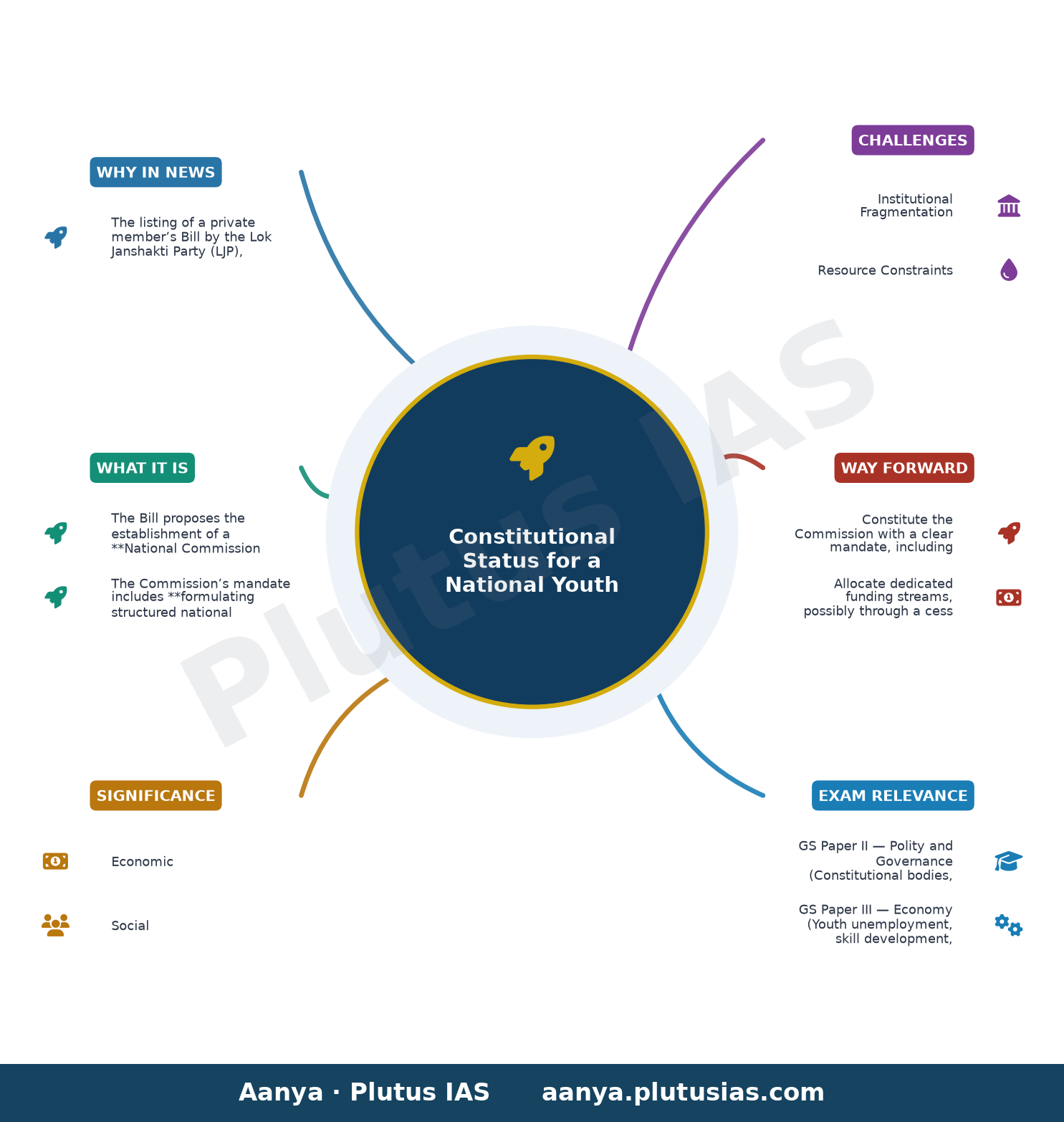
- GS Paper II — Polity and Governance (Constitutional bodies, Parliamentary procedures) | GS Paper III — Economy (Youth unemployment, skill development, entrepreneurship)
- Prelims: National Commission for Youth, Private Member’s Bill, Parliamentary procedures, Youth unemployment, Skill India Mission, Gen Z protests
- Essay: The role of constitutional bodies in addressing socio-economic challenges: A case for institutionalising youth policy, Parliamentary democracy in India: The efficacy of private member’s initiatives in addressing systemic gaps
Quick Revision: The National Commission for Youth Bill, 2026, seeks to institutionalise a permanent, Constitutionally empowered body to address youth unemployment and skill gaps, filling a critical governance void left by the disbanded 2002–2004 National Youth Commission.
Why is this in the news?
The listing of a private member’s Bill by the Lok Janshakti Party (LJP), an NDA ally, seeking Constitutional status for a National Commission for Youth assumes significance against the backdrop of escalating Gen Z protests, legislative gridlock over the Public Examination (Amendment) Bill, and the persistent challenge of youth unemployment in India. The Bill, inspired by Union Minister Chirag Paswan’s long-standing advocacy for youth-centric policies, proposes a permanent statutory body to address multidimensional youth issues, including unemployment, skill development, and entrepreneurship. Its introduction reflects both the growing political salience of youth concerns and the limitations of existing institutional mechanisms in addressing systemic gaps.
Background
- The last institutional mechanism for youth affairs, the National Youth Commission (2002–2004), was a non-statutory body that was disbanded in 2004, leaving youth policy coordination to the Ministry of Youth Affairs and Sports under the aegis of programmes like the Nehru Yuva Kendra Sangathan and the National Youth Policy.
- India’s demographic dividend, with over 68% of the population below 35 years, amplifies the urgency of addressing youth unemployment, which stood at 17.5% in 2023 (PLFS data), with underemployment and skill mismatches persisting despite initiatives like Skill India and Startup India.
- The Gen Z protests in July 2026, centred on issues like examination paper leaks, retest timelines, and academic year disruptions, underscore the socio-economic pressures faced by India’s youth and the perceived inadequacies of existing governance structures.
- Private member’s Bills, while rarely enacted, serve as a barometer of parliamentary discourse and can influence government policy by highlighting gaps in statutory frameworks, as seen in past instances like the Right to Information Act (2005), which originated as a private member’s initiative.
- The Public Examination (Amendment) Bill, 2026, debated concurrently in the Lok Sabha, reflects the intersection of youth concerns with legislative priorities, particularly in the context of competitive examinations and employment opportunities.
- The LJP’s initiative aligns with broader political narratives on youth empowerment, including the BJP’s ‘Yuva Shakti’ programmes and the Congress’s ‘Nyay’ framework, which have sought to position youth issues as central to electoral and governance agendas.
What is the National Commission for Youth Bill, 2026?
- The Bill proposes the establishment of a **National Commission for Youth** with **Constitutional status**, elevating it from a non-statutory advisory body to a permanent, statutory institution with enhanced authority and accountability.
- The Commission’s mandate includes **formulating structured national policies** to address youth unemployment, skill development, entrepreneurship, and idea incubation, with a focus on **specialised financing mechanisms** for young innovators.
- It seeks to serve as the **nodal agency** for coordinating youth-centric programmes across ministries, including the Ministries of Education, Skill Development, Labour, and MSME, to ensure coherence and avoid duplication of efforts.
- The Bill envisages the Commission as a **multi-stakeholder platform**, involving youth representatives, industry leaders, academicians, and civil society organisations in policy formulation and implementation.
- Critically, the Bill addresses the **institutional vacuum** left by the dissolution of the 2002–2004 Commission, which was criticised for its lack of statutory powers and limited impact on policy outcomes.
Key Features
| Feature | Significance |
|---|---|
| Constitutional status for National Commission for Youth | Elevates the Commission to a permanent, legally empowered body, ensuring continuity and authority in policy formulation beyond executive orders. |
| Permanent establishment of the Commission | Prevents ad-hoc dissolution, unlike the 2002-2004 non-statutory body, which was wound up due to lack of legal permanence. |
| Focus on youth unemployment mitigation | Directs policy towards structural solutions, including skill development, entrepreneurship, and financing for young innovators. |
| Inspiration from Union Minister Chirag Paswan | Demonstrates political commitment to youth issues, linking legislative action to sustained advocacy since 2014. |
| Alignment with Gen Z protests and student concerns | Responds to contemporary socio-economic pressures, including examination reforms and unemployment anxieties among young Indians. |
Why it Matters
Economic
- Addresses structural unemployment by proposing a dedicated institutional mechanism for skill development and entrepreneurship, critical for India’s demographic dividend.
- Potential to reduce brain drain and underemployment by creating structured pathways for youth participation in the formal economy.
- Enhances labour market efficiency by aligning education and skill training with industry demands through a permanent commission.
Social
- Provides a formalised platform for youth representation in policy-making, addressing grievances and aspirations of a large demographic segment.
- Mitigates socio-economic discontent by institutionalising mechanisms to address unemployment, a key driver of youth unrest.
- Promotes intergenerational equity by ensuring policies are responsive to the needs of young citizens.
Political
- Demonstrates NDA allies’ responsiveness to youth-centric issues, potentially strengthening electoral appeal among Gen Z voters.
- Highlights intra-party dynamics, with the Bill reflecting the LJP’s alignment with the NDA’s broader governance agenda.
- Signals a shift from reactive measures (e.g., examination reforms) to proactive institutional solutions for youth challenges.
Institutional
- Strengthens governance by creating a permanent, Constitutionally mandated body, reducing reliance on ad-hoc committees.
- Enhances accountability through a dedicated commission, ensuring sustained focus on youth issues beyond electoral cycles.
- Provides a model for other demographic-focused commissions, potentially expanding to senior citizens or women.
Challenges
1. Institutional Fragmentation
- Overlap with existing ministries (e.g., Ministry of Youth Affairs and Sports) may lead to duplication of efforts or jurisdictional conflicts.
- Risk of the Commission becoming a toothless body if its recommendations lack binding authority or adequate funding.
- Coordination challenges with state governments, which may resist centralisation of youth-related policies.
UPSC Link: GS-II: Governance
2. Resource Constraints
- Sustained funding for skill development, entrepreneurship financing, and policy implementation remains a perennial challenge.
- Human resource gaps in a new Commission may delay its operationalisation, especially if staffing is not prioritised.
- Dependence on private sector collaboration for skill development may lead to inequities in access.
UPSC Link: GS-III: Economy
3. Policy Implementation Gaps
- Past non-statutory bodies (e.g., 2002-2004 Commission) were dissolved due to lack of political will; similar fate may await this initiative.
- Bureaucratic inertia may dilute the Commission’s autonomy, reducing its effectiveness in addressing youth unemployment.
- Lack of measurable outcomes (e.g., employment metrics) may hinder accountability and public trust.
UPSC Link: GS-II: Governance
4. Youth Expectations vs. Ground Reality
- Gen Z protests reflect deep-seated frustrations with employment opportunities; a Commission alone may not suffice without tangible job creation.
- Overemphasis on entrepreneurship may neglect the need for stable, salaried employment, which remains the primary aspiration for many.
- Cultural and regional disparities in youth aspirations may require tailored approaches, complicating national-level policies.
UPSC Link: GS-I: Social Issues
5. Political Sustainability
- The Bill’s success hinges on bipartisan support; political polarisation may stall its passage or dilute its provisions.
- Shifting government priorities post-elections may deprioritise youth issues, rendering the Commission ineffective.
- Lack of public awareness about the Commission’s role may reduce pressure for its implementation.
UPSC Link: GS-II: Polity
Challenges — UPSC Perspective
| Issue | Concern |
|---|---|
| Overlap with existing ministries | Risk of duplication and jurisdictional conflicts, reducing efficiency. |
| Funding and resource allocation | Sustained financial support for programmes may be inconsistent, limiting impact. |
| Political will and continuity | Past non-statutory bodies were dissolved; similar fate may await this Commission. |
| Implementation lag | Bureaucratic delays may postpone the Commission’s operationalisation. |
| Youth unemployment complexity | Structural issues require multi-sectoral solutions beyond a single commission’s mandate. |
| Regional disparities in youth aspirations | One-size-fits-all policies may fail to address diverse local needs. |
Way Forward
- Constitute the Commission with a clear mandate, including binding recommendations and measurable outcomes to ensure accountability.
- Allocate dedicated funding streams, possibly through a cess or budgetary allocations, to avoid resource constraints.
- Establish a robust inter-ministerial coordination mechanism to integrate the Commission’s work with existing youth programmes.
- Involve state governments through a federal structure, ensuring policy alignment while respecting local autonomy.
- Launch pilot programmes in high-unemployment regions to test the Commission’s effectiveness before nationwide rollout.
- Create a public dashboard tracking youth employment metrics, linking Commission recommendations to tangible results.
- Engage private sector stakeholders to design skill development programmes aligned with industry needs.
- Ensure the Commission’s autonomy by insulating it from bureaucratic interference and political pressures.
UPSC Value Addition
Keywords for Mains Answer-Writing
National Commission for Youth · Constitutional status · youth unemployment · skill development · entrepreneurship · private member’s Bill · Lok Janshakti Party (LJP) · Ministry of Youth Affairs and Sports · Gen Z protests · Public Examination (Amendment) Bill 2026 · structural unemployment · youth policy formulation
Concept Flow
Gen Z protests and unemployment anxieties → Political response by NDA allies (LJP) → Proposal for a National Commission for Youth → Constitutional status to ensure permanence → Focus on skill development and entrepreneurship → Potential overlap with existing ministries → Risk of institutional fragmentation → Need for sustained funding and political will → Implementation challenges → Long-term impact on youth employment and social stability
Prelims Practice Questions
Q1. Consider the following statements regarding the proposed National Commission for Youth:
1. The Bill seeks Constitutional status for the Commission.
2. The Commission is proposed to be a permanent body.
3. The Commission will focus exclusively on youth employment generation.
4. The last such commission existed between 2002 and 2004.
How many of the above statements are correct?
- Only one
- Only two
- Only three
- All four
Answer: Only three — Statements 1, 2, and 4 are correct. Statement 3 is incorrect as the Commission’s mandate includes skill development, entrepreneurship, and idea incubation alongside employment generation.
Q2. Assertion (A): The Ministry of Youth Affairs and Sports currently handles all government programmes related to young people.
Reason (R): The proposed National Commission for Youth would replace the Ministry’s role entirely.
Options:
A. Both A and R are true, and R is the correct explanation of A.
B. Both A and R are true, but R is not the correct explanation of A.
C. A is true, but R is false.
D. A is false, but R is true.
Answer: ? — Assertion (A) is true as the Ministry currently handles youth programmes. Reason (R) is false because the Bill proposes the Commission as a nodal agency, not a replacement for the Ministry.
Q3. Match the following pairs related to youth policy in India:
Column I (Policy/Body) Column II (Year/Status)
1. National Youth Policy A. 2014
2. National Commission for Youth (Proposed) B. 2002-2004
3. Last National Commission for Youth C. Constitutional status
4. Public Examination (Amendment) Bill 2026 D. 2026
Options:
A. 1-A, 2-C, 3-B, 4-D
B. 1-B, 2-C, 3-A, 4-D
C. 1-C, 2-A, 3-B, 4-D
D. 1-D, 2-B, 3-A, 4-C
- A
- B
- C
- D
Answer: A — Correct match: 1-A (National Youth Policy 2014), 2-C (Proposed Constitutional status), 3-B (Last Commission existed 2002-2004), 4-D (Bill listed in 2026).
Mains Practice Question
✍ Critically examine the constitutional and institutional feasibility of establishing a National Commission for Youth with Constitutional status in India. How far would such a Commission address the multidimensional challenges faced by the youth, particularly structural unemployment? (15 Marks)
Approach: MODEL-ANSWER SKELETON:
1. **Constitutional Feasibility**:
– Article 246 read with Seventh Schedule: Youth policy falls under Concurrent List (Entry 20). Constitutional status requires a constitutional amendment (Article 368), which is feasible but politically challenging.
– Comparison with existing constitutional bodies (e.g., National Commission for Scheduled Castes under Article 338) to assess institutional design.
2. **Institutional Role and Mandate**:
– Proposed functions: Skill development, entrepreneurship, idea incubation, and specialised financing (aligns with NITI Aayog’s Aspirational Districts Programme and Skill India Mission).
– Overlap with existing bodies: Ministry of Youth Affairs and Sports, National Skill Development Corporation (NSDC), and Atal Innovation Mission (AIM). Need for clear delineation of roles to avoid duplication.
3. **Addressing Structural Unemployment**:
– Structural unemployment in India stems from demand-supply mismatches, lack of formal skill training, and rigid labour market regulations. A Commission alone cannot resolve macroeconomic issues; it must coordinate with fiscal and monetary policies.
– Reference to Economic Survey 2023-24 and Periodic Labour Force Survey (PLFS) data on youth unemployment rates (~17% in 2022-23 for ages 15-29).
4. **Challenges and Limitations**:
– **Political**: Requires bipartisan consensus for constitutional amendment; risk of politicisation (e.g., LJP’s electoral calculus in Bihar).
– **Administrative**: Coordination challenges among Centre, States, and line ministries (e.g., Ministry of Education, MSME).
– **Financial**: Requires sustainable funding; reliance on budgetary allocations or cess (e.g., Skill Development Cess under the Finance Act).
5. **Comparative Perspective**:
– Lessons from countries like Singapore (SkillsFuture Council) and Germany (Dual Education System), where institutionalised youth policy bodies have succeeded due to strong state capacity and industry linkages.
6. **Conclusion**:
– While a Constitutional Commission can provide a robust institutional framework, its success hinges on political will, inter-ministerial coordination, and alignment with broader economic reforms. It is a necessary but insufficient condition for addressing youth unemployment.
Source: The Hindu
Generated by AanyaAi for educational purpose.

- स्वच्छ सागर सुरक्षित सागर 5.0: 15 लाख लोगों ने ली महासागर संरक्षण की शपथ, जानें पूरा विवरण - September 21, 2026
- 15 लाख लोगों ने ली महासागर संरक्षण की शपथ: स्वच्छ सागर सुरक्षित सागर 5.0 अभियान की सफलता - September 21, 2026
- आईसीआई अगस्त 2026: आधार वर्ष 2022-23 के साथ प्रमुख उद्योगों का प्रदर्शन एवं वृद्धि दर - September 21, 2026

No Comments