


31 Jul VB-G RAMJI Act 2025: 125-Day Rural Job Guarantee & Livelihood Support
✎ The VB-G RAM-JI Act, 2025 guarantees 125 days of wage employment per rural household annually, mandates timely wage payments with compensation for delays, and strengthens rural infrastructure through a statutory framework with…
Subject Relevance — Where This Topic Fits
- GS Paper II — Governance, Constitution, Polity, Social Justice and International Relations (Rural Employment Schemes) | GS Paper III — Agriculture, Rural Development, Employment, and Issues Relating to Planning
- Prelims: MGNREGA, Rural Employment Guarantee, Livelihood Support, Direct Benefit Transfer (DBT), Rural Infrastructure, Unskilled Labour, Wage Payment Compensation, Social Audit, Gram Panchayat, Fund Sharing Ratio, 125 Days Employment Guarantee
- Essay: Rural Employment as a Catalyst for Inclusive Growth, Balancing Economic Development and Social Equity: The Role of Legal Frameworks
Quick Revision: The VB-G RAM-JI Act, 2025 guarantees 125 days of wage employment per rural household annually, mandates timely wage payments with compensation for delays, and strengthens rural infrastructure through a statutory framework with enhanced transparency and convergence mechanisms.
Why is this in the news?
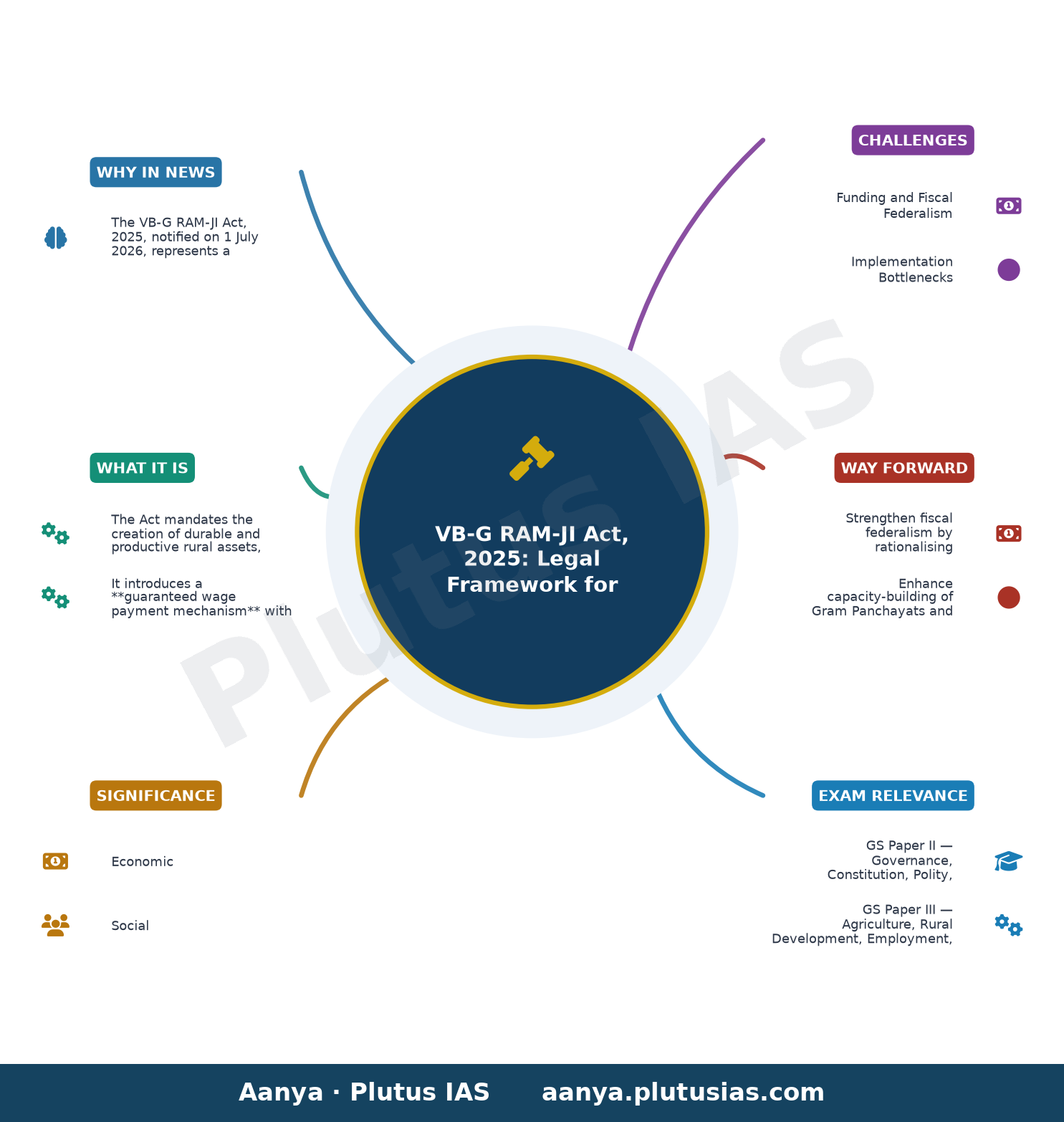
The VB-G RAM-JI Act, 2025, notified on 1 July 2026, represents a significant legislative intervention aimed at enhancing rural livelihood security by guaranteeing 125 days of wage employment per household per year, strengthening wage payment mechanisms, and promoting sustainable rural infrastructure and livelihood assets. The Act introduces a robust statutory framework with enhanced monitoring, grievance redressal, and fund-sharing mechanisms, marking a departure from existing schemes by integrating technology-enabled transparency and convergence with other government programmes.
Background
- The MGNREGA (Mahatma Gandhi National Rural Employment Guarantee Act), 2005, has been the cornerstone of rural employment guarantee schemes in India, providing up to 100 days of guaranteed wage employment per household annually.
- Despite its successes, MGNREGA has faced challenges such as delayed wage payments, limited convergence with other rural development programmes, and suboptimal creation of durable assets.
- The VB-G RAM-JI Act, 2025, builds upon MGNREGA’s framework while addressing these gaps through statutory enhancements, including extended employment duration, stricter wage payment timelines, and a focus on sustainable rural infrastructure.
- The Act aligns with the broader policy objective of ‘Viksit Bharat’ (Developed India) by integrating employment guarantee with livelihood support and climate-resilient infrastructure development.
- Funding for the scheme in FY 2026-27 includes a central share of ₹95,692.31 crore, the highest allocation for rural employment to date, with an estimated total outlay exceeding ₹1.51 lakh crore.
- The Act introduces a 90:10 fund-sharing ratio for North-Eastern and Himalayan states (including Uttarakhand, Himachal Pradesh, and Jammu & Kashmir) and a 60:40 ratio for other states, ensuring equitable fiscal federalism.
What is the VB-G RAM-JI Act, 2025?
- The Act mandates the creation of durable and productive rural assets, including water-related works, rural infrastructure, livelihood infrastructure, and climate-resilient measures, to foster sustainable rural development.
- It introduces a **guaranteed wage payment mechanism** with compensation for delays, ensuring timely and transparent disbursement of wages directly into workers’ bank accounts via Direct Benefit Transfer (DBT-SPARSH).
- The Act strengthens the role of **Gram Panchayats** in planning, implementation, and monitoring, ensuring grassroots-level participation and accountability.
- A **comprehensive institutional framework** is established for monitoring, evaluation, and grievance redressal, including technology-enabled Management Information Systems (MIS), periodic reviews, social audits, and multi-level grievance mechanisms at the block and district levels.
- The Act promotes **convergence** with other central and state government programmes, ensuring synergy in rural development initiatives and avoiding duplication of efforts.
- It includes provisions for **capacity building, technical assistance, and guiding support** to states/UTs to ensure effective implementation and adherence to statutory timelines.
- The Act is designed to address **climate vulnerabilities** by prioritising works that mitigate adverse weather events, thereby enhancing the resilience of rural communities.
Key Features
| Feature | Significance |
|---|---|
| Guaranteed wage employment | Increases employment security for rural households by extending guaranteed employment from 100 to 125 days per financial year under the MGNREGA framework. |
| Unemployment allowance and compensation | Provides statutory protection by mandating unemployment allowance and compensation for delayed wage payments, strengthening workers’ rights. |
| Direct Benefit Transfer (DBT) for wages | Ensures timely, transparent, and accountable wage disbursement through DBT-SPARS, reducing leakages and delays. |
| Convergence with other schemes | Promotes synergy with central and state government programmes, integrating water-related works, rural infrastructure, and livelihood infrastructure for holistic development. |
| Institutional monitoring framework | Establishes a multi-level grievance redressal mechanism and technology-enabled MIS for real-time monitoring, social audits, and periodic reviews. |
Why it Matters
Economic
- Enhances rural income security by guaranteeing 125 days of wage employment, reducing seasonal unemployment and underemployment in agrarian economies.
- Stimulates rural demand through increased liquidity from guaranteed wages, supporting local markets and small enterprises.
- Creates durable rural assets (e.g., water conservation structures, rural roads) that enhance agricultural productivity and climate resilience.
Social
- Strengthens statutory labour rights of rural workers by enforcing unemployment allowances and compensation for delayed payments.
- Promotes gender equity by ensuring equitable access to employment opportunities for women in rural areas.
- Reduces distress migration from rural to urban areas by providing local livelihood options.
Institutional
- Institutionalises a robust legal framework (VB-G RAMJI Act, 2025) for rural employment guarantee, ensuring continuity and accountability.
- Enhances transparency and accountability through technology-enabled monitoring (MIS, DBT-SPARS) and social audits.
- Fosters decentralised governance by empowering Gram Panchayats in planning, implementation, and monitoring of rural works.
Environmental
- Prioritises climate-resilient infrastructure (e.g., water conservation, drought-proofing) to mitigate adverse weather impacts on rural livelihoods.
- Promotes sustainable natural resource management through convergence with water-related and afforestation programmes.
Challenges
1. Funding and Fiscal Federalism
- Disparities in fund-sharing ratios (90:10 for NE/Himalayan states vs. 60:40 for others) may strain state finances, particularly for resource-constrained states.
- High central allocation (₹95,692.31 crore for 2026-27) requires sustained budgetary support, posing fiscal challenges amid competing priorities.
UPSC Link: GS-II: Centre-State Relations
2. Implementation Bottlenecks
- Delays in fund disbursement to states or Gram Panchayats may disrupt employment guarantee schemes, defeating the purpose of statutory guarantees.
- Capacity constraints in local governance (e.g., Panchayati Raj Institutions) could hinder effective planning and monitoring of rural works.
UPSC Link: GS-II: Local Governance
3. Technological and Digital Divide
- Reliance on DBT-SPARS and MIS assumes universal digital literacy and connectivity, which may exclude marginalised groups in remote rural areas.
- Cybersecurity risks and data privacy concerns in digital wage disbursement systems need robust safeguards.
UPSC Link: GS-III: Technology and Rural Development
4. Monitoring and Accountability Gaps
- Social audits, while mandated, often face resistance from local elites, leading to underreporting of irregularities or corruption.
- Multi-level grievance redressal mechanisms may suffer from bureaucratic delays or lack of awareness among beneficiaries.
UPSC Link: GS-IV: Ethics and Governance
5. Equity and Inclusion Challenges
- Ensuring equitable access for marginalised groups (e.g., SCs, STs, women, persons with disabilities) requires targeted outreach and affirmative action.
- Wage disparities between skilled and unskilled labour may persist, undermining the scheme’s poverty-alleviation objectives.
UPSC Link: GS-I: Social Justice
Challenges — UPSC Perspective
| Issue | Concern |
|---|---|
| Fund-sharing disparities | May create fiscal imbalances between states, affecting implementation quality. |
| Delays in fund disbursement | Undermines the guarantee of timely employment and wage payments. |
| Digital divide | Excludes technologically disadvantaged groups from accessing benefits. |
| Social audit resistance | Compromises transparency and accountability in fund utilisation. |
| Wage parity issues | Perpetuates income inequalities within rural labour markets. |
Government Initiatives — Must-Memorise for Prelims
- MGNREGA (Mahatma Gandhi National Rural Employment Guarantee Act, 2005)
- Deendayal Antyodaya Yojana – National Rural Livelihoods Mission (DAY-NRLM)
- Pradhan Mantri Krishi Sinchayee Yojana (PMKSY)
- Pradhan Mantri Gram Sadak Yojana (PMGSY)
Way Forward
- Strengthen fiscal federalism by rationalising fund-sharing ratios to balance equity and fiscal prudence.
- Enhance capacity-building of Gram Panchayats and local officials for effective planning, monitoring, and grievance redressal.
- Expand digital infrastructure in rural areas to ensure universal access to DBT-SPARS and MIS platforms.
- Institutionalise transparent social audits with third-party verification to curb corruption and leakage.
- Promote convergence with livelihood programmes (e.g., DAY-NRLM) to create sustainable income-generating assets.
- Address wage parity by linking unskilled labour wages to local market rates and inflation indices.
- Develop climate-resilient rural infrastructure to mitigate adverse weather impacts on agriculture and livelihoods.
UPSC Value Addition
Keywords for Mains Answer-Writing
VBG Ram-Ji Act 2025 · Rural Employment Guarantee Scheme · Livelihood Security Framework · 125 Days Wage Employment · Direct Benefit Transfer (DBT) · Rural Infrastructure Development · Fiscal Federalism in India · Mahatma Gandhi National Rural Employment Guarantee Scheme (MGNREGS) · Rural Livelihood Missions · Gram Panchayat Role in Implementation · Unemployment Allowance Provisions · Social Audit Mechanisms · Convergence with Other Centrally Sponsored Schemes
Constitutional & Policy Linkages
- Article 243G (Powers, authority and responsibilities of Panchayats)
- Article 243W (Powers, authority and responsibilities of Municipalities)
Concept Flow
Rural unemployment and underemployment → Economic distress and migration → Policy response: VB-G RAMJI Act, 2025 → Guaranteed 125-day wage employment → Creation of rural assets → Enhanced livelihood security → Reduced distress migration → Sustainable rural development.
Prelims Practice Questions
Q1. Consider the following statements regarding the VBG Ram-Ji Act, 2025:
1. The Act guarantees 125 days of wage employment to rural households in a financial year.
2. The funding pattern between the Centre and States is 90:10 for North-Eastern and Himalayan States.
3. The Act mandates the use of Direct Benefit Transfer (DBT) for wage payments.
4. The Gram Panchayats are excluded from the implementation framework of the Act.
How many of the above statements are correct?
- Only one
- Only two
- Only three
- All four
Answer: Only three — Statements 1, 2, and 3 are correct. Statement 4 is incorrect as the Act explicitly assigns a critical role to Gram Panchayats in implementation.
Q2. Assertion (A): The VBG Ram-Ji Act, 2025 increases the guaranteed wage employment from 100 to 125 days per rural household per year.
Reason (R): This enhancement is aimed at strengthening rural livelihood security and infrastructure development.
Options:
A. Both A and R are true, and R is the correct explanation of A.
B. Both A and R are true, but R is not the correct explanation of A.
C. A is true, but R is false.
D. A is false, but R is true.
Answer: ? — Both Assertion (A) and Reason (R) are true. The Act indeed increases guaranteed wage employment to 125 days, and the stated objective is to enhance rural livelihood security and infrastructure development, making R the correct explanation of A.
Q3. Match the following pairs related to the VBG Ram-Ji Act, 2025:
Column I (Provision) Column II (Description)
1. Unemployment Allowance A. Direct transfer of wages to workers’ bank accounts
2. DBT-Sparsh Mechanism B. Compensation for delayed wage payments
3. Social Audit C. Periodic evaluation by local communities
4. Gram Panchayat Role D. Implementation and monitoring at the grassroots level
Options:
A. 1-B, 2-A, 3-C, 4-D
B. 1-A, 2-B, 3-C, 4-D
C. 1-D, 2-A, 3-B, 4-C
D. 1-C, 2-D, 3-A, 4-B
- A
- B
- C
- D
Answer: A — The correct matching is: 1-B (Unemployment Allowance provides compensation for delays), 2-A (DBT-Sparsh ensures direct wage transfers), 3-C (Social Audit involves community evaluation), and 4-D (Gram Panchayats are responsible for implementation and monitoring).
Mains Practice Question
✍ The VBG Ram-Ji Act, 2025 represents a significant evolution in India’s rural employment and livelihood security framework. Critically examine its key provisions, institutional mechanisms, and potential challenges in ensuring effective implementation. Also, analyse how it compares with the Mahatma Gandhi National Rural Employment Guarantee Scheme (MGNREGS) in terms of scope, funding, and accountability. (15 Marks)
Approach: MODEL-ANSWER SKELETON:
1. **Introduction (2 marks)**
– Context: Need for enhanced rural livelihood security and infrastructure development.
– Objective of the VBG Ram-Ji Act, 2025: Expanding guaranteed wage employment to 125 days, promoting sustainable rural assets, and strengthening rural infrastructure.
2. **Key Provisions (4 marks)**
– Guaranteed wage employment: Increase from 100 to 125 days per rural household.
– Unemployment allowance and compensation for delayed wage payments (Section 22(2)).
– Direct Benefit Transfer (DBT-Sparsh) for transparent and timely wage payments.
– Focus on sustainable and productive rural assets, including water-related works and climate-resilient infrastructure.
– Fiscal federalism: 90:10 funding pattern for North-Eastern, Himalayan States, and Union Territories; 60:40 for other states.
3. **Institutional Mechanisms (4 marks)**
– Role of Gram Panchayats in implementation and monitoring.
– Technology-enabled Management Information System (MIS) for real-time tracking.
– Social audit and periodic reviews for transparency and accountability.
– Multi-level grievance redressal mechanism at Block and District levels.
– Convergence with other central and state government schemes for synergy.
4. **Comparison with MGNREGS (3 marks)**
– **Scope**: VBG Ram-Ji Act expands beyond employment guarantee to include livelihood support and rural infrastructure.
– **Funding**: Higher central allocation (₹95,692.31 crore for 2026-27) compared to MGNREGS, with a focus on climate-resilient works.
– **Accountability**: Enhanced provisions for unemployment allowances and delayed wage payments, stricter timelines, and technology-driven monitoring.
5. **Potential Challenges (2 marks)**
– Fiscal sustainability: High central allocation may strain resources; need for efficient fund utilisation.
– Implementation bottlenecks: Coordination between central, state, and local governments.
– Ensuring last-mile delivery: Addressing delays in wage payments and grievance redressal.
– Inclusivity: Ensuring marginalised groups (SC/ST, women) benefit equitably.
6. **Conclusion (2 marks)**
– VBG Ram-Ji Act is a progressive step towards enhancing rural livelihood security.
– Success hinges on effective implementation, robust monitoring, and convergence with existing schemes.
– Lessons from MGNREGS (e.g., social audits, DBT) can inform its execution.
Source: PIB (Press Information Bureau)
Generated by AanyaAi for educational purpose.


No Comments