


31 Jul Cabinet Approves ₹84,084 Crore ‘Samudra Manthan’ Offshore Exploration Scheme
✎ Samudra Manthan is a ₹84,084 crore scheme to accelerate offshore oil and gas exploration, aiming to create a 600 MMTOE reserve by FY 2030-31, enhance energy security, and foster a globally competitive domestic offshore ecosystem…
Subject Relevance — Where This Topic Fits
- GS Paper II — International Relations (Energy Diplomacy, Maritime Security) | GS Paper III — Economy (Energy Security, Infrastructure, Make in India, Atmanirbhar Bharat)
- Prelims: Offshore exploration, National Data Repository, Hydrocarbon Exploration Licensing Policy, Energy security, Blue Economy, Deep-water drilling, Seismic data, PM Vision 2047, Maritime India Vision 2030
- Essay: India’s Energy Security: Balancing Domestic Aspirations and Global Commitments, Blue Economy as a Catalyst for Sustainable Development and National Prosperity
Quick Revision: Samudra Manthan is a ₹84,084 crore scheme to accelerate offshore oil and gas exploration, aiming to create a 600 MMTOE reserve by FY 2030-31, enhance energy security, and foster a globally competitive domestic offshore ecosystem through advanced technology and infrastructure.
Why is this in the news?
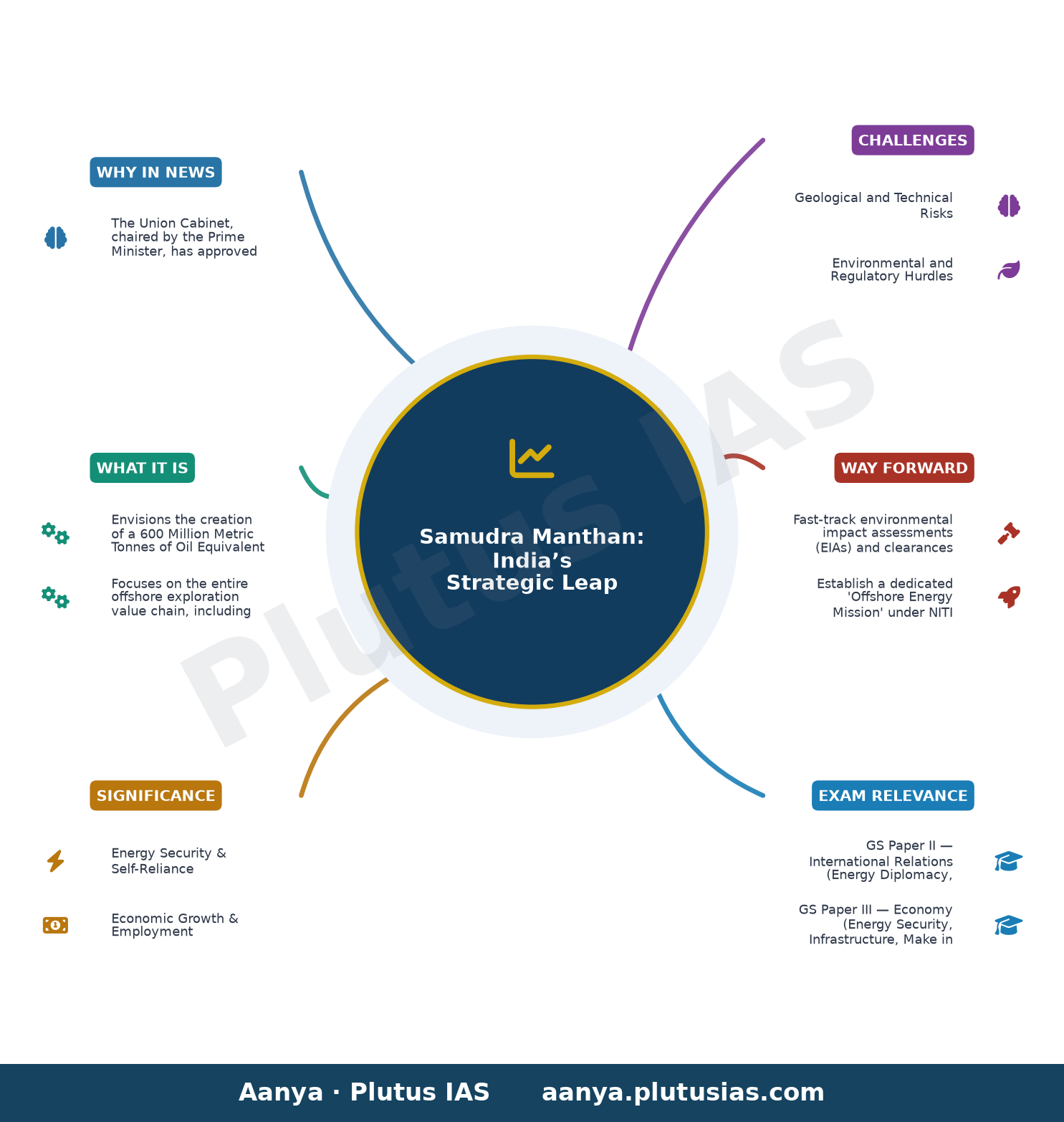
The Union Cabinet, chaired by the Prime Minister, has approved the ‘Samudra Manthan’ (National Offshore Exploration Programme) with an outlay of ₹84,084 crore for implementation by FY 2030-31. This initiative aligns with the Prime Minister’s vision, articulated during the 2025 Independence Day address, to harness India’s vast offshore energy potential. It represents a transformative step toward enhancing energy security, accelerating domestic exploration and production, fostering technological leadership, and advancing the ‘Viksit Bharat’ (Developed India) vision through strategic public investment and cutting-edge infrastructure.
Background
- India’s hydrocarbon sector has historically relied heavily on imports, with over 85% of its crude oil and 55% of its natural gas requirements met through external sources, posing significant risks to energy security.
- The upstream sector has undergone transformative reforms in the past decade, including the opening of nearly the entire offshore acreage for exploration, modernisation of legislative and contractual frameworks, and strengthening of the National Data Repository (NDR).
- The Hydrocarbon Exploration Licensing Policy (HELP) and Open Acreage Licensing Policy (OALP) were introduced to streamline exploration and production activities, reducing bureaucratic delays and enhancing investor confidence.
- India’s maritime domain spans over 2.4 million square kilometres of Exclusive Economic Zone (EEZ), with significant untapped potential in offshore oil and gas reserves, particularly in deep and ultra-deep waters.
- The global energy transition has intensified the need for domestic energy security, making indigenous offshore exploration a strategic imperative for reducing import dependence and ensuring price stability.
- The ‘Blue Economy’ has emerged as a key pillar of India’s maritime strategy, integrating sustainable utilisation of ocean resources with economic growth and environmental conservation.
What is Samudra Manthan (National Offshore Exploration Programme)?
- Envisions the creation of a 600 Million Metric Tonnes of Oil Equivalent (MMTOE) reserve through systematic exploration, thereby reducing import dependence and enhancing energy security.
- Focuses on the entire offshore exploration value chain, including high-resolution seismic data acquisition, analysis, and interpretation; rapid drilling in deep and ultra-deep waters; scientific drilling in under-explored basins; and development of shared infrastructure for offshore production and evacuation.
- Aims to establish an integrated oil and gas manufacturing and services ecosystem, fostering ‘Make in India’ and ‘Atmanirbhar Bharat’ through domestic manufacturing of offshore equipment and services.
- Incorporates digital programme management, capacity building, technology adoption, stakeholder engagement, and international collaboration to create a globally competitive offshore exploration ecosystem.
- Leverages advanced technologies such as AI-driven seismic interpretation, autonomous underwater vehicles (AUVs), and digital twins for real-time monitoring and decision-making in exploration activities.
- Seeks to generate substantial employment opportunities across the value chain, from geoscientists and engineers to technicians and support staff, thereby contributing to socio-economic development.
- Aligns with India’s commitment to the United Nations Sustainable Development Goals (SDGs), particularly SDG 7 (Affordable and Clean Energy) and SDG 14 (Life Below Water), by promoting sustainable and responsible offshore resource utilisation.
Key Features
| Feature | Significance |
|---|---|
| Central Sector Scheme under Ministry of Petroleum & Natural Gas | Ensures direct government oversight, alignment with national energy security goals, and centralized funding for high-risk, long-term exploration projects. |
| 84,084 Crore INR outlay (2026-2031) | Represents a strategic public investment to unlock offshore hydrocarbon potential, reduce import dependence, and stimulate ancillary industries. |
| Comprehensive offshore exploration value chain coverage | Includes seismic data acquisition, scientific drilling, infrastructure development, and digital management to create an integrated ecosystem. |
| Focus on deep-water and ultra-deep-water basins | Targets high-risk, high-reward geological formations to accelerate domestic production of oil and gas. |
| Integration of digital tools and capacity building | Enhances data analytics, stakeholder collaboration, and technological adoption to improve efficiency and global competitiveness. |
Why it Matters
Energy Security & Self-Reliance
- Aims to tap India’s estimated 600+ MMT of oil equivalent offshore reserves, reducing reliance on crude oil imports and strengthening energy sovereignty.
- Aligns with the vision of ‘Energy Atmanirbhar Bharat’ by fostering domestic exploration, production, and technological innovation.
- Supports the transition toward a ‘Developed India’ by ensuring long-term energy availability for industrial and household sectors.
Economic Growth & Employment
- Expected to generate large-scale employment across exploration, drilling, infrastructure, and ancillary services, particularly in coastal states.
- Stimulates investment in ‘Make in India’ initiatives by promoting domestic manufacturing of offshore equipment and services.
- Creates a multiplier effect through backward and forward linkages in the oil and gas value chain, including logistics, engineering, and R&D.
Technological Advancement & Global Competitiveness
- Encourages adoption of cutting-edge technologies such as 3D seismic imaging, autonomous underwater vehicles, and AI-driven data analytics.
- Positions India as a hub for offshore energy services, attracting global partnerships and reducing dependence on foreign technology providers.
- Enhances India’s negotiating power in international energy markets by expanding domestic production capabilities.
Policy & Regulatory Alignment
- Builds on previous reforms in the upstream sector, including the Open Acreage Licensing Policy (OALP) and Hydrocarbon Exploration & Licensing Policy (HELP).
- Strengthens the National Data Repository (NDR) by integrating high-resolution seismic data, improving transparency and investor confidence.
- Facilitates a predictable and stable regulatory environment for both domestic and international investors.
Challenges
1. Geological and Technical Risks
- Deep-water and ultra-deep-water basins present high exploration risks due to complex geological formations, extreme pressures, and harsh environments.
- Requires significant technological and financial investments to overcome operational challenges such as subsea infrastructure reliability and drilling efficiency.
UPSC Link: Geology of sedimentary basins
2. Environmental and Regulatory Hurdles
- Offshore drilling poses risks to marine ecosystems, necessitating stringent environmental impact assessments and compliance with global standards.
- Balancing energy security with ecological sustainability requires robust policy frameworks and international best practices.
UPSC Link: Environmental Impact Assessment
3. Infrastructure and Logistics Bottlenecks
- Limited port infrastructure, supply chain constraints, and skilled labor shortages in coastal regions may delay project execution.
- Dependence on foreign vessels and equipment for deep-water operations could lead to cost overruns and supply chain vulnerabilities.
UPSC Link: Infrastructure development
4. Market and Investment Dynamics
- Volatility in global oil prices may deter private sector participation, necessitating government-backed incentives and risk-sharing mechanisms.
- Competition from other energy sources (e.g., renewables) requires a balanced portfolio approach to ensure long-term viability of offshore projects.
UPSC Link: Energy pricing and subsidies
5. Human Resource and Capacity Gaps
- Shortage of specialized manpower in offshore drilling, geophysics, and subsea engineering may hinder rapid scale-up of operations.
- Requires targeted capacity-building programs in collaboration with academic institutions and industry partners.
UPSC Link: Human resource development
Challenges — UPSC Perspective
| Issue | Concern |
|---|---|
| High capital expenditure (CAPEX) for deep-water projects | Limited private sector appetite due to long payback periods and geological uncertainties. |
| Environmental clearances and compliance delays | Potential litigation and public opposition to offshore drilling activities. |
| Dependence on foreign technology and expertise | Vulnerability to geopolitical disruptions and technology transfer restrictions. |
| Skilled labor shortages in coastal regions | Need for vocational training and industry-academia partnerships. |
| Integration with existing energy infrastructure | Coordination challenges between upstream exploration and downstream refining/marketing networks. |
Way Forward
- Fast-track environmental impact assessments (EIAs) and clearances for high-potential offshore blocks to reduce project timelines.
- Establish a dedicated ‘Offshore Energy Mission’ under NITI Aayog to coordinate inter-ministerial efforts and monitor progress.
- Expand vocational training programs in partnership with IITs, IIMs, and industry leaders to address skill gaps in offshore engineering and geosciences.
- Leverage public-private partnerships (PPPs) to develop shared infrastructure such as deep-water ports, subsea pipelines, and floating production storage and offloading (FPSO) units.
- Incentivize domestic manufacturing of offshore equipment (e.g., drilling rigs, ROVs) through Production-Linked Incentive (PLI) schemes and import duty exemptions.
- Strengthen the National Data Repository (NDR) with AI-driven analytics to improve exploration efficiency and reduce dry well risks.
- Promote international collaborations with countries like Norway, Brazil, and the USA to access advanced technologies and best practices in offshore exploration.
- Develop a phased roadmap for monetizing discovered reserves, including auctioning of exploration blocks and streamlining production-sharing contracts (PSCs).
UPSC Value Addition
Keywords for Mains Answer-Writing
National Offshore Exploration Policy (NOEP) · Samudra Manthan Scheme · Energy Security in India · Offshore Hydrocarbon Exploration · Petroleum and Natural Gas Ministry · Deep-Water Drilling · Seismic Data Acquisition · Atmanirbhar Bharat in Energy · Make in India for Oil & Gas · Blue Economy Vision · Energy Transition in India · Strategic Public Investment in Energy · Oil Equivalent Reserves (MMTOE) · Integrated Ecosystem for Offshore Exploration · PM Modi’s Vision for Energy Independence
Concept Flow
Energy security concerns → Government approval of ‘Samudra Manthan’ → Strategic allocation of ₹84,084 Crore → Offshore exploration value chain activation → High-resolution seismic data acquisition → Scientific drilling in deep-water basins → Domestic oil & gas production ramp-up → Reduction in crude oil imports → Strengthening of ‘Atmanirbhar Bharat’ in energy sector.
Prelims Practice Questions
Q1. Consider the following statements regarding the ‘Samudra Manthan’ scheme: 1. It is a centrally sponsored scheme under the Ministry of Petroleum and Natural Gas. 2. The scheme aims to accelerate offshore hydrocarbon exploration and production in India. 3. The total outlay approved for the scheme is ₹84,084 crore for implementation up to the financial year 2030-31. 4. The scheme includes provisions for capacity building in offshore drilling technology among Indian workforce. How many of the above statements are correct?
- Only one
- Only two
- Only three
- All four
Answer: All four — Statements 1, 2, and 3 are correct as per the official PIB release. Statement 4 is also correct, as the scheme includes provisions for capacity development and technology adoption in offshore exploration.
Q2. Assertion (A): The ‘Samudra Manthan’ scheme is designed to enhance India’s energy security by accelerating offshore hydrocarbon exploration and production. Reason (R): The scheme includes provisions for high-quality seismic data acquisition, deep-water drilling, and the development of shared infrastructure for offshore production and extraction.
- Both A and R are true and R is the correct explanation of A.
- Both A and R are true but R is NOT the correct explanation of A.
- A is true but R is false.
- A is false but R is true.
Answer: Both A and R are true but R is NOT the correct explanation of A. — The assertion is true as the scheme aims to boost energy security through offshore exploration. The reason correctly explains the assertion by detailing the scheme’s components (seismic data, deep-water drilling, and infrastructure development).
Q3. Match the following components of the ‘Samudra Manthan’ scheme with their corresponding objectives:
Column I (Component)
A. High-quality seismic data acquisition
B. Deep-water and ultra-deep-water drilling
C. Development of shared infrastructure for offshore production
D. Digital programme management and capacity development
Column II (Objective)
1. To enhance the accuracy of hydrocarbon reserve estimation
2. To exploit hydrocarbon reserves in deeper offshore regions
3. To reduce costs and improve efficiency in offshore production
4. To streamline project execution and skill development in offshore exploration
- A-1, B-2, C-3, D-4; A-2, B-1, C-4, D-3; A-3, B-4, C-1, D-2; A-4, B-3, C-2, D-1
- answer_options_indexes_to_match_pairs_are_provided_in_options_array
- answer_pairs_indexes_are_0,
Answer: A-1, B-2, C-3, D-4; A-2, B-1, C-4, D-3; A-3, B-4, C-1, D-2; A-4, B-3, C-2, D-1 — The correct matching is: A-1 (seismic data improves reserve estimation), B-2 (deep-water drilling exploits deeper reserves), C-3 (shared infrastructure reduces costs), and D-4 (digital management and capacity development streamline execution and skill-building).
Mains Practice Question
✍ Critically examine the significance of the ‘Samudra Manthan’ scheme in the context of India’s energy security and the broader vision of ‘Viksit Bharat’. Substantiate your arguments with reference to the scheme’s components and its potential socio-economic impacts. (15 Marks)
Approach: MODEL-ANSWER SKELETON:
1. **Introduction (2 Marks)**
– Briefly define the ‘Samudra Manthan’ scheme and its objectives as a central sector scheme under the Ministry of Petroleum and Natural Gas.
– Mention its vision alignment with PM Modi’s call for a modern ‘Samudra Manthan’ to harness India’s offshore energy potential.
2. **Energy Security and Strategic Autonomy (4 Marks)**
– Discuss how the scheme addresses India’s energy import dependence and enhances domestic hydrocarbon production.
– Highlight the role of offshore exploration in reducing reliance on foreign oil and gas imports.
– Reference India’s energy transition goals and the importance of offshore reserves in achieving them.
3. **Scheme Components and Their Significance (5 Marks)**
– **Seismic Data Acquisition and Analysis**: Explain how high-quality seismic data improves reserve estimation and reduces exploration risks.
– **Deep-Water and Ultra-Deep-Water Drilling**: Discuss the technological challenges and opportunities in exploiting deeper offshore basins (e.g., Krishna-Godavari, Cauvery basins).
– **Shared Infrastructure for Production**: Analyze how shared infrastructure (e.g., pipelines, platforms) reduces costs and improves efficiency in offshore production.
– **Digital Programme Management and Capacity Development**: Explain the role of digital tools in project execution and the importance of skill development for India’s workforce in offshore exploration.
4. **Socio-Economic Impacts (3 Marks)**
– **Employment Generation**: Discuss the potential for large-scale job creation in offshore exploration, drilling, and ancillary industries.
– **Make in India and Atmanirbhar Bharat**: Explain how the scheme promotes indigenous manufacturing of offshore equipment and technology.
– **Economic Growth and Revenue Generation**: Highlight the potential for increased revenue from hydrocarbon production and its contribution to GDP.
5. **Challenges and Critical Examination (3 Marks)**
– **Environmental Concerns**: Discuss the potential environmental impacts of offshore drilling and the need for sustainable practices.
– **Technological and Financial Challenges**: Analyze the high costs and technological complexities associated with deep-water drilling.
– **Policy and Regulatory Framework**: Examine the role of the National Data Repository and other reforms in facilitating the scheme’s success.
6. **Conclusion (2 Marks)**
– Summarize the scheme’s transformative potential in enhancing India’s energy security and contributing to the ‘Viksit Bharat’ vision.
– Emphasize the need for balanced implementation, addressing environmental concerns, and leveraging global best practices.
Source: PIB (Press Information Bureau)
Generated by AanyaAi for educational purpose.

- संयुक्त राष्ट्र पैनल ने AI एजेंटों की बढ़ती शक्ति पर सुरक्षा बढ़ाने की चेतावनी दी - September 21, 2026
- UN Panel Warns: AI Agents May Outpace Human Control Safeguards - September 21, 2026
- तमिलनाडु में मुर्गे की लड़ाई पर पूर्ण प्रतिबंध नहीं: डीजीपी कार्यालय ने मद्रास उच्च न्यायालय को बताया - September 21, 2026

No Comments