


31 Jul RBI to Auction ₹26,850 Crore State Govt Securities on Aug 4, 2026
✎ State Government Securities (SGS) are debt instruments issued by state governments to finance developmental expenditure, with auctions conducted by the RBI to ensure transparency and broad-based participation, including a…
Subject Relevance — Where This Topic Fits
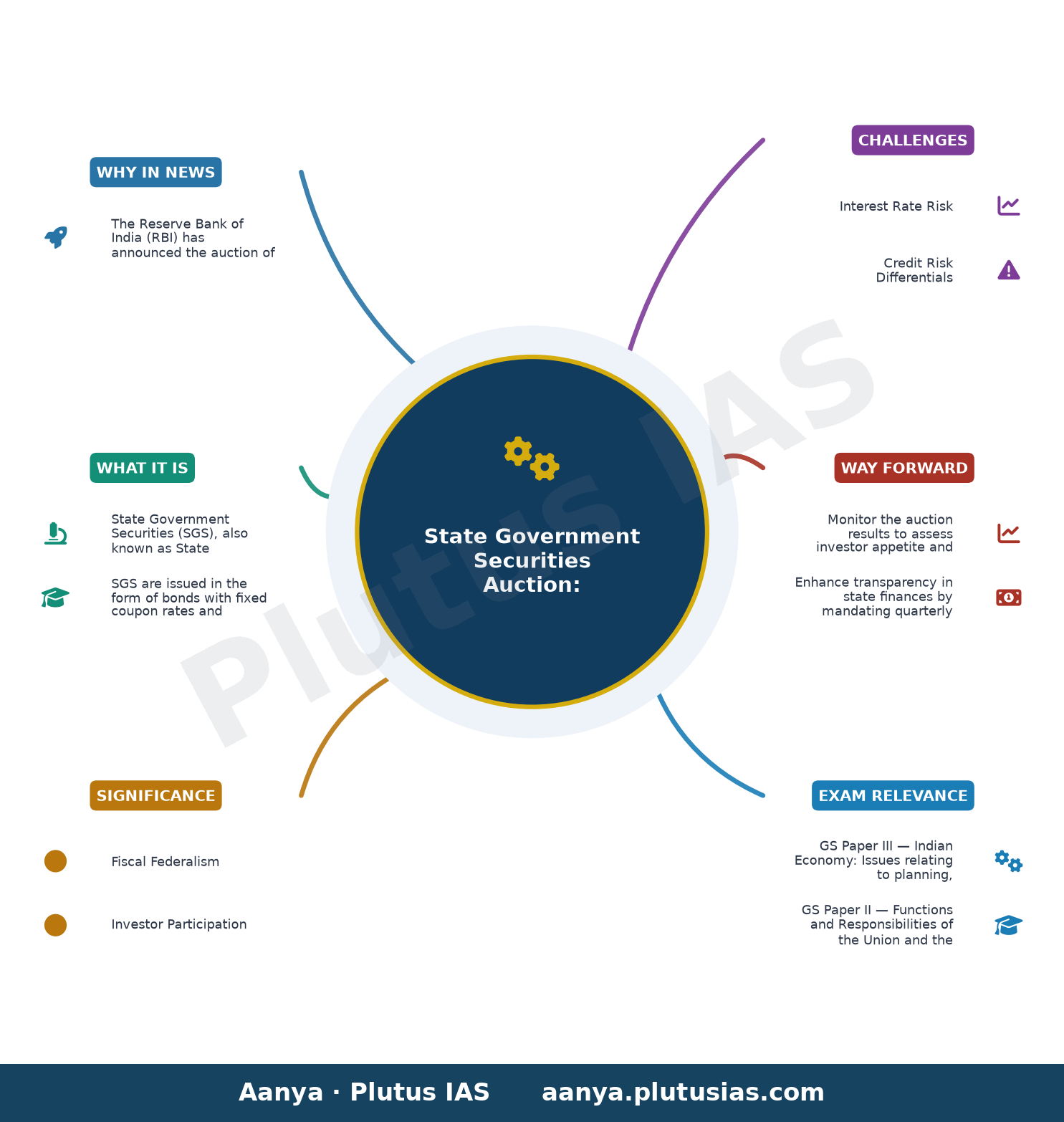
- GS Paper III — Indian Economy: Issues relating to planning, mobilisation of resources, growth, development and employment, Government Budgeting | GS Paper II — Functions and Responsibilities of the Union and the States, Issues and Challenges Pertaining to the Federal Structure, Devolution of Powers and Finances up to Local Levels
- Prelims: State Development Loans (SDLs), Fiscal Responsibility and Budget Management (FRBM) Act, Debt-to-GDP ratio, RBI Core Banking Solution (E-Kuber), Non-competitive Bidding Facility, Retail Direct Portal
- Essay: Fiscal Federalism in India: Balancing Autonomy and Accountability, Role of State Governments in Sustainable Development: Challenges of Resource Mobilisation
Quick Revision: State Government Securities (SGS) are debt instruments issued by state governments to finance developmental expenditure, with auctions conducted by the RBI to ensure transparency and broad-based participation, including a non-competitive bidding facility for retail investors.
Why is this in the news?
The Reserve Bank of India (RBI) has announced the auction of State Government Securities (SGS) for an aggregate face value of ₹26,850 crore on August 4, 2026, underlining the critical role of state governments in mobilising resources for developmental expenditure. This auction, involving 17 states, reflects the evolving dynamics of fiscal federalism, debt management, and the integration of state governments into the broader financial ecosystem of India. The timing and structure of the auction also provide insights into the RBI’s monetary policy transmission and the growing participation of retail investors in government securities.
Background
- State governments in India rely significantly on market borrowings to finance their developmental and welfare expenditures, as their revenue receipts often fall short of expenditure commitments.
- The issuance of State Development Loans (SDLs), commonly referred to as State Government Securities (SGS), is a key instrument for state governments to raise funds from the market, distinct from the Centre’s borrowings.
- The RBI, acting as the debt manager for state governments, conducts auctions for SGS on behalf of the states, ensuring transparency and efficiency in the borrowing process.
- The FRBM Act, 2003, and its subsequent amendments, mandate fiscal discipline for both the Centre and states, influencing their borrowing patterns and debt sustainability.
- The introduction of the ‘Scheme for Non-competitive Bidding Facility’ in 2016 and the Retail Direct Portal in 2021 has democratised access to government securities, including SGS, for retail investors.
- The auction mechanism for SGS is designed to balance the interests of competitive bidders (institutional investors) and non-competitive bidders (retail investors and small institutions), ensuring broad-based participation.
What are State Government Securities (SGS)?
- State Government Securities (SGS), also known as State Development Loans (SDLs), are debt instruments issued by state governments to raise funds from the market for developmental projects and other expenditure commitments.
- SGS are issued in the form of bonds with fixed coupon rates and maturities ranging from 5 to 30 years, as per the requirements of the issuing state.
- The coupon rates on SGS are typically higher than those on Central Government Securities (G-Secs) due to the higher credit risk associated with state governments, though they are still considered relatively safe investments.
- The RBI conducts auctions for SGS on behalf of state governments, ensuring a standardised and transparent process for price discovery and allocation.
- SGS are eligible for inclusion in the Statutory Liquidity Ratio (SLR) requirements of banks, making them attractive to institutional investors like banks and insurance companies.
- The interest income from SGS is exempt from income tax under Section 10(15) of the Income Tax Act, 1961, providing a tax advantage to investors.
- SGS are tradable in the secondary market, allowing investors to liquidate their holdings before maturity, subject to market conditions.
- The auction process for SGS includes both competitive bidding (for institutional investors) and non-competitive bidding (for retail investors and small institutions), ensuring inclusivity.
Key Features
| Feature | Significance |
|---|---|
| Aggregate Amount (₹26,850 Crore) | Represents the total face value of State Government Securities (SGS) offered for auction, reflecting the borrowing requirements of state governments for fiscal year 2026-27. |
| Tenor Range (2031-2056) | Indicates the maturity period of securities, with shorter tenors (e.g., 2031-2033) offering lower risk and longer tenors (e.g., 2051-2056) providing higher yields to investors. |
| Re-issue Mechanism | Leverages existing securities to raise additional capital, reducing the need for new issuances and maintaining liquidity in the secondary market. |
| Competitive and Non-competitive Bidding | Ensures participation from institutional investors (via competitive bids) and retail investors (via non-competitive bids), promoting inclusivity in government securities markets. |
| Electronic Auction Platform (E-Kuber) | Facilitates transparent, efficient, and real-time bidding processes, aligning with digital governance initiatives in financial markets. |
Why it Matters
Fiscal Federalism
- Demonstrates the operational autonomy of state governments in raising capital through market-based instruments, independent of the Union Government’s borrowing limits.
- Highlights the role of State Development Loans (SDLs) in financing state-specific developmental projects, infrastructure, and social welfare schemes.
- Reflects the interdependence between central and state finances, particularly in the context of the Goods and Services Tax (GST) compensation mechanism.
Investor Participation
- Expands investment avenues for institutional investors (banks, insurance companies, pension funds) seeking sovereign-backed securities with varying risk-return profiles.
- Enables retail investors to participate via the Retail Direct portal, democratising access to government securities and fostering financial inclusion.
- Signals market confidence in state governments’ fiscal discipline, as evidenced by the re-issue of existing securities with stable coupon rates.
Monetary Policy Transmission
- Provides the Reserve Bank of India (RBI) with a tool to manage liquidity in the banking system by influencing the supply of state securities.
- Serves as a benchmark for pricing corporate bonds and other debt instruments, given the sovereign guarantee implicit in SGS.
- Supports the RBI’s Open Market Operations (OMOs) by offering tradable securities for liquidity adjustment.
Macroeconomic Stability
- Contributes to the overall borrowing program of the government, which must align with fiscal deficit targets under the Fiscal Responsibility and Budget Management (FRBM) Act.
- Helps states meet their revenue expenditure needs without resorting to excessive taxation or debt restructuring, thereby stabilising public finances.
- Reduces reliance on external commercial borrowings (ECBs) or multilateral loans, mitigating currency risk and external sector vulnerabilities.
Challenges
1. Interest Rate Risk
- Longer-tenor securities (e.g., 2051-2056) expose investors to interest rate volatility, particularly in a rising rate environment.
- State governments with higher debt burdens may face elevated interest servicing costs, straining fiscal sustainability.
UPSC Link: Monetary Policy – Inflation targeting
2. Credit Risk Differentials
- Variations in credit ratings across states may lead to asymmetric investor demand, with fiscally weaker states facing higher borrowing costs.
- The absence of a formal sovereign guarantee for SGS (unlike Central Government securities) introduces credit risk, albeit minimal.
UPSC Link: Fiscal Federalism – State finances
3. Liquidity Constraints
- Thin secondary market liquidity for certain state securities may deter institutional investors, limiting price discovery and market depth.
- Concentration of holdings among a few large investors could exacerbate volatility during market stress.
UPSC Link: Financial Markets – Secondary market
4. Operational Challenges
- Technical glitches in the E-Kuber platform during the auction window could disrupt bidding processes, as noted in the RBI’s advisory.
- Compliance requirements for non-competitive bidding (e.g., maximum 1% per stock) may limit retail investor participation.
UPSC Link: Digital Governance – E-governance
Challenges — UPSC Perspective
| Issue | Concern |
|---|---|
| Debt Sustainability | Risk of states exceeding their fiscal deficit targets due to high borrowing requirements. |
| Market Fragmentation | Diverse coupon rates and tenors across states may fragment the SGS market, reducing efficiency. |
| Investor Skepticism | Perception of higher risk in state securities compared to Central Government bonds may deter participation. |
| Regulatory Overlap | Potential conflicts between RBI’s monetary policy stance and state governments’ fiscal policies. |
| Data Asymmetry | Lack of real-time, granular data on state finances may hinder accurate credit assessment by investors. |
Way Forward
- Monitor the auction results to assess investor appetite and pricing trends for state securities.
- Enhance transparency in state finances by mandating quarterly fiscal reports aligned with FRBM Act guidelines.
- Develop a secondary market for SGS by incentivising market-makers and reducing settlement risks.
- Conduct investor education programs to familiarise retail participants with the benefits and mechanics of SGS.
- Strengthen inter-state coordination to harmonise borrowing strategies and reduce market fragmentation.
- Integrate SGS auctions with the RBI’s liquidity management framework to ensure alignment with monetary policy objectives.
- Explore the introduction of credit enhancement mechanisms for fiscally weaker states to lower borrowing costs.
UPSC Value Addition
Keywords for Mains Answer-Writing
State Government Securities · State Development Loans · Auction Mechanism · Reserve Bank of India · Fiscal Federalism · Non-Competitive Bidding Facility · E-Kuber System · Public Debt Management · Sub-National Borrowing · Debt Sustainability
Constitutional & Policy Linkages
- [‘Article 293 – Borrowing by States’, ‘Permits states to borrow within limits set by the Union Government.’]
- [‘Article 282 – Grants-in-Aid’, ‘Authorises Union Government grants to states, complementing market borrowings.’]
Concept Flow
State governments identify fiscal deficit requirements for FY 2026-27. → Reserve Bank of India (RBI) announces auction of State Government Securities (SGS) via E-Kuber platform. → States determine tenor and coupon rates based on market conditions and fiscal needs. → Investors (institutional and retail) submit competitive and non-competitive bids for allocation. → RBI conducts allotment and settlement, ensuring transparency and price discovery. → Proceeds from the auction are credited to state treasuries for developmental expenditure. → Secondary market trading of SGS begins, influencing broader debt markets and monetary policy.
Prelims Practice Questions
Q1. Consider the following statements regarding the auction of State Government Securities (SGS) in India:
1. The auction of SGS is conducted exclusively through the Reserve Bank of India’s Core Banking Solution (E-Kuber) system.
2. Competitive bids for SGS auctions must be submitted between 10:30 AM and 11:30 AM on the auction date.
3. Non-competitive bids are permitted only for retail investors and are capped at 10% of the notified amount per stock.
4. The Scheme for Non-competitive Bidding Facility allows individuals to place bids through the Retail Direct portal.
How many of the above statements are correct?
- Only one
- Only two
- Only three
- All
Answer: All — Statements 1, 2, and 4 are correct. Statement 3 is incorrect because the non-competitive bidding facility is capped at 10% of the notified amount for a single bid per stock, not 10% of the total notified amount.
Q2. Assertion (A): The auction of State Government Securities (SGS) is a mechanism through which state governments raise funds from the market.
Reason (R): The Reserve Bank of India (RBI) conducts these auctions to ensure fiscal discipline and transparency in sub-national borrowing.
Options:
A. Both A and R are true, and R is the correct explanation of A.
B. Both A and R are true, but R is not the correct explanation of A.
C. A is true, but R is false.
D. A is false, but R is true.
Answer: ? — Assertion (A) is true as SGS auctions are indeed a mechanism for state governments to raise funds. Reason (R) is also true, but it does not directly explain why the auction mechanism exists; it merely states RBI’s role in ensuring fiscal discipline and transparency.
Q3. Match the following State Governments with their respective notified amounts for the auction of State Government Securities (SGS) as per the RBI press release dated July 31, 2026:
Column I (State Government) | Column II (Notified Amount in ₹ Crore)
— | —
A. Assam | 1. 1000
B. Bihar | 2. 2000
C. Madhya Pradesh | 3. 1600
D. Tamil Nadu | 4. 2500
Options:
A. A-1, B-2, C-3, D-4
B. A-1, B-3, C-2, D-4
C. A-1, B-2, C-4, D-3
D. A-2, B-1, C-3, D-4
- A
- B
- C
- D
Answer: B — Assam (1000), Bihar (2000), Madhya Pradesh (1600), and Tamil Nadu (2500) match the respective notified amounts as per the RBI press release.
Mains Practice Question
✍ The auction mechanism for State Government Securities (SGS) represents a critical instrument of fiscal federalism in India, facilitating sub-national borrowing under the oversight of the Reserve Bank of India (RBI). Critically analyse the significance of this mechanism for state governments, the RBI, and the broader macroeconomic stability of the country. Also, examine the challenges associated with the auction process and suggest reforms to enhance its efficacy. (15 Marks)
Approach: MODEL-ANSWER SKELETON:
1. **Introduction (2 Marks)**: Define State Government Securities (SGS) and their role in fiscal federalism. Briefly explain the auction mechanism and its purpose.
2. **Significance for State Governments (3 Marks)**:
– Enables states to raise funds for developmental projects and budgetary deficits.
– Provides access to market-based borrowing, reducing reliance on central government loans.
– Encourages fiscal discipline through competitive pricing and transparency.
3. **Role of the RBI (3 Marks)**:
– Acts as the regulator and facilitator of SGS auctions, ensuring transparency and efficiency.
– Implements the Scheme for Non-Competitive Bidding Facility to broaden investor participation.
– Monitors debt sustainability and fiscal health of state governments.
4. **Macroeconomic Stability (3 Marks)**:
– Helps in managing fiscal deficits at the sub-national level without compromising macroeconomic stability.
– Ensures that state borrowing does not crowd out private investment or lead to inflationary pressures.
– Contributes to the development of a robust secondary market for government securities.
5. **Challenges (2 Marks)**:
– Limited participation from retail investors due to complexity and lack of awareness.
– Potential for high interest rates due to fiscal stress in certain states.
– Regulatory and operational hurdles in the auction process.
6. **Reforms (2 Marks)**:
– Enhance retail investor participation through simplified bidding processes and awareness campaigns.
– Introduce differentiated interest rates based on state fiscal health to ensure market discipline.
– Strengthen the secondary market for SGS to improve liquidity and price discovery.
7. **Conclusion (2 Marks)**: Summarise the importance of SGS auctions in India’s fiscal architecture and the need for continuous reforms to address emerging challenges.
Source: RBI
Generated by AanyaAi for educational purpose.

- नवीन एवं नवीकरणीय ऊर्जा मंत्रालय ने विशेष अभियान 6 में 70% प्रगति हासिल की - October 25, 2026
- NCERT’s AI Module for Classes 9-12: Deepfakes & Ethical AI for UPSC - October 25, 2026
- अक्टूबर 28 को आएगा चक्रवात, आंध्र प्रदेश में बाढ़ और निकासी की तैयारी - October 25, 2026

No Comments