


31 Jul Allahabad HC: Voluntary Conversion & Marriage is Constitutional Right for Adults
✎ The Allahabad High Court’s judgment reaffirms that **voluntary religious conversion and interfaith marriage are constitutionally protected rights under Articles 25 and 21**, provided they are exercised without coercion or fraud.
Subject Relevance — Where This Topic Fits
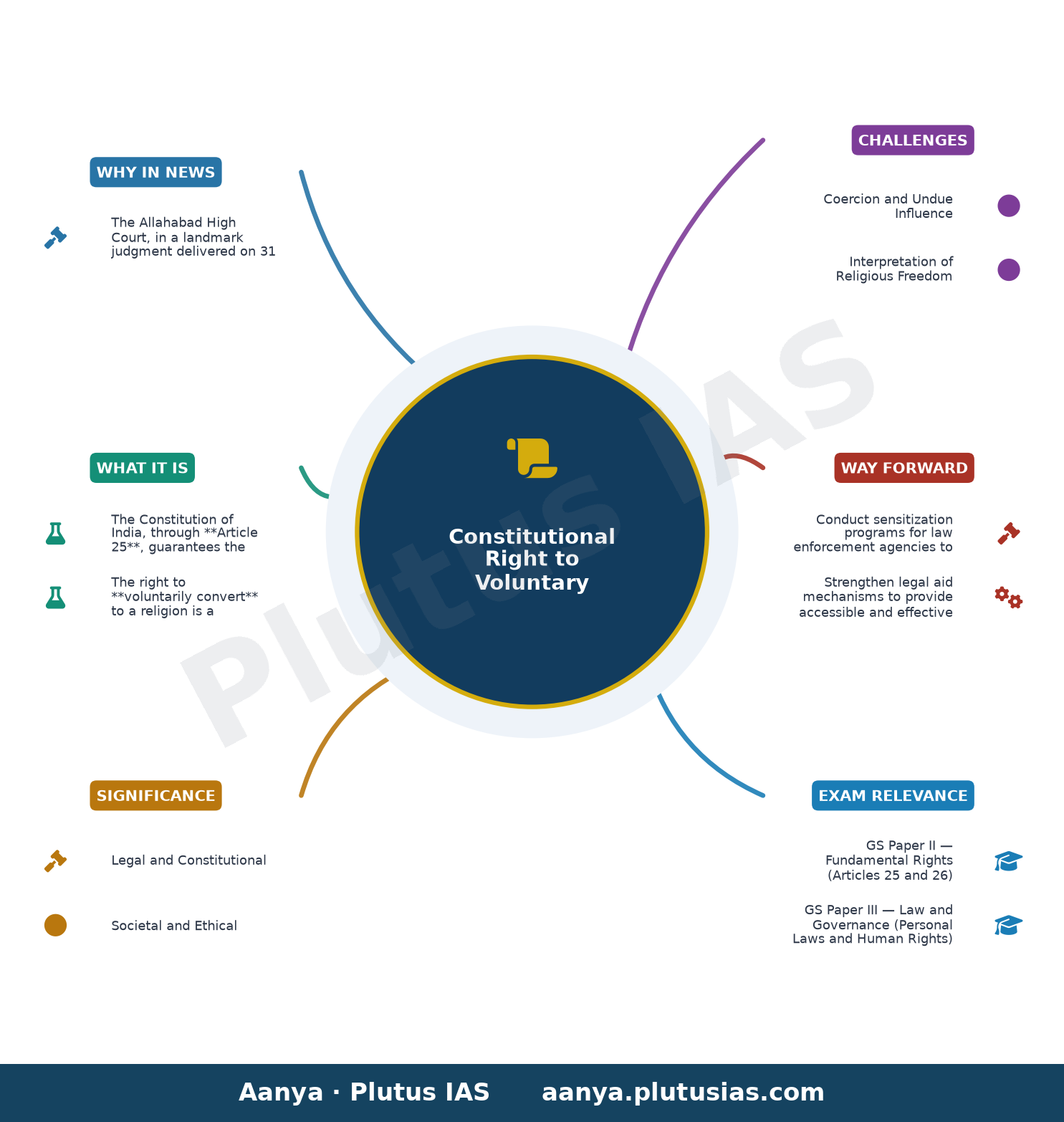
- GS Paper II — Fundamental Rights (Articles 25 and 26) | GS Paper III — Law and Governance (Personal Laws and Human Rights)
- Prelims: Article 25, Article 26, Right to Freedom of Religion, Interfaith Marriage, Personal Liberty, Habeas Corpus, Fundamental Rights, Constitutional Provisions on Conversion, Sarkaria Commission Recommendations, Supreme Court Judgments on Conversion, Directive Principles of State Policy (DPSP) — Article 44, Uniform Civil Code, Constitutional Morality, Secularism, Individual Autonomy
- Essay: Secularism and Constitutional Morality: Balancing Individual Freedom and Social Harmony, The Role of Judiciary in Protecting Fundamental Rights in a Pluralistic Society
Quick Revision: The Allahabad High Court’s judgment reaffirms that **voluntary religious conversion and interfaith marriage are constitutionally protected rights under Articles 25 and 21**, provided they are exercised without coercion or fraud.
Why is this in the news?
The Allahabad High Court, in a landmark judgment delivered on 31 July 2026, reaffirmed that the right to voluntarily convert to a religion and to choose one’s spouse is a constitutional right guaranteed under Articles 25 and 26 of the Constitution of India. The ruling was delivered in response to a habeas corpus petition filed by two adult sisters who alleged coercion by their father and police complicity in their illegal detention. The court underscored the primacy of individual autonomy and directed the state to ensure that the sisters’ decisions were made without undue influence, thereby reinforcing the constitutional safeguards against forced conversions and unlawful restraints.
Background
- Judicial precedents, including the Supreme Court’s judgment in *Rev. Stanislaus v. State of Madhya Pradesh* (1977), have consistently upheld the right to propagate religion but have also cautioned against forced conversions.
- The issue of religious conversion has been a subject of intense debate, particularly in cases involving interfaith marriages, where concerns about coercion, family pressure, and social disharmony often arise.
- The Allahabad High Court’s judgment aligns with the constitutional principle of individual autonomy, as enunciated in *Shayara Bano v. Union of India* (2017), which emphasized the right to make personal choices free from coercion.
- The judgment also reflects the judiciary’s role in safeguarding personal liberty, as enshrined in Article 21 of the Constitution, against arbitrary state or familial interference.
What is the Constitutional Right to Voluntary Religious Conversion and Interfaith Marriage?
- The Constitution of India, through **Article 25**, guarantees the freedom of conscience and the right to freely profess, practice, and propagate religion, subject to reasonable restrictions imposed by the state in the interest of public order, morality, and health.
- The right to **voluntarily convert** to a religion is a corollary of the freedom of conscience and the right to propagate one’s faith, as long as the conversion is not induced by fraud, coercion, or undue influence.
- The Supreme Court, in *Rev. Stanislaus v. State of Madhya Pradesh* (1977), upheld the validity of laws regulating conversions but clarified that the right to propagate religion does not include the right to convert another person by force or fraud.
- The right to **choose one’s spouse** is a fundamental aspect of personal liberty under **Article 21** of the Constitution, which guarantees the right to life and personal liberty. This includes the freedom to enter into interfaith marriages without state or familial interference.
- The Allahabad High Court’s judgment reinforces the principle that **adult individuals have the autonomy to make informed and voluntary decisions** regarding their religious beliefs and marital choices, free from coercion or unlawful restraint.
- The court’s directive to ensure that the sisters’ decisions were made without undue influence aligns with the constitutional principle of **‘constitutional morality’**, which prioritizes individual dignity and autonomy over societal or familial pressures.
- The judgment also highlights the judiciary’s role in **preventing illegal detention** and ensuring that habeas corpus petitions are adjudicated expeditiously to protect personal liberty.
- The case underscores the need for **judicial vigilance** in cases involving interfaith marriages and conversions, particularly where allegations of coercion or familial interference are raised.
Key Features
| Feature | Significance |
|---|---|
| Right to Freedom of Religion (Article 25) | Guarantees the freedom to profess, practice, and propagate religion, subject to public order, morality, and health. |
| Right to Personal Liberty (Article 21) | Ensures the protection of life and personal liberty, including the right to make autonomous decisions regarding religion and marriage. |
| Right to Freedom of Choice in Marriage (Article 19(1)(a) & 21) | Affirms the constitutional right to choose one’s spouse and life partner without coercion or undue influence. |
| Writ of Habeas Corpus (Article 32) | Provides judicial remedy to individuals unlawfully detained, ensuring their liberty is protected. |
| Judicial Scrutiny of Voluntariness | Courts must verify that decisions regarding religion and marriage are made without coercion, fraud, or undue influence. |
Why it Matters
Legal and Constitutional
- Reinforces the supremacy of constitutional rights over personal or familial objections, ensuring autonomy in matters of religion and marriage.
- Clarifies that the State cannot interfere in an adult’s decision to convert or marry unless there is evidence of coercion or fraud.
- Sets a precedent for future cases involving interfaith marriages and voluntary religious conversions, reducing ambiguity in judicial interpretation.
Societal and Ethical
- Affirms the principle of individual agency in matters of faith and personal relationships, aligning with modern democratic values.
- Challenges regressive societal norms that restrict personal freedom in the name of tradition or familial control.
- Promotes gender equality by recognizing the right of women to make independent choices regarding their religion and marital partners.
Judicial Precedent
- Strengthens the role of the judiciary in safeguarding fundamental rights against societal or familial pressures.
- Provides a framework for lower courts to adjudicate similar cases with consistency and fairness.
- Highlights the judiciary’s responsibility to ensure that no individual is subjected to unlawful detention or coercion.
Challenges
1. Coercion and Undue Influence
- Identifying genuine voluntariness in cases of religious conversion or marriage can be challenging due to subtle forms of coercion.
- Familial or societal pressure may not always be overt, making it difficult to distinguish between choice and compulsion.
- The burden of proof lies on the individual asserting coercion, which can be a deterrent for victims of subtle manipulation.
UPSC Link: GS-II: Fundamental Rights and DPSP
2. Interpretation of Religious Freedom
- Balancing the right to religious freedom with public order and morality remains a contentious issue in constitutional law.
- Courts must navigate the fine line between protecting individual rights and preventing misuse of religious freedom for unlawful purposes.
- The absence of a uniform civil code complicates the application of constitutional principles in matters of marriage and religion.
UPSC Link: GS-II: Fundamental Rights and DPSP
3. Enforcement of Judicial Orders
- Ensuring compliance with judicial orders, such as producing individuals before the court, can be logistically challenging.
- Delays in enforcement may undermine the effectiveness of judicial remedies, particularly in cases involving detention or coercion.
- Collaboration between the judiciary, police, and administrative authorities is essential for timely and effective implementation.
UPSC Link: GS-II: Judiciary and Judicial Reforms
4. Social Stigma and Backlash
- Individuals exercising their constitutional rights may face social ostracization, familial disownment, or even violence.
- The lack of societal acceptance can deter individuals from asserting their rights, despite legal protections.
- Addressing societal attitudes requires a multi-pronged approach, including awareness campaigns and legal literacy.
UPSC Link: GS-I: Social Empowerment and Inclusion
5. Role of Law Enforcement Agencies
- Police and administrative authorities must act impartially and without bias in cases involving interfaith marriages or religious conversions.
- Instances of collusion or inaction by law enforcement agencies can exacerbate the vulnerability of individuals.
- Training and sensitization of law enforcement personnel are critical to ensure fair and just outcomes.
UPSC Link: GS-II: Role of Civil Services
Challenges — UPSC Perspective
| Issue | Concern |
|---|---|
| Proving Voluntariness | The absence of overt coercion does not guarantee voluntariness; subtle forms of pressure may go undetected. |
| Familial Opposition | Families may resort to legal or extralegal means to obstruct an individual’s constitutional rights, including filing false cases. |
| Judicial Delays | Prolonged legal proceedings can erode the effectiveness of judicial remedies and prolong the agony of the affected individuals. |
| Social Ostracization | Individuals asserting their rights may face societal rejection, economic hardship, or even physical harm. |
| Enforcement Gaps | Non-compliance with judicial orders by authorities or private actors can undermine the rule of law. |
| Lack of Legal Literacy | Limited awareness of constitutional rights among marginalized sections can prevent them from seeking justice. |
Way Forward
- Conduct sensitization programs for law enforcement agencies to ensure impartial and timely intervention in cases of alleged coercion or detention.
- Strengthen legal aid mechanisms to provide accessible and effective representation to individuals asserting their constitutional rights.
- Promote awareness campaigns to educate the public about the constitutional guarantees of freedom of religion and personal liberty.
- Encourage interfaith dialogue and community engagement to foster acceptance of individual choices in matters of faith and marriage.
- Establish fast-track courts or dedicated benches to expedite cases involving interfaith marriages and religious conversions.
- Collaborate with civil society organizations to monitor and report instances of coercion or undue influence.
- Formulate guidelines for courts to standardize the process of verifying voluntariness in such cases.
- Ensure the protection of whistleblowers and witnesses who come forward to testify against coercion or fraud.
UPSC Value Addition
Keywords for Mains Answer-Writing
Constitutional Right to Freedom of Religion · Freedom of Choice in Marriage · Personal Liberty under Article 21 · Inter-faith Marriages · Constitutional Morality · Right to Privacy and Autonomy · Protection of Minorities · Freedom of Conscience · Supreme Court Judgments on Religion and Marriage · Constitutional Rights of Adults · Interpretation of Articles 25 and 26 · Judicial Review of Religious Conversions · Balancing Individual Rights and Social Order · Constitutional Safeguards Against Coercion
Constitutional & Policy Linkages
- {‘Article 25’: ‘Freedom of conscience and religion’}
- {‘Article 21’: ‘Protection of life and personal liberty’}
- {‘Article 19(1)(a)’: ‘Freedom of speech and expression’}
- {‘Article 32’: ‘Remedies for enforcement of rights’}
- {‘Article 14’: ‘Equality before law’}
Concept Flow
Adult individual’s decision to convert religion or marry → Assertion of constitutional rights under Articles 25 and 21 → Potential familial or societal opposition → Filing of habeas corpus petition → Judicial scrutiny of voluntariness → Court’s ruling on constitutional validity → Enforcement of judicial order → Societal and legal acceptance of individual autonomy
Prelims Practice Questions
Q1. Consider the following statements regarding the constitutional provisions related to freedom of religion and marriage in India:
1. Article 25 of the Constitution guarantees the freedom of conscience and the right to freely profess, practise, and propagate religion.
2. The Supreme Court has consistently held that the right to marry is not a fundamental right under Article 21.
3. The High Courts in India have the jurisdiction to protect the constitutional rights of adults to choose their religion and spouse.
4. The Special Marriage Act, 1954, provides a secular framework for inter-faith marriages but does not guarantee the right to convert.
How many of the above statements are correct?
- Only one
- Only two
- Only three
- All four
Answer: Only three — Statements 1 and 3 are correct. Statement 2 is incorrect as the Supreme Court has recognized the right to marry as a part of the right to life and personal liberty under Article 21. Statement 4 is incorrect as the Special Marriage Act does not address the issue of conversion but provides a secular mechanism for marriage.
Q2. Assertion (A): The Allahabad High Court has ruled that the decision to voluntarily convert to another religion and marry is a constitutional right of an adult.
Reason (R): The Constitution of India guarantees the freedom of conscience and the right to freely practise and propagate religion under Article 25, and the right to life and personal liberty under Article 21.
Options:
A. Both A and R are true, and R is the correct explanation of A.
B. Both A and R are true, but R is not the correct explanation of A.
C. A is true, but R is false.
D. A is false, but R is true.
Answer: ? — Both the Assertion (A) and Reason (R) are true, and the Reason (R) correctly explains the Assertion (A). The High Court’s ruling is grounded in the constitutional provisions cited in the Reason.
Mains Practice Question
✍ The Allahabad High Court has held that the decision of an adult to voluntarily convert to another religion and marry is a constitutional right. Critically examine this judicial pronouncement in the context of the constitutional framework of India, including Articles 25, 26, and 21. Also, analyse the implications of this judgment on the balance between individual autonomy and societal concerns. (15 Marks)
Approach: MODEL-ANSWER SKELETON:
1. **Constitutional Provisions and Judicial Precedents**
– Article 25: Freedom of conscience and right to freely profess, practise, and propagate religion.
– Article 26: Freedom to manage religious affairs subject to public order, morality, and health.
– Article 21: Right to life and personal liberty, including the right to privacy and autonomy.
– Supreme Court judgments: *Shayara Bano v. Union of India* (2017) on triple talaq; *Joseph Shine v. Union of India* (2018) on adultery; *Navtej Singh Johar v. Union of India* (2018) on LGBTQ+ rights.
2. **Judicial Reasoning in the Instant Case**
– The High Court’s emphasis on the absence of coercion or inducement.
– Recognition of the right to choose one’s religion and spouse as part of constitutional morality.
– Reference to the principle of ‘self-determination’ in *Common Cause v. Union of India* (2018).
3. **Balancing Individual Autonomy and Societal Concerns**
– Arguments for individual autonomy: Right to privacy (*Puttaswamy v. Union of India*, 2017), freedom of choice, and protection against societal pressure.
– Arguments for societal concerns: Potential misuse of conversion for fraudulent purposes, social harmony, and protection of vulnerable groups.
4. **Judicial Safeguards and Legislative Framework**
– Need for judicial scrutiny to ensure voluntariness in conversions.
– Role of the *Uttar Pradesh Prohibition of Unlawful Conversion of Religion Act, 2021* and similar state legislations.
– The balance between preventing forced conversions and protecting individual rights.
5. **Conclusion**
– The judgment reinforces constitutional morality and individual autonomy.
– Calls for a nuanced approach to balance individual rights with societal interests, ensuring no coercion while addressing potential misuse.
Source: amarujala.com
Generated by AanyaAi for educational purpose.

- UPSC Civil Services (Main) Examination 2026 — Geology Optional Paper I: Question Paper | Plutus IAS - September 21, 2026
- विशेष अभियान 6: रेलवे में लंबित मामलों के निपटान और स्वच्छता को संस्थागत रूप देने की तैयारी शुरू, जानिए पूरी योजना - September 21, 2026
- Railway Special Campaign 6: Key Focus Areas for UPSC & State PCS 2026 - September 21, 2026

No Comments