


01 Aug CBSE’s 3-Language Policy 2026: Key Rules for UPSC & State PCS Aspirants
✎ CBSE’s three-language policy (R1, R2, R3) mandates at least two Indian languages, exempts R3 from Class X Board Exams, and aligns with NEP 2020 and NCFSE 2023 to promote multilingual competence and global readiness.
Subject Relevance — Where This Topic Fits
- GS Paper II — Governance, Constitution, Polity, Social Justice and International Relations (Education Policy) | GS Paper IV — Ethics, Integrity and Aptitude (Multilingual Competence and Inclusivity)
- Prelims: National Education Policy 2020, National Curriculum Framework for School Education 2023, CBSE Board Examination Reforms, Kothari Commission 1964-66, Three-Language Formula, Bhartiya Bhashas, Class X Board Examination, Multilingualism in Education
- Essay: The Role of Language in National Integration and Global Competitiveness, Balancing Academic Rigour and Holistic Development in School Education
Quick Revision: CBSE’s three-language policy (R1, R2, R3) mandates at least two Indian languages, exempts R3 from Class X Board Exams, and aligns with NEP 2020 and NCFSE 2023 to promote multilingual competence and global readiness.
Why is this in the news?
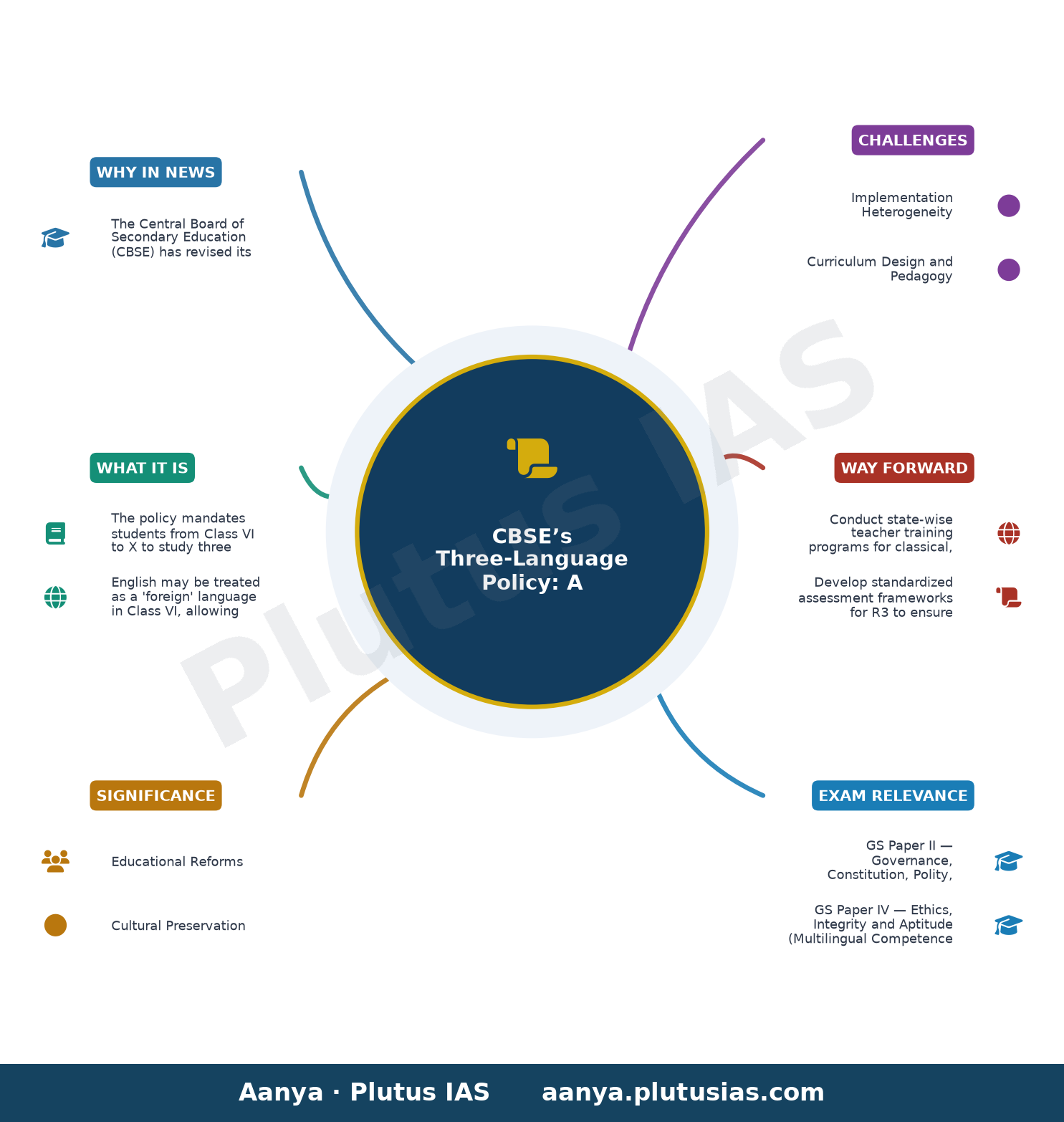
The Central Board of Secondary Education (CBSE) has revised its language policy with effect from the academic year 2026-27, mandating students from Class VI to X to study three languages, with at least two being Indian languages. This policy, aligned with the National Education Policy (NEP) 2020 and the National Curriculum Framework for School Education (NCFSE) 2023, aims to foster multilingual competence while easing examination pressure by exempting the third language (R3) from the Class X Board Examination. The move addresses concerns about academic overload while preparing students for global citizenship.
Background
- The three-language formula has been a longstanding recommendation in Indian education policy, first proposed by the Kothari Commission (1964-66) to promote national integration and linguistic diversity.
- The National Education Policy 2020 reaffirmed the importance of multilingualism, emphasizing the study of Indian languages alongside English to preserve cultural heritage and enhance cognitive development.
- The National Curriculum Framework for School Education (NCFSE) 2023 provided a structured implementation framework for the three-language policy, integrating it with competency-based learning.
- CBSE, as a leading national board, has historically aligned its policies with NEP recommendations to ensure uniformity and quality in school education.
- The policy aims to counter the overemphasis on English-medium education, which often marginalizes regional languages and indigenous knowledge systems.
- The phased implementation allows schools and students to adapt gradually, reducing resistance to change while ensuring continuity in learning.
What is the CBSE Three-Language Policy?
- The policy mandates students from Class VI to X to study three languages, designated as R1, R2, and R3, with at least two being Indian languages (Bhartiya Bhashas), such as Hindi, regional languages, or classical languages like Sanskrit.
- English may be treated as a ‘foreign’ language in Class VI, allowing flexibility in language selection based on regional and individual needs.
- The third language (R3) is exempt from the Class X Board Examination; schools will conduct internal assessments, and the results will be recorded in the CBSE certificate without impacting the student’s promotion.
- The policy is designed to foster multilingual competence, emphasizing comprehension, communication, application, and articulation rather than rote learning.
- Curriculum activities include storytelling, debates, discussions, and presentations to enhance interactive and experiential learning in languages.
- The framework allows for the inclusion of foreign languages (e.g., French, German, Spanish) as R3, provided the other two languages are Indian, or as an additional fourth language if desired.
- The policy does not apply to the current batch of Class X students, ensuring no disruption to their examination preparations.
Key Features
| Feature | Significance |
|---|---|
| Compulsory three-language policy (R1, R2, R3) from Class VI to X | Ensures multilingual proficiency, aligning with NEP 2020 and NCFSE 2023 objectives for global citizenship. |
| Mandatory inclusion of two Indian languages (Bhartiya Bhashas) | Preserves linguistic diversity and cultural heritage while meeting NEP’s emphasis on Indian languages. |
| No Class X board exam for R3; internal assessment only | Reduces examination pressure while maintaining accountability through school-based evaluation. |
| Flexibility for foreign languages as R3 or fourth language | Facilitates exposure to global languages without compromising the two-Indian-language requirement. |
| Phased implementation starting Class VI (2026-27 batch) | Allows gradual adaptation for schools, students, and parents to avoid abrupt disruption. |
Why it Matters
Educational Reforms
- Implements NEP 2020’s vision of multilingualism and holistic learning through language acquisition.
- Aligns with NCFSE 2023’s focus on competency-based education and experiential learning in languages.
- Promotes cognitive benefits of multilingualism, including improved problem-solving and analytical skills.
Cultural Preservation
- Mandates inclusion of Indian languages, reinforcing linguistic diversity and cultural identity.
- Encourages appreciation of classical languages (e.g., Sanskrit) as part of the curriculum.
Global Competitiveness
- Equips students with multilingual skills to compete in international academic and professional arenas.
- Enhances employability by fostering adaptability in multicultural work environments.
Policy Continuity
- Exempts current batches (Class X, VII, VIII, IX) from immediate changes, ensuring stability in transition.
Challenges
1. Implementation Heterogeneity
- Variation in school resources (teachers, infrastructure) may lead to uneven quality across regions.
- Urban-rural divide in access to qualified language instructors, particularly for classical or regional languages.
UPSC Link: GS2: Education, GS1: Social Issues
2. Curriculum Design and Pedagogy
- Need for teacher training to shift from rote learning to interactive, communicative methods.
- Balancing depth and breadth in language instruction to avoid superficial learning.
UPSC Link: GS2: Education, GS1: Social Issues
3. Assessment and Accountability
- Internal assessment for R3 lacks standardized benchmarks, risking subjectivity in evaluation.
- Lack of external validation may reduce perceived importance of R3 among stakeholders.
UPSC Link: GS2: Education
4. Parental and Student Resistance
- Perception of increased academic burden, especially in competitive exam environments.
- Language choices may conflict with parental aspirations or regional preferences.
UPSC Link: GS1: Social Issues
5. Resource Allocation
- Financial constraints for schools to hire specialized language teachers or develop materials.
- Opportunity cost of diverting resources from core STEM subjects.
UPSC Link: GS2: Education
Challenges — UPSC Perspective
| Issue | Concern |
|---|---|
| Teacher shortages | Insufficient trained instructors for classical/regional languages, particularly in rural areas. |
| Curriculum overload | Risk of overburdening students with excessive language requirements alongside core subjects. |
| Assessment validity | Internal evaluation for R3 may lack rigour compared to board examinations. |
| Language selection bias | Parents may prioritize English or Hindi over regional languages, undermining policy intent. |
| Infrastructure gaps | Schools lack digital or print resources for less commonly taught languages. |
| Equity concerns | Students from disadvantaged backgrounds may face greater challenges in accessing language support. |
Way Forward
- Conduct state-wise teacher training programs for classical, regional, and foreign languages under CBSE’s aegis.
- Develop standardized assessment frameworks for R3 to ensure consistency and transparency in internal evaluations.
- Launch awareness campaigns for parents and students to highlight the cognitive and career benefits of multilingualism.
- Allocate dedicated funds for language labs and digital resources in government and rural schools.
- Pilot a mentorship program pairing schools with universities for language curriculum support.
- Establish a national helpline for schools to address implementation challenges in real time.
- Encourage peer learning among states with successful language programs (e.g., Kerala’s Malayalam initiatives).
- Integrate language proficiency into skill-based assessments (e.g., internships, project work) to reduce exam-centric pressure.
UPSC Value Addition
Keywords for Mains Answer-Writing
CBSE three-language policy · National Education Policy 2020 · National Curriculum Framework for School Education 2023 · Bhartiya Bhashas · multilingual education · Class IX and X curriculum · internal assessment in languages · global citizenship education · language pedagogy · exam reforms in secondary education
Concept Flow
NEP 2020 and NCFSE 2023 → Policy formulation for three-language mandate → CBSE circular (July 2026) → Phased implementation (Class VI, 2026-27) → Internal assessment for R3 (Class X) → Multilingual proficiency outcomes → Global citizenship and employability.
Prelims Practice Questions
Q1. Consider the following statements regarding the CBSE three-language policy as per NEP 2020 and NCFSE 2023:
1. The policy mandates three languages for Classes VI to X.
2. At least two of the three languages must be native Indian languages (Bhartiya Bhashas).
3. English is treated as a foreign language in Class VI.
4. The third language (R3) will have a Class X board examination.
How many of the above statements are correct?
- Only one
- Only two
- Only three
- All four
Answer: Only three — Statements 1, 2, and 3 are correct. Statement 4 is incorrect as the third language (R3) will be internally examined and recorded in the CBSE certificate without a Class X board examination.
Q2. Assertion (A): The CBSE three-language policy aligns with the recommendation of the National Education Policy (NEP) 2020.
Reason (R): NEP 2020 emphasizes multilingualism and the promotion of Indian languages to foster global citizenship.
- Both A and R are true, and R is the correct explanation of A.
- Both A and R are true, but R is not the correct explanation of A.
- A is true, but R is false.
- A is false, but R is true.
Answer: Both A and R are true, and R is the correct explanation of A. — Both the assertion and reason are true. The three-language policy is indeed a direct implementation of NEP 2020’s emphasis on multilingualism and the promotion of Indian languages to prepare students as global citizens.
Q3. Match the following language categories under the CBSE three-language policy with their respective descriptions:
Column I (Language Category)
A. R1
B. R2
C. R3
D. Foreign Language
Column II (Description)
1. First language, typically the mother tongue or regional language.
2. Second language, another Indian language or classical language.
3. Third language, internally examined and recorded in the CBSE certificate.
4. Language studied as an additional fourth language, such as French or German.
- A-1, B-2, C-3, D-4
- A-2, B-1, C-3, D-4
- A-1, B-2, C-4, D-3
- A-3, B-1, C-2, D-4
Answer: A-1, B-2, C-3, D-4 — R1 is the first language (typically the mother tongue or regional language), R2 is the second language (another Indian or classical language), R3 is the third language (internally examined), and a foreign language can be studied as an additional fourth language.
Mains Practice Question
✍ Critically examine the rationale behind the CBSE’s three-language policy in Classes IX and X, as mandated by the National Education Policy (NEP) 2020 and the National Curriculum Framework for School Education (NCFSE) 2023. Also, discuss the pedagogical and administrative challenges that schools may face in implementing this policy effectively. (15 Marks)
Approach: MODEL-ANSWER SKELETON:
1. **Rationale for the Policy** (4 points):
– Alignment with NEP 2020’s emphasis on multilingualism and global citizenship (cite NEP 2020, para 4.12).
– Promotion of Bharatiya Bhashas (Hindi, regional, classical languages) to preserve linguistic diversity (reference to Article 351 of the Constitution).
– Pedagogical shift from rote learning to comprehension, communication, and application (cite NCFSE 2023, Section 2.3).
– Preparing students for a globalized world by fostering linguistic and cultural competence.
2. **Pedagogical Challenges** (4 points):
– Curriculum design: Ensuring balanced coverage of three languages without overburdening students (reference to CBSE circular dated 31.07.2026).
– Teacher availability: Shortage of qualified teachers in less commonly taught languages (e.g., classical languages like Sanskrit or Pali).
– Assessment reforms: Transitioning from summative to formative assessments for R3 (internal examination model).
– Student adaptability: Varied proficiency levels in languages across regions and socio-economic backgrounds.
3. **Administrative Challenges** (4 points):
– Resource allocation: Infrastructure and material support for multiple languages in schools (reference to Samagra Shiksha Abhiyan).
– Parental concerns: Resistance due to perceived academic pressure or preference for English-medium education.
– Phased implementation: Gradual rollout from Class VI to X (2026–2031) and its logistical complexities.
– Monitoring and evaluation: Ensuring consistency in internal assessments across CBSE-affiliated schools.
4. **Conclusion** (3 points):
– Acknowledge the policy’s long-term benefits for linguistic diversity and global competitiveness.
– Highlight the need for collaborative efforts among schools, teachers, and policymakers to address challenges.
– Emphasize the role of continuous teacher training and community engagement in successful implementation.
Source: Hindustan Times
Generated by AanyaAi for educational purpose.

- महाराष्ट्र में त्योहार जुलूसों पर बॉम्बे हाईकोर्ट का बड़ा फैसला: पटाखे, लेजर और संगीत पर रोक - September 24, 2026
- Bombay HC Bans Firecrackers, Music in Maharashtra Processions: Key UPSC Analysis - September 24, 2026
- तमिलनाडु में महिला कर्मचारियों के लिए सवैतनिक माहवारी अवकाश नीति पर HC का आदेश - September 24, 2026

No Comments