


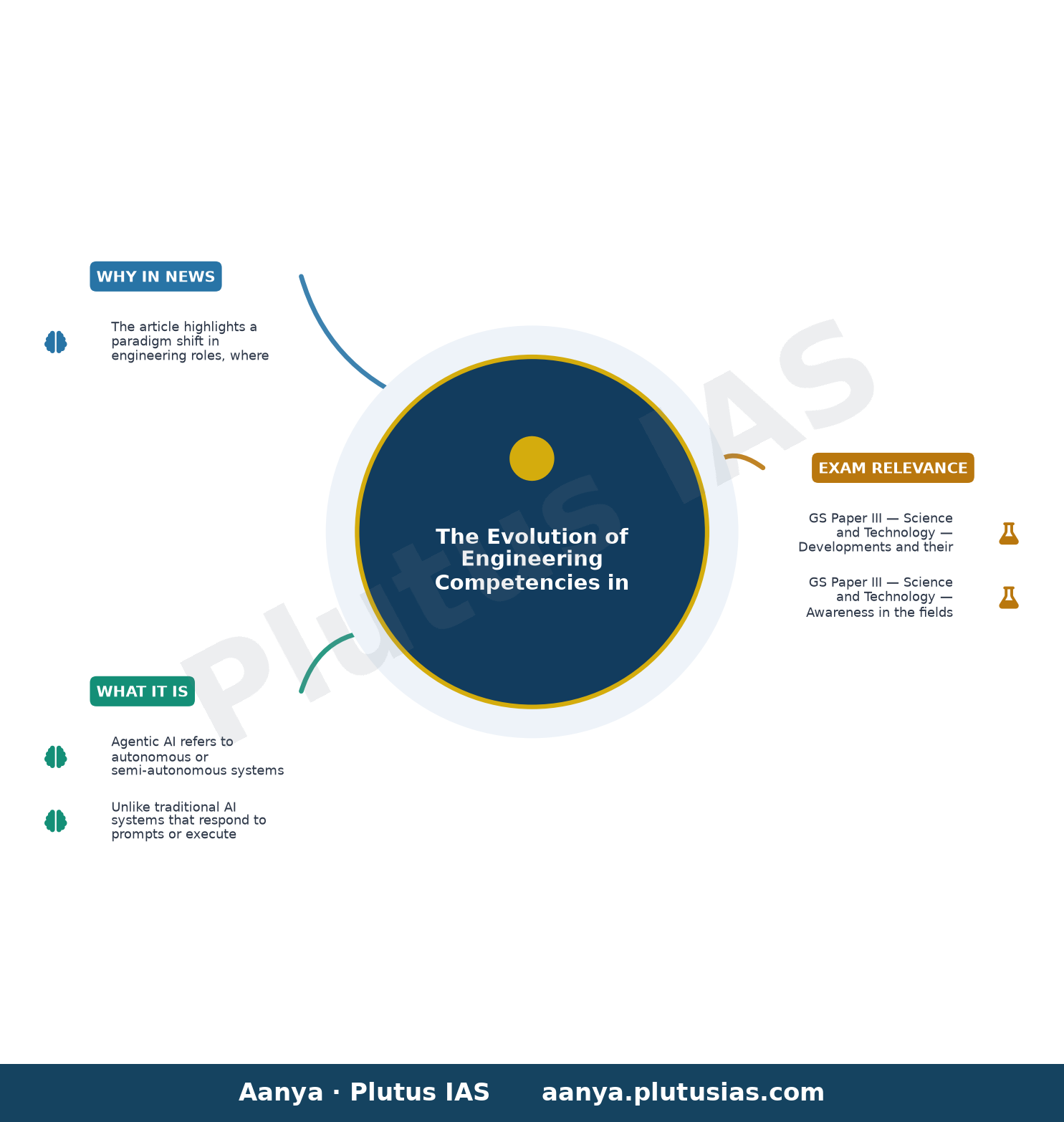
01 Aug AI Agents Reshape Engineering: UPSC 2026-27 Science & Tech Syllabus Insights
✎ Engineers in the agentic AI era must transition from coding-centric roles to designing intelligent systems that define goals, ensure safety, and operate under human supervision, while mastering programming, cloud platforms, and…
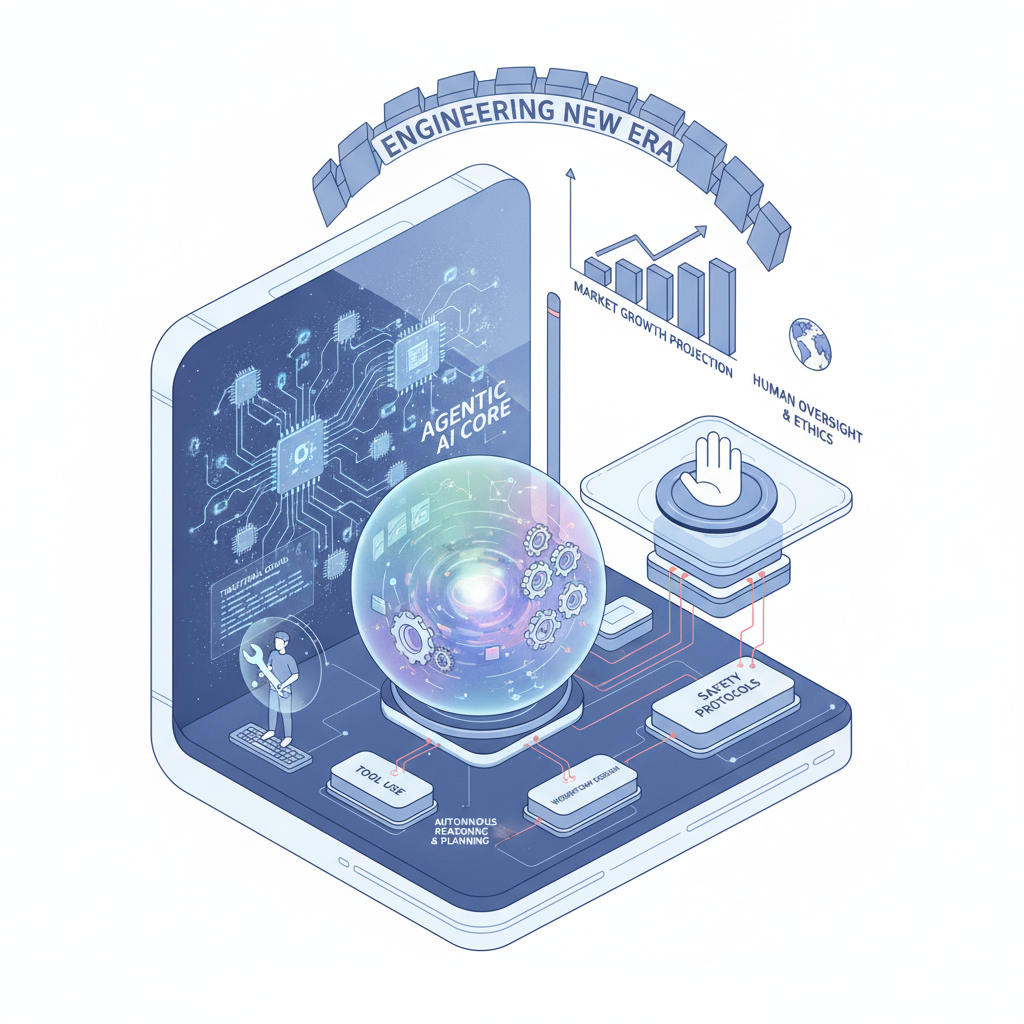 Agentic AI systemsIntelligent workflowsHuman oversightEthical operation
Subject Relevance — Where This Topic Fits
- GS Paper III — Science and Technology — Developments and their Applications and Effects in Everyday Life | GS Paper III — Science and Technology — Awareness in the fields of IT, Space, Computers, Robotics, Nano-technology, Bio-technology
- Prelims: Agentic AI, AI agents, World Economic Forum Future of Jobs Report 2025, CAGR of AI market, Human-in-the-loop systems, AI governance frameworks, Ethical AI, AI literacy
- Essay: The role of human ingenuity in an age of artificial intelligence: Challenges and opportunities
Quick Revision: Engineers in the agentic AI era must transition from coding-centric roles to designing intelligent systems that define goals, ensure safety, and operate under human supervision, while mastering programming, cloud platforms, and ethical AI governance.
Why is this in the news?
The article highlights a paradigm shift in engineering roles, where proficiency in coding is no longer the sole determinant of professional readiness. The emergence of agentic AI systems—capable of autonomous reasoning, planning, and tool use—demands engineers who can define goals, design intelligent workflows, and ensure safe, ethical operation under human oversight. This transformation is underscored by projections from the World Economic Forum’s Future of Jobs Report 2025, which anticipates significant job displacement and creation, with AI and information-processing technologies as primary drivers. The market for agentic AI is projected to grow exponentially, reflecting its integration into sectors such as banking, healthcare, legal, and education, thereby necessitating a reevaluation of engineering education and workforce strategies.
Background
- The traditional role of engineers has been centred on writing, debugging, and deploying code to solve specific problems, often in a deterministic and rule-based manner.
- The advent of generative AI and large language models (LLMs) has introduced systems capable of generating, summarising, and even reasoning over complex information, but these systems often lack autonomy, adaptability, and goal-directed behaviour.
- Agentic AI represents a leap beyond reactive AI systems, enabling autonomous execution of multi-step tasks, tool integration, and adaptive problem-solving, thereby necessitating a shift in engineering competencies.
- The World Economic Forum’s Future of Jobs Report 2025 projects a net gain of 78 million jobs by 2030, with AI and information-processing technologies identified as major disruptors in workforce composition.
- The agentic AI market is projected to grow from USD 7.84 billion in 2025 to USD 52.62 billion by 2030, at a compound annual growth rate (CAGR) of 46.3%, indicating rapid commercial adoption.
- Regulatory and ethical frameworks for AI, particularly in high-stakes domains such as healthcare, finance, and legal services, are evolving to ensure safety, privacy, and accountability in automated systems.
What is Agentic Artificial Intelligence?
- Agentic AI refers to autonomous or semi-autonomous systems capable of performing goal-directed tasks without continuous human intervention, by leveraging reasoning, planning, tool use, and adaptive learning.
- Unlike traditional AI systems that respond to prompts or execute predefined instructions, agentic AI systems can break down complex goals into sub-tasks, retrieve and process information, test outputs, monitor progress, and iteratively improve their approach.
- Key capabilities of agentic AI include multi-step reasoning, tool integration (e.g., APIs, databases, or external services), coordination of workflows, and self-correction based on feedback or failures.
- Agentic AI systems operate within defined boundaries and are designed to escalate exceptions or uncertainties to human supervisors, ensuring safety and reliability in critical applications.
- The term ‘agentic’ emphasises the system’s ability to act with a degree of autonomy while remaining aligned with human-defined objectives, values, and constraints.
- Agentic AI is distinct from generative AI, which primarily focuses on content creation, summarisation, or dialogue generation, though the two can be combined to enhance functionality.
- Applications of agentic AI span sectors such as banking (fraud detection, loan processing), healthcare (patient intake, care coordination), legal (contract review), and education (personalised learning), where routine tasks are automated to improve efficiency and accuracy.
- The design of agentic AI systems requires interdisciplinary expertise, including software engineering, data science, ethics, and domain-specific knowledge, to ensure robustness and trustworthiness.
UPSC Value Addition
Keywords for Mains Answer-Writing
Agentic AI systems · AI-driven engineering paradigm shift · human-in-the-loop supervision · World Economic Forum Future of Jobs Report 2025 · AI market projections (2025-2030) · ethical guardrails in AI deployment · reskilling and upskilling in AI era · interdisciplinary engineering competencies
Prelims Practice Questions
Q1. Consider the following statements regarding Agentic AI systems:
1. Agentic AI systems can autonomously define goals and break them into executable steps.
2. Agentic AI systems require human supervision primarily for writing initial lines of code.
3. Agentic AI systems are currently operational in sectors such as banking, healthcare, and legal services.
4. Agentic AI systems eliminate the need for programming fluency among engineers.
How many of the above statements are correct?
- Only one
- Only two
- Only three
- All
Answer: Only three — Statements 1 and 3 are correct as Agentic AI systems autonomously define and execute goals and are operational in multiple sectors. Statement 2 is incorrect because human supervision is required for defining goals, interpreting results, and ensuring ethical guardrails, not merely for writing code. Statement 4 is incorrect as programming fluency remains essential for designing and supervising these systems.
Q2. Assertion (A): The World Economic Forum’s Future of Jobs Report 2025 projects a net gain of 78 million jobs by 2030 due to AI and information-processing technologies.
Reason (R): AI systems, including Agentic AI, are projected to displace 92 million jobs but create 170 million new roles, primarily in AI-supervised engineering and related domains.
Code:
A. Both A and R are true, and R is the correct explanation of A.
B. Both A and R are true, but R is NOT the correct explanation of A.
C. A is true but R is false.
D. A is false but R is true.
- A
- B
- C
- D
Answer: A — Both Assertion (A) and Reason (R) are factually correct and R correctly explains A. The report indeed projects a net gain of 78 million jobs by 2030, driven by AI and information-processing technologies, with 170 million new jobs and 92 million displacements.
Q3. Match the following sectors with the specific Agentic AI applications mentioned in the report:
Column I (Sector) | Column II (Agentic AI Application)
——————|——————————-
1. Banking | A. Contract review and obligation summarization
2. Healthcare | B. Fraud triage and loan processing
3. Legal | C. Intake documentation and care coordination
4. Education | D. Personalized learning and practice task generation
Options:
A. 1-B, 2-C, 3-A, 4-D
B. 1-C, 2-B, 3-D, 4-A
C. 1-A, 2-D, 3-B, 4-C
D. 1-D, 2-A, 3-C, 4-B
- A
- B
- C
- D
Answer: A — The correct pairing is: Banking (B: Fraud triage and loan processing), Healthcare (C: Intake documentation and care coordination), Legal (A: Contract review and obligation summarization), and Education (D: Personalized learning and practice task generation).
Mains Practice Question
✍ The role of engineers is transitioning from writing code to supervising Agentic AI systems. Critically examine the implications of this shift for the engineering profession, the workforce, and the ethical dimensions of AI deployment. (15 Marks)
Approach: MODEL-ANSWER SKELETON:
1. **Engineering Profession**:
– Shift from coding-centric to system-design-centric roles.
– Need for interdisciplinary competencies: programming, data structures, cloud platforms, ML, and human-AI interaction design.
– Emphasis on designing guardrails, observability, fallback mechanisms, and audit trails.
– Cite the World Economic Forum’s Future of Jobs Report 2025 for workforce projections.
2. **Workforce Implications**:
– Net gain of 78 million jobs by 2030, but 92 million displacements (WEF 2025).
– Reskilling and upskilling imperative: focus on AI supervision, ethical governance, and cross-domain collaboration.
– Agentic AI market growth (USD 7.84 billion in 2025 to USD 52.62 billion by 2030, CAGR 46.3%).
3. **Ethical Dimensions**:
– Human-in-the-loop supervision: engineers must define goals, interpret results, and ensure safety and compliance.
– Sector-specific challenges: privacy in healthcare, regulatory compliance in finance, linguistic diversity in multilingual systems.
– Trustworthiness and accountability: need for transparent, auditable, and human-supervised AI systems.
4. **Balanced View**:
– While Agentic AI enhances efficiency and innovation, over-reliance without human oversight risks systemic failures.
– Governments and institutions must invest in ethical frameworks, regulatory standards, and workforce training.
5. **Conclusion**:
– The shift underscores the need for engineers to evolve into ‘system architects’ who balance technical prowess with ethical responsibility.
Source: Hindustan Times
Generated by AanyaAi for educational purpose.

- केरल में एंटीमाइक्रोबियल रेजिस्टेंस: सरकारी रिपोर्ट में चौंकाने वाले आँकड़े सामने - September 23, 2026
- Kerala’s AMR Crisis: Rising Drug Resistance Threatens Public Health in 2025 - September 23, 2026
- सुप्रीम कोर्ट ने दवाओं की ऊंची कीमतों को ‘लूट’ बताया, सरकार से पूछा- क्या है कानून? - September 23, 2026

No Comments