


01 Aug Supreme Court Orders DNA Tests for Indians Killed in Russian Army
✎ The Supreme Court’s directive mandates DNA testing of repatriated mortal remains of Indian nationals killed in foreign conflict zones to ensure accurate identification, aligning with India’s obligations under international…

Subject Relevance — Where This Topic Fits
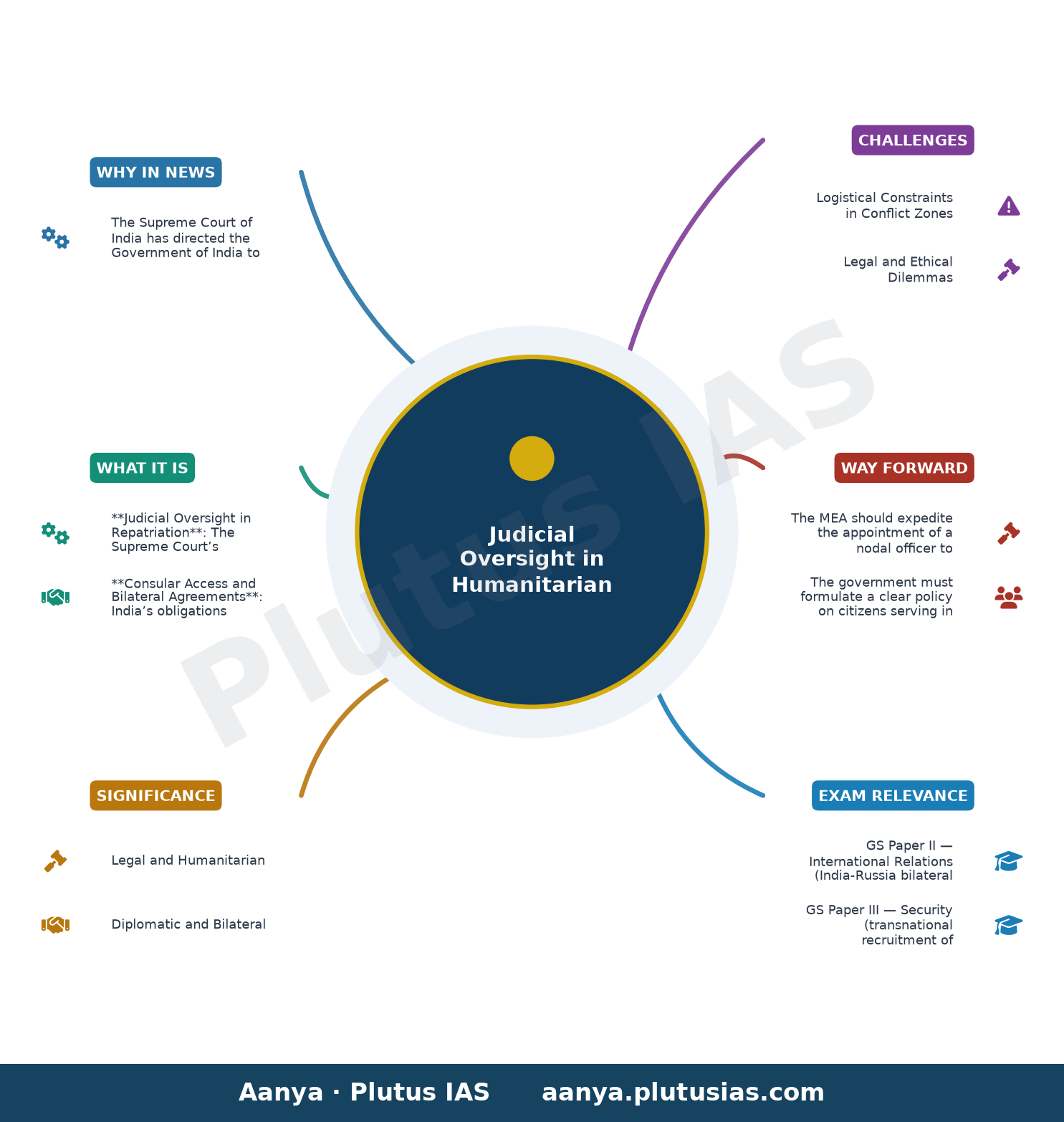
- GS Paper II — International Relations (India-Russia bilateral relations, consular access, humanitarian diplomacy) | GS Paper III — Security (transnational recruitment of mercenaries, legal frameworks for repatriation of remains)
- Prelims: DNA profiling, consular access, mercenary, repatriation of mortal remains, International Humanitarian Law (IHL), bilateral treaties (e.g., India-Russia agreements on consular access), Geneva Conventions, 1949 (protection of victims in armed conflict), Ministry of External Affairs (MEA) nodal officer, Supreme Court’s writ jurisdiction under Article 32
- Essay: The ethical and legal dimensions of state responsibility in protecting citizens abroad, Balancing sovereignty and humanitarian obligations in foreign policy
Quick Revision: The Supreme Court’s directive mandates DNA testing of repatriated mortal remains of Indian nationals killed in foreign conflict zones to ensure accurate identification, aligning with India’s obligations under international humanitarian law and bilateral agreements with Russia.
Why is this in the news?
The Supreme Court of India has directed the Government of India to conduct DNA testing of the mortal remains of 20 Indian nationals killed while serving in the Russian Armed Forces during the ongoing conflict in Ukraine. This directive addresses concerns regarding the identification and repatriation of remains, ensuring due process for grieving families while navigating the legal and logistical challenges posed by the conflict conditions in Ukraine. The order underscores the judiciary’s role in upholding humanitarian and legal standards in cases involving citizens abroad.
Background
- The conflict in Ukraine has seen the involvement of foreign nationals in various capacities, including military service, raising complex legal and ethical questions for their home countries.
- India has maintained a policy of neutrality in the Ukraine conflict but faces challenges in addressing the status of its nationals who have enlisted in foreign armed forces.
- The Russian Ministry of Defence has acknowledged the presence of foreign nationals in its ranks but has cited operational constraints—such as drone attacks and explosions in conflict zones—as impediments to the recovery and repatriation of mortal remains.
- The Ministry of External Affairs (MEA) has reported that 51 deaths among approximately 80 Indians who joined the Russian Armed Forces have been confirmed, with 29 bodies repatriated, 2 locally cremated, and 20 yet to be returned.
- Families of the deceased have raised concerns over the authenticity of repatriated remains, prompting judicial intervention to ensure transparency and accountability.
- The Supreme Court’s directive aligns with India’s obligations under international humanitarian law (IHL) and bilateral agreements with Russia to facilitate consular access and repatriation of remains.
What are the legal and humanitarian implications of the Supreme Court’s directive on DNA testing for repatriated mortal remains?
- **Judicial Oversight in Repatriation**: The Supreme Court’s directive ensures that the repatriation of mortal remains of Indian nationals from conflict zones adheres to due process, including DNA verification to confirm identities, thereby addressing concerns of misidentification or fraudulent claims.
- **Consular Access and Bilateral Agreements**: India’s obligations under the Vienna Convention on Consular Relations (1963) and bilateral treaties with Russia require the facilitation of consular access to citizens abroad, including in conflict zones. The MEA’s appointment of a nodal officer is a procedural step to assist families in pursuing compensation and repatriation claims.
- **Humanitarian and Legal Challenges**: The directive highlights the humanitarian crisis arising from the involvement of foreign nationals in armed conflicts, where conflict conditions—such as drone strikes and explosions—complicate the recovery and identification of remains.
- **DNA Profiling in Legal Contexts**: DNA testing is a scientifically validated method for identifying human remains, particularly in cases where visual identification is impossible due to decomposition or fragmentation. The directive ensures that repatriated remains are accurately identified, providing closure to families and preventing potential disputes over inheritance or compensation.
- **Role of the Judiciary in Foreign Policy**: The Supreme Court’s intervention demonstrates the judiciary’s role in ensuring that executive actions—such as repatriation policies—comply with constitutional and international legal standards. This reinforces the principle of checks and balances in governance, particularly in matters affecting citizens abroad.
- **Ethical Considerations**: The directive also raises ethical questions about the state’s responsibility to protect citizens who voluntarily join foreign armed forces, particularly in conflicts where their actions may contravene India’s official stance on neutrality or international law.
- **Operational Constraints in Conflict Zones**: The Russian Ministry of Defence’s assertion that conflict conditions hinder the recovery of remains underscores the practical challenges in repatriation, necessitating international cooperation and adherence to IHL protocols for the protection of victims and the facilitation of humanitarian access.
Key Features
| Feature | Significance |
|---|---|
| Supreme Court directive for DNA testing | Ensures accurate identification of mortal remains, upholding the dignity of the deceased and providing closure to families. |
| Appointment of a nodal officer by the MEA | Facilitates streamlined compensation claims and legal recourse for aggrieved families with Russian authorities. |
| Confirmation of 51 deaths among 80 Indians in Russian Army | Establishes a factual basis for repatriation and legal proceedings, though discrepancies in numbers persist. |
| Conflict-zone challenges in repatriation | Highlights geopolitical and logistical constraints in recovering mortal remains from active war zones. |
| Centre’s claim of facilitated DNA testing by Russian authorities | Demonstrates diplomatic engagement but raises questions about transparency in the repatriation process. |
Why it Matters
Legal and Humanitarian
- The Supreme Court’s intervention underscores the constitutional duty of the state to protect citizens abroad, even in non-state military service.
- DNA testing addresses ethical concerns about misidentification, ensuring families receive the correct remains for last rites.
- The directive balances national security considerations with individual rights, particularly in cases involving foreign military engagements.
Diplomatic and Bilateral
- The case tests India-Russia judicial cooperation, especially in conflict zones where consular access and repatriation are logistically constrained.
- The MEA’s role in appointing a nodal officer reflects proactive diplomacy to secure compensation and closure for affected families.
- The dispute over DNA testing access highlights potential gaps in consular protection for citizens serving in foreign militaries.
Socio-Political
- The incident raises questions about the recruitment of Indian nationals by foreign militaries, particularly during active conflicts.
- Familial distress and public scrutiny amplify the need for transparent policies on citizens’ participation in foreign armed conflicts.
- The case may influence future legislative or policy responses to prevent such engagements without state oversight.
Challenges
1. Logistical Constraints in Conflict Zones
- Active hostilities in Ukraine impede the recovery and repatriation of mortal remains, delaying closure for families.
- Constant drone attacks and explosions exacerbate the difficulty of locating and retrieving remains.
- The Russian Defence Ministry’s acknowledgment of these challenges underscores the need for international protocols for such scenarios.
UPSC Link: GS-II: Bilateral Groupings
2. Legal and Ethical Dilemmas
- Ambiguity in the legal status of Indian nationals serving in foreign militaries complicates consular protection and compensation claims.
- Disputes over DNA testing access highlight potential violations of humanitarian norms in repatriation processes.
- The case tests the balance between state sovereignty and individual rights in foreign military engagements.
UPSC Link: GS-II: Fundamental Rights
3. Diplomatic Friction Points
- Differing narratives between Indian and Russian authorities on DNA testing access risk eroding trust in bilateral mechanisms.
- The absence of a bilateral agreement on repatriation protocols for non-state military personnel creates systemic vulnerabilities.
- Public scrutiny may strain diplomatic relations, particularly if compensation claims are not resolved satisfactorily.
UPSC Link: GS-II: India and its Neighbourhood
4. Policy and Governance Gaps
- The lack of a national policy on citizens serving in foreign militaries leaves families without clear recourse or protection.
- Inadequate pre-deployment screening or awareness campaigns may have contributed to the recruitment of Indian nationals in conflict zones.
- The case highlights the need for inter-ministerial coordination (MEA, MoD, Home Affairs) to address such contingencies.
UPSC Link: GS-II: Government Policies
5. Public Perception and Trust
- Allegations of misidentification or inadequate repatriation processes risk undermining public confidence in state institutions.
- Media scrutiny and familial distress may lead to political pressure, necessitating transparent and timely interventions.
- The case underscores the importance of proactive communication to manage public expectations and prevent misinformation.
UPSC Link: GS-IV: Ethics in Governance
Challenges — UPSC Perspective
| Issue | Concern |
|---|---|
| Conflict-zone repatriation | Geopolitical and logistical barriers delay recovery and closure for families. |
| DNA testing access | Disputes over identification processes raise ethical and legal concerns. |
| Compensation claims | Families face uncertainty in pursuing claims with Russian authorities. |
| Policy vacuum | Absence of national guidelines for citizens in foreign militaries complicates legal recourse. |
| Diplomatic trust | Narrative discrepancies between India and Russia risk straining bilateral relations. |
Way Forward
- The MEA should expedite the appointment of a nodal officer to streamline compensation claims and legal recourse for affected families.
- The government must formulate a clear policy on citizens serving in foreign militaries, including pre-deployment screening and awareness campaigns.
- India and Russia should establish bilateral protocols for repatriation and identification of mortal remains in conflict zones.
- The Supreme Court’s directive should be operationalised through inter-ministerial coordination to ensure timely DNA testing and repatriation.
- Consular protection mechanisms must be strengthened to prevent similar incidents, including monitoring of recruitment by foreign militaries.
- Public awareness campaigns should be launched to educate citizens about the risks of serving in foreign armed conflicts.
- The government should explore diplomatic channels to secure compensation for families, leveraging existing bilateral agreements.
- A grievance redressal mechanism should be established to address familial concerns and ensure transparency in the repatriation process.
UPSC Value Addition
Keywords for Mains Answer-Writing
Supreme Court of India · DNA testing protocol · repatriation of mortal remains · Ministry of External Affairs (MEA) · jus sanguinis in citizenship · international humanitarian law · bilateral judicial cooperation · right to dignity under Article 21 · compensation claims for foreign deaths · rights of non-combatant citizens abroad
Constitutional & Policy Linkages
- Article 21: Right to Life and Dignity (ensuring proper identification and repatriation of mortal remains)
Concept Flow
Recruitment of Indian nationals by foreign militaries → Active conflict in Ukraine → Casualties among recruits → Logistical challenges in repatriation → Supreme Court intervention for DNA testing → Diplomatic engagement with Russia → Policy gaps in consular protection → Legal and humanitarian concerns → Way forward for systemic reforms
Prelims Practice Questions
Q1. Consider the following statements regarding the repatriation of mortal remains of Indian citizens from foreign countries:
1. The Supreme Court of India has recently mandated DNA testing of mortal remains before repatriation.
2. The Ministry of External Affairs (MEA) is statutorily required to appoint a nodal officer for facilitating compensation claims.
3. The right to dignity under Article 21 of the Constitution extends to the repatriation of mortal remains.
4. The Geneva Conventions explicitly provide for the DNA testing of war casualties.
How many of the above statements are correct?
- Only one
- Only two
- Only three
- All four
Answer: Only three — Statements 1 and 3 are correct. Statement 2 is contextually accurate but not statutorily mandated. Statement 4 is incorrect as the Geneva Conventions do not explicitly mandate DNA testing.
Q2. Assertion (A): The Supreme Court of India has directed the Ministry of External Affairs to appoint a nodal officer for facilitating compensation claims of Indian citizens killed abroad.
Reason (R): The nodal officer is empowered to override the decisions of the Russian authorities regarding the repatriation of mortal remains.
In the context of the above two statements, which one of the following is correct?
- Both A and R are true and R is the correct explanation of A
- Both A and R are true but R is not the correct explanation of A
- A is true but R is false
- A is false but R is true
Answer: A is true but R is false — Assertion (A) is true as per the Supreme Court order. Reason (R) is false because the nodal officer facilitates claims but does not override foreign authorities’ decisions.
Mains Practice Question
✍ The Supreme Court of India has recently directed the repatriation of mortal remains of Indian citizens killed while serving in the Russian Army, mandating DNA testing for identification. Critically examine the legal and ethical dimensions of this directive in the context of Article 21 of the Constitution, international humanitarian law, and India’s obligations under bilateral judicial cooperation. Also, analyse the implications for the rights of non-combatant citizens abroad. (15 Marks)
Approach: MODEL-ANSWER SKELETON:
1. **Constitutional Right to Dignity (Article 21)**:
– Right to life includes right to a dignified death and proper disposal of mortal remains (citing *Ashray Adhikar Abhiyan v. Union of India* and *Common Cause v. Union of India*).
– DNA testing ensures correct identification, upholding dignity and preventing misidentification.
2. **International Humanitarian Law (IHL)**:
– Repatriation of mortal remains is a humanitarian obligation under IHL, particularly the Geneva Conventions and Additional Protocols.
– DNA testing aligns with the principle of respect for the dead (Article 17 of Additional Protocol I).
3. **Bilateral Judicial Cooperation**:
– India-Russia judicial cooperation is governed by the *Treaty on Mutual Legal Assistance in Criminal Matters (1999)* and the *Agreement on Consular Access (2008)*.
– The Supreme Court’s directive reinforces the need for robust bilateral mechanisms for repatriation and compensation.
4. **Rights of Non-Combatant Citizens Abroad**:
– The MEA’s role as a nodal agency for compensation claims reflects India’s protective jurisdiction over its citizens (jus sanguinis principle).
– Challenges: Conflict zones hinder recovery (as noted by the Russian Deputy Defence Minister), requiring diplomatic and logistical solutions.
5. **Ethical and Legal Balancing**:
– Balancing sovereignty with humanitarian obligations: India must ensure its citizens are not exploited in foreign conflicts while upholding their rights.
– The directive sets a precedent for future cases involving Indian nationals in foreign conflicts.
6. **Critical Analysis**:
– Strengths: Upholds constitutional rights, aligns with IHL, and strengthens bilateral cooperation.
– Limitations: Over-reliance on DNA testing may delay repatriation; geopolitical constraints in conflict zones.
7. **Conclusion**:
– The directive is a progressive step in safeguarding citizens’ rights abroad but requires sustained diplomatic efforts and legal frameworks for effective implementation.
Source: Hindustan Times
Generated by AanyaAi for educational purpose.

- महाराष्ट्र में त्योहार जुलूसों पर बॉम्बे हाईकोर्ट का बड़ा फैसला: पटाखे, लेजर और संगीत पर रोक - September 24, 2026
- Bombay HC Bans Firecrackers, Music in Maharashtra Processions: Key UPSC Analysis - September 24, 2026
- तमिलनाडु में महिला कर्मचारियों के लिए सवैतनिक माहवारी अवकाश नीति पर HC का आदेश - September 24, 2026

No Comments